








As game-based microlearning gains popularity, a wide range of people have begun using this term, even if it does not strictly qualify as microlearning. It may sound fancy, but it is based on a relatively simple premise.
The game-based microlearning definition is straightforward: it is a learning approach that delivers focused content in short learning units (typically 3-10 minutes), while incorporating game mechanics like points and badges, challenges, and leaderboards to drive engagement. This mobile-first training format enables employees to learn on their smartphones at any time and from any location, which makes it ideal for today’s distributed workforce.
In practice, most of us have been engaging in microlearning long before the term became popular. At its core, microlearning simply means learning in small, focused steps, which makes the process easier to follow and less overwhelming. This principle lies at the heart of game-based microlearning.
Recognizing that learners absorb information more effectively in short segments, instructors began creating courses built around smaller learning units. Instead of moving too fast and processing large volumes of information at once, learners progress in manageable chunks. This approach helps reduce cognitive overload and learning-related stress, which often leads to better focus, higher efficiency, and stronger retention.
The widespread use of smartphones and tablets has further increased the relevance of game-based microlearning. Short, focused learning units are easier to consume on smaller screens, making this format well-suited to mobile and on-the-go learning.

Benefits of Game-Based Microlearning
Here is what game-based microlearning does better than traditional training approaches:
- Improve knowledge retention. Microlearning can raise retention by up to 80% over regular training. Learning in short sessions gives your brain time to process information well. Game parts make you use what you learn right away with quizzes and challenges.
- Increase learner engagement. Games grab and keep your focus. Training with points, badges, leaderboards, and challenges gets more people to finish. People join in, compete, and move up levels, turning training into something fun.
- Mobile-friendly training. People can train on any device, anywhere. Your frontline workers can do a quick module on break, remote workers can learn between meetings, and sales teams can review product info before calls. It fits into how people work.
- Instant feedback. Traditional training makes you wait to see if you got something right. Game-based microlearning tells you right away. If you mess up, it explains why and shows the correct answer, speeding up learning and stopping bad habits.
- Better completion rates. Short modules seem easier, so more people finish them. A quick module feels easier than a really long course. Games keep people coming back, turning training into quick wins instead of a chore.
However, game-based microlearning is not limited to shorter formats or simplified content. It leverages proven game mechanics that support motivation, focus, and long-term learning.
Where Game-Based Microlearning Works Best
Game-based microlearning works particularly well in specific scenarios:
- Remote and frontline employees. People who are not at a desk all day, like retail workers, healthcare staff, warehouse teams, and field technicians, need training that fits into their workday. They can do quick learning activities on their phones during breaks, instead of sitting through long classes or going to a training center. They can learn while working, wherever that may be.
- Compliance and product training. When it comes to compliance and product know-how, things move fast. Rules change, and products get upgrades. Companies need to get info out fast. Game-based microlearning uses quick activities and quizzes to see how people use what they learn, not just what they remember. This keeps everyone current without long interruptions.
- Onboarding new hires with quick missions. Gamified modules work well for bringing on new hires. Trying gamified modules to bring on new hires. Instead of overloading them on day one, break things into smaller tasks over their first weeks. Reward them for reading rules, meeting others, and mastering initial tasks. This makes starting a job feel like progress, not paperwork.
- Continuous upskilling. The skills workers need are always changing. Game-based microlearning makes it easier to learn little by little. Whether it is a new software, better leadership, or industry news, improvement feels doable, not scary.
Why Use Game-Based Microlearning Instead of Traditional Training?
Many of us may find ourselves feeling resistant to learning at times. There could be several reasons for this reluctance. Many of us prefer to play video games instead of learning. Some don’t like learning by themselves. Others find the material to be far too dreary and dry. In many cases, the unappealing format and lack of multimedia are to blame. Game-based learning does away with all of these problems by leveraging the power of games to make learning fun, engaging, and stimulating.
We know intuitively that whenever something becomes more engaging, interesting, and stimulating, we pay more attention and retain more information. On the other hand, if information feels dull, prosaic, and boring, then we won’t make progres,s no matter how hard we try to push ourselves.
Microlearning Gamification
Gamified microlearning brings together two concepts: microlearning breaks content into small, easy pieces, and gamification makes learning fun through games and rewards.
Some typical game elements that keep people involved are:
- Points, badges, and leaderboards. These help because people like to compete — your employees earn points for finishing lessons, get badges when they know topics well, and see their rank compared to others. This turns learning into a contest.
- Story-based learning. Stories keep people hooked. Story-based games build learning into interesting plots that keep you going. As employees train, they solve puzzles, face problems, and see what happens next while learning important info. Wanting to know what happens in the story keeps them learning.
- Challenge-based progress. Instead of just reading, people face scenarios where they must use what they learned to fix problems. They decide, see what happens, and see the results from their choices. This active learning sticks better than reading.
- Short learning missions. Each part becomes a goal with rewards and progress shown. Staff handle one challenge at a time, building skills without feeling stressed by what they need to learn.
The best part of the gamification in online learning how it gets people going while they learn well. Students don’t have to struggle to engage with the content, as the urge to skip learning disappears. Rather than pushing info on their own will, students want to move and see what’s next. When you like something, learning is easier, and game-based learning makes you like it, so you learn more naturally.
Microlearning Enhances Retention
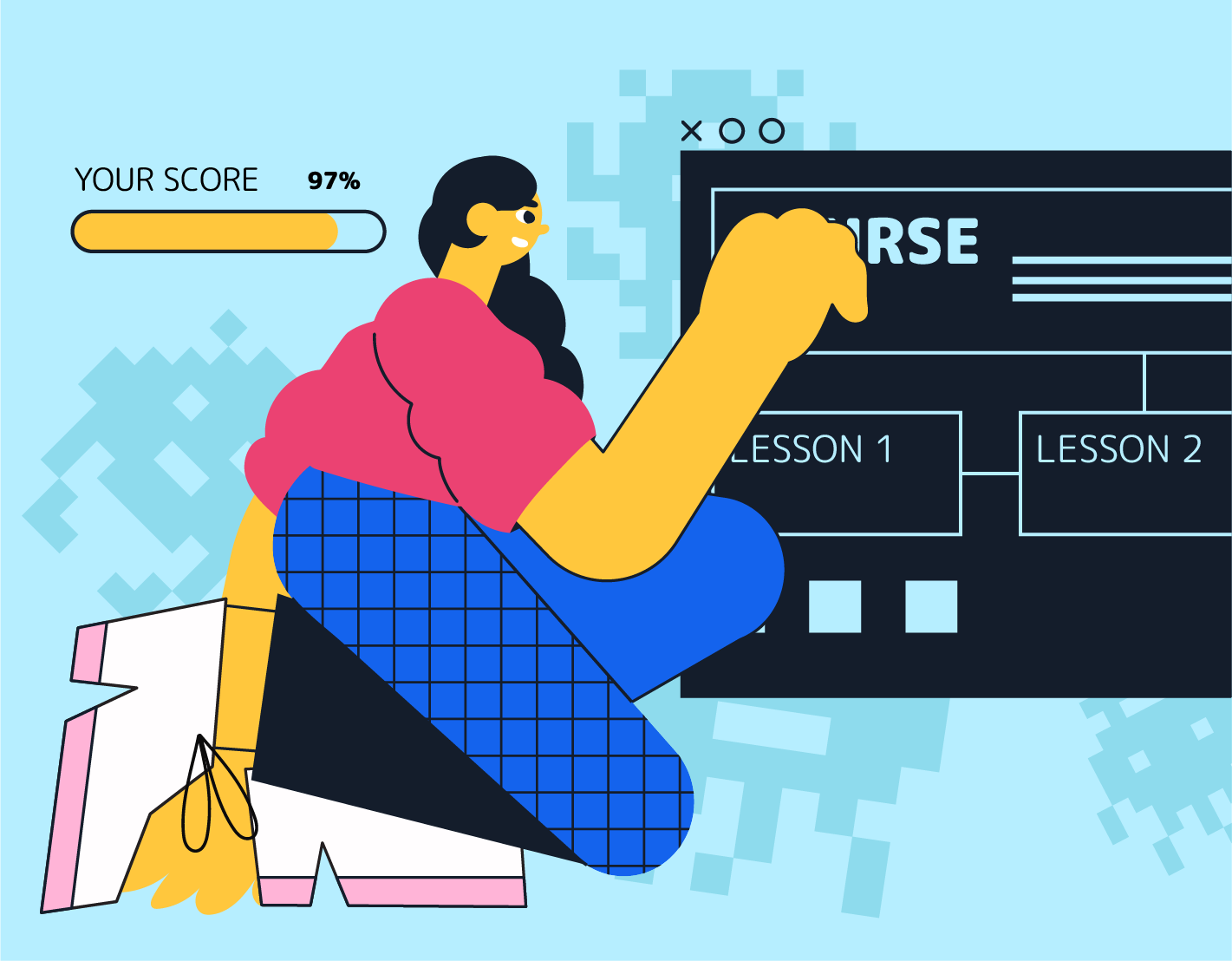
Microlearning is based on presenting information in small bits and pieces so that learners do not get overwhelmed – a major problem with traditional modes of presentation that rely on vast tracts of seemingly unending text. However, microlearning does not comprise disparate and unconnected bits of information. Each bit of information builds upon another so that you can get a smooth flow in discrete, manageable sizes. Thus, microlearning is a very gentle mode of learning that is easy on the mind. This is imperative since huge amounts of information can quickly overwhelm and confuse students, making them less willing to learn. Microlearning thus provides the ultimate learning experience since it eases a mentally intensive endeavor. This is how learning should be carried out. Learning step by step is the ideal way of learning.
By breaking down long and complicated concepts into small bits that are easy to assimilate, microlearning can greatly enhance learning. In fact, microlearning modules are completed 60% faster than traditional e-learning courses.
The Confluence of Microlearning and Game-Based Learning
Both microlearning and game-based learning are highly efficacious in their own right. But when taken together, their benefits can increase tremendously.
While microlearning eases the learning process, the game-based approach boosts motivation. The combination of ease and motivation can be the perfect recipe for highly effective learning.
The game-based microlearning approach ensures that students can learn more effortlessly with a much higher motivation level. Thus, even the most reluctant pupils will find that they have the motivation they need to excel. Comprehending difficult concepts will become much easier and boost motivation thanks to the inherent simplicity of microlearning. Games can stimulate students even further so that their motivation level rises to new heights. Game-based microlearning is thus gaining widespread acceptance and will soon be the norm rather than a novel concept.
Game-based microlearning is also perfectly amenable to distance learning, which is now paramount owing to the covid-19 outbreak. Traditional classroom learning is no longer advisable owing to the high risk of infection. In such cases, trainers can turn to game-based microlearning as a superior alternative to conventional learning methods.
With game-based microlearning, students in far-flung locations can study effectively since this approach is highly suited to distance learning. This approach may be better than conventional methods since students will love the inherent ease and stimulating nature of the game-based microlearning approach. Thus, if you feared that remote learning would disrupt learning, then you may be in for a pleasant surprise. Far from impeding learning, game-based microlearning may help to improve outcomes, bolster student engagement, and facilitate learning.
Why combining microlearning and game-based learning approaches works so well:
- Less overwhelm. Breaking content into smaller pieces means people don’t get overwhelmed. Each part seems doable, which lowers anxiety, encouraging them to start and finish the whole thing.
- Higher motivation. Game elements provide constant positive reinforcement through visible progress markers, celebrated achievements, and healthy competition that keep people engaged and coming back for more.
Better completion rates. When learning feels manageable and enjoyable, people are more likely to complete it. Businesses often see completion rates rise from 20-30% with standard online learning to a strong 80-90% with game-based microlearning.
Mobile Game-Based Microlearning
Smartphones are now the new computers. Long gone are the days when cell phones were used just for calling and texting. The demanding consumer of today expects the smartphone to accomplish everything that PCs and laptops can. The truth is that smartphones are highly versatile devices that have nearly the same functionality as computers and laptops, and with advancements in technology, are now approaching their high-performance levels.
Thus, it is smart to use smartphones for learning. You can carry your smartphone anywhere you like, so you can carry out learning even while you are traveling or waiting outside. The smartphone frees you up and empowers you to learn anywhere you choose, unlike PCs and laptops.
Game-based microlearning is particularly well-suited to smartphones. This learning model is ideal for smartphones since the bite-sized presentation of information is perfect for the relatively small screens that smartphones have. With game-based microlearning, small screens need not impede learning. Instead of being a liability, small screen sizes can become an asset since they are sized perfectly to present small, discrete bits of information.
Since Game-based microlearning is well-suited to mobile phones, it is the ideal way to engage students. We are perennially checking out smartphones and wish to do everything we like using our smartphones. Thus, leveraging a learning platform that works effectively on smartphones is a smart move. Game-based microlearning apps installed on smartphones can help to increase learner motivation, engagement, and interest. Since information is presented in compact discrete sizes, users can pick up something new and make progress each time they check their smartphones.
Students will be more accepting of learning methods that work on their smartphones. That being said, game-based microlearning is equally suited to PCs and laptops.

Data and Analytics
Since you can do game-based microlearning on smartphones, laptops, and computers, these platforms generate valuable data that shows what is working and what needs improvement. Trainers can use this data to refine their courses and address issues before they become widespread problems. Whether you are running sales training quizzes, compliance scenarios, remote employee training, or contact center training, the analytics give you clear insights into how learners engage with your content.
Key metrics you can track are:
- Completion rates by module. See where learners drop off or struggle. A sudden drop at a specific module tells you that the content needs revision.
- Time spent per section. Shows which topics take longer to grasp and which ones people understand quickly, helping you adjust difficulty and pacing.
- Quiz performance and common mistakes. Patterns in wrong answers reveal misconceptions or unclear explanations. If many employees miss the same questions in your sales training quizzes or compliance scenarios, you know exactly where to clarify your content.
- Engagement patterns. Track when employees prefer to learn, which devices they use, and how often they return. This reveals the best times to push out new content and which formats work best.
- Progress and leaderboard rankings. Monitor how individuals advance through the material and use competitive rankings to maintain motivation. High performers often inspire others to put in more effort.
Analytics make it easy for trainers to monitor student progress and spot areas that need attention. The data is especially useful for setting up leaderboards that rank students by progress and results, making learning more competitive and engaging. The competitive spirit encourages students to go further and perform better, often finishing courses faster with stronger results.
These game-based microlearning examples show how valuable this data becomes when you are managing large, distributed teams.
Examples of Game-Based Microlearning in Corporate Training
Real-world examples demonstrate how versatile and effective this approach can be across different industries:
- Remote employees. If you have teams spread out, training has to reach them wherever they are. Game-based microlearning sends compliance info, product news, and skill training right to their devices, no matter where they’re working. Sales staff can do short product quizzes between appointments, and customer service can learn about new policies when things are slow. This way, they get training without long, disruptive sessions.
- Contact centers and banks. Places with many employees coming and going find game-based training very useful for getting people up to speed fast. These programs use modules to teach everything from following the rules to improving people skills. New employees move through levels and get badges as they learn their jobs. Regular workers stay updated with quick monthly refreshers that don’t get in their way.
- Sales enablement. Sales teams always need the newest info on products, competitors, and how to handle difficult clients. Game-based microlearning does this with short quizzes, competitive situations, and practice scenarios that take just five minutes. Salespeople learn new features, check their knowledge with challenges, and compete on leaderboards, all while staying in the field and avoiding long training days.
- Compliance. Perhaps no area benefits more dramatically from game-based microlearning than compliance training. Traditional compliance training is notoriously boring and doesn’t produce effective results, but game-based approaches completely transform this through realistic scenarios where employees make decisions and immediately see the consequences. Anti-harassment training, data security protocols, and safety procedures all become significantly more engaging and memorable when delivered through interactive modules instead of long, forgettable videos or dense documents.
Conclusion
Game-based microlearning is really changing corporate training in many industries. It has made learning simpler and more fun for both new and seasoned employees. Companies that use this method are finding that people are way more likely to participate and finish their training. They no longer see it as a chore.
For corporate training professionals, this approach solves real problems you’ve been dealing with for years. You can train distributed teams effectively, handle compliance requirements without putting everyone to sleep, onboard new hires faster, and keep continuously upskilling your workforce — all while seeing better completion rates and knowledge retention. The combination of microlearning’s efficiency with gaming’s natural engagement creates a training method that works with how people naturally learn instead of fighting against human nature.
FAQ
What is game-based microlearning?
How is game-based microlearning different from simple gamification?
What types of content work best in game-based microlearning?
Where can organizations use game-based microlearning?
How do we measure the success of game-based microlearning?



- Benefits of Game-Based Microlearning
- Why Use Game-Based Microlearning Instead of Traditional Training?
- Microlearning Gamification
- Microlearning Enhances Retention
- The Confluence of Microlearning and Game-Based Learning
- Mobile Game-Based Microlearning
- Data and Analytics
- Examples of Game-Based Microlearning in Corporate Training
- Conclusion