TL;DR
- What is blended learning? A structured mix of online study and in-person practice designed to work as one system.
- It balances flexibility and control — self-paced theory online, applied work in live sessions.
- The 4 types of blended learning you can rely on: Rotation, Flex, Enriched Virtual, and Self-Blended.
- The right model will depend on your schedule control, learner autonomy, and compliance requirements you want realize.
- A blended learning LMS combines features such as content delivery, tracking, assessments, and analytics into one flow.
- Blended and hybrid learning are not identical: blended is sequential; hybrid is simultaneous.
What is blended learning? This is a question that arises for everyone who is no longer satisfied with only the traditional face-to-face approach, or, in other words, traditional classroom learning. On the other hand, interest in blended learning often arises among educators and training providers who are armed only with online learning tools.
Unfortunately, a purely offline approach costs more per learner and becomes a problem if you need to scale. But even a purely online approach often fails without live practice.
In this article, we will prove to you that it is time to make a smoothie of these two learning approaches and finally blend them. Looking ahead, we can say that the blended option’s response to flexibility, scale, and engagement needs will not leave you indifferent, wherever you are — and here is why.
- Blended learning for corporate training is the online bridge through which teams reach theory remotely. In parallel, managers can continue offline practice. What are the benefits? IBM reported up to 40% lower training costs after blended rollouts.
- Blended learning for higher education is also a kind of online portal for conducting online lectures. In addition, this portal gives faculty the opportunity to use class time for discussion, labs, problem-solving, and more. Research from the U.S. Department of Education shows better outcomes in blended formats than face-to-face alone.
- Blended learning for professional development is the same learning format in which each learner can prepare online, then pass proctored or in-person assessments. For certifications, this format is simply ideal.
Let’s talk about all this more consistently.
What Is Blended Learning?
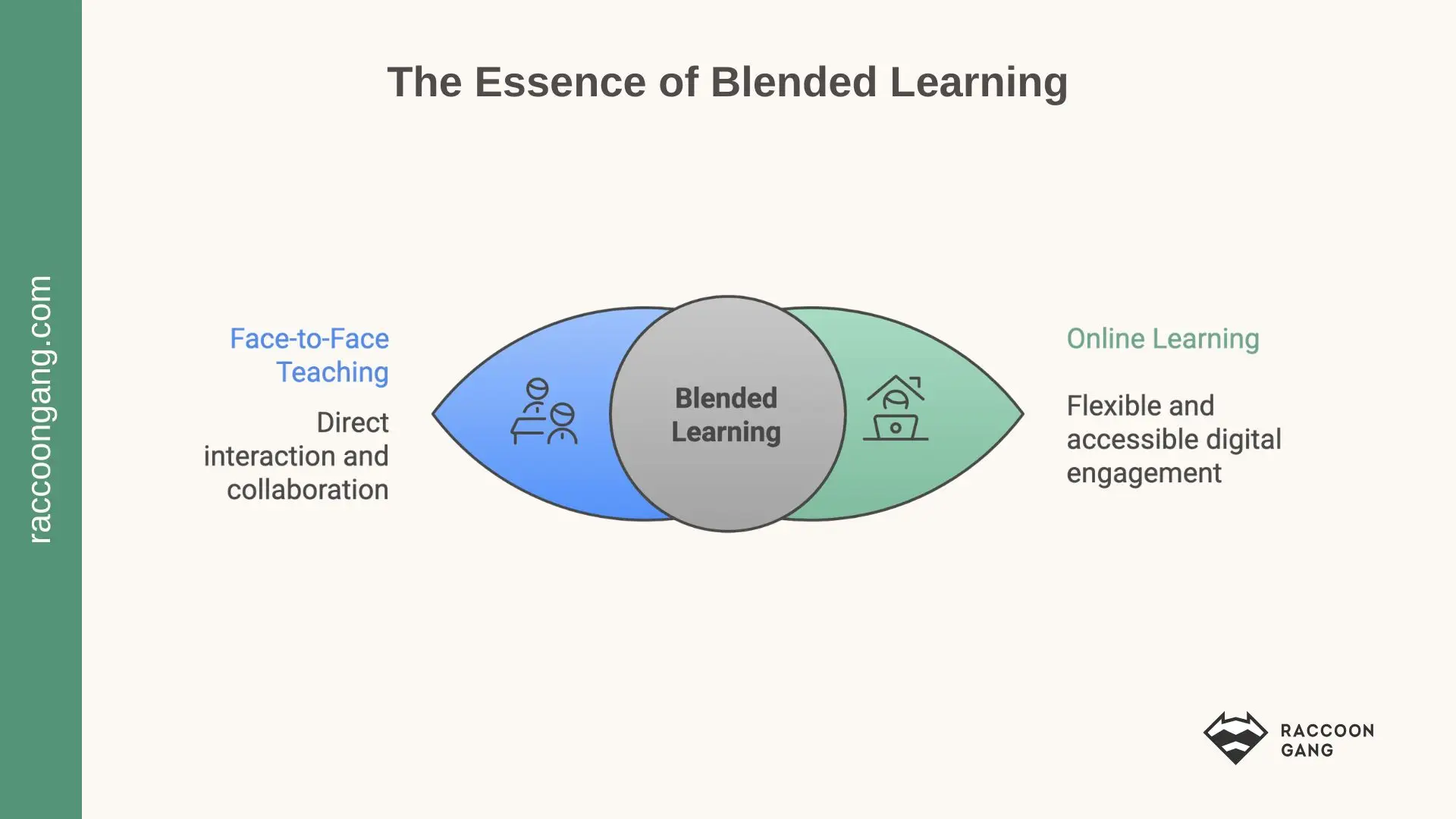
Oddly enough, the definition of blended learning goes beyond the simple phrase “a combination of online and face-to-face learning.” That part is true, of course. In our view, the blended approach deserves more respect and detail.
When you combine traditional in-person instruction with online, digital, or remote components, you create a unified learning experience that takes the best from both sides.
Blended learning is similar to other teaching methods in that it also depends on a structured learning design. You should map objectives, activities, and assessments.
At its simplest, blended learning approach combines face-to-face teaching with online learning possibilities.
Technology — especially an LMS — will help you with online content and progress tracking, and even give instructors data to adjust in-person sessions.
Benefits Of Blended Learning
Before listing the main benefits of blended learning, it is worth emphasizing that the digital era is already here. This means that most of today’s skills are digital or computer-based. Accordingly, it makes sense to study many of these skills in an electronic format. Blended learning strategies also help you bring digital elements into offline education and training.
Here is why the blended approach is in the spotlight for educational institutions and corporations today:
1. Flexibility and accessibility
The flexibility that the blended format adds is difficult to overestimate. Your students—and even educators—no longer depend on a fixed schedule. The time they spend in the classroom is often reduced by 30–50%.
Among the less obvious but still significant advantages, it is fair to mention universal access for everyone: office and remote employees, as well as commuter and part-time students.
2. Better learner engagement
Online modules, unlike printed materials used in face-to-face learning, can include gamified mechanics and analytics built into the LMS. Thanks to this, the number of passive students starts to shrink.
3. The new role of in-person time
You can assign theory for independent study at home or elsewhere. Then you use face-to-face time with a mentor, educator, or expert as efficiently as possible — focusing on dead ends and gaps learners hit while studying the theory.
4. Scalability and cost efficiency
Once you create digital content, you can repackage it and use it many times for any number of learners.
In practice, you stop worrying about limits like room capacity, printed materials, and other things that do not scale easily.
5. Improved learning outcomes
Blended formats support retention through spaced repetition. An LMS can remind learners about material they studied recently. As an organization or course owner, you can feel confident that your course will not turn into “memorize, pass the test, and forget.”
Types of Blended Learning Models
To better understand the nuances, let’s look at the types of blended learning models and what each one is for. Yes, blended learning has its own “sub-formats.” Below, we list the main 4 types of blended learning.
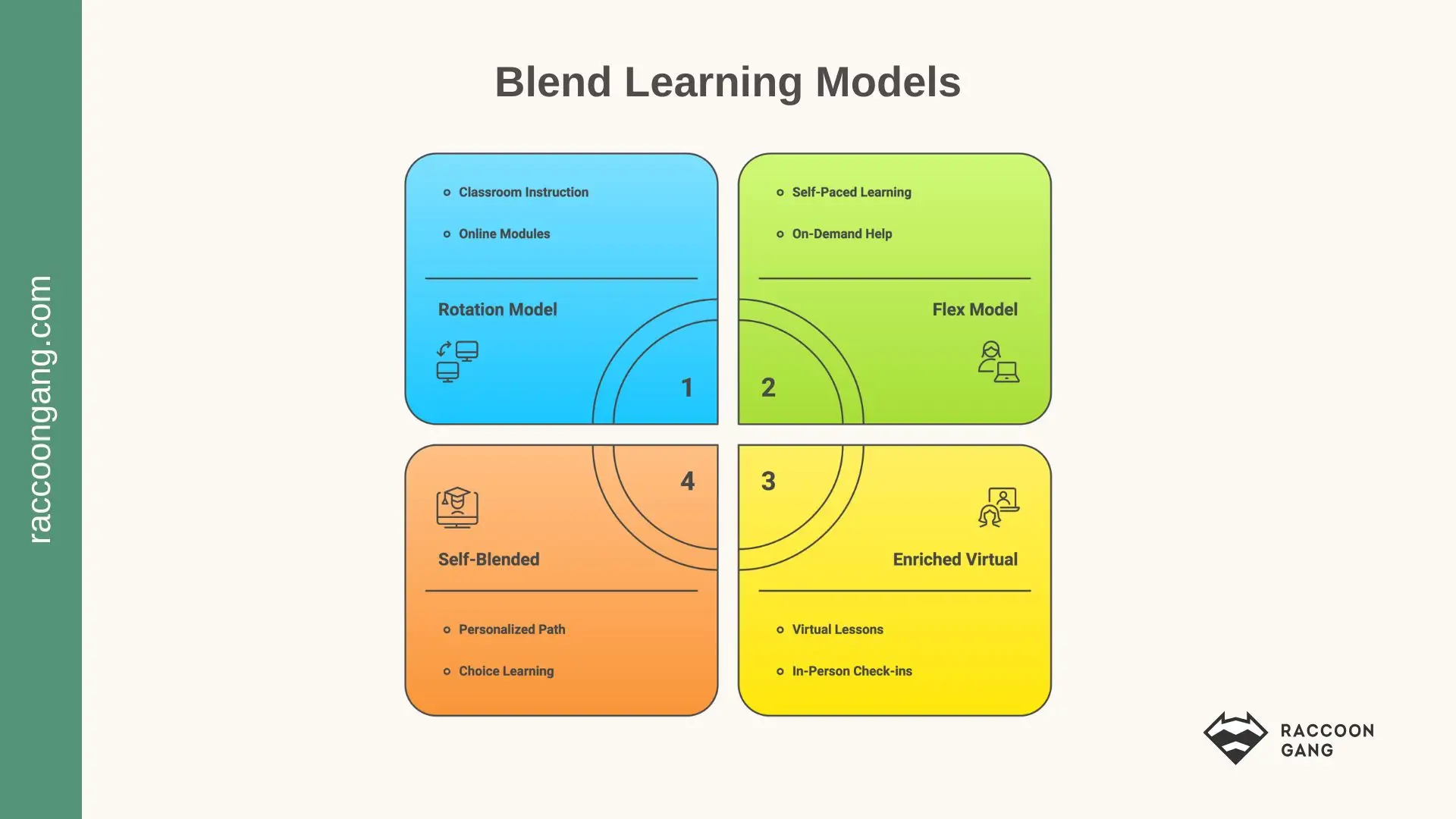
Overview of the four main blended learning models: Rotation, Flex, Enriched Virtual, and Self-Blended, with their key characteristics.
Rotation model
The rotation model centers on a planned schedule. That schedule sets the learning map for learners who move between online work and in-person sessions within this model.
As we mentioned in the previous block, the online part usually includes short checks and prep tasks inside the LMS. Then, classroom time shifts to discussions, role plays, labs, and coached feedback.
If your curriculum, course, or training program depends on many variables and you must schedule it tightly, this model will work best.
Flex model
The model’s key advantage is that it is primarily online with teacher support as needed. Learners study in the LMS and move at their own pace. At the same time, instructors monitor analytics and can step in when needed — for example, when someone gets stuck or needs coaching.
A major plus of the flex model is that the LMS lets you teach multiple groups, multiple levels of complexity, and multiple topics at once. At the same time, the model keeps the human touch and supervision.
Enriched virtual model
The enriched virtual model is about Most coursework online. Learners still study remotely in the LMS, and when it is time for practice, they attend scheduled sessions for labs, group work, coaching, or proctored assessments.
This model is a strong option for degree programs and professional training where you still need real-time interaction, but you do not want weekly classroom attendance.
Self-blended model
This is a model you could jokingly call a self-made barista. Self-blended usually refers to learners adding online courses to a traditional school program.
The model holds the learner’s interests and improves personalization. At the same time, this can become a drawback, because without a mentor and some control, optional modules can take up too much time and distract from the main learning path.
👉 Bonus material: Advantages and disadvantages of blended learning
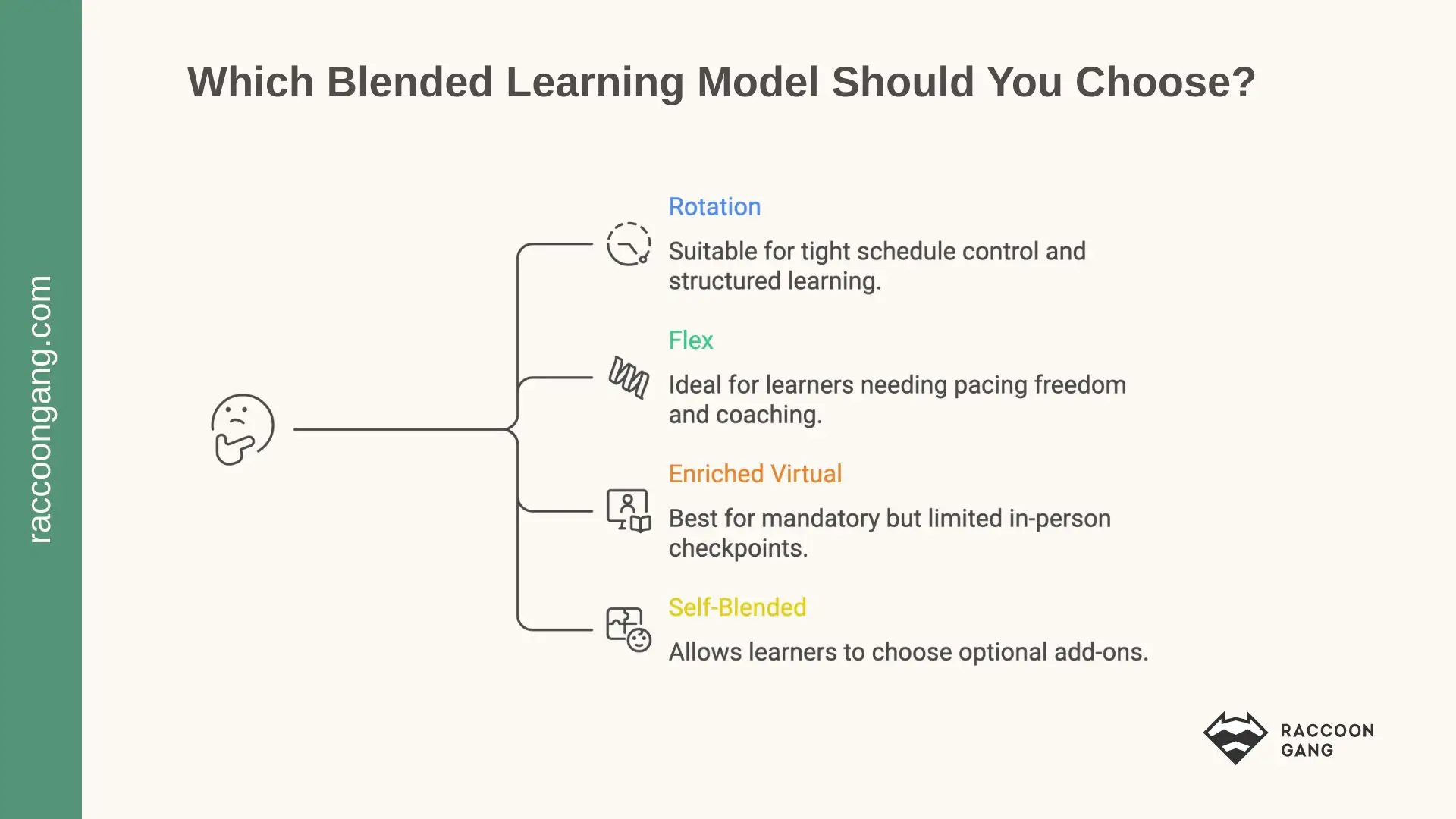
Quick decision guide for selecting the right blended learning model based on schedule control, pacing freedom, and required in-person checkpoints.
Blended Learning Examples
Now that we have looked at the main types of blended learning models, let’s teleport to the real blended learning examples.
| Scenario | Example (can be fictional) |
| Corporate onboarding program | A 200-person retail chain decided to onboard new hires every Monday. New staff will complete 6 LMS modules in 3 days. Then attend a 2-hour in-person session on Thursday for POS practice and role plays. |
| Leadership development program | A SaaS company decided to start a 10-week “New Managers” program. Leaders should watch short online lessons, submit reflections, and then book 1:1 coaching when weak quiz scores or missed assignments appear. |
| University course with online modules + seminars | A university decided to run “Intro to Data Analysis.” Students will watch lectures and complete quizzes online. And after that, they will go to weekly seminars for support from the educator during practice. |
| Certification or compliance training | A healthcare provider decided to train staff on data privacy. Learners will study modules online, then attend a scheduled proctored assessment and a short in-person scenario drill. |
| Self-blended learning (optional upskilling) | A manufacturing company chose to offer an optional “Excel for Analysts” track in the LMS. Employees take it alongside mandatory safety training and core role courses. |
Blended Learning LMS and Software
Now let’s talk about the tools for handling blended learning. If Excel works for formulas and Google Docs works for text, what software helps you create a strong blended learning experience?
Blended learning software is, in practice, an LMS. Almost every modern learning platform offers features that support blended formats.
- Content delivery. Online learning platforms (Open edX, Moodle, Canvas, etc.) support the online part of a course or training. When learners complete modules, videos, readings, and tasks at home, you receive more free time for upcoming workshops or seminars.
- Tracking. Popular LMS platforms give you visibility into the online part of training because they collect and organize learner activity. Progress across cohorts — logins, completion, time spent, and status by module — is just the tip of the iceberg. The bigger advantage is that instructors and managers can see who needs support, and where, before the practical part begins.
- Assessments. You can require a passing score before learners join a live session. This protects facilitator time and prevents unprepared attendance.
- Analytics. This is the deeper layer behind tracking. A blended learning LMS can collect and display the data you actually need, such as low scores, drop-off points, slow modules, and repeated attempts.
👉 Bonus material: Best Blended Learning LMS in 2026
Generic LMS vs blended learning LMS
A generic LMS delivers online courses and tracks completion. A blended learning LMS is essentially the same LMS, but set up with the functionality that manages schedules, sets required pre-work, tracks attendance, and follows up after live training.
Blended Learning vs Hybrid Learning
If, while reading this article, you kept thinking that blended learning is hybrid learning, we have two pieces of news for you. First, that’s not entirely true. Second, you’re not the only one confused.
The hybrid learning definition usually refers to a model where the same course, lesson, or training session can be attended by participants from the same group either online or in person.
To avoid getting too verbose here, we prepared a separate guide on the differences between Blended Learning vs Hybrid Learning. We recommend reading it as well.
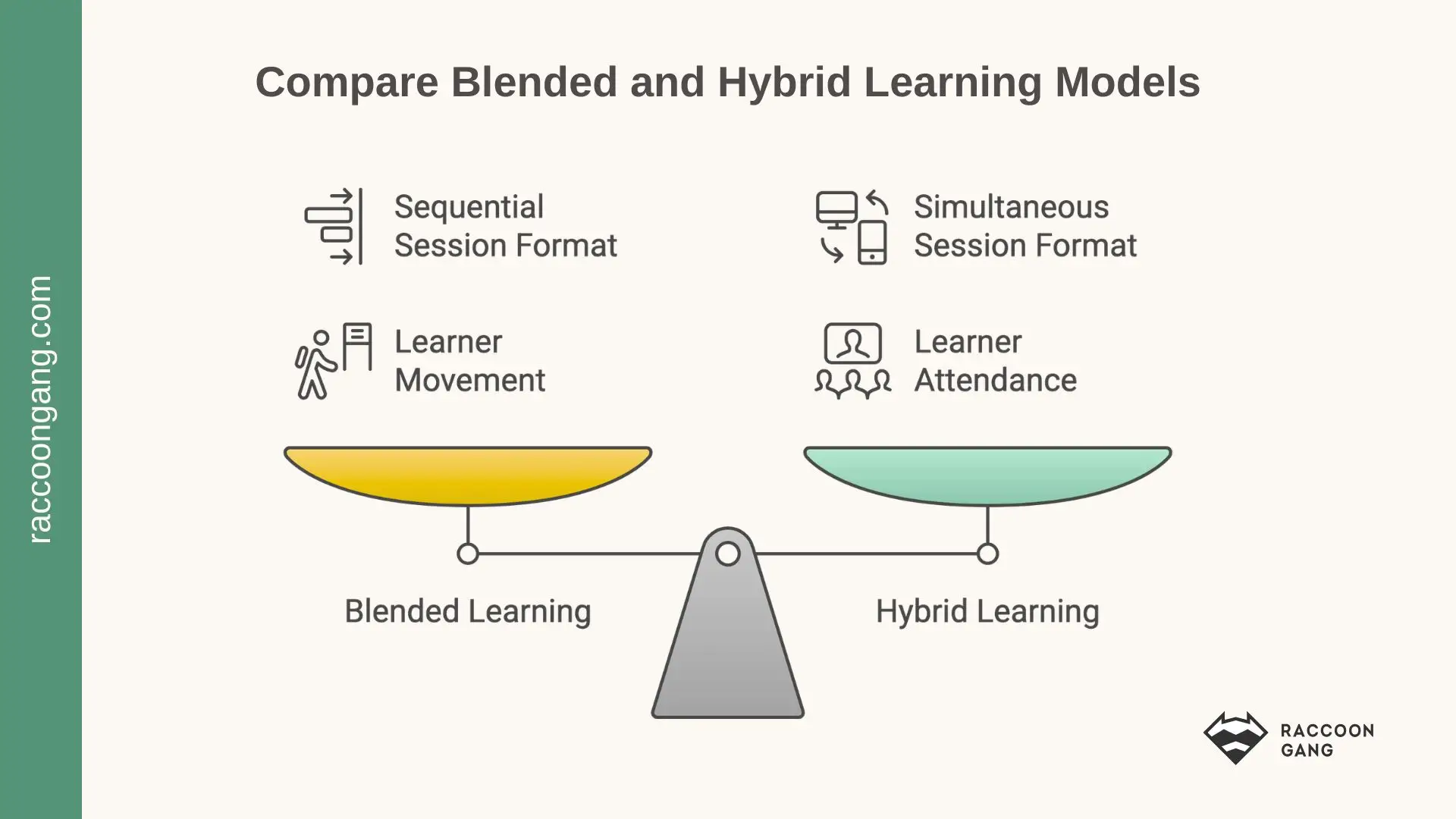
Visual cheat sheet showing when to use blended vs hybrid learning: blended runs in a sequence (online prep → in-person practice), while hybrid runs one session in two modes (classroom + live online at the same time).
How Raccoon Gang Designs Blended Learning Programs
Raccoon Gang is a practical implementation partner for many types of digital learning solutions, and we can help you implement the blended learning model you choose. Our team includes specialists in instructional design and educational content development. The developers have worked with leading learning platforms for more than 10 years, including Open edX, Moodle, and Canvas.
To avoid overloading you with marketing, here is where we can support you:
- Blended learning strategy and design
- LMS configuration and customization
- Open edX–based (or other) blended learning solutions
- Analytics and optimization
Conclusion
Thank you for reading to the end — the author is sincerely happy. At this stage, we hope you have found the answer to the question of what blended learning looks like in practice.
We’d like to remind you once again: too much freedom without checkpoints is a direct path to low completion rates. Too much rigidity reduces autonomy and slows progress. We have seen this many times in our work with customers. Only when you balance and blend these approaches do you get the best result.
We also hope the blended learning format soon becomes part of your L&D strategy. In short:
“Treat online modules as prep work, and use classroom time for practice and feedback. That’s where blended learning starts to pay off.”
FAQ
What is blended learning?
What are the benefits of blended learning?
What are the 4 types of blended learning?
How does blended learning differ from hybrid learning?
What LMS is best for blended learning?


- TL;DR What is blended learning? A structured mix of online study and in-person practice designed to work as one system. It balances flexibility and control — self-paced theory online, applied work in live sessions. The 4 types of blended learning you can rely on: Rotation, Flex, Enriched Virtual, and Self-Blended. The right model will depend on your schedule control, learner autonomy, and compliance requirements you want realize. A blended learning LMS combines features such as content delivery, tracking, assessments, and analytics into one flow. Blended and hybrid learning are not identical: blended is sequential; hybrid is simultaneous. What is blended learning? This is a question that arises for everyone who is no longer satisfied with only the traditional face-to-face approach, or, in other words, traditional classroom learning. On the other hand, interest in blended learning often arises among educators and training providers who are armed only with online learning tools. Unfortunately, a purely offline approach costs more per learner and becomes a problem if you need to scale. But even a purely online approach often fails without live practice. In this article, we will prove to you that it is time to make a smoothie of these two learning approaches and finally blend them. Looking ahead, we can say that the blended option’s response to flexibility, scale, and engagement needs will not leave you indifferent, wherever you are — and here is why. Blended learning for corporate training is the online bridge through which teams reach theory remotely. In parallel, managers can continue offline practice. What are the benefits? IBM reported up to 40% lower training costs after blended rollouts. Blended learning for higher education is also a kind of online portal for conducting online lectures. In addition, this portal gives faculty the opportunity to use class time for discussion, labs, problem-solving, and more. Research from the U.S. Department of Education shows better outcomes in blended formats than face-to-face alone. Blended learning for professional development is the same learning format in which each learner can prepare online, then pass proctored or in-person assessments. For certifications, this format is simply ideal. Let's talk about all this more consistently. What Is Blended Learning? Oddly enough, the definition of blended learning goes beyond the simple phrase “a combination of online and face-to-face learning.” That part is true, of course. In our view, the blended approach deserves more respect and detail. When you combine traditional in-person instruction with online, digital, or remote components, you create a unified learning experience that takes the best from both sides. Blended learning is similar to other teaching methods in that it also depends on a structured learning design. You should map objectives, activities, and assessments. At its simplest, blended learning approach combines face-to-face teaching with online learning possibilities. Technology — especially an LMS — will help you with online content and progress tracking, and even give instructors data to adjust in-person sessions. Benefits Of Blended Learning Before listing the main benefits of blended learning, it is worth emphasizing that the digital era is already here. This means that most of today’s skills are digital or computer-based. Accordingly, it makes sense to study many of these skills in an electronic format. Blended learning strategies also help you bring digital elements into offline education and training. Here is why the blended approach is in the spotlight for educational institutions and corporations today: 1. Flexibility and accessibility The flexibility that the blended format adds is difficult to overestimate. Your students—and even educators—no longer depend on a fixed schedule. The time they spend in the classroom is often reduced by 30–50%. Among the less obvious but still significant advantages, it is fair to mention universal access for everyone: office and remote employees, as well as commuter and part-time students. 2. Better learner engagement Online modules, unlike printed materials used in face-to-face learning, can include gamified mechanics and analytics built into the LMS. Thanks to this, the number of passive students starts to shrink. 3. The new role of in-person time You can assign theory for independent study at home or elsewhere. Then you use face-to-face time with a mentor, educator, or expert as efficiently as possible — focusing on dead ends and gaps learners hit while studying the theory. 4. Scalability and cost efficiency Once you create digital content, you can repackage it and use it many times for any number of learners. In practice, you stop worrying about limits like room capacity, printed materials, and other things that do not scale easily. 5. Improved learning outcomes Blended formats support retention through spaced repetition. An LMS can remind learners about material they studied recently. As an organization or course owner, you can feel confident that your course will not turn into “memorize, pass the test, and forget.” [cta-green t="Turn Blended Strategy into Platform Reality." d="Schedule a consultation to design your blended learning ecosystem."] Types of Blended Learning Models To better understand the nuances, let’s look at the types of blended learning models and what each one is for. Yes, blended learning has its own “sub-formats.” Below, we list the main 4 types of blended learning. [caption id="attachment_15249" align="aligncenter" width="1920"] Overview of the four main blended learning models: Rotation, Flex, Enriched Virtual, and Self-Blended, with their key characteristics.[/caption] Rotation model The rotation model centers on a planned schedule. That schedule sets the learning map for learners who move between online work and in-person sessions within this model. As we mentioned in the previous block, the online part usually includes short checks and prep tasks inside the LMS. Then, classroom time shifts to discussions, role plays, labs, and coached feedback. If your curriculum, course, or training program depends on many variables and you must schedule it tightly, this model will work best. Flex model The model’s key advantage is that it is primarily online with teacher support as needed. Learners study in the LMS and move at their own pace. At the same time, instructors monitor analytics and can step in when needed — for example, when someone gets stuck or needs coaching. A major plus of the flex model is that the LMS lets you teach multiple groups, multiple levels of complexity, and multiple topics at once. At the same time, the model keeps the human touch and supervision. Enriched virtual model The enriched virtual model is about Most coursework online. Learners still study remotely in the LMS, and when it is time for practice, they attend scheduled sessions for labs, group work, coaching, or proctored assessments. This model is a strong option for degree programs and professional training where you still need real-time interaction, but you do not want weekly classroom attendance. Self-blended model This is a model you could jokingly call a self-made barista. Self-blended usually refers to learners adding online courses to a traditional school program. The model holds the learner's interests and improves personalization. At the same time, this can become a drawback, because without a mentor and some control, optional modules can take up too much time and distract from the main learning path. 👉 Bonus material: Advantages and disadvantages of blended learning [caption id="attachment_15247" align="aligncenter" width="1920"] Quick decision guide for selecting the right blended learning model based on schedule control, pacing freedom, and required in-person checkpoints.[/caption] Blended Learning Examples Now that we have looked at the main types of blended learning models, let's teleport to the real blended learning examples. Scenario Example (can be fictional) Corporate onboarding program A 200-person retail chain decided to onboard new hires every Monday. New staff will complete 6 LMS modules in 3 days. Then attend a 2-hour in-person session on Thursday for POS practice and role plays. Leadership development program A SaaS company decided to start a 10-week “New Managers” program. Leaders should watch short online lessons, submit reflections, and then book 1:1 coaching when weak quiz scores or missed assignments appear. University course with online modules + seminars A university decided to run “Intro to Data Analysis.” Students will watch lectures and complete quizzes online. And after that, they will go to weekly seminars for support from the educator during practice. Certification or compliance training A healthcare provider decided to train staff on data privacy. Learners will study modules online, then attend a scheduled proctored assessment and a short in-person scenario drill. Self-blended learning (optional upskilling) A manufacturing company chose to offer an optional “Excel for Analysts” track in the LMS. Employees take it alongside mandatory safety training and core role courses. [cta-orange t="Not Sure Which Blended Model Fits?" d="Book a strategy call and get a clear recommendation based on your goals, timeline, and LMS setup."] Blended Learning LMS and Software Now let’s talk about the tools for handling blended learning. If Excel works for formulas and Google Docs works for text, what software helps you create a strong blended learning experience? Blended learning software is, in practice, an LMS. Almost every modern learning platform offers features that support blended formats. Content delivery. Online learning platforms (Open edX, Moodle, Canvas, etc.) support the online part of a course or training. When learners complete modules, videos, readings, and tasks at home, you receive more free time for upcoming workshops or seminars. Tracking. Popular LMS platforms give you visibility into the online part of training because they collect and organize learner activity. Progress across cohorts — logins, completion, time spent, and status by module — is just the tip of the iceberg. The bigger advantage is that instructors and managers can see who needs support, and where, before the practical part begins. Assessments. You can require a passing score before learners join a live session. This protects facilitator time and prevents unprepared attendance. Analytics. This is the deeper layer behind tracking. A blended learning LMS can collect and display the data you actually need, such as low scores, drop-off points, slow modules, and repeated attempts. 👉 Bonus material: Best Blended Learning LMS in 2026 Generic LMS vs blended learning LMS A generic LMS delivers online courses and tracks completion. A blended learning LMS is essentially the same LMS, but set up with the functionality that manages schedules, sets required pre-work, tracks attendance, and follows up after live training. Blended Learning vs Hybrid Learning If, while reading this article, you kept thinking that blended learning is hybrid learning, we have two pieces of news for you. First, that’s not entirely true. Second, you’re not the only one confused. The hybrid learning definition usually refers to a model where the same course, lesson, or training session can be attended by participants from the same group either online or in person. To avoid getting too verbose here, we prepared a separate guide on the differences between Blended Learning vs Hybrid Learning. We recommend reading it as well. [caption id="attachment_15246" align="alignnone" width="1920"] Visual cheat sheet showing when to use blended vs hybrid learning: blended runs in a sequence (online prep → in-person practice), while hybrid runs one session in two modes (classroom + live online at the same time).[/caption] How Raccoon Gang Designs Blended Learning Programs Raccoon Gang is a practical implementation partner for many types of digital learning solutions, and we can help you implement the blended learning model you choose. Our team includes specialists in instructional design and educational content development. The developers have worked with leading learning platforms for more than 10 years, including Open edX, Moodle, and Canvas. To avoid overloading you with marketing, here is where we can support you: Blended learning strategy and design LMS configuration and customization Open edX–based (or other) blended learning solutions Analytics and optimization [cta-green t="Design Your Blended Learning Program with Experts." d="Book a consultation and get a practical roadmap for your LMS, content, and delivery model."] Conclusion Thank you for reading to the end — the author is sincerely happy. At this stage, we hope you have found the answer to the question of what blended learning looks like in practice. We’d like to remind you once again: too much freedom without checkpoints is a direct path to low completion rates. Too much rigidity reduces autonomy and slows progress. We have seen this many times in our work with customers. Only when you balance and blend these approaches do you get the best result. We also hope the blended learning format soon becomes part of your L&D strategy. In short: “Treat online modules as prep work, and use classroom time for practice and feedback. That’s where blended learning starts to pay off.” [faq title="FAQ"] [faq-item question="What is blended learning?"] When, during training, part of the material is processed by students independently, remotely, in an online format, and the practical part takes place in the same way as in a traditional classroom, the training becomes blended. [/faq-item] [faq-item question="What are the benefits of blended learning?"] The combination of the advantages of full-time and, so to speak, correspondence (remote, online) training—saving time and materials for the part of the course that students can process independently, and focused practical training with a teacher without wasting time on repetition or simple note-taking under dictation—makes blended learning attractive. [/faq-item] [faq-item question="What are the 4 types of blended learning?"] The most popular blended learning models are often called the Rotation model, Flex model, Enriched virtual model, and Self-blended model. But it is important to remember that these are only the main fundamental models, which can be divided into sub-models. [/faq-item] [faq-item question="How does blended learning differ from hybrid learning?"] In hybrid learning, students take the same course or lesson at the same time, with the only difference being that someone is sitting at a desk and someone is online. In the blended format, theoretical classes are almost always online and at a time decided by the student, and practice takes place at a different time and usually offline. [/faq-item] [faq-item question="What LMS is best for blended learning?"] Any leading LMS on the market can be upgraded to support blended learning. Raccoon Gang, for example, uses Open edX, Moodle, and Canvas for this. [/faq-item] [/faq]
- What Is Blended Learning?
- Benefits Of Blended Learning
- Types of Blended Learning Models
- Blended Learning Examples
- Blended Learning LMS and Software
- Blended Learning vs Hybrid Learning
- How Raccoon Gang Designs Blended Learning Programs
- Conclusion