
Let’s start with the core idea: employee retention training will not solve all the problems with staff engagement and turnover by magic. Sad but true, as the Metallica song tells us. Even competitive compensation may not always help here.
Meanwhile, at the other end of the scale, you can expect strong increases in employee commitment and loyalty, which are consistently linked to lower intent to quit and lower actual turnover.
When a company provides retention training as part of a comprehensive set of initiatives to increase employee retention and cultivates skill development, long-term retention will no doubt improve.
In this material, we described the benefits, impact, and types of Employee Retention Training. And to make our explanation ring true, we added our personal experience in developing retention-focused training programs.
Also, in this article, you’ll find:
- What employee retention training really is
- Why retention training changes behavior, not moods
- How training shifts turnover numbers in practice
- Which retention training formats actually get used
- How to design a retention training program that holds up
TL;DR
Training and retention are inseparable. People stay when learning connects to real work, growth, and clear next steps.
Employee retention training works through mechanics, not motivation. It builds skills, confidence, and internal mobility before disengagement starts.
Soft skill training matters as much as technical skills. Communication, problem-solving, and adaptability reduce friction, burnout, and manager dependency.
Retention fails when skills don’t stick. Training without reinforcement improves market value faster than internal value.
Learning platforms scale retention training. Repetition, applied tasks, and feedback loops keep skills alive over time.
The goal isn’t zero turnover. Strong training and retention systems shape who stays, who grows, and when exits happen.
What Is Employee Retention Training?
First things first, let’s answer the question: What is retention training?
Retention training is a set of company initiatives that aims for an equal exchange between the organization and the employee. The company offers workshops and courses on leadership development, communication, and soft skills training, with the expectation that the employee will support that exchange and, in response to their own development, bring more value to the business over a longer period of cooperation.
In the context of retention learning, it is important to note three points that it cultivates:
- First, it raises the odds that employees stay long term.
- Second, it builds a real connection to the organization.
- Third, it improves skill retention and transfer to the job.
The logic is simple: when an employee feels progress in competence and sees how learning turns into real impact and career prospects, engagement increases and the likelihood of dismissal decreases.
Onboarding and compliance training are tactical. Onboarding answers: “How does this place work?” Compliance answers: “What rules can’t I break?” Retention training is strategic preparation that helps the workforce grow, build capability, and strengthen confidence.
👉 Go deeper: Onboarding Best Practices
Simply put, people use what they learn. People feel competent. People stop burning energy without a career perspective.
LinkedIn’s Workplace Learning research shows that 90% of organizations worry about employee retention, and learning opportunities rank as the top retention strategy.
Next, we’ll break down what companies gain when they treat retention learning as a reference point.
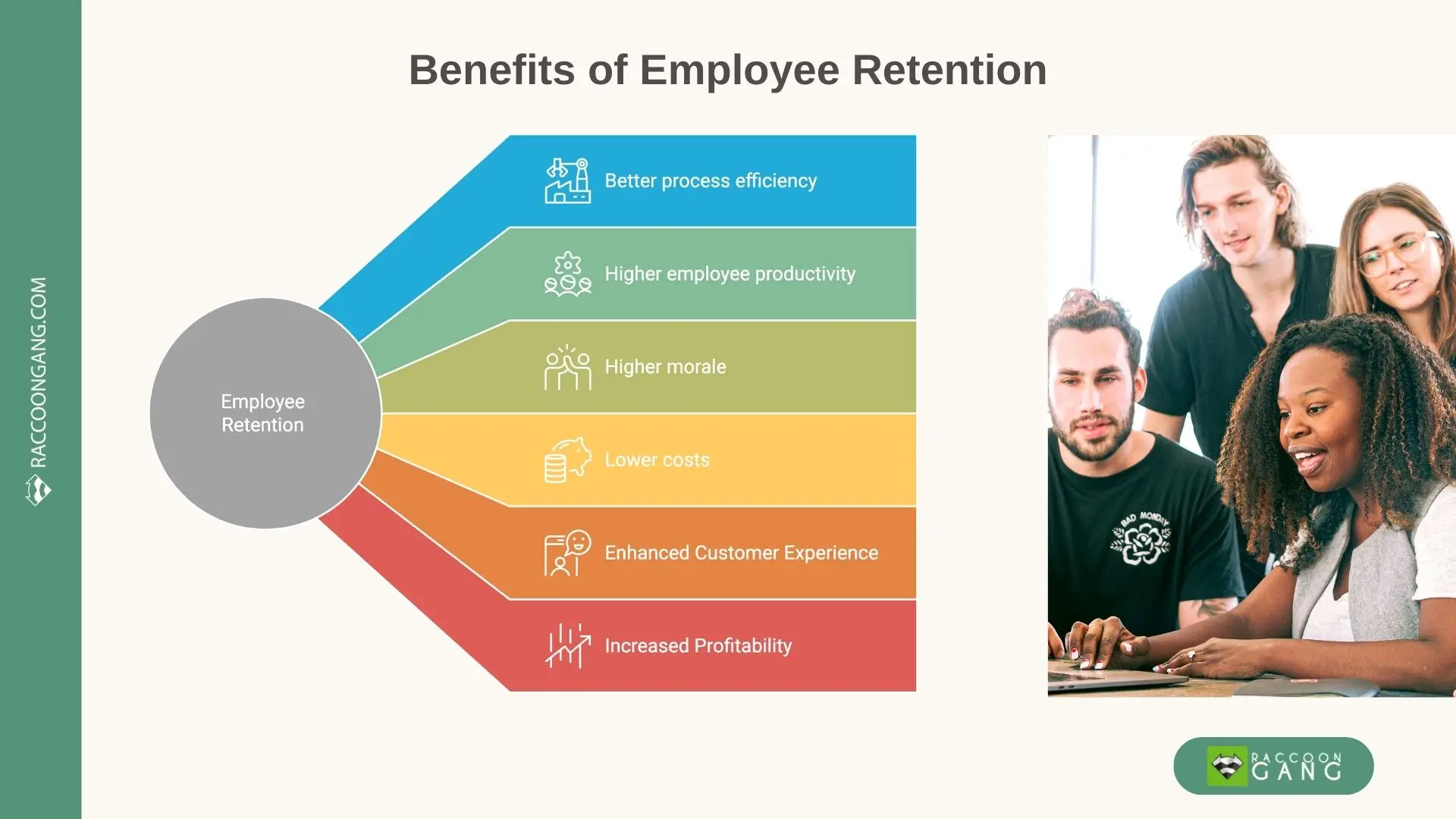
Employee retention training improves efficiency, productivity, morale, costs, customer experience, and long-term profitability.
Benefits of Retention Training
It is the right time to inspect the main benefits of employee retention training, and maybe you decide to reassess your training plans for the next quarter.
- Better process efficiency. When people stay longer at the same company, even if they change roles, work flows more smoothly. Tasks get solved faster because all the tools are well known, such as Jira, Asana, etc. And everyone on the team knows the board rules.
- Higher employee productivity. Retention training shortens the period during which employees don’t know the exact standards for their roles. Workshops and knowledge-sharing sessions show how to finish tasks correctly on the first try.
- Higher morale. Most workplace frustration comes from limited advancement or skill gaps. Don’t be surprised that this kind of tension drains people’s energy. Employee retention training addresses these dissatisfaction drivers.
- Lower costs. Replacing people is expensive. And it’s not only a question of staff shortages. Here you need to look wider. Seniors aren’t very happy when they constantly have to interview new candidates and then onboard them. Not to mention HR managers, whose heads are spinning from the constant change of faces. The math is pretty simple here: Fewer recruiting fees. Fewer training cycles for the same role. Less lost output during vacancies.
“When training makes an employee more ‘marketable’, the company needs retention mechanisms. Internal mobility, transparent levels, project rotations, compensation reviews. Combine training with a career offer to avoid training for the exit.”
— HR team, Raccoon Gang
- A better experience for your customers. Customers prefer familiar faces. When employees stay, customers don’t need to re-explain their problems. Issues get solved faster because employees remember past context.
- Greater profitability. Stable teams waste less time. They make fewer errors and deliver consistent results. Over time, this saves money and increases revenue.
Next, we’ll look at what “retention” actually means in the wider context.
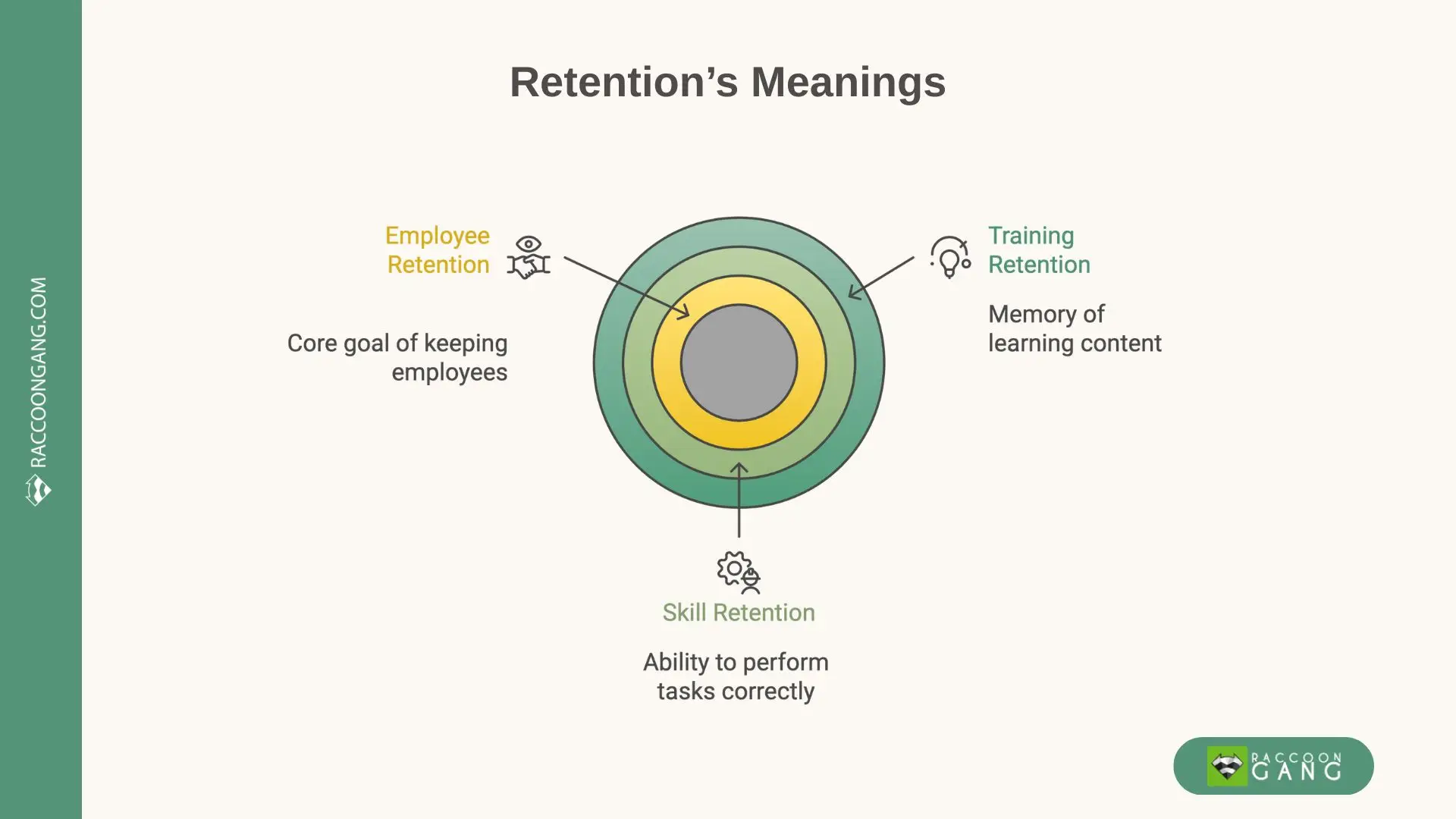
Retention has different meanings in HR and L&D: keeping employees, remembering learning content, and sustaining job-ready skills.
Retention Meaning in a Learning Context
Retention’s meaning may change when you switch the learning context.
From an HR perspective, retention means keeping employees with the company over time. Measurements here are simple: fewer resignations, longer tenure, and lower turnover rates.
From a learning and development specialist’s perspective, retention is what happens to knowledge and skills after training ends. Every L&D professional asks the same questions: Did employees remember the material? Did they apply it on the job?
To avoid chaos, let’s clarify it once again:
- Employee retention focuses on people staying employed by the organization.
- Training retention focuses on whether learning content stays in memory.
- Skill retention focuses on whether employees can still perform tasks correctly weeks or months later.
All of these definitions of “retention” are related, but they are not interchangeable.
We often see a scenario where a company invests in training retention and still loses employees. That tends to happen when learning improves someone’s external value faster than their internal growth path. If promotions are vague, levels are unclear, and project work stays repetitive, training turns into polish for the résumé.
The LinkedIn Workplace Learning Report states that 7 in 10 people say that learning improves their sense of connection to the organization, and 8 in 10 say that learning adds “purpose” to work.
The opposite scenario also happens. A company can keep people for years while skill retention stays low because the work never forces mastery. Teams rely on templates, senior “fixers,” and tribal knowledge, so employees get by without building durable skills.
This is why retention training must connect learning outcomes to long-term work and career paths.
How Training Impacts Employee Retention
Training affects retention through direct and indirect mechanisms:
- Investment (“side bets”). Employees invest time and effort now and expect a future payoff (career growth, wage gains).
- Reciprocity. Employees treat training as a “gift” and feel a duty to give back (effort, loyalty).
- Social identity / identification. Training socializes people into “how we do things here,” building belonging.
- Lack of alternatives. More firm-specific skills reduce attractive outside options and reduce quitting.
Here, it’s also necessary to emphasize one thing again regarding training and employee retention. General training builds the so-called “portable skills” in employees. This set of skills can increase turnover risk because employees become more marketable.
In contrast, specific training develops and reinforces “firm-only skills.” Narrowly trained specialists tend to be more closely connected to the company because the acquired skills and experience are not as easy to apply elsewhere. This tends to reduce turnover.
👉 Go deeper: Why Training Is Important for Employees in 2026
Of course, in practice, companies create blended training offers (general + specific) to balance the benefits for both sides.
Types of Employee Retention Training Programs
That’s the picture so far. It’s time to clearly outline examples of employee retention training and development programs. We’ve created a table below so you can quickly see what each type actually does for retention. This table also clarifies retention program meaning beyond generic learning catalogs.
| Training program type | What it focuses on | How it supports retention |
| Onboarding and early-stage retention programs | Role clarity, tools, workflows, and early expectations | Reduces first-year attrition by shortening time-to-confidence and preventing early frustration |
| Continuous upskilling and reskilling | Updating skills as tools, processes, and roles evolve | Prevents skill decay and career stagnation that often trigger disengagement |
| Leadership and management development | Coaching, feedback, decision-making, people management | Improves manager quality, which strongly correlates with employee retention |
| Role-specific skill development | Deep, job-specific knowledge and applied practice | Builds firm-specific expertise that increases performance and commitment |
| Learning paths tied to career growth | Structured progression across levels or roles | Makes growth visible and reduces exits caused by “no clear next step” |
* Not every retention program needs all five types. Strong employee retention training starts with real retention risks and selects learning formats to address them.
Skill Retention and Retention Skills
What do we actually mean by retention skills?
Retention skills keep people equipped. Learning agility means you learn fast. New tool? You pick it up. New rule? You adjust. Problem-solving means you don’t freeze. You break the issue down. You choose a move. You ship a fix. Adaptability means change doesn’t wreck your output. Priorities shift. Process changes. You stay useful.
Is there a difference between retention skills meaning and skill retention?
Retention skills meaning describes which skills help employees stay productive over time. Skill retention tells you if those skills still hold after training. One sets the target. The other checks whether it stuck.
Why do retention skills matter as much as hiring?
When people can’t learn and adapt, every tool update turns into friction and extra headcount. Teams with strong retention skills absorb change, keep moving, and hire less out of panic.
How do learning platforms support retention skills over time?
Platforms help when they don’t stop at completion. They repeat practice, drip refreshers, and push real tasks back into the flow of work. That keeps skills alive instead of fading into “I took that course once.”
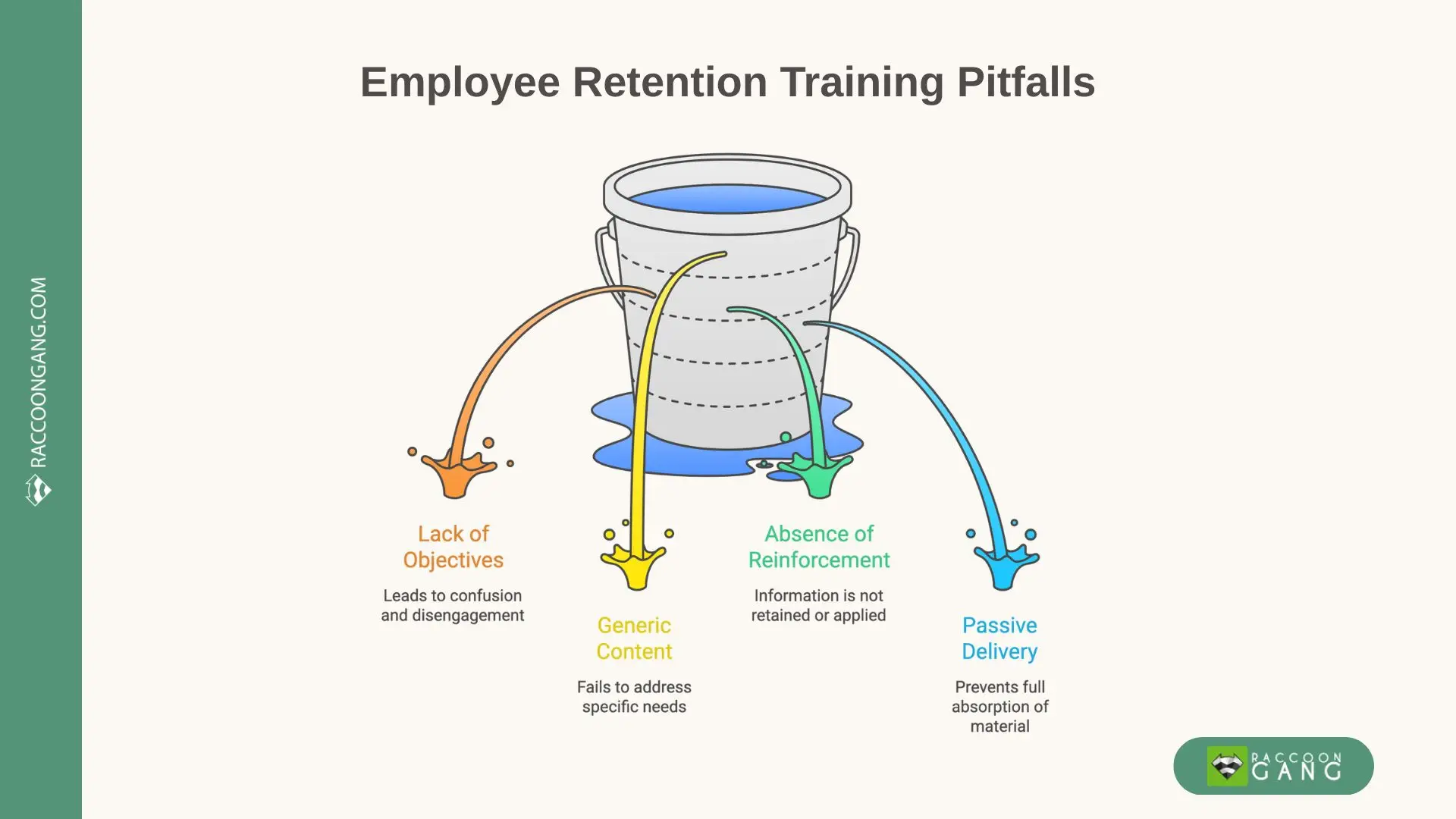
Common employee retention training pitfalls that weaken learning impact and increase disengagement.
How to Develop a Retention Training Program
- Step. Start with exit data, not course ideas
- Step. Define the retention risk you want to reduce
- Step. Map skills to future roles, not current tasks
- Step. Mix general and firm-specific training
- Step. Build learning into the flow of work
- Step. Connect training to visible career signals
- Step. Track retention signals, not just completions
“You can deliver retention training through mentoring, eLearning, instructor-led training, virtual instructor-led sessions, immersive formats, rotations, or shadowing. The format depends on the topics — either the ones that could have prevented former employees from leaving, or the ones that address current employees’ concerns about career growth.”
— Course Development Specialist, Raccoon Gang
How Learning Platforms Support Retention Training
No secret that many modern learning initiatives now run through digital tools. So retention training fits best inside learning platforms like Open edX, Moodle, and Canvas.
LMS platforms already extend with dashboards, analytics, and gamification. Recent updates often add AI features that support personalized learning paths, skill tracking, and social learning.
Therefore, the role of technology in education and training is difficult to overestimate and easy to underestimate. Based on our own experience, we would add that behind each of our solutions is a team of experienced instructional designers who use best practices and proven strategies for creating courses and learning materials, and who supplement the platform with truly valuable content.
Conclusion
And at the very end, sorry, but we should add a portion of the uncomfortable truth most teams avoid.
“Retention training does not prevent people from leaving. It decides who leaves and when.”
In every company, some exits are inevitable. Training does not cancel that. But without retention training, the wrong people leave first.
- High performers walk.
- Low performers stay longer.
Retention training is not about holding everyone. It’s about keeping momentum while change happens anyway.
Once a company understands that, training stops being a benefit. It becomes a stability mechanism.
That’s the part most articles never say out loud.
FAQ
What is employee retention training?
How does training improve employee retention?
What is retention training for managers?
What does retention mean in training and development?
How can learning platforms support retention programs?




- TL;DR
- What Is Employee Retention Training?
- Benefits of Retention Training
- Retention Meaning in a Learning Context
- How Training Impacts Employee Retention
- Types of Employee Retention Training Programs
- Skill Retention and Retention Skills
- How to Develop a Retention Training Program
- How Learning Platforms Support Retention Training
- Conclusion