LMS ROI is nothing but the answer to the question: ‘how much money you earn or save compared to what you spend on your learning platform.’
For most L&D and HR teams, budgets are, as always, tight. Stakeholders, sooner or later, or someone in finance will ask, “So what did we actually get from this LMS implementation?” That’s why a clear metric is so meaningful.
In our practice, a situation in which measuring the real ROI of an LMS investment feels like guesswork rather than analysis is very common. So many teams still track impact in spreadsheets or slide decks that never quite connect training to business results.
This article helps you move past that.
- First, we’ll explain what LMS ROI is and why it matters to your org.
- Then we’ll walk through how to measure the ROI of an LMS investment in practice.
- We’ll unpack a simple LMS ROI calculator with real numbers.
- Next, we’ll go through the factors that push ROI up or drag it down.
- Finally, we’ll share practical ways to squeeze more return from your current or future LMS implementation.
If you’ve ever felt nervous before a budget review, this piece is built to help you walk into the next one with precise numbers, a simple story, and fewer “trust us, it’s working” slides.
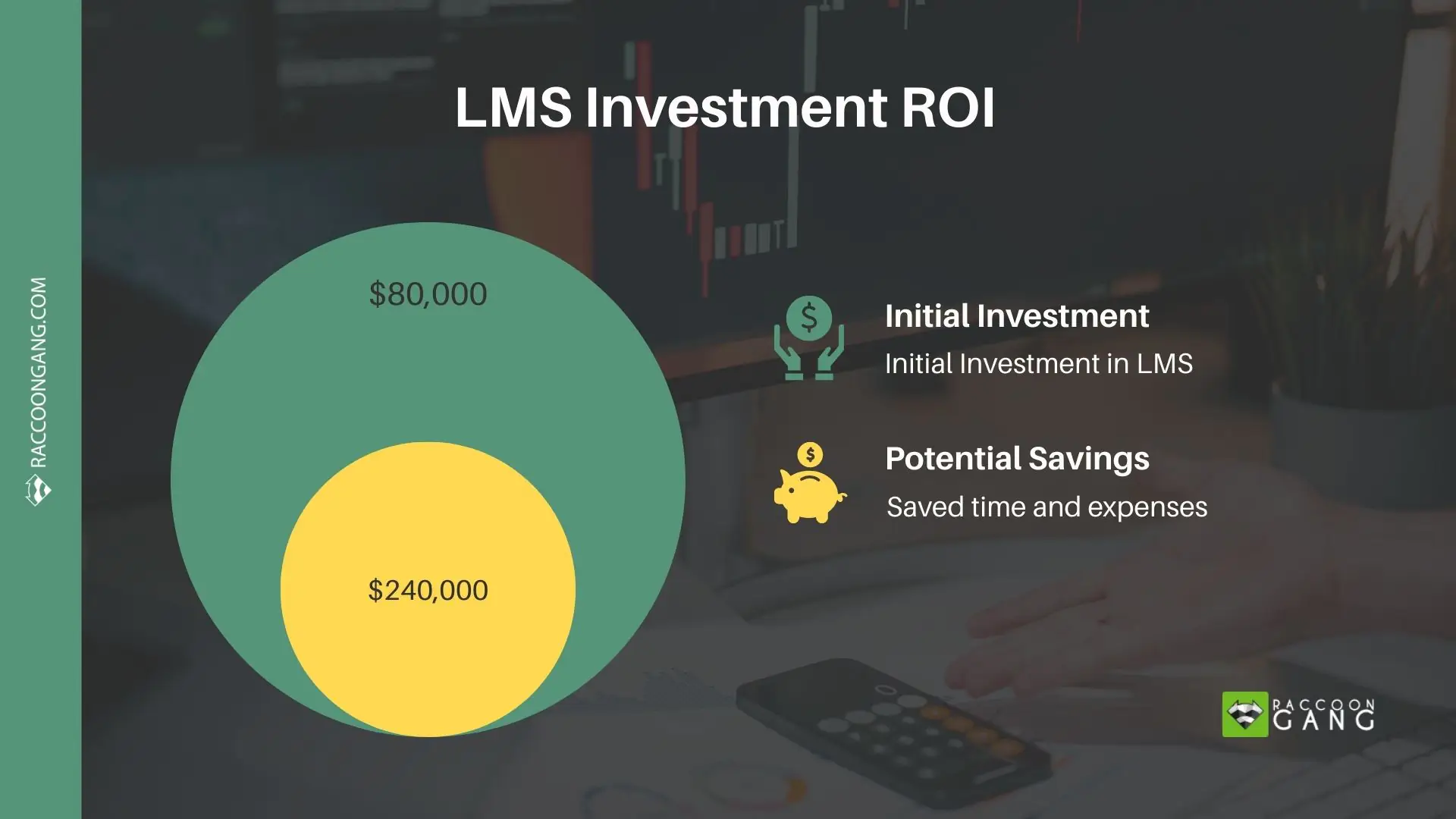
With a $80,000 LMS implementation that cuts classroom time, shortens onboarding, and replaces legacy tools, this example shows $240,000 in yearly savings — a 3:1 ROI of an LMS investment.
What Is LMS ROI and Why It Matters
Don’t take this for granted, but let’s specify it again — LMS ROI is how much money and time your LMS returns after costs. Picture next.
You spend $80,000 on an LMS implementation in year one:
- Platform
- Setup
- Content
- Internal hours
In return, you cut:
- Classroom sessions by half
- Trim onboarding by a week
- Drop two legacy tools
At the end of the year, you see about $240,000 in saved time and expenses. That’s a 3:1 ROI of an LMS investment.
Words are good, but numbers are even better. IBM shared that structured training can bring about $30 in productivity gains for every $1 spent. Replacing one employee can cost 30–50% of their annual salary. If your LMS helps people ramp faster, make fewer mistakes, and see a future in your company, that learning platform is covering its own bill.
“To be able to confidently say ‘Our programs saved X hours, Y dollars, and kept Z people on the team’ in your next financial meeting, you need to consider side metrics like error rates, ticket volume, and real performance shifts in addition to the cost of LMS implementation and/or support.”
— BizDev Manager at Raccoon Gang.
In passing, Raccoon Gang has built Open edX platforms with analytics and reporting for more than 10 years. In the chapter “LMS ROI Calculator,” you will see how analytics tools help you identify which courses move the right numbers, where people stall, and which teams get the most value. But for now, let’s explore the ways to measure the ROI of an LMS Investment.
How to Measure the ROI of an LMS Investment
If you want real answers, not vibes, here’s how to measure the ROI of an LMS investment step by step.
1. Define learning goals and metrics
Our thorny path has given us valuable lessons that we would like to share with you. It is better to start by defining the main business goals and develop course ideas later. A good approach would be to find answers to the following questions for yourself: What must actually change? Fewer defects, faster ramp-up, better CSAT? Turn those goals into measurable marks.
Your potential targets could be:
- “Reduce onboarding time from 8 weeks to 6.”
- “Cut error rate by 20% in six months.”
- “Increase first-call resolution by 10%.”
2. Collect data
Next, gather the evidence. You need a “before” and an “after.”
For each program, track:
- Who enrolled, who showed up
- Who finished and passed
- Time spent, replays, quiz attempts
- Time to first sale, output per person, quality checks
Your LMS and related tools should feed all this into one view. The Open edX LMS that Raccoon Gang configures comes with reporting and learning metrics and analytics dashboards, so you’re not stuck stitching CSVs late at night.
3. Calculate benefits
Now translate the impact into money and hours. Examples:
- Time saved: shorter onboarding or shorter sessions. Multiply hours saved by the average hourly cost.
- Improved performance: higher sales, fewer defects, fewer callbacks. Multiply changes by their financial value.
- Reduced training costs: less travel, fewer external trainers, fewer rented classrooms, fewer separate tools.
Add these up for a 6–12 month period. That total is your benefits number.
4. Compare benefits against total costs
Then gather all LMS-related costs for the same period:
- Platform fees and hosting
- Implementation and integrations
- Content design and updates
- Admin time and internal trainers
The basic formula for ROI
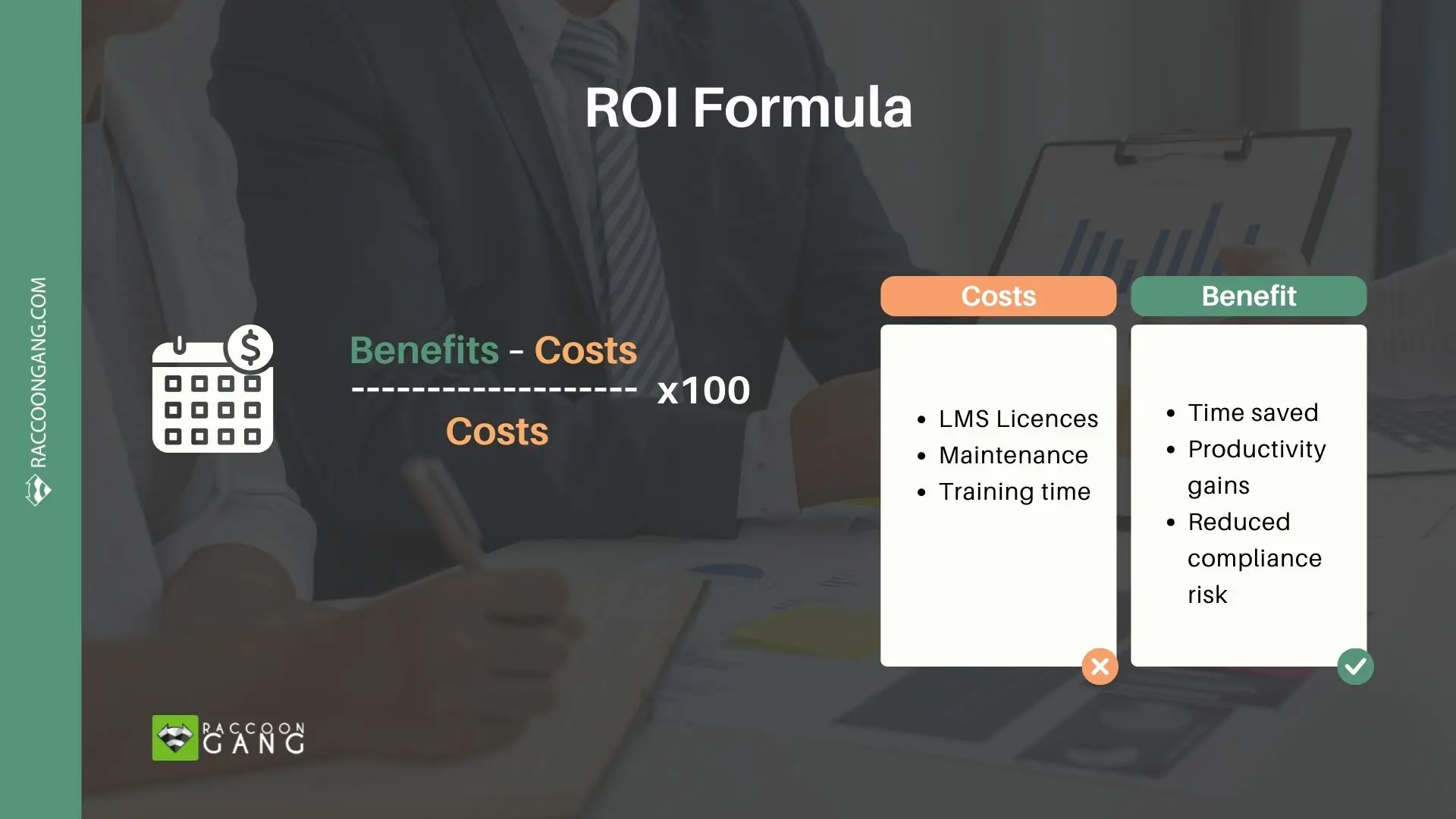
The basic LMS ROI formula compares costs like licenses, maintenance, and training time against benefits such as saved time, higher productivity, and lower compliance risk.
LMS ROI Calculator: Example and Breakdown
An LMS ROI calculator is a visual template for objective calculations. You can use our example below instead of theoretical evidence. You just put in what you spend on learning, what actually happens in the LMS, and what changes in the business.
At a high level, the calculator guides you through four inputs:
- Your LMS and training costs for a specific period
- Learner activity from the platform
- Business impact data from the field
- The time frame you want to measure
Even the default components of modern LMS platforms, such as Open edX, can help you pull the learning side of the story: enrollments, completions, time spent, and key paths like onboarding or mandatory compliance. Not to mention some custom LMS features like RG Analytics from Raccoon Gang.
Unfortunately, those learning numbers are not the finish line. On their own, they only show “people took the course.” They don’t prove business value yet.
ROI appears only when you connect learning data to business data. You have to match course activity with your business outcomes: fewer errors, faster ramp-up, more calls handled per agent, fewer trips for classroom sessions.
ROI on LMS — How to calculate it
Download the free LMS ROI calculator template and get a clear ROI number for your LMS.
Business example of the learning platform ROI calculation
Imagine you plan to run compliance training using an LMS.
- LMS and content costs (year): $25,000
- In-person compliance sessions before LMS: trainer travel + rooms = $40,000
- After LMS: in-person sessions reduced by 70%, travel spend drops to $10,000
Benefits sum up: Travel and room savings = 40,000 – 10,000 = $30,000
Costs sum up: LMS and content = $25,000
“Just moving compliance online gives us a 20% ROI, even before we count productivity gains. In our example ROI = ((30,000−25,000) / 25,000) × 100 = 20%”
That’s the kind of number you can show finance and say, “This LMS is not just a line item. It is returning real cash and time.”
Factors That Influence LMS ROI
Even the best LMS can give you poor numbers if the wrong pieces are in place. Here are the main factors that push LMS ROI up or drag it down.
1. Implementation and maintenance costs
If you only knew how often we see customers who come to us after a previous LMS vendor overspent on useless features. To have budget left over for content creation or change management, it’s worth focusing only on the necessary LMS features.
2. Course development time
Slow content production delays result in 9 out of 10 cases. Can you believe it?
If it takes months to launch one course, the business waits months for value. In such cases, it would be superfluous to talk about any positive trend in measuring ROI.
3. Employee engagement and completion rates
To prevent your platform’s ROI from collapsing, it’s better to engage people enough. In other words, people should start and successfully finish the courses on your learning platform.
Sounds too obvious? Agreed. That’s why we recommend L&D and HR set up nudges, manager reminders, and simple rules like “no more than 20 minutes per learning block.” Believe us, these small changes often move completion rates up.
4. Reporting and data tracking capabilities
As we said in previous blocks, you can’t prove ROI with guesswork. If your LMS reports only completions, you are flying blind.
In short, LMS ROI is, at the beginning, just the price of the platform. If you spread ROI out over space and time, it’s about how you control side costs, build content, keep people engaged, and track what happens next. Only the combination of these makes the return on investment a whole map.
Ways to Maximize ROI on LMS Implementation
The following table is a practical manual for turning your LMS into a system that continuously improves the return on investment in training.
| Strategy | What it means | Key steps |
| Run a low-risk pilot before full rollout | Test your LMS implementation with one business unit first, not the whole company. Use the pilot to find blockers, refine workflows, and prove early ROI on LMS with real numbers. | – Choose one high-impact use case (e.g., onboarding for sales or support).
– Define 2–3 success metrics before launch (time to productivity, error rate, CSAT, etc.). – Run the pilot, gather feedback, and fix issues fast. – Analyze a short “before/after” ROI snapshot. |
| Upgrade instructional design, not just content volume | More courses don’t automatically improve employee training ROI. Better structure and practice do. Focus on tasks, decisions, and real scenarios instead of page-turning theory. | – We recommend using rapid instructional design so the content creation process becomes much faster. Or use the help of a third-party instructional design team that will help you expand or augment your own team.
– Audit one flagship course with an ID expert and use it as a pattern. |
| Automate reporting and LMS analytics | Manual reporting kills your time and hides insight. Automated dashboards show where return on investment in training comes from, and where it doesn’t. | – Connect Open edX (or your LMS) to RG Analytics or similar tools.
– Automate weekly or monthly KPI reports for managers. – Track links between training and business metrics (tickets, sales, defects). – Use those reports to catch low-impact courses and back winning ones. |
| Treat content as a living product, not a one-off project | “Continuous content improvement” is a better way than “set and forget.” | – Review top courses quarterly using usage and performance data.
– Refresh examples, screenshots, and policies on a fixed schedule. – Retire content with low engagement or no business impact. – Build a simple backlog of “next fixes” for each core program. |
Conclusion
So, we have reached the conclusion of our article. But please don’t close the tab just because you’ve seen an LMS ROI calculator. That’s only the starting point for your next considerations.
It is not for us to tell you that learning is messy in real life. So the question is: how do you keep the ROI model honest when there are so many variables in the environment—blended formats, shared budgets, soft skills, multiple authoring tools?
Adapting the calculator for complex or blended setups
Instead of chasing one big number, it is better to treat your calculator as a set of “mini-models” that roll up:
- Build separate ROI lines for onboarding and compliance programs, or product training.
- Tag which parts run online, in-person, or mixed, then assign partial credit to the LMS (for example, “40% of time saved comes from digital modules”).
- Use cohorts or branches as comparison groups. The gap between them can be your signal.
Common traps when teams try to measure LMS ROI
- Completions are important; we don’t argue, but they unfortunately don’t prove revenue, savings, or fewer errors.
- Another common trap is that teams forget to capture “life before the LMS.”
- Finally, we strongly advise against ignoring hidden costs. Change management, admin time, extra integrations, and rework should be reflected on paper.
- Don’t try to measure everything. In other words, focus only on the 5–10% of programs with real money on the line. For example, it could be sales.
If you avoid these traps, your model might look more modest, but it will survive a CFO’s questions. That’s the real win.