Online education runs on two delivery formats: synchronous and asynchronous learning. One happens in real time with everyone present together. The other lets people learn on their own schedule. Your choice determines whether your training scales, whether learners complete courses, and whether the program fits your organization.
This article explains both models and when to use each. We’ve built LMS platforms for universities, corporations, and schools, so this guidance comes from production environments.
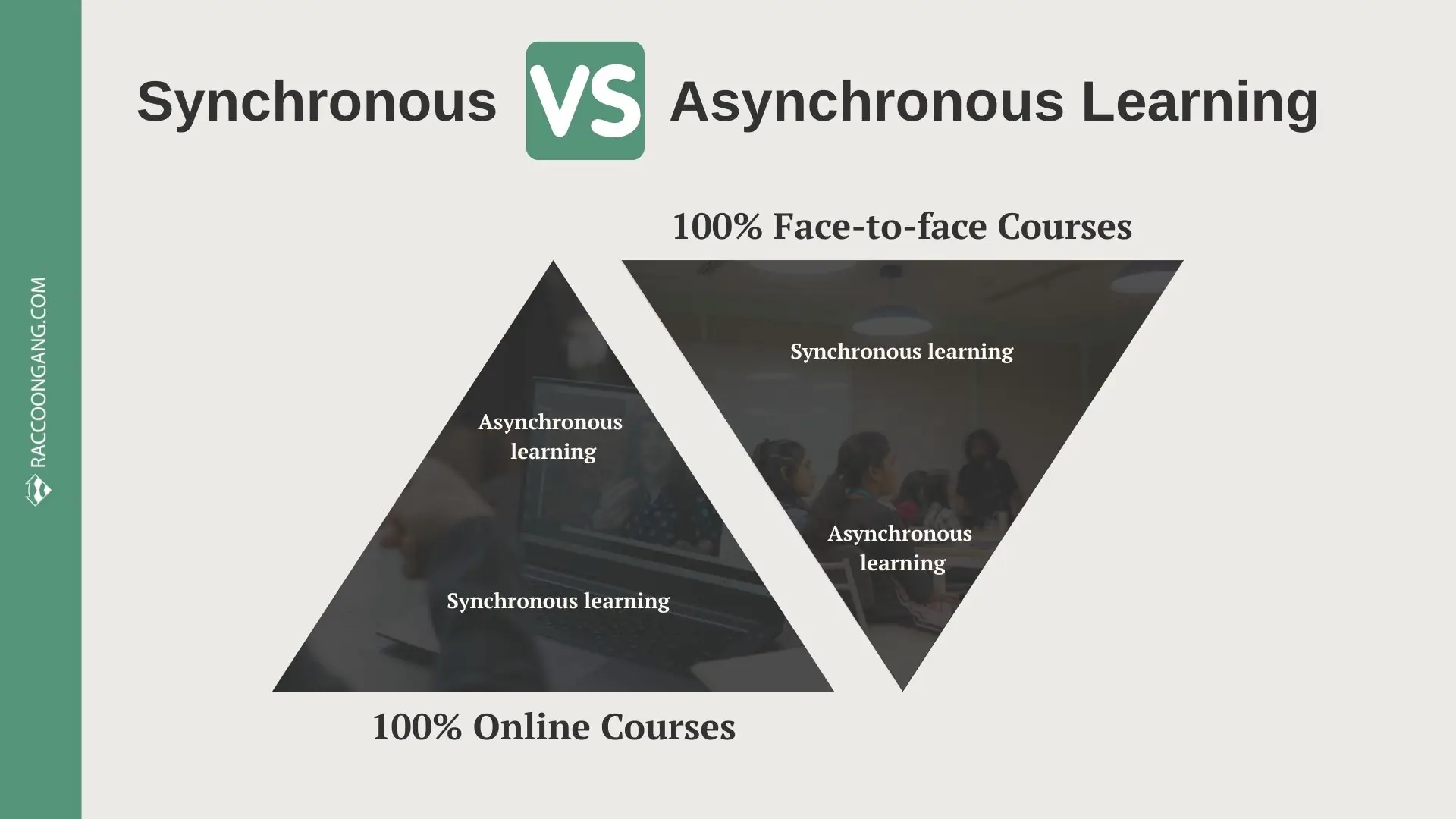
Same course, different timing: how live sessions and self-paced work fit in fully online and fully in-person training.
What Is Synchronous Learning?
Synchronous learning brings everyone together at the same scheduled time for real-time online learning interaction. Students and teachers meet virtually, where immediate feedback and natural dialogue drive the learning experience.
Common examples:
- Live online classes with video conferencing
- Webinars with Q&A sessions
- Virtual instructor-led training
- Real-time workshops with breakout rooms
- Online seminars with live discussion and polling
What ties them all together is the immediacy, as everyone participates simultaneously, which allows to create the digital equivalent of a classroom environment.
What Is Asynchronous Learning?
The asynchronous meaning refers to learning that doesn’t require simultaneous participation — instead of requiring everyone to show up at the same moment, asynchronous learning lets learners access materials whenever their schedule allows and work through content at their own pace.
Typical formats include:
- Recorded lectures that learners can pause and rewatch
- Self-paced modules with embedded knowledge checks
- Discussion forums where conversations develop over days
- Reading materials and downloadable resources
- Assignments with flexible deadlines
Synchronous vs Asynchronous Learning: Key Differences
The choice between synchronous and asynchronous learning models becomes clearer when you compare them across several dimensions:
| Aspect | Synchronous Learning | Asynchronous Learning |
| Timing | Fixed schedule | Self-paced within deadlines |
| Communication | Live dialogue | Forum posts with delays |
| Feedback | Instant | Typically 24-48 hours |
| Engagement | Social presence, scheduled commitment | Self-motivation required |
| Scalability | Limited by instructor availability | Serves unlimited learners |
| Best For | Complex discussions, immediate correction | Foundational knowledge, global teams |
| Technical Needs | Stable internet for video | Content access when convenient |
| Common Uses | Leadership training, troubleshooting | Compliance courses, product knowledge |
Most effective programs blend both. For example, healthcare organizations have clinical staff complete asynchronous modules on medical protocols (flexible around shifts), then attend synchronous simulation sessions for hands-on practice with real-time feedback.
Benefits of Synchronous Learning
Synchronous learning brings specific advantages that mostly come from everyone being present at the same time.
- Immediate feedback corrects mistakes fast. When someone misunderstands a concept, the instructor fixes it on the spot. Errors don’t compound over multiple modules.
- Conversation drives learning forward. When learners can ask questions immediately, complex topics become clearer faster. This matters most for hands-on subjects, like software tools, lab techniques, and equipment operation, where watching someone demonstrate while asking questions works better than any recording.
- Social presence reduces isolation. Real-time communication helps learners feel connected to the course and the instructor, which Ohio State identifies as an important factor in keeping people actively involved in the learning process.
- A fixed schedule supports steady participation. Fixed schedules provide structure. Learners prepare for sessions, creating external motivation that supplements internal drive. This matters for topics people should learn but don’t naturally prioritize.
- Real-time verification for high-stakes training. When errors carry significant consequences, like in medical procedures, safety protocols, and financial operations, instructors confirm capability before certification. You can’t fake understanding in a live session the way you sometimes can on a multiple-choice quiz.
In our platform for ICNC, these benefits came together through custom Jitsi video conferencing, а redesigned discussion forum with daily digests, and real-time notifications. The updated version of RG Analytics, customized with additional reports, helped the team track learner activity more precisely and understand engagement patterns across the platform.
Benefits of Asynchronous Learning
This format’s independence from live sessions allows learners to engage with content in ways that suit their own routines.
- Flexibility accommodates real schedules. Students fit learning into lunch breaks, early mornings, late evenings — whatever works. According to Ohio State research on online programs, this flexibility is why most students choose online asynchronous formats. It opens education to working professionals, parents, and anyone whose schedule doesn’t fit traditional class times.
- Global distribution eliminates impossible scheduling. Organizations with employees across time zones often struggle to find meeting times that work for everyone. Instead, one well-designed module serves unlimited learners.
- Thoughtful participation increases depth. Discussion forums give learners time to research, reflect, and compose contributions. Boise State research shows introverted learners participate more actively without pressure for immediate responses.
- Control over pace improves retention. Learners replay sections they didn’t understand, pause to look things up, and take notes without time pressure. Materials remain available long after initial access, unlike live sessions that happen once.
- Cost efficiency grows with audience size. Asynchronous programs have higher upfront development costs but lower ongoing delivery costs compared to synchronous formats, which require repeated instructor presence.
For UCLA’s Courselets project, we built an adaptive learning platform serving thousands of students. The self-paced system reduced course dropping rates by 320% (1000% for female students). Learners work through modules independently, and the system adapts to their progress.
Challenges and Solutions
Synchronous Challenges
Despite its engagement benefits, synchronous learning faces some practical constraints:
- Scheduling conflicts multiply with group size. Finding times that work for 20+ people across three time zones becomes genuinely difficult. When headquarters schedules sessions for their local business hours, remote employees attend early morning or late evening, which reduces engagement because people aren’t mentally present at 6 AM or 9 PM.
- Bandwidth requirements exclude learners. Video conferencing demands a stable internet. For instance, technical challenges related to WiFi strength create accessibility limitations that disproportionately affect rural employees, international participants, and anyone without reliable broadband.
- Instructor workload limits scale. Each live session requires instructor presence. Running identical training for multiple cohorts multiplies hours linearly.
Asynchronous Challenges
Flexibility of asynchronous learning creates its own obstacles:
- Motivation drops without structure. Self-paced often becomes never-paced. Without deadlines and social pressure, learners postpone coursework.
- Delayed feedback frustrates learners. Feedback gaps make it hard to stay focused. Watching videos alone doesn’t create bonds, which can increase dropout risk.
- Lower perceived value. Some view self-paced courses as less rigorous than instructor-led programs, even with identical content.
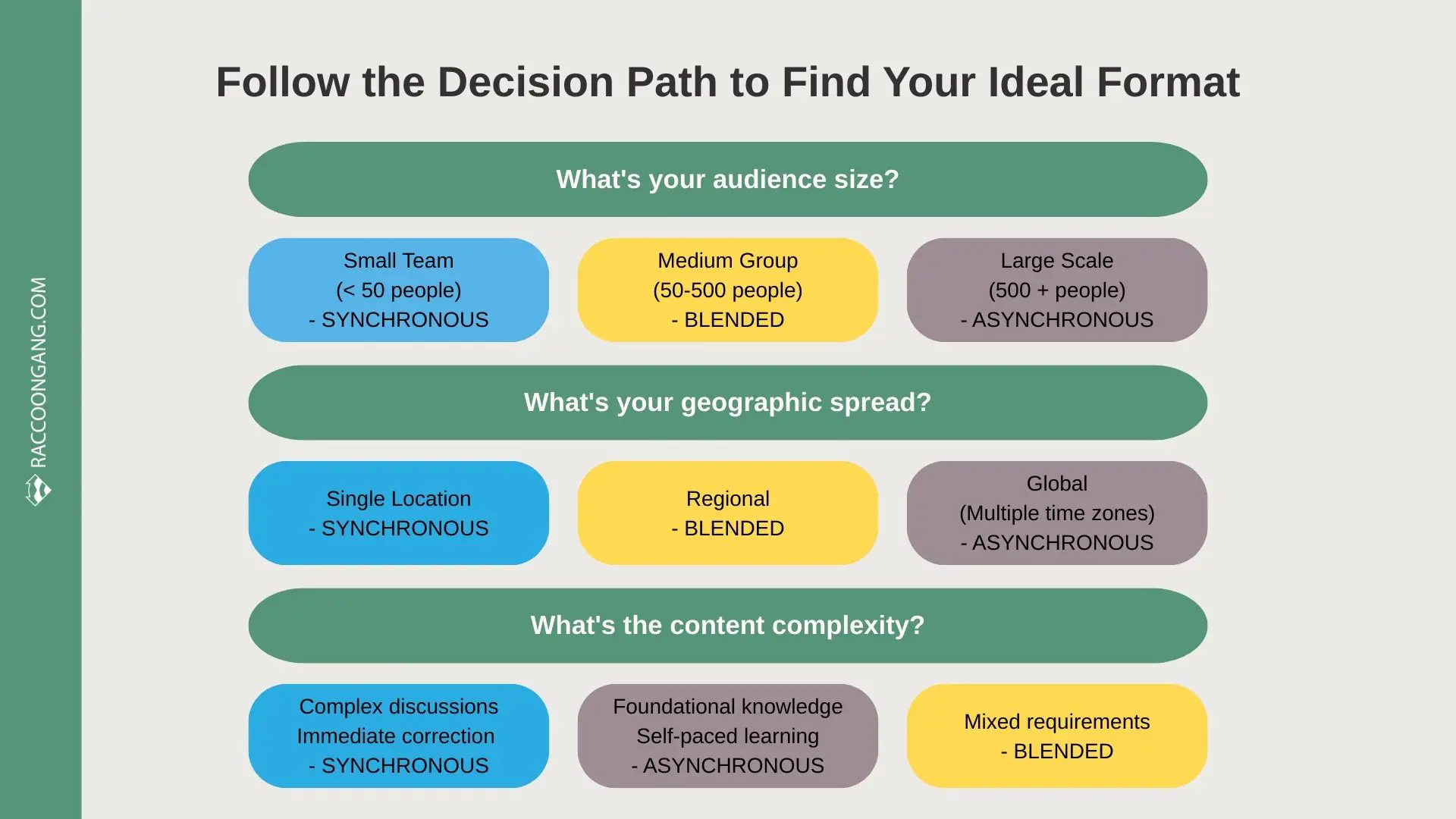
A quick filter to match your delivery mode to real constraints: headcount, time zones, and how much live guidance learners need.
Which Model Is Right for You?
Higher Education
Universities typically need both synchronous and asynchronous formats working together. Large intro courses (100+ students) work well with mostly recorded content plus optional live office hours. Core material reaches everyone while instructors save their time for students who need extra help.
Upper-level courses often flip this ratio with more live discussion, less recorded lecture, because advanced topics benefit from the real-time exchange of ideas that builds deeper understanding.
Corporate Training
Which format to choose for your corporate training? Geography and scale answer this question quickly. Training a small team in one place? Synchronous works. Training thousands across continents? You need asynchronous.
Synchronous makes sense for leadership programs requiring live coaching and practice, product launches where live Q&A builds momentum, and onboarding where connection matters as much as information.
Asynchronous handles foundational skills that don’t change, compliance training needing consistent delivery, reference materials people use repeatedly, and procedures updated frequently enough that recording beats scheduling.
Custom LMS delivered by Raccoon Gang specialists for Cybint shows corporate asynchronous learning at scale — 55,000 learners across multiple industries with customized training for each business vertical. Custom dashboards track risk factors, and automated course updates cascade across all customer sites.
K-12 Education
Younger learners need more structure, which typically translates to more synchronous time in the schedule. The appropriate balance shifts with student age and developing self-regulation skills:
- Elementary (K-5): Predominantly synchronous with short asynchronous activities. Young children need real-time structure and social connection that live classes provide.
- Middle School (6-8): Roughly 60% synchronous, 40% asynchronous as students develop more independence in learning.
- High School (9-12): Approaches college patterns. Advanced courses may favor asynchronous content for highly motivated students, while struggling students benefit from more synchronous support.
Teachers report that the flexibility accommodates diverse student needs without requiring them to develop multiple parallel instruction tracks. Our K–12 LMS solutions balance both formats appropriately for different age groups.
Decision Factors
When deciding between the formats, consider the following factors: audience self-direction, content complexity, geographic distribution, scale, budget, and urgency.
Most organizations adopt blended approaches. Start with an asynchronous foundation, add synchronous elements where they deliver value, and optimize based on engagement data.
Conclusion
Live learning accelerates understanding through immediate feedback. Self-paced learning accommodates different schedules and scales globally. Most organizations combine both to address different needs.
Raccoon Gang builds custom platforms that support synchronous and asynchronous learning within a single LMS. Our experience spans higher education, large-scale corporate training, and K–12 environments.