Most companies consider the benefits of Moodle LMS only through the prism of features. In fact, for organizations evaluating long-term learning infrastructure, the real advantages lie in architectural control, extensibility, cost predictability, governance flexibility, and data ownership.
Organizations still choose Moodle because it solves problems SaaS platforms were never designed for. A good example is long-term governance. Yes, in the first year you may not feel a noticeable financial difference. But in a couple of years, you will be glad you chose Moodle.
Moodle, as an open-source learning management system, gives you ownership and full control of the platform. You choose where it runs and how. More importantly, you select who will support it. If you choose to use a vendor’s services (for example, when you do not have an in-house technical team — since hosting and support still matter), you still are not tied to a specific vendor. Vendors may change; the platform remains yours.
Of course, different sectors may cite different Moodle benefits that matter most to them.
- Universities and schools use Moodle to control academic data and policies long term.
- Corporate training teams use it to fit internal systems and reporting without waiting on a vendor roadmap.
- Nonprofits and associations use LMSs based on Moodle to keep costs predictable and stay adaptable in situations when membership or funding changes.
But let’s not move too fast. Let’s look at this in order.
TL;DR
- The difference between Moodle LMS and distinct SaaS options is structural, not functional.
- Advantages of a learning management system, such as Moodle or another open-source platform, lie in operational control rather than surface features.
- Moodle LMS provides architectural control and deep customization through its open ecosystem.
- This flexibility reduces licensing barriers but increases internal governance and technical ownership.
- Over a 3–5 year horizon, the right choice depends on your organizational complexity and how much operational responsibility your team is prepared to carry.
What is Moodle LMS?
Moodle LMS is an open-source learning management system built around modularity and extensibility. It serves as the foundation of your learning infrastructure — not just a place to upload slides.
The Moodle learning management system, like any other LMS, can be used to create and manage online courses. That’s what all LMSs are designed for, right? But let’s try to look at the question ‘what is Moodle’ from the angle of a learning infrastructure layer.
Here’s where it gets interesting. If we answer the question ‘what is Moodle LMS’ from the organizational layer, the definition expands:
- It runs the structure.
- It defines roles and permissions.
- It controls certifications and compliance paths.
- It connects to HR and reporting systems.
- It scales across departments and regions.
For you, as a platform owner or administrator, this means that Moodle will connect to HR systems, compliance frameworks, certification logic, reporting structures, and access policies. So multi-department setups, regional requirements, and integration with internal systems can be managed within a unified governance structure.
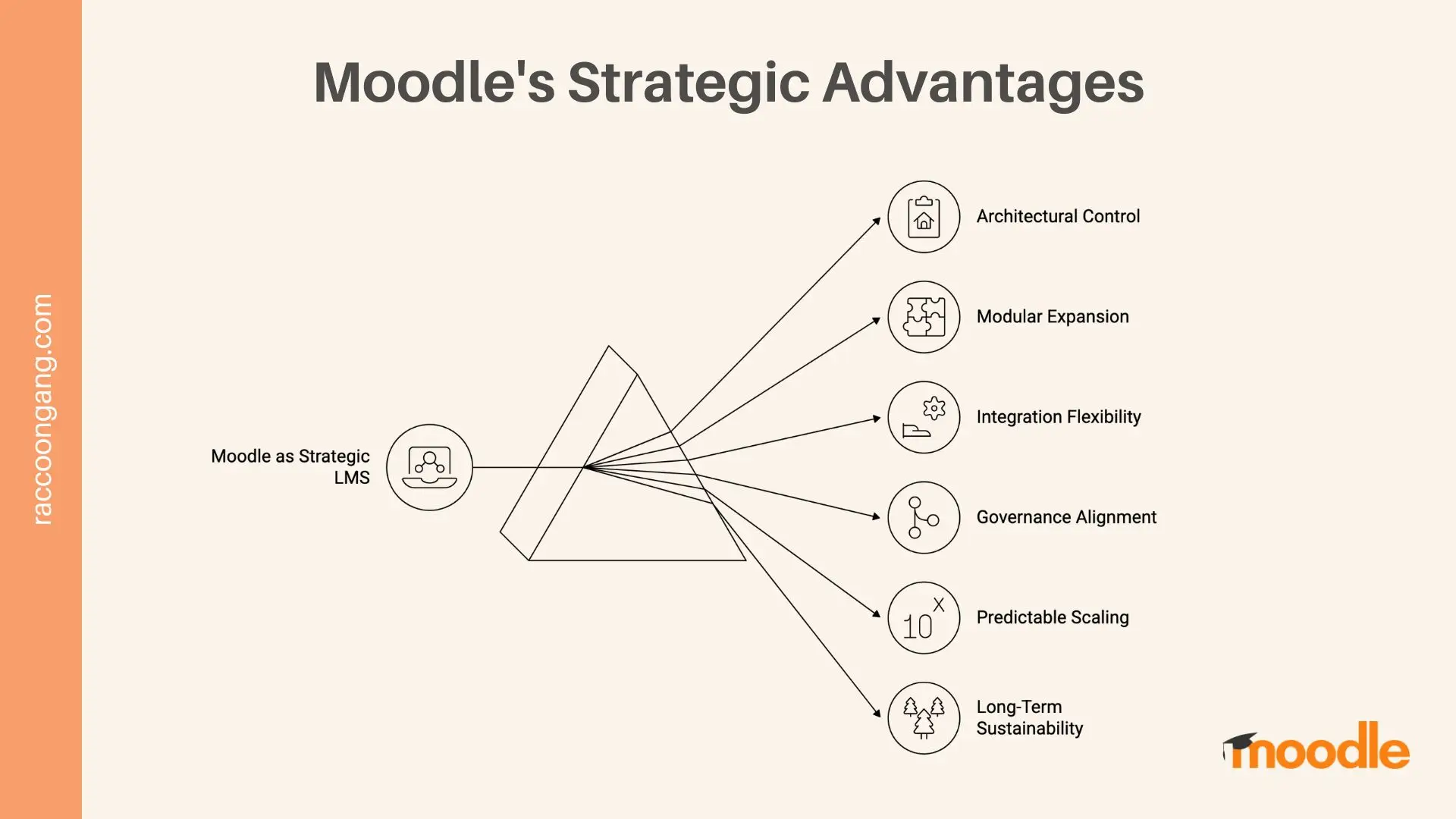
Moodle functions as an infrastructure layer within the organization — enabling governance alignment, integration depth, and controlled scalability beyond basic course delivery.
Moodle LMS Features and Architectural Capabilities
The vast majority of reviews of Moodle features reduce them to a simple catalog of buttons. But the reality is more complex. With over 10 years of experience implementing LMS platforms at various scales, we can confidently say that in real deployments, the functionality that removes manual work, reduces cross-team friction, and makes learning manageable at the organizational level is what truly matters.
So which Moodle LMS features will deliver real value in two or three years — and truly become the benefits of LMS in practice, not just options in the interface?
| Moodle LMS Feature | Operational Value | Strategic Implication |
| Course Management | Standardizes program structures, enrollment logic, and learning paths | Prevents fragmentation across faculties, departments, or business units as the organization scales |
| Activities & Assessments | Configures evaluations, conditional progression, and certification rules | Embeds quality assurance and compliance directly into the learning process |
| Grading & Feedback | Automates grading schemes and feedback workflows | Ensures consistent evaluation standards and defensible academic or training records |
| User Roles & Permissions | Applies granular access control across roles and hierarchies | Aligns the LMS with institutional governance, security policies, and data protection requirements |
| Reporting & Analytics | Provides structured insights into completion, performance, and engagement | Enables evidence-based decision-making and supports accreditation, audits, or executive oversight |
| Plugins & Integrations | Extends functionality and connects external systems | Preserves architectural flexibility and reduces long-term dependency on fixed vendor roadmaps |
Each feature should be something like an infrastructure mechanism that sustains institutional growth and operational control for your LMS.
Strategic Benefits of Moodle LMS
Instead of asking whether the Moodle learning system has advantages, organizations should ask: What capabilities will still matter in three years? From this angle, we prepared the list of the benefits of Moodle LMS below, framed through operational impact and sustainability.
1. User-Friendly Interface
When administrators, instructors, and learners see only what is relevant to them, it reduces cognitive load and onboarding time. Your organization will win because of more consistent user behavior across teams and business units.
Moodle uses role-based dashboards and structured navigation that lower initial friction. Operationally, in large universities or enterprises with thousands of users, this translates into lower helpdesk demand and faster, organization-wide platform adoption.
While Moodle’s default interface is functional, advanced UX optimization may require configuration adjustments or custom theme development.
2. Ease of Integration
Conventional wisdom tells us that integrations are where many LMS decisions become expensive later.
Moodle has a strong position here. It supports APIs, LTI, and SSO. It also supports extensibility through plugins and web services, including access tokens, server protocols, and core APIs that speed up connector development. That shortens the path to integrations with HRIS/CRM, video conferencing, proctoring, analytics tools, and content catalogs.
Ajman University described “seamless integration” with Banner SIS, Zoom, and ExamSoft after an upgrade, whereby the university achieved a 50% performance boost.
Strategically, integration maturity protects long-term TCO. It reduces the chance you will pay for replatforming later just to keep systems in sync.
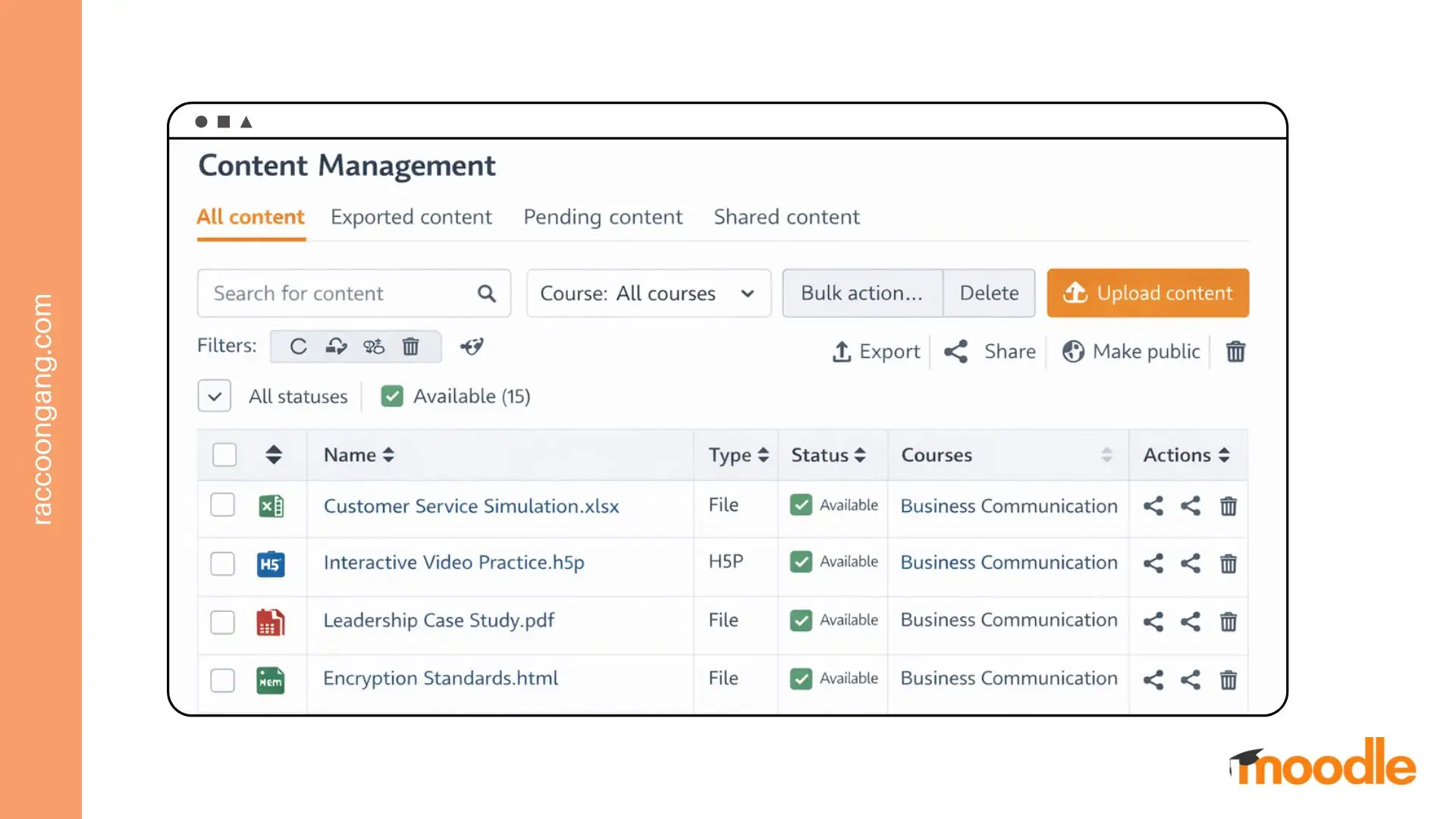
Centralized content governance in Moodle reduces duplication, prevents curriculum drift, and supports structured updates across departments and programs.
3. Content Management
Most companies perceive content management as something basic. That perception changes if we view it as the factor that determines whether your learning ecosystem scales cleanly or fragments over time.
Moodle structures content governance through centralized repositories and version-controlled course formats.
Your organization, if it chooses Moodle, will notice a reduced risk of curriculum drift across departments. All future updates to learning materials will be faster and require less employee time because there will be no need to rebuild courses from scratch each time.
“In large implementations, content fragmentation may become a real risk. Structured versioning and centralized updates prevent shadow courses from spreading across departments.”
— LMS implementation specialist.
If your institution should manage complex curricula, multi-program portfolios, or recurring certification cycles, Moodle’s content management features strike a chord with you.
4. Ease of Access
As long as you treat access as a simple UX detail, you will never get high participation rates.
From a business standpoint, Moodle LMS runs in the browser and works on mobile devices. That means learners can access training across regions, time zones, and different bandwidth conditions without special setup.
Operationally, remote employees, field staff, part-time students, and association members log in and start learning without extra technical barriers or local installations.
For hybrid or fully online models — where access equals adoption — Moodle represents a justified investment. In other words, access simplicity = lower operational overhead + cleaner scalability model.
5. Blended Learning Features
When organizations try to combine classroom sessions with digital coursework, they risk facing fragmented tracking and inconsistent completion records. Moodle combines online modules with in-person sessions, attendance tracking, and activity sequencing. In this scenario, all blended learning needs sit in one system.
Operationally, this reduces:
- duplicate tracking systems
- spreadsheet-based attendance control
- compliance documentation gaps
- manual certification updates
Moodle-based platforms perform well in higher education and professional training environments.
6. Assessment and Testing
To avoid burdening teachers and trainers with manual testing—because this method only works when there are no more than 10 students — Moodle allows you to standardize scoring, set prerequisites, and define pass/fail logic tied to specific outcomes.
With Moodle, your organization can automate validation and reduce errors and bias in grading. Moodle LMS supports: configurable quizzes, assignments, question banks, and competency frameworks.
In regulated environments, where you must clearly prove who completed training, when it happened, and under which requirements, these features matter most.
7. Reporting and Tracking
The reporting and tracking features that Moodle offers reinforce the previous point about assessment, especially in regulated environments.
Custom reports and completion tracking are most valuable where executive reporting, accreditation, or regulatory review depends on structured evidence.
More broadly, for any business, these features function as operational control panels — providing visibility into performance, participation, and compliance at scale.
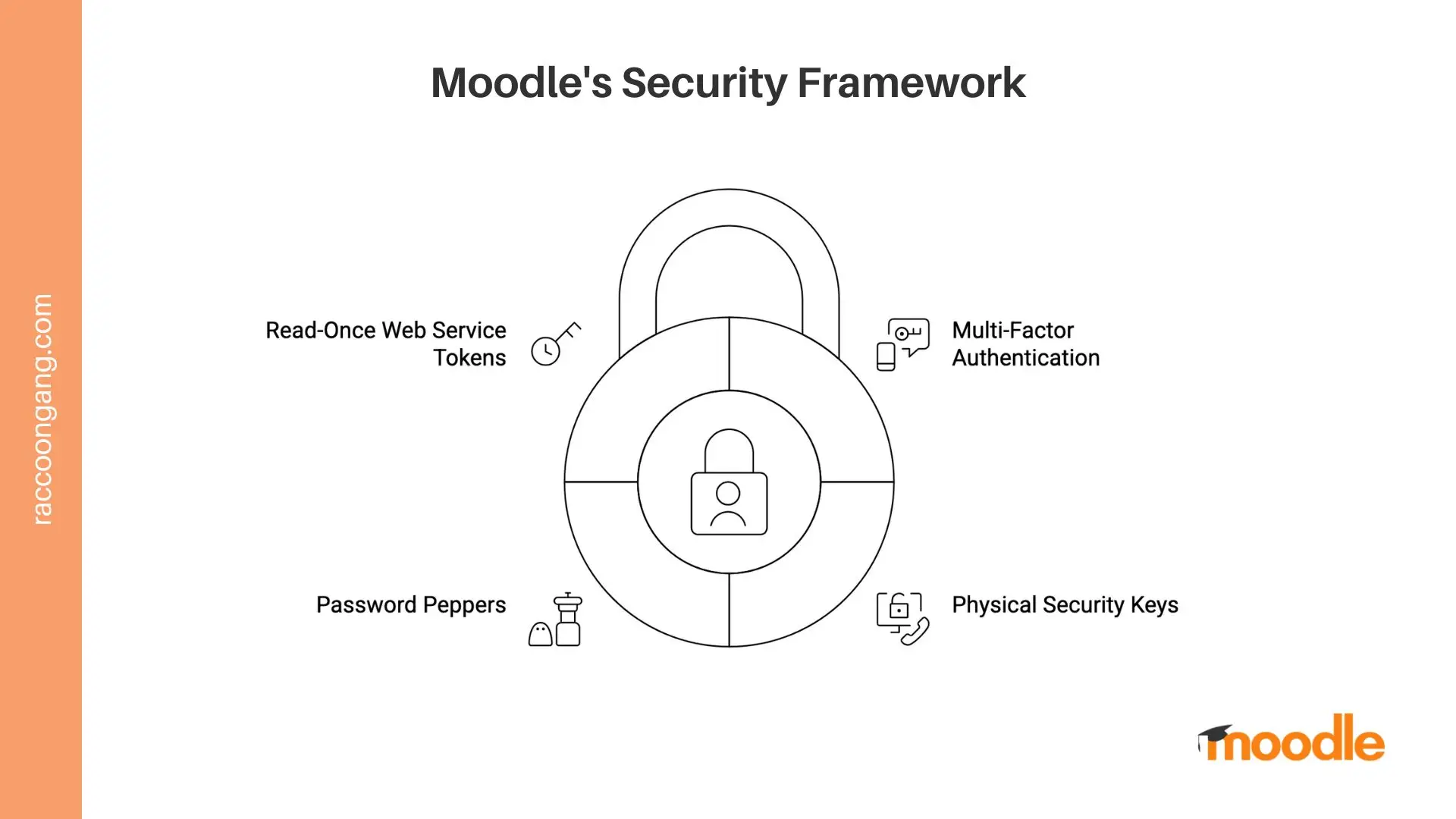
Moodle’s layered security model combines authentication controls, token governance, and access management to align with institutional data protection and audit requirements.
8. Security
The Moodle platform already includes granular roles, layered permissions, and deployment control. As an LMS owner, you can manage permissions to view, edit, approve, export, or administer data. By working within the roles and permissions that you configure for your organization, you significantly increase overall control and platform security.
Moodle allows you to configure the system in line with internal security standards and audit requirements, which is a necessity in regulated sectors — government, healthcare, and finance.
To summarize, we can say one thing: Moodle’s security features reduce unauthorized access and limit data exposure.
9. E-commerce Functionality
The e-commerce features of the Moodle platform are revealed in all their glory through payment gateways and enrollment automation. Built-in options and plugins are thoughtful functionality for configuring paid course access, subscription models, and automated enrollment workflows.
It reduces manual enrollment handling and shortens the path from payment to course access. Your organization can monetize training programs without relying on separate platforms.
10. More Than 500 Plugins
Moodle’s ecosystem was built for controlled expansion. Its modular architecture includes more than 500 plugins. That gives you room to grow.
You can adapt the learning management system to new regulatory rules, instructional models, or business demands without replacing the core platform.
Operationally, plugins reduce development time. If a mature extension already exists, you do not need to build functionality from scratch. Proctoring tools. Analytics modules. Content formats. Integrations. All can extend your LMS benefits without new licensing layers — though governance and maintenance still require attention.
Moodle as a Learning Management System Strategy
When evaluating Moodle, think beyond features. If we are talking not only about Moodle but about an LMS in general, then regardless of the platform you choose, treat it as the future learning infrastructure — not just software.
At a strategic level, four factors matter:
1. Platform control
Moodle gives you architectural ownership. From hosting to integrations, your specialists can control the environment.
The price of that flexibility, especially in a long-term strategy, is the need for clear internal governance.
2. Blended delivery
Moodle is ready to support blended learning initiatives. However, no LMS creates impact on its own. Everything depends on how well your structure and processes are defined.
3. Program scalability
As organizations grow, learning changes from isolated courses to structured programs. Moodle can support this transition — if the architecture reflects organizational complexity, of course.
4. Continuous learning
A learning management system should enable recurring certifications, learning paths, and visibility into performance. Moodle provides these capabilities when properly configured.
Implementation Defines the Outcome
The platform itself does not determine success. Architecture planning, governance design, and disciplined implementation do.
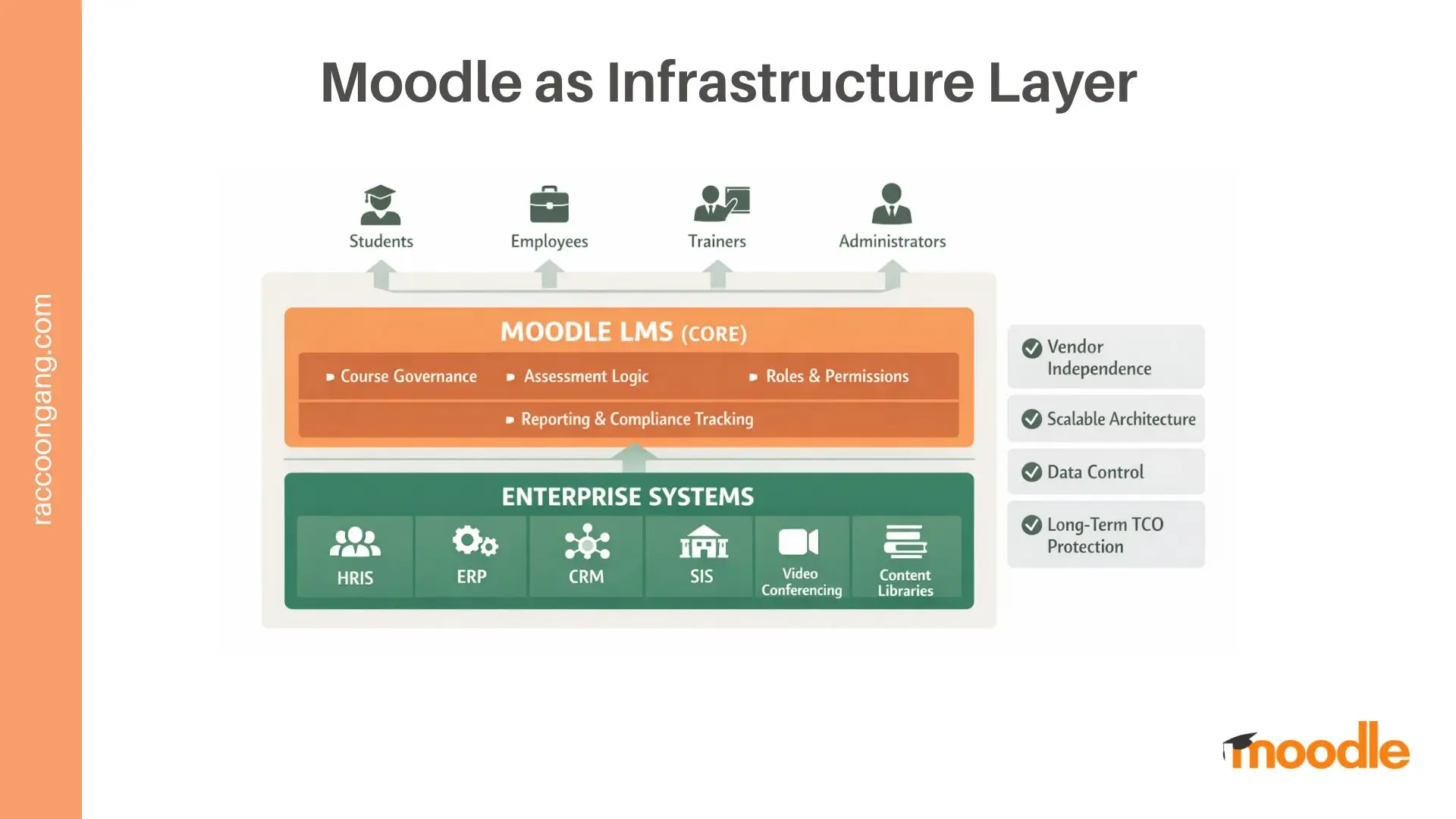
Moodle operates between users and enterprise systems, enforcing governance rules, compliance tracking, and integration consistency across the organization.
How to Choose the Best LMS — and Implement It Strategically
As you should have understood by now, the main point we have tried to convey in this article is this: selecting an LMS is not a feature comparison exercise—it is an infrastructure decision. When making that decision, it is better to rely on a solid foundation than to risk the investment.
- Define governance first.
- Align the LMS with your operating model.
- Treat integrations as cost drivers.
- Stress-test scalability early.
- View customization as architecture.
Let’s be honest — experience matters in implementation. Raccoon Gang has been supporting organizations with LMS platforms in general, and Moodle in particular, through setup, customization, integrations, and migrations for over 10 years. Our team of Moodle specialists is ready to support you.
Conclusion
An LMS decision rarely fails because of missing features. It fails because the organization underestimated what the platform would eventually need to carry. Moodle is no exception. However, its existing capabilities can help you avoid unnecessary costs later — when you face:
- User growth.
- Regulatory pressure.
- New business models.
- Stronger reporting demands.
The final point is simple: Moodle rewards planning.
- The real question is not whether Moodle has advantages.
- The question is whether your organization is ready to treat the LMS as infrastructure.
FAQ
What are the benefits of Moodle LMS?
The benefits of Moodle LMS become clear under growth and regulation. It supports architectural control, deep integrations, and configurable governance. As programs expand or compliance tightens, it reduces replatforming risk and protects long-term stability.
What is Moodle LMS used for?
Organizations use Moodle LMS to structure and manage learning at scale. Universities run curricula and blended delivery. Enterprises handle onboarding and certification. Associations manage member education and paid programs.
What are the advantages of Moodle over other LMS platforms?
The advantages over many SaaS LMS platforms come down to control. You define integrations, governance rules, and expansion paths. The system adapts as the organization evolves.
Is Moodle a free learning management system?
No license fee for the core software. That part is straightforward. But implementation costs. Hosting costs. Integrations and maintenance cost. Total investment depends on scale and on how complex your governance model becomes.
Who should use Moodle LMS?
Choose Moodle if you treat the LMS as infrastructure, not as a tool. It serves institutions with layered governance. It supports regulated environments. It scales for enterprises that expect growth and cannot afford vendor lock-in.