









Here’s what constructivist learning theory argues: knowledge isn’t something you hand over. People construct understanding. They do it by solving problems, reflecting on the process, and getting their hands dirty with experience.
Education and corporate training face a persistent problem: methods optimized for information delivery don’t create practical capability. Learners pass tests on concepts they can’t apply and complete training that changes nothing about how they work.
Education has been shifting this way, and so has corporate training and eLearning. LMS and LXP platforms now build in discussion forums, simulations, peer assessment — basically, tools that get learners actively involved instead of just sitting there absorbing content.
Let’s explore what this means in practical terms.
TL;DR
- Constructivism provides the basis for active learning that centers on what students need and what they experience.
- The basic principle is pretty simple — understanding develops when people do things rather than when they hear about them.
- Knowledge gets built through solving actual problems, thinking about the process afterward, and working on challenges that matter. Lectures and reading materials? They don’t produce the same quality of learning.
Constructivist Learning Theory Definition
Knowledge develops when learners integrate new information with prior experience through activity. Understanding emerges from wrestling with problems, testing hypotheses, and reflecting on outcomes.
What Is Constructivist Learning? (Plain Explanation)
Constructivist learning is a model where students construct their own understanding through experience. This looks quite different from traditional lecture-based learning.
Traditional classrooms operate in a familiar pattern: the teacher stands at the front, presenting information, and students sit and take notes. Homework follows to reinforce the lesson, and tests come next to check retention. The syllabus controls what gets taught and the order in which it happens.
Constructivist learning changes this dynamic completely. Problems come first, before any formal instruction. The instructor moves around the classroom asking questions, helping students find resources rather than delivering answers. Students experiment with different solutions, talk through ideas with classmates, and reflect on their progress.
This process centers on three elements:
- Active participation. Students don’t watch someone solve problems from the front of the room. They solve problems themselves, which means writing code that breaks and then debugging it in a programming class, or analyzing actual financial data in an accounting course. The cognitive work happens in the student’s mind, not just the instructor’s.
- Reflection. Students solve a problem (or don’t — failure is part of this) and afterwards think back through their approach. What helped them make progress? What sent them down the wrong path? Where exactly did their thinking break? If they faced something similar next week, what would they change? That reflection piece is crucial. Skip it, and it’s just one isolated task. Include it, and they’re learning something reusable.
- Context and problem-solving. Learning happens when scenarios feel like actual professional work. Traditional approaches ask what students should know. Constructivist approaches ask something different — what should students be able to do? And then, what knowledge do they need to build to get there?
To sum up, content-first models ask what students should know. Constructivist models, in turn, ask what students should be able to do and what knowledge they need to construct to do it well.
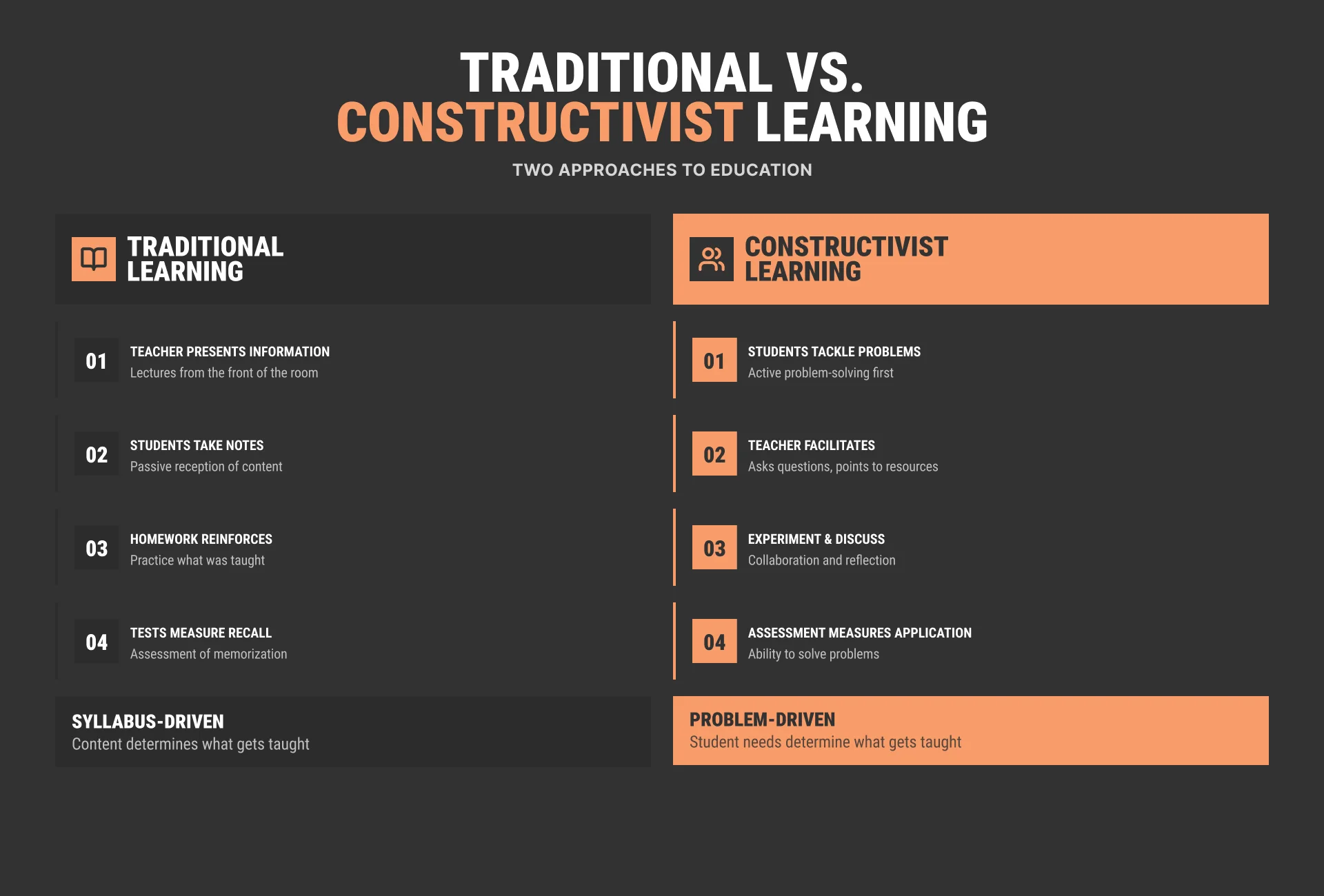
Traditional learning focuses on information transfer, while constructivist learning develops applied skills through problem-solving and collaboration.
Origins of Constructivist Theory
Constructivist theory has its roots in research from the 1900s, particularly from two researchers who approached learning from different angles.
Jean Piaget studied child development for decades. His big insight was that children don’t learn by being told, but they learn by doing. For instance, a child figures out that objects fall not from a lecture about gravity but from dropping their spoon off the high chair multiple times.
Lev Vygotsky focused on something Piaget’s work didn’t emphasize enough — the social dimension. According to Vygotsky, we don’t build knowledge alone. Learning happens through interaction with other people. For example, children learn language through conversation, and students learn by discussing ideas with classmates who have different perspectives. Therefore, knowledge construction is a social process, not just an individual one.
Today’s constructivist theory recognizes that learning involves both. You need personal engagement with material, and you need interaction with others who challenge your thinking.
A word on terminology: both “constructivist theory” and “constructivism theory” mean the same thing. Constructivism is the overall philosophy — the idea that learning happens through active construction. Constructivist is the adjective you use to describe things related to that philosophy.
Principles of Constructivism
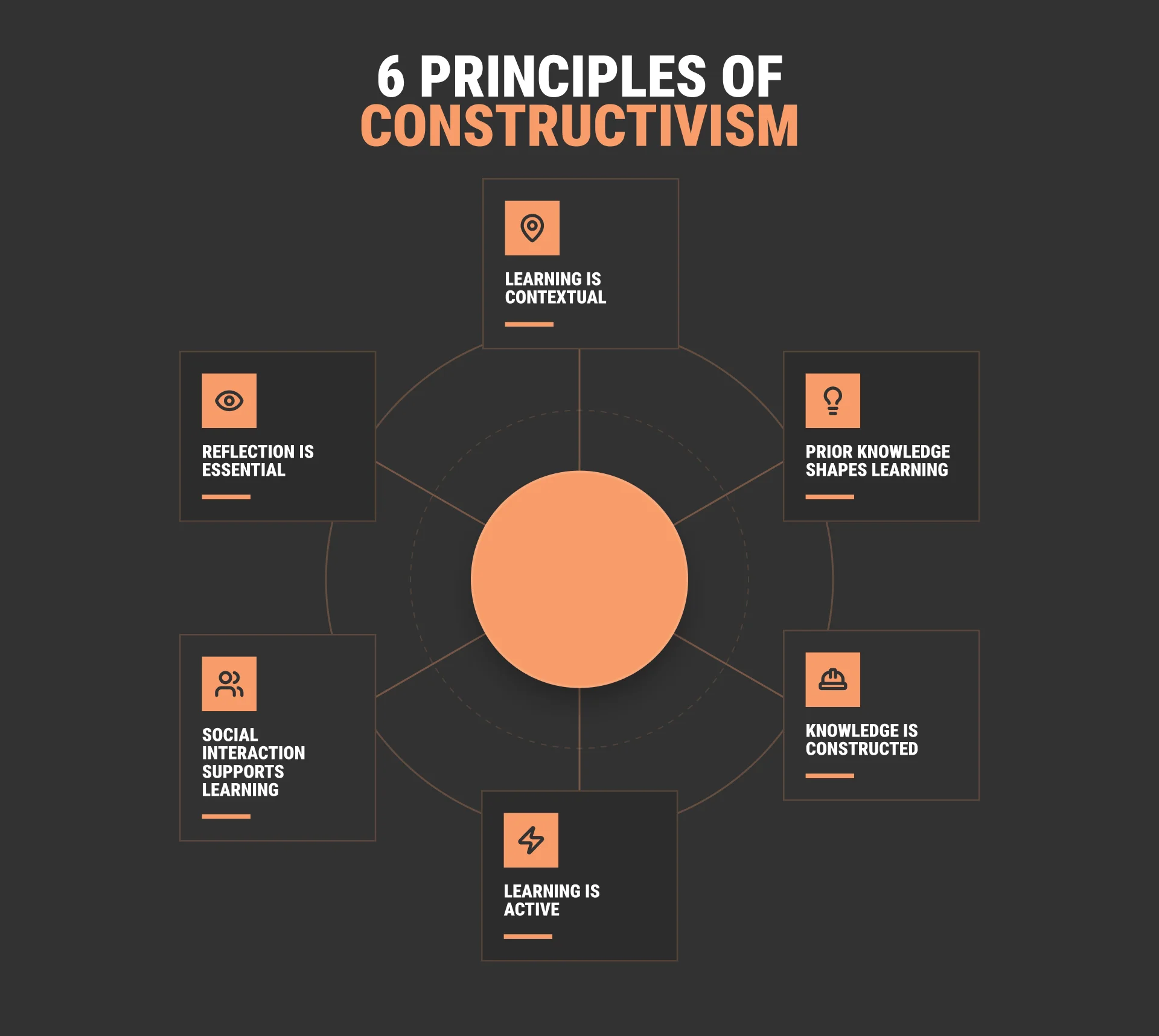
Constructivist principles help explain a familiar frustration: courses that look great on paper but don’t produce capable learners. Six principles with examples reveal what creates effective learning.
Principle 1: Active learning creates lasting skills
Evidence: Cybersecurity students who identify actual phishing attempts develop better threat detection than those who watch videos about phishing. Passive observation doesn’t build the neural pathways that active problem-solving creates.
Principle 2: Knowledge construction is individual
Evidence: Two people reading the same case study construct different insights — for instance, the marketer sees branding issues, the accountant sees financial mismanagement. Everyone filters new information through existing knowledge.
Principle 3: Prior knowledge determines what learners can absorb
Evidence: Teaching Agile to Waterfall-experienced project managers requires addressing their existing frameworks. Learners can’t integrate new concepts that contradict everything they know without explicit connections.
Principle 4: Context determines where knowledge transfers
Evidence: Leadership principles taught through workplace scenarios transfer to workplace decisions. Abstract instruction stays abstract, since the brain stores and retrieves knowledge in context.
Principle 5: Reflection converts experience into understanding
Evidence: Military instruction includes mandatory after-action reviews because combat experience alone doesn’t create transferable tactical knowledge. Structured reflection transforms events into principles.
Principle 6: Social interaction accelerates construction
Evidence: Code reviews develop programming skills better than solo practice because explaining your approach and evaluating others’ code forces knowledge construction that isolated work leaves incomplete.
Social Constructivist Learning Theory
As mentioned before, constructivism focuses on how individuals build knowledge. Social constructivist learning theory focuses on how groups build it together and argues that the social version creates understanding that individual construction can’t match.
Here’s why: working alone keeps your thinking private. Working with others forces you to verbalize it. You explain your approach and catch your own logical gaps mid-sentence. Someone challenges you, and you have to defend your reasoning or revise it. Another person sees what you missed. This back-and-forth builds understanding that solo work can’t replicate.
This plays out in several settings:
- Group projects work when collaboration is genuine. For instance, architecture students designing a building debate approaches, challenge calculations, and construct a shared understanding of design principles. Their collective knowledge exceeds what any individual could develop.
- Communities of practice rely on social construction. Software developers, for example, discuss architecture and construct collective frameworks through conversation — one shares an approach, another identifies tradeoffs, a third suggests modifications. The group develops shared expertise through dialogue.
- Discussion forums in LMS and LXP platforms enable asynchronous construction. Take business students who post analyses, challenge assumptions, and build on insights. Understanding develops through collective dialogue rather than individual heads.
Raccoon Gang developed a learning experience platform for a global network of higher education institutions serving 60,000+ students. The platform works through social learning and community-driven mechanics. Learners do peer feedback with each other — they create groups based on shared interests and build courses for fellow learners. Based on user interests and what people have achieved, the system creates personalized learning paths. Collaborative knowledge construction happens through discussion forums and peer assessment that are integrated throughout.
Constructivist Learning Theory in Practice
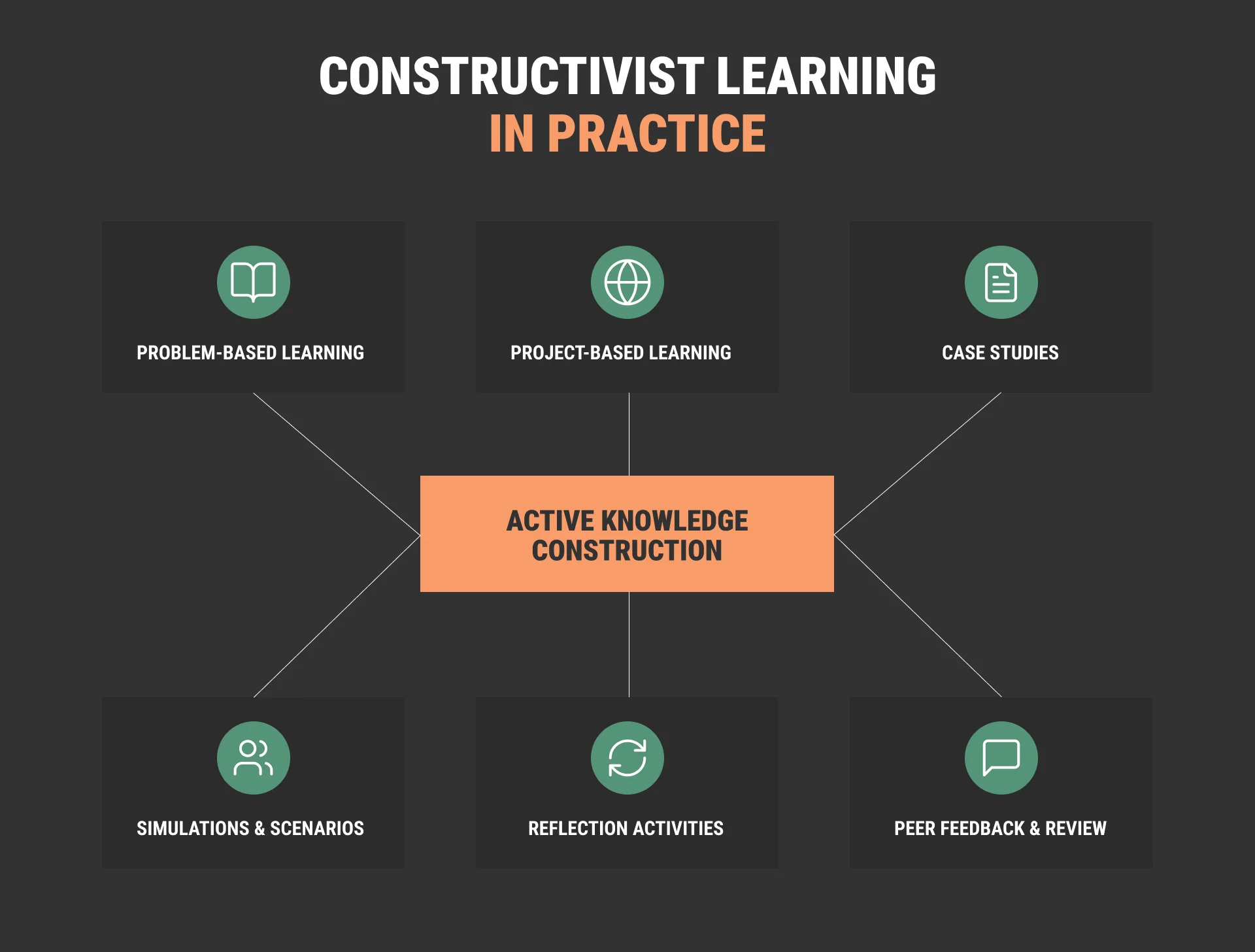
When constructivism learning theory moves into practice, it creates several methods that all make learners actively build knowledge.
- Problem-based learning inverts traditional sequencing by presenting authentic challenges before instruction. For instance, medical schools give patient cases before lectures, corporations use realistic scenarios for new hires, and online platforms require solution construction before providing resources.
- Project-based learning involves creating real deliverables with actual constraints. Architecture students design genuine buildings with real budgets, corporate training assigns real projects, and online MBA programs require market strategies for actual companies.
- Case studies construct understanding through analysis and debate. Business students examining company failures develop strategic frameworks through discussion, corporate leaders analyze organizational challenges in groups, and online learners debate cases asynchronously across diverse perspectives.
- Simulations provide realistic practice without consequences. Pilots use flight simulators, customer service representatives role-play difficult interactions, and online nursing students work with virtual patients responding to their decisions.
- Reflection activities extract transferable principles from experience. Teacher candidates journal about classroom experiences, salespeople analyze deal outcomes, and online learners reflect on concept application to their work.
- Peer feedback develops skills bidirectionally through evaluation. Students workshop writing, developers review code, and online learners provide structured critique through forums.
Constructivist learning theory unites these methods: knowledge develops through active construction, whether in universities, corporations, or online environments.
Constructivism and eLearning Design
E-Learning has evolved considerably as designers figured out how to apply constructivist principles in digital environments.
- Learner control creates ownership. Good eLearning doesn’t force everyone down identical paths. Learners choose which case studies interest them, select projects relevant to their work, and decide whether to dive deep into foundation content or skip to application. This choice matters because learners construct knowledge based on their existing understanding and immediate needs.
- Interactive elements force engagement. You can’t construct knowledge by watching videos passively. Effective eLearning includes simulations where your decisions play out, branching scenarios that respond to your choices, and activities that require you to manipulate concepts and solve problems. The interaction creates construction.
- Authentic scenarios provide context. Learning abstract principles in isolation doesn’t transfer well. Constructivist eLearning situates concepts in realistic contexts. Marketing courses analyze real campaigns. Finance courses work with actual company data. Leadership development uses genuine organizational challenges. The realistic context helps learners build understanding they can actually apply.
- Social features enable collaborative construction. Discussion forums let learners debate interpretations and challenge each other’s thinking. Peer review has learners evaluate each other’s work using explicit criteria. Group projects require collaboration and negotiation. These social elements offer a lot of meaningful construction.
- Platforms support constructivist design. Modern LMS and LXP systems include features for constructivist learning. Open edX® platform, for instance, has robust discussion forums for ongoing peer dialogue, cohort functionality that creates learning communities, peer assessment tools where learners evaluate each other’s projects, and supports substantial project-based assignments.
Our work with the International Center on Nonviolent Conflict demonstrates how these platform features are applied in practice. Raccoon Gang created a custom Open edX platform featuring peer-to-peer assignments, interactive discussion forums, and mobile apps that are offline-capable. Learners from over 100 countries collaborate asynchronously, engaging in structured peer dialogue to construct an understanding of nonviolent conflict strategies through community interaction.
Benefits and Limitations of Constructivist Learning Theory
Like any learning model, constructivism brings measurable strengths and real limitations. Let’s examine both sides.
Benefits
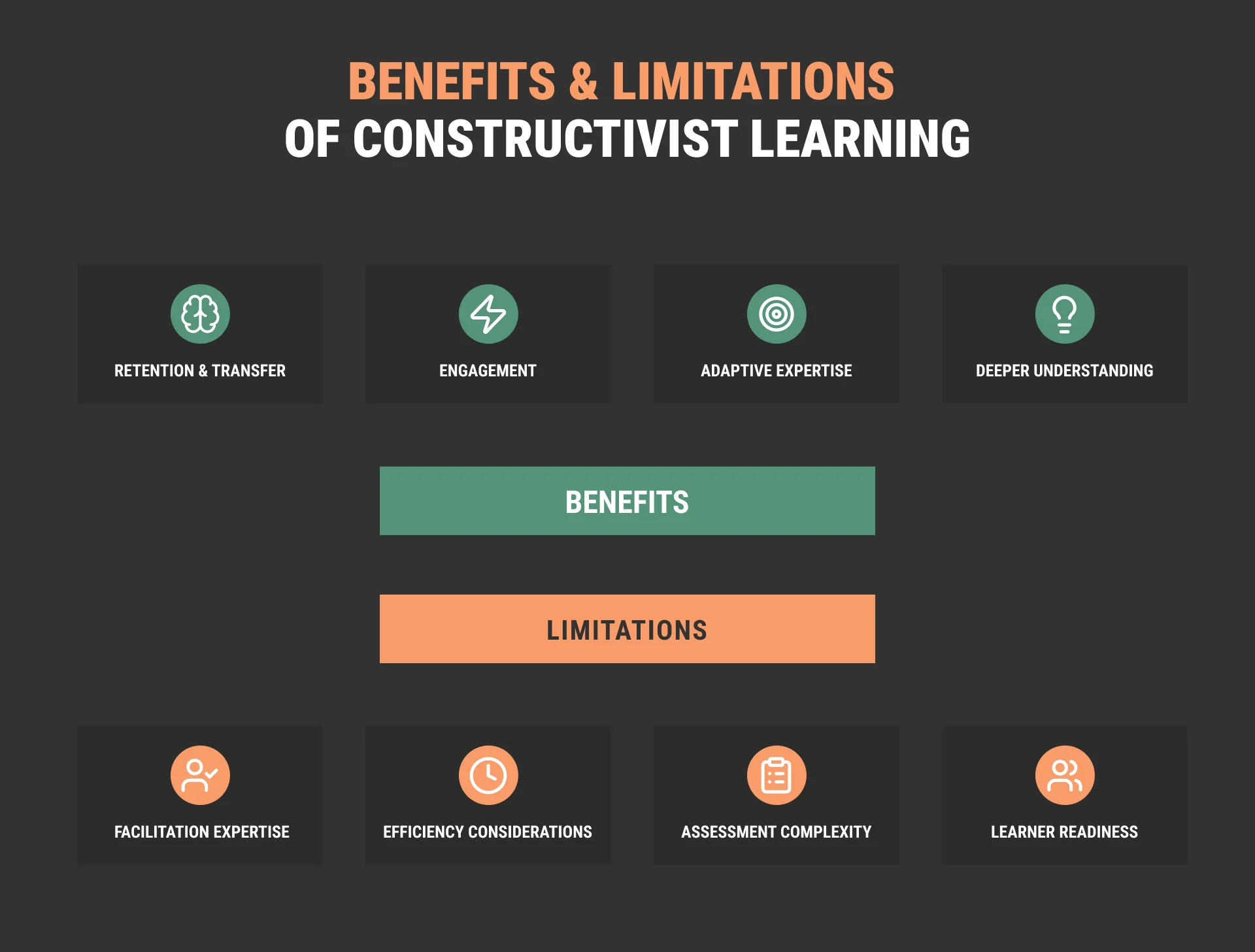
Organizations that commit to constructivist approaches see consistent gains in three areas.
- Deeper understanding emerges. When learners construct knowledge rather than absorb it, they develop understanding that includes the why behind the what. They can explain concepts to others, recognize when standard approaches won’t work, and adapt their knowledge to novel situations. This depth comes from the construction process itself.
- Engagement stays higher. Active problem-solving maintains focus better than passive content consumption. Learners working through authentic challenges, seeing consequences of their decisions, and dealing with realistic complexity stay engaged longer than those clicking through information modules.
- Transfer improves significantly. Knowledge constructed through realistic problems transfers more reliably to actual work. If you learned project management by navigating real project challenges with actual constraints, you’re better prepared for real projects than if you learned through abstract principles and simplified case studies.
Limitations
Constructivist approaches aren’t perfect for every situation. Here are the practical constraints worth considering.
- Requires skilled facilitation. Effective constructivist instruction demands expertise beyond subject matter knowledge. Designing good problems, facilitating productive discussions, and knowing when to intervene takes skill that many instructors haven’t developed.
- Not ideal for all learning objectives. Some objectives need speed and standardization rather than depth. Safety procedures, compliance requirements, and basic operational steps often work better with direct instruction.
- More complex to design. Constructivist learning experiences require more upfront work than traditional instruction. Creating authentic problems, developing simulations, and designing effective assessments takes substantial time and effort.
The key is matching the method to objectives. Constructivist theory works well for building judgment and adaptive expertise. Other approaches work better when standardization and efficiency are priorities.
Conclusion
The interesting thing about constructivist learning theory is how it reframes what we consider a successful learning program. Organizations often measure success through completion rates and test scores, but those metrics tell us remarkably little about whether people can actually apply what they’ve learned when it matters. The real measure is whether learning creates capability that shows up in performance.
This shift in thinking, from measuring consumption to measuring construction, requires rethinking how we design learning experiences. It’s not about adding complexity for its own sake, but about aligning instructional methods with how people actually develop expertise. The challenge is determining where this investment makes sense for your specific objectives and constraints.
FAQ
What is constructivist learning theory?
What are the main principles of constructivism?
How is constructivist learning different from traditional learning?
What is social constructivist learning theory?
Is constructivist learning suitable for eLearning?




- TL;DR
- Constructivist Learning Theory Definition
- What Is Constructivist Learning? (Plain Explanation)
- Origins of Constructivist Theory
-
Principles of Constructivism
- Principle 1: Active learning creates lasting skills
- Principle 2: Knowledge construction is individual
- Principle 3: Prior knowledge determines what learners can absorb
- Principle 4: Context determines where knowledge transfers
- Principle 5: Reflection converts experience into understanding
- Principle 6: Social interaction accelerates construction
- Social Constructivist Learning Theory
- Constructivist Learning Theory in Practice
- Constructivism and eLearning Design
- Benefits and Limitations of Constructivist Learning Theory
- Conclusion