








Quite often, hybrid learning vs blended learning sounds like a terminology debate. Then the team has to turn a course, unit, or training program into a real learning experience. That’s where many organizations stop trusting the neat definitions and start asking a more practical question: do we actually need a blended model, a hybrid model, or something in between?
In our work with learning platforms and course design, the right choice usually comes down to operations. Who participates, and from where? Do learners join at the same time? Can they choose the format? How will assessment work inside the LMS? We’ve seen teams define a program one way, then redesign parts of it weeks later because delivery reality pushed back.
So let’s move past the definitions. Our main purpose is to find out how both models work in real courses and what each one demands from an LMS, from teams, and from learners of the course.
TL;DR
- Hybrid learning focuses on audience format: some learners join in person, others online.
- Blended learning focuses on course format: learners move through online and offline steps according to a pre-planned scenario.
- Hybrid is ideal when learners are scattered across different locations or time zones, but you need the training to continue uninterrupted.
- Blended is ideal for complex skill-building where learners review theory online at their own pace, then come to a physical classroom to practice.
- Choose by learners, instructors, and LMS readiness, not by the model name.
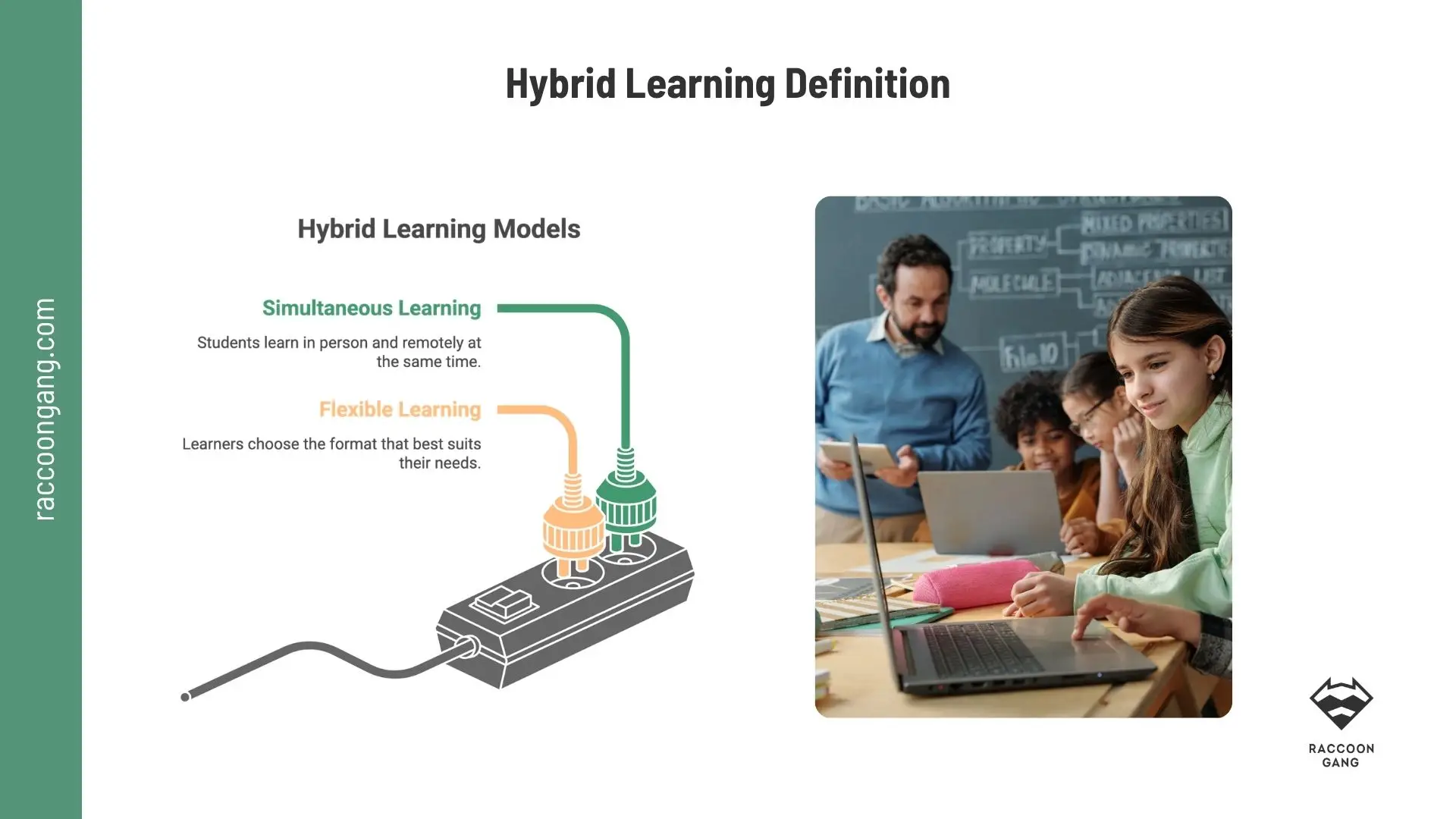
Hybrid learning connects online and in-person learners during the same session.
What Is Hybrid Learning in Digital Education?
The Hybrid Learning Definition is no longer limited to “some online, some offline.” Today, it usually means that part of the group learns in person while another part joins remotely at the same time. In some programs, learners can also choose the format that fits their situation.
- The main point is simple: one learning event, different locations.
That seems convenient. In practice, it changes the whole setup. Instructors have to work with two audiences at once. The LMS needs to support live session links, reminders, attendance, recordings, and follow-up communication.
Hybrid learning often works well when schools face safety, staffing, or logistics issues. It also fits organizations with distributed teams, expensive travel, expert-led sessions, client workshops, or cross-region training.
We’ve seen teams plan a “simple hybrid session” and then realize the content was the easy part. The harder part was making sure remote and in-room learners could actually participate on equal terms.
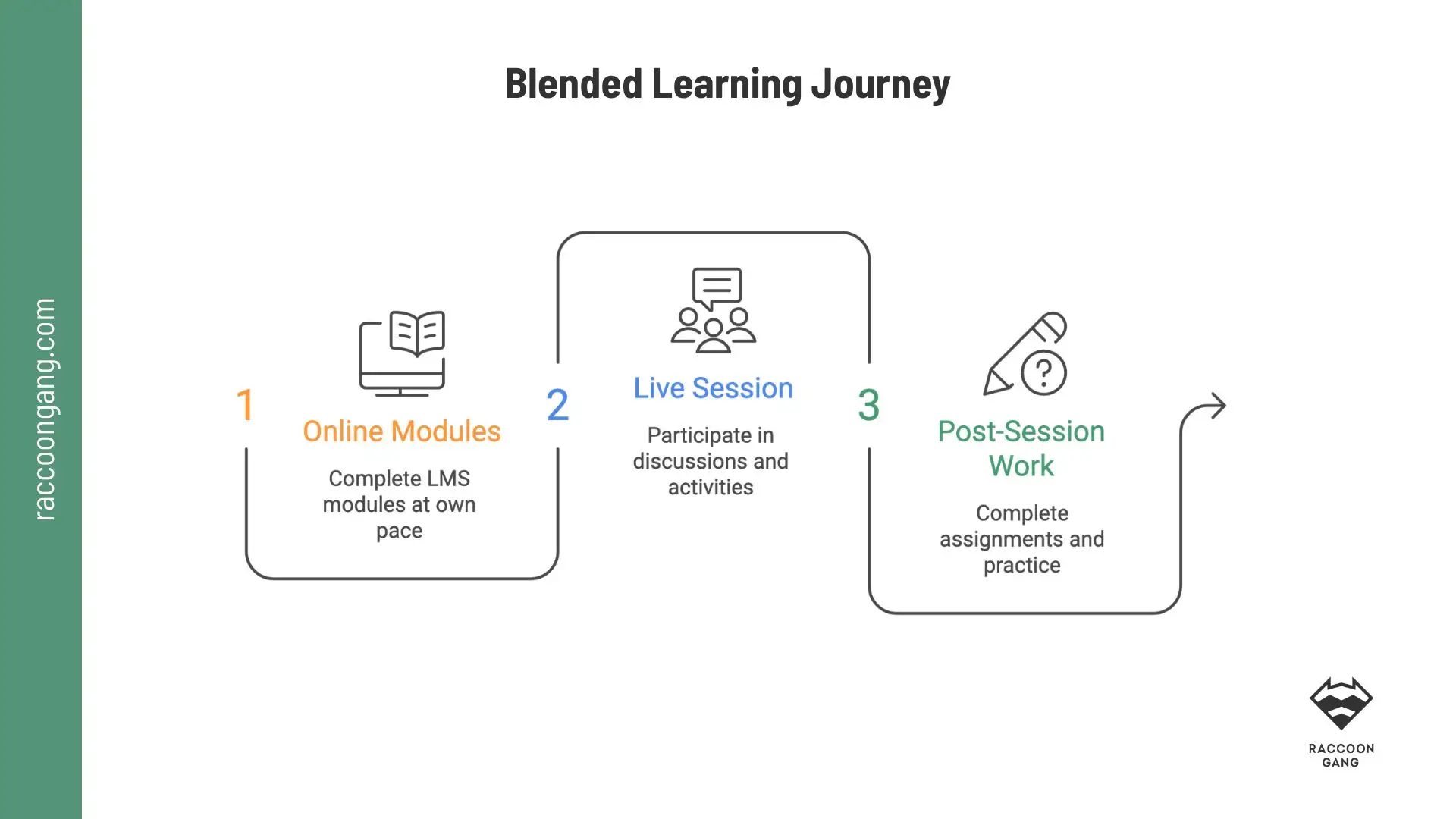
Blended learning combines self-paced LMS study with live practice and follow-up.
What Is Blended Learning in Digital Education?
The Blended Learning Definition describes a planned mix of in-person and online activities within one course or program. Learners move through different formats as part of a structured path. They might complete LMS modules before a workshop, join discussions during a live session, and continue with assignments or practice afterward.
- The main point is design, not location.
Research has repeatedly shown strong results for this model. A large meta-analysis prepared for the U.S. Department of Education found that blended approaches performed better on average than classroom-only learning. Later studies in teacher training reached a similar conclusion.
For schools, the blended classroom approach works well when there is a necessity for stability, differentiated learning paths, learning recovery, and structured LMS workflows for K-12.
For organizations, blended learning will be a great choice for onboarding, compliance training, product enablement, and large-scale reskilling programs.
“Teachers need the important skills of collaboration, peer-learning, critical thinking and digital-physical blending.”
— Anir Chowdhury
Hybrid vs Blended Learning: The Key Difference Most Teams Miss
To compare blended and hybrid, we would recommend starting with the in-person vs online learning perspective. Will everyone attend the same session? Or will some learners join online while others sit in the room? That answer will influence the LMS setup directly.
| Area | Hybrid Learning | Blended Learning |
| Core idea | Learners join the same session from different locations. | Learners move through online and offline learning activities in one planned sequence. |
| Main question | “How do we support remote and in-room learners at the same time?” | “What should learners do online, in class, and after the session?” |
| Learner location | Mixed: some learners attend on-site, others join online. | Usually the same group uses both formats at different stages. |
| Timing | Often synchronous. Everyone may participate at once. | Often combines asynchronous LMS work with scheduled live sessions. |
| LMS role | Supports access, reminders, live links, attendance, recordings, and communication. | Structures learning paths, modules, prerequisites, assessments, and progress tracking. |
| Teaching approach | Relies on hybrid teaching methods that keep remote and in-room learners involved. | Relies on blended instruction, where each activity has a clear purpose. |
| Instructor workload | Higher during live delivery because the instructor manages two audiences. | Higher during course design because each activity must connect to the next one. |
| Biggest risk | Remote learners become observers instead of participants. | Online tasks feel like extra homework instead of part of the course. |
| Best fit | Distributed teams, safety limits, travel constraints, expert sessions, cross-region workshops. | Onboarding, compliance, product training, learning recovery, reskilling, and structured programs. |
| Success depends on | Facilitation, classroom tech, live engagement, and equal access. | Instructional design, sequencing, LMS workflows, and assessment alignment. |
* For blended learning, the LMS has to connect the pieces. That’s where technology in blended learning becomes practical: pre-work, workshop tasks, quizzes, and follow-up assignments should appear in the right order.
When Hybrid Learning Works Best
As we have mentioned before, the strongest value of the hybrid learning is operational flexibility. Don’t get us wrong; it doesn’t always guarantee stronger learning outcomes.
A hybrid learning approach works best when learners can join from different locations, and mixed cohorts can stay together.
- A school may have students at home because of safety, transport, or staffing issues.
- A company may have teams spread across regions, external experts can teach without travel, and training can continue during disruptions.
“While implementing the Open Science 101 Curriculum for NASA, we saw again that the main benefits of hybrid learning are flexibility and continuity. When learners cannot always meet in one place, the learning model has to keep the program moving without lowering participation standards.”
— Olha Turutova, Head of Instructional Design, Raccoon Gang
That is why hybrid learning often works best for:
- continuity during disruptions
- inclusion for learners who cannot attend in person
- cross-campus delivery
- distributed workforce learning
Research sounds cautiously positive here. A KU Leuven review found that synchronous hybrid approach can increase learning flexibility and reach, while also creating pedagogical and technical challenges. Some challenges we will discover in the following section right now.
Where Hybrid Learning Gets Hard After Launch
The biggest challenges of hybrid learning often start before the course exists, when nobody in the room can explain what “hybrid” actually means.
Some teams call a course “hybrid” when they only mix online tasks with classroom lessons. Others use the same word for a live lesson where some learners sit in the room and others join online. That difference matters because each version needs a different LMS setup, support model, and budget after launch.
“Hybrid learning is one of the hardest formats for instructors. They have to manage two audiences at once, and remote learners can feel less connected or motivated if the session design does not include them. Add one weak camera, a bad microphone, or unstable internet, and the whole class feels it. That’s why hybrid learning needs technical support, clear facilitation rules, and a platform setup that keeps both groups involved.”
— Volodymyr Chekyrta, Engineering Manager, Raccoon Gang
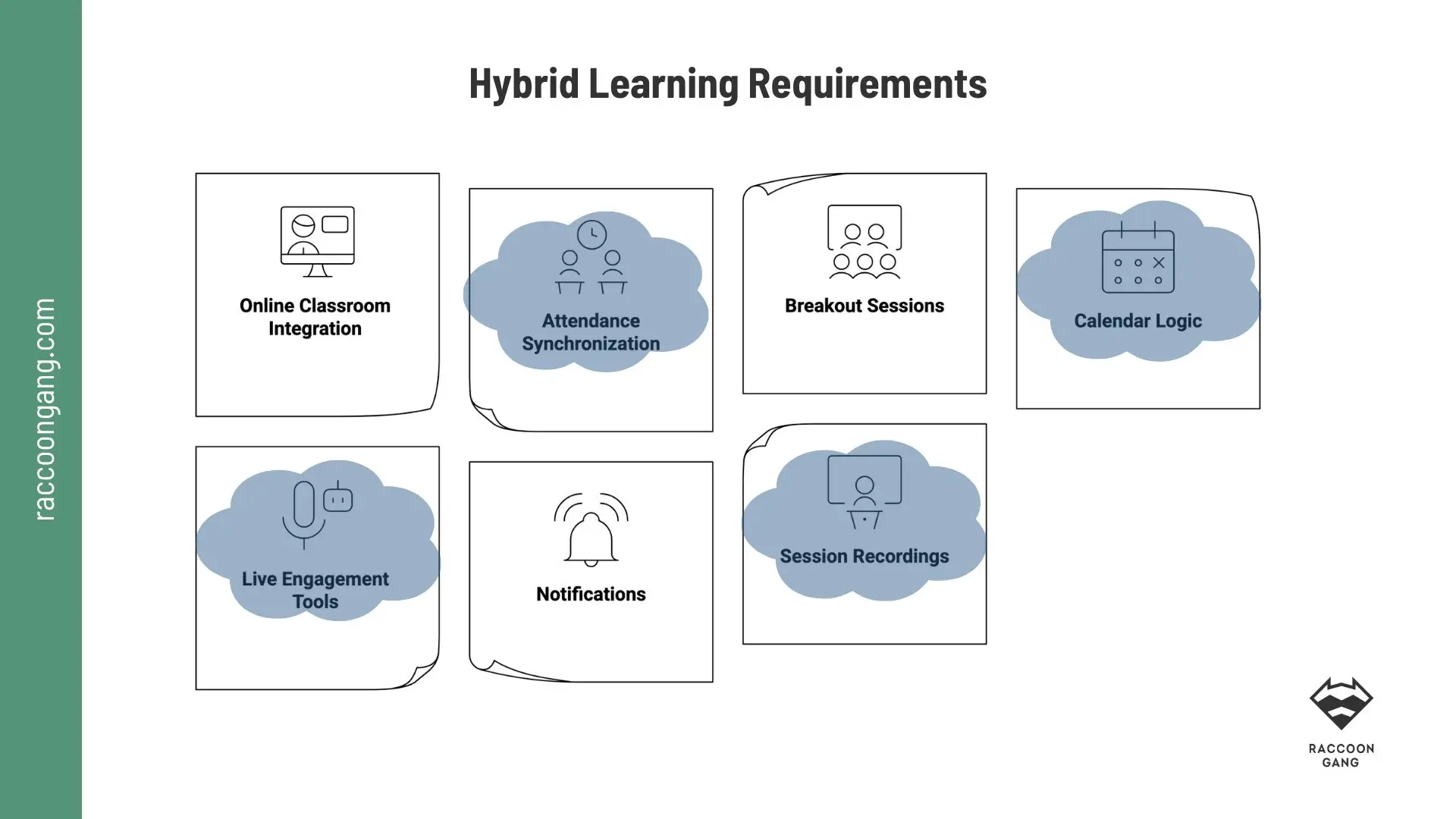
Hybrid environments often require:
- online classroom integration
- attendance synchronization
- breakout sessions
- calendar logic
- live engagement tools
- notifications
- session recordings
Always calculate hybrid learning costs beyond content: include equipment, platforms, instructor training, support, and future hardware updates.
When Blended Learning Works Best
Blended learning works best when teams want to use classroom time more intentionally. These are the main benefits of the blended learning model in practice. Learners can study theory, watch short lectures, or complete LMS activities before the live session starts. Then instructors spend classroom time on workshops, discussions, practice, feedback, or group tasks.
Another advantage is scalability. A blended course does not require everyone to be physically present at every stage. Learners move through different parts of the course at different times, while instructors still keep visibility through the LMS.
Blended learning often works best for:
- practice-based workshops
- flipped sessions
- spaced repetition
- data-informed feedback
- modular course structures
And one more thing. If learners study between shifts, travel between campuses, or complete tasks away from a desk, mobile access quickly becomes part of the decision. Raccoon Gang’s mobile application development services help extend LMS workflows beyond the desktop experience.
Where Blended Learning Breaks Down
On the other side of the scale, the main disadvantages of blended learning appear when the model lacks well-thought-out instructional design. If learners complete assignments but nobody explains why those activities mattered, the completion rate goes down. Self-paced learning can also increase pressure on learners who struggle with time management or self-regulation.
Content quality matters too. Weak videos, confusing instructions, poor feedback, or inconsistent assessment logic quickly reduce engagement.
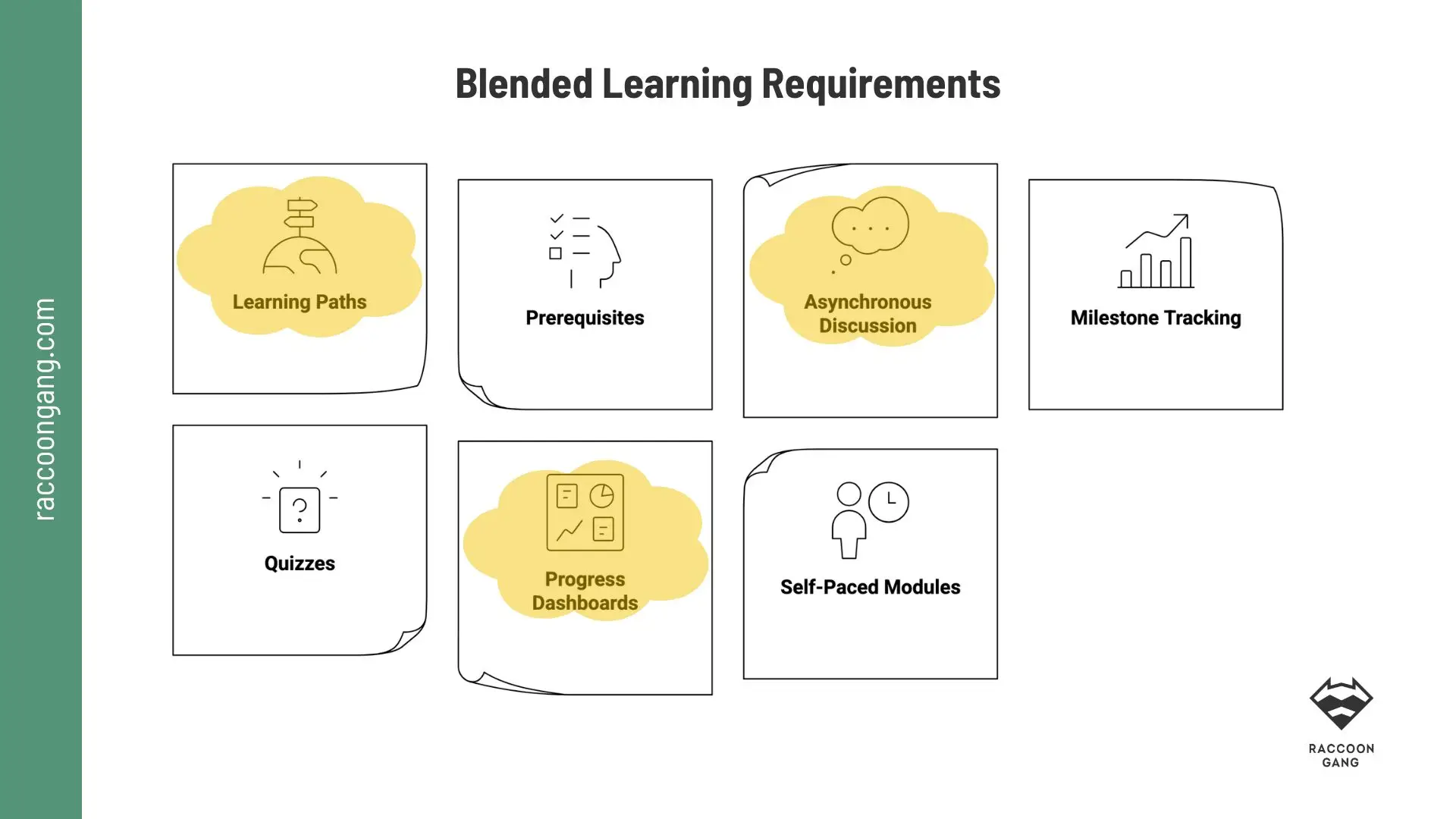
Blended environments often require:
- learning paths
- prerequisites
- asynchronous discussion
- milestone tracking
- quizzes
- progress dashboards
- self-paced modules
How to Choose the Right Model for Your Learners, Instructors, and LMS
As we move toward the final part of this article, it is time to separate three main lenses through which you should look at blended and hybrid learning in your own context.
By three lenses, we mean that the final choice should depend on:
- learners’ needs and expectations
- instructors’ capacity and workload
- the LMS and technical setup your organization already has
If you start with learners
- When you implement hybrid learning, one group may sit in the classroom while another connects online. Learners inside and outside the room join the same discussion at the same time.
- With blended learning, the learning path needs more design. Learners may study theory online first. Then they will join a workshop later. If they skipped the online part, they may arrive unprepared and unsure what to do.
If you look from the instructor’s side
- Hybrid learning challenges instructors because they have to manage two audiences at once. They teach the room. They watch the chat. They answer remote questions and depend on stable cameras, microphones, and internet during every session. It might feel somewhat like being a Twitch streamer who also has an offline audience in front of them.
- Blended learning is less demanding in this sense. It gives instructors time to prepare online activities separately from live sessions. They can review LMS data before class, adjust the workshop, and spend live time on practice or discussion.
If you look at the LMS and its functionality
- Hybrid learning needs strong live-delivery support. The platform should handle live links and reminders. The LMS also needs recordings, attendance tracking, and breakout rooms. Remote learners still need clear communication before, during, and after the session.
- Blended learning depends more on learning structure. The LMS should support learning paths, prerequisites, assignments, quizzes, dashboards, and follow-up activities that connect the course into one sequence.
We’ve also seen this in large-scale training environments where different cohorts move through the same learning path at different speeds. In projects for international organizations like EBRD, LMS structure, reporting, prerequisites, and progress visibility quickly became more important than the live session itself.
Final Checklist: Hybrid or Blended?
Before you choose the model, answer the questions the vast majority of teams prefer to skip when they have to compare blended vs hybrid learning. Don’t repeat their mistakes.
For your convenience, we have summarized the dilemma of choosing in the table below.
| Choose hybrid learning when: | Choose blended learning when: |
| learners must join the same live session from different locations | learners need a structured path across multiple stages |
| real-time discussion, coaching, or facilitation matters | the program must scale across teams or cohorts |
| continuity and access are bigger priorities than optimization | progress tracking and assessment consistency matter |
| travel, safety, geography, or staffing create barriers | self-paced preparation improves live sessions |
| the organization can support live delivery technically and operationally | the LMS already supports modular learning workflows |
Use the answers as your decision filter.
- Who will support instructors during live delivery?
- What happens if the technology fails mid-session?
- Can learners realistically manage self-paced work without reminders?
- Will instructors redesign activities for online participation, or simply stream classroom teaching?
- Can the LMS support the workflow you are planning, not just store the content?
Remember, the strongest programs often combine both intentionally, because one model can’t solve every problem you may face.
FAQ
What is blended learning?
Blended learning becomes easier to understand when we look at the word “blended" as a course format, not an audience format. A blended course or training program may include online and offline activities, but the key point is sequence. Learners move through these activities step by step, not at the same time.
What is hybrid blended learning?
Learning scenario where some part of the audience is present in the classroom and the other part is connected online, you can call it a hybrid learning process. Let’s clarify it once more — some part of the group learns in person while another part joins remotely at the same time.
What are the main benefits of hybrid learning?
Learners choose how and where they participate. Connects remote and local students in a single session. Minimizes the need for large physical training spaces.
What are the disadvantages of blended learning?
Technical glitches or poor internet can completely derail a lesson. You must build, test, and fund all digital materials before the course even starts — you cannot improvise on the fly. Even before the first student starts learning, you need to invest a lot of time, money, and resources of methodologists. You need to pre-record high-quality videos, develop online tests, adapt materials for digital use, and set up a learning platform.
How do you choose between blended and hybrid learning?
Look at your audience’s location. Depending on it, you may choose blended if your learners can all physically show up but would benefit from digital flexibility, or hybrid if you need to train local and geographically dispersed learners simultaneously. Don’t forget about tech support and instructors’ skills when you compare blended learning vs hybrid learning.

- What Is Hybrid Learning in Digital Education?
- What Is Blended Learning in Digital Education?
- Hybrid vs Blended Learning: The Key Difference Most Teams Miss
- When Hybrid Learning Works Best
- Where Hybrid Learning Gets Hard After Launch
- When Blended Learning Works Best
- Where Blended Learning Breaks Down
- How to Choose the Right Model for Your Learners, Instructors, and LMS
- Final Checklist: Hybrid or Blended?