









Andragogy meaning: the theory and practice of adult learning — self-directed, experience-based, and driven by relevance to real-life goals. Pedagogy meaning: structured, teacher-led instruction designed for children, where the educator controls the curriculum, pace, and assessment. The terms come from Greek: andros (adult) + agogos (leader) and paidos (child) + agogos (leader). In eLearning design, understanding the difference determines whether your course structure, autonomy level, and assessment approach will actually work for your audience.
TL;DR
- Andragogy is a self-directed, experience-based approach to adult learning. If you’re wondering about andragogy vs pedagogy, andragogy is most common in corporate training, professional development, higher education, and online courses.
- Pedagogy is a structured, teacher-led approach typically used with children and dominant in K-12 education.
- Both share a need for engagement and a skilled facilitator — and are increasingly combined through blended learning models.
Introduction to Andragogy and Pedagogy
The methods and strategies we use to impart knowledge are pivotal in education. Two foundational concepts influencing educational theory and practice are andragogy and pedagogy.
Both play distinct roles in shaping individuals’ learning experiences, but they cater to different age groups and employ varied approaches.
What Is Andragogy? Definition and Meaning
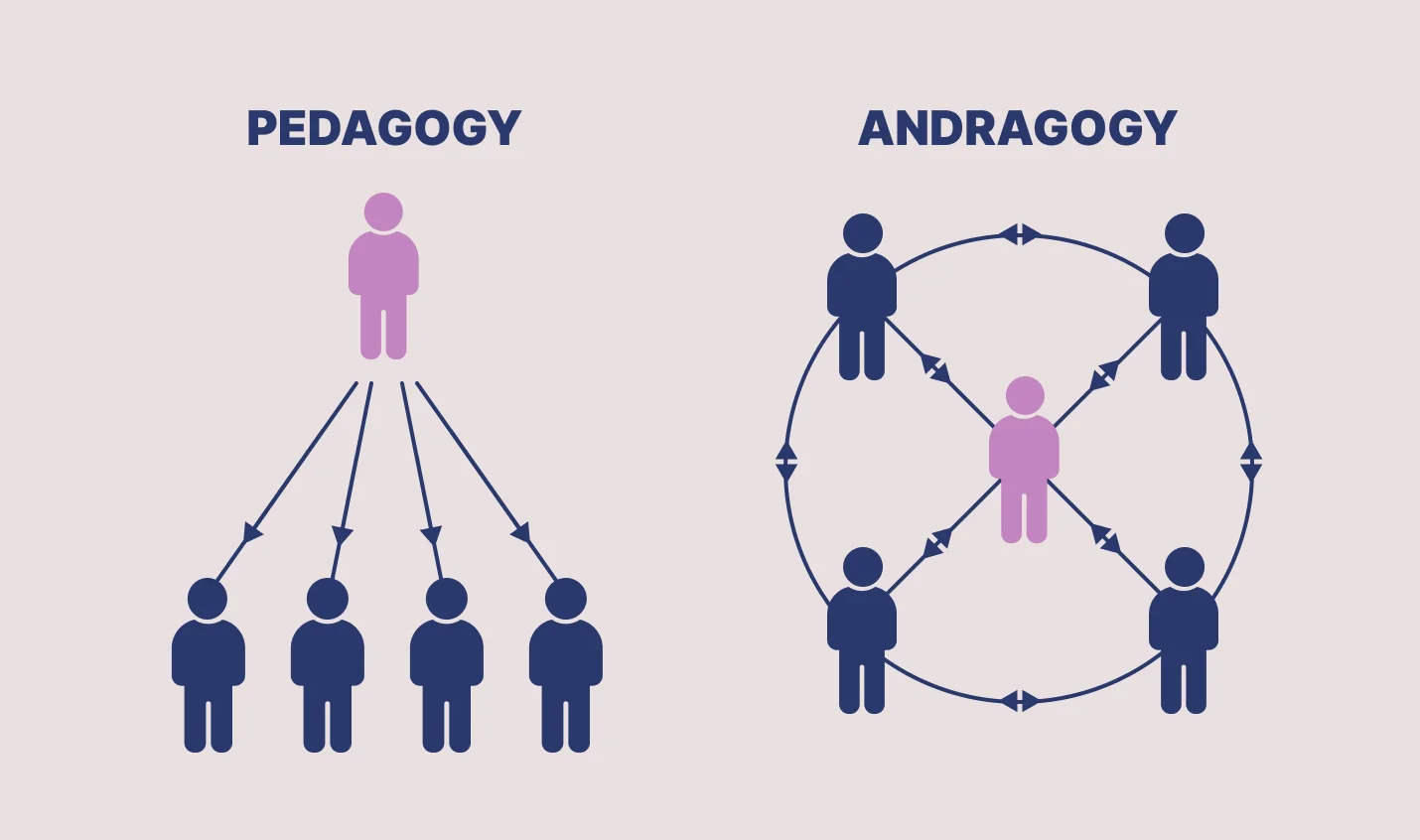
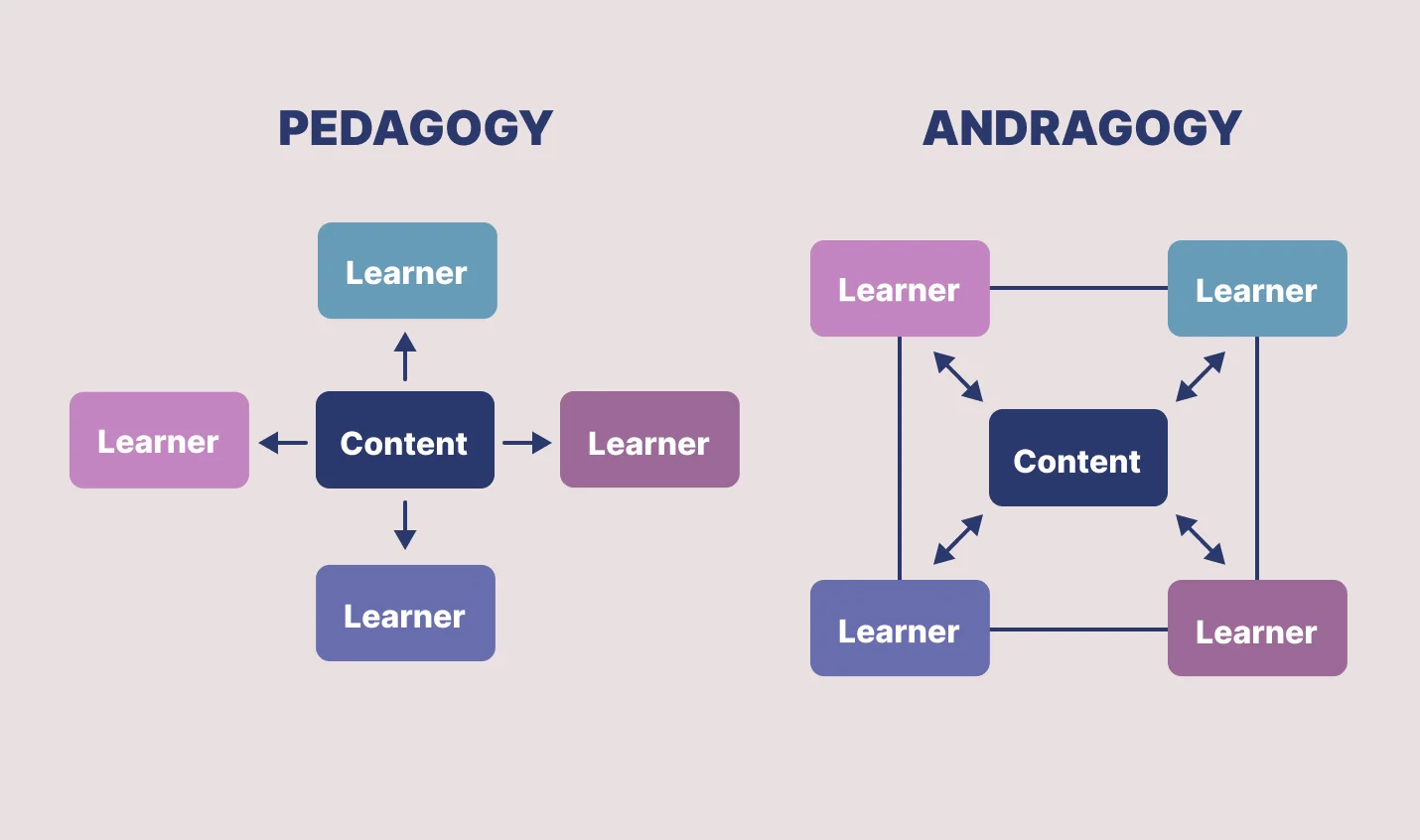
Andragogy, from the Greek andros (adult) + agogos (leader), is the theory and practice of self-driven learning based on adult learners’ experiences and real-life needs. In simple terms, the andragogy meaning is: learning designed for adults, where the learner — not the instructor — drives the direction, pace, and relevance of the content.
Andragogy is today the dominant approach in corporate training, professional development, higher education, and online learning courses.
Malcolm Knowles’ 6 Principles of Andragogy
Knowles outlined six principles that explain how adults learn at work and beyond. For e-learning teams, they give a practical checklist for onboarding, compliance training, customer education, and certification programs.
| # | Principle | What it means in practice |
| 1 | Need to Know | Explain why the training matters before learners start. Tie each module to a clear work outcome. |
| 2 | Self-Concept | Adults expect control. Let them choose pace, sequence, or practice format where the LMS allows it. |
| 3 | Prior Experience | Learners bring job history, mistakes, and patterns. Use scenarios, reflection, and peer exchange to turn that into course fuel. |
| 4 | Readiness to Learn | Adults pay attention when training solves today’s task. Match content to role changes, deadlines, or performance gaps. |
| 5 | Orientation to Learning | Adults prefer problems over theory. Build around real tasks, decisions, and workplace friction. |
| 6 | Motivation | Career progress, confidence, and skill mastery often matter more than grades or badges. |
In e-learning design, these principles shape content strategy: open with the reason, connect every activity to real work, give learners some control, and favor practice over recall.
What Is Pedagogy? Definition and Meaning
Pedagogy, from the Greek paidos (child) + agogos (leader), is structured, teacher-led instruction designed primarily for children and novice learners. The pedagogy meaning in education: the educator controls the curriculum, content sequence, pace, and assessment — the learner follows a defined path rather than directing their own.
Pedagogy remains the foundational framework in K-12 education worldwide and provides children with the structured, sequenced instruction they need to build core academic knowledge.
Pedagogy in Practice
- Teacher Training Programs — Educators learn pedagogical strategies to manage classrooms, design lesson plans, and evaluate student progress.
- Structured curriculum delivery — Content is sequenced by the instructor, not the learner.
- Assessment-driven — Grades and formal evaluation document progress.
- Works for adults too — When an adult learner is a complete novice in a domain (e.g. first programming lesson), pedagogical scaffolding is often more effective than andragogical self-direction.
What Is Heutagogy
Heutagogy takes learning one step further than andragogy: rather than simply directing their own learning, the learner also determines what competencies to develop and designs the entire learning experience from the ground up. It is a model of fully self-determined learning, most relevant in advanced professional development, entrepreneurial education, and environments where individuals need to navigate rapidly changing knowledge landscapes independently.
Andragogy vs Pedagogy: Key Differences
Comparison Table: Pedagogy, Andragogy & Heutagogy
| Learner role | Dependent | Self-directed | Self-determined |
| Teacher role | Authority / expert | Facilitator / guide | Resource / collaborator |
| Content source | Instructor decides | Negotiated together | Learner decides entirely |
| Motivation | Extrinsic (grades) | Mostly intrinsic | Fully intrinsic |
| Learning orientation | Subject-centered | Problem-centered | Capability-centered |
| Prior experience | Not a learning resource | Central resource | Foundation for new learning |
| Best suited for | K-12, novice learners | Corporate L&D, HE, eLearning | Advanced PD, research |
Heutagogy (coined by Stewart Hase and Chris Kenyon) extends andragogy further: the learner decides not just how to engage with content, but what to learn and why. It is most applicable in advanced professional development, research, and AI-driven adaptive learning contexts.
Methodologies: How Information Delivery Varies
Pedagogy:
- Structured Curriculum: Learning is often pre-arranged, following a set curriculum.
- Directive Approach: Teachers provide direct instruction and guidance.
- Assessment-Oriented: Regular testing and grading assess children’s grasp of content.
Andragogy:
- Problem-Centered Approach: Adults prefer to learn in the context of solving real-life problems.
- Collaborative Learning: The classroom becomes a space for discussion, debate, and shared experiences.
- Self-Evaluation: Adults often prefer self-assessment and reflection over formal testing.
Andragogy vs Pedagogy: Key Differences at a Glance
Contextualizing Adult Learning: When Andragogy Takes the Center Stage
The shift to andrological practices becomes evident in environments where learning is tailored to adult needs. This includes:
- Corporate Training: Adult employees learning new skills or software.
- Continuing Education: Adults returning to school or attending workshops to advance their skills.
- Online Learning Platforms: Many e-learning platforms cater to self-directed adult learners looking to expand their knowledge at their own pace.
In these contexts, recognizing the unique characteristics of adult learners — their motivations, experiences, and preferred learning styles — is essential for educators and trainers to ensure effective and meaningful learning experiences.
Andragogy Meaning, Andragogical Definition & Related Terms
Several terms around andragogy often cause confusion. Here are clear definitions for the most common ones:
| Term | Meaning | Used in |
| Andragogy | The theory and practice of adult learning: self-directed, experience-based, relevance-driven | Corporate L&D, higher education, professional development, eLearning |
| Andragogy meaning | From Greek: andros (adult) + agogos (leader). Literally: “the art and science of leading adults” | Academic discussion, instructional design literature |
| Andragogical | Adjective form: relating to andragogy. An “andragogical approach” is one that applies adult learning principles | Course design, learning theory, L&D strategy |
| Andragogical meaning | Describes something that embodies or applies the principles of adult learning | Academic writing, instructional design briefs |
| Andragogical model | Malcolm Knowles’ framework of 6 principles that define how adults learn differently from children | L&D strategy, eLearning course design |
| Pedagogy | Structured, teacher-directed instruction primarily designed for children and novice learners | K-12 education, foundational skills programs |
| Pedagogy meaning | From Greek: paidos (child) + agogos (leader). Literally: “the art and science of leading children” | Education theory, teacher training |
| Heutagogy meaning | Self-determined learning: the learner decides not just how to engage but what to learn and why. Extends beyond andragogy | Advanced professional development, research, AI-driven adaptive learning |
Common spelling variants that appear in search (and all refer to the same concept): andragogy / androgogy / androgy / adragogy / andagogy / andregogy. The correct spelling is andragogy.
Andragogy vs Pedagogy: Advantages and Challenges
Both andragogy and pedagogy come with their unique sets of advantages and challenges. By understanding them, educators can more effectively tailor their teaching methods and address misconceptions that might arise in both domains.
Andragogy
Andragogy works best with learners who already know why they’re there — adults with professional context, clear goals, and enough experience to connect new knowledge to what they already do.
Pros:
- Prior experience becomes part of the learning process, not just background noise.
- Adults motivated by real goals tend to engage more deeply and retain more.
- Learning tied to actual problems gets applied; abstract content often doesn’t.
- Self-paced, modular delivery on an LMS fits naturally into how adults manage their time.
Cons:
- Designing for a group of adults with very different backgrounds is genuinely difficult.
- Competing responsibilities — work, family, other priorities — make sustained. engagement hard to guarantee.
- Adults with years of experience in a field can be slow to accept approaches that contradict how they’ve always worked.
Pedagogy
Pedagogy gives children something they genuinely need — a clear structure, a defined sequence, and an expert who can guide them through material they have no prior frame of reference for.
Pros:
- A sequential curriculum helps children build knowledge layer by layer without gaps.
- Lesson design can account for where children are developmentally, not just what the subject requires.
- Standardized structure means progress is measurable and comparable across groups.
Cons:
- A fixed curriculum doesn’t leave much room for children who learn differently or move at a different pace.
- When the structure is too rigid, it can work against curiosity and independent thinking.
- Heavily teacher-led delivery can produce compliance rather than genuine understanding.
Addressing Common Misconceptions in Learning Strategies
Clarity is essential when discussing pedagogical methods. Common misconceptions include:
- Both methods are universally applicable. While pedagogy suits younger learners and andragogy adults, they aren’t rigid categories. Adults can benefit from structured learning in areas like language acquisition.
- Digital learning isn’t standalone; both approaches can integrate with online platforms, merging traditional and digital techniques.
Andragogy vs Pedagogy: Practical Implications in Education
The realms of andragogy and pedagogy are more than just theoretical. They significantly shape modern education systems, influencing how educators design curricula, engage with students, and evaluate outcomes. We better understand their impact on various learning scenarios by examining their practical applications.
When to Use Andragogy
Andragogy is the right choice when learners are adults with existing experience, when the learning goal is performance-related (not foundational knowledge), and when intrinsic motivation can be activated through relevance and autonomy.
- Workplace Training: Corporations and businesses often employ andragogical principles to train employees. Recognizing their prior experiences and fostering a collaborative environment allows for more efficient skill acquisition and professional growth.
- Higher Education: Universities and colleges, especially in postgraduate courses, often prioritize self-directed research and learning, mirroring andragogical principles.
- Online Learning Platforms: With the rise of MOOCs (Massive Open Online Courses) and other e-learning platforms, adult learners can choose their learning path, pace, and area of interest, epitomizing the essence of andragogy.
When to Use Pedagogy
Pedagogy works best when learners have little prior knowledge, when standardized outcomes matter, or when learners (adult or child) genuinely need structured guidance to build foundational competence.
- K-12 Education: Most school systems globally are built on pedagogical principles, with a structured curriculum, guided learning objectives, and standardized assessments.
- This foundation has carried over naturally into digital environments — many K-12 schools now use LMS platforms to deliver the same structured, teacher-directed experience through blended classrooms, where lessons, assignments, and progress tracking all follow the same pedagogical logic, just through a different medium.
- Use of Technology: Technology has entered classrooms and is often used to reinforce pedagogical practices. For instance, interactive whiteboards, educational apps, and online quizzes can enhance traditional teaching methods.
- Teacher Training Programs: Those aspiring to become educators often undergo rigorous training that equips them with pedagogical strategies to manage classrooms, create lesson plans, and evaluate student progress effectively.
When to Blend Both Approaches
Knowles later described pedagogy and andragogy as a spectrum, not opposing camps. In practice, e-learning teams often need both: structure first, autonomy later.
- New employee onboarding — Use guided content during the first 1–2 weeks. Then move learners into role-based paths, practice tasks, and manager-led application.
- Online courses — Teach the core theory through instructor-led modules. After that, let learners choose projects or case tasks.
- Certification programs — Deliver required content through a fixed sequence. Then add reflection, scenarios, and workplace application.
Andragogy in Practice: eLearning and Corporate Training Examples
Understanding andragogy vs pedagogy is only half the work. The more important question is: how do you apply andragogical principles in a real training programme? Here are three concrete scenarios.
Scenario 1: Compliance Training
Instead of presenting regulatory rules for memorisation (a pedagogical approach), design scenario-based modules where employees navigate realistic workplace situations and experience the consequences of different decisions.
This directly activates Knowles’ 5th principle (Orientation to Learning — problem-centered) and his 1st (Need to Know — the consequences are the ‘why’). Research shows scenario-based compliance training produces retention rates up to 75% higher than lecture-based delivery (ASTD).
Scenario 2: Employee Onboarding
Start with 1–2 weeks of structured, instructor-led content covering company tools, policies, and workflows (pedagogical scaffolding). Then shift to an andragogical model: give new employees a learning roadmap with optional depth on topics they find most relevant to their specific role, peer learning sessions, and a practical project.
This blended approach recognises that new employees need foundation before self-direction — and that andragogy without foundation often creates anxiety, not autonomy.
Scenario 3: Professional Certification Programmes
Let learners control the pace, access supplementary resources based on self-identified knowledge gaps, and integrate content with their existing professional experience through reflective exercises. Use peer cohorts and discussion forums to activate the ‘Prior Experience’ principle — colleagues learn as much from each other as from the formal content.
Raccoon Gang in Practice: Our instructional designers apply Knowles’ andragogical principles in every course we build. For NASA’s Open Science 101 curriculum, we structured five self-paced modules with learner-controlled depth and scenario-based assessments — resulting in high completion rates across a global, expert-level audience. For EBRD compliance programmes, we redesigned policy documents into problem-centered eLearning that connects regulation to real banking scenarios. Each project starts with the same question: why will this learner care?
Choosing the Right Approach: When to Use Pedagogy or Andragogy
The choice between andragogy and pedagogy is pivotal for effective knowledge transfer, and it hinges on learners’ needs, contexts, and objectives. Here’s a concise breakdown.
Why Choose Andragogical Approaches?
Andragogy, tailored for adult learners, leverages:
- Experience as a Resource: Adults integrate their vast personal and professional experiences into learning.
- Self-directed Learning: Adults often pursue learning due to its direct relevance to their lives or careers.
- Practical Application: Andragogy focuses on skills and problem-solving over memorization.
The Role of Pedagogy in Comprehensive Education Strategies
Pedagogy, which is traditionally for children, offers:
- Structured Learning: Essential for building foundational knowledge.
- Catering to Diverse Needs: Allows customization for varying student backgrounds and abilities.
- Holistic Development: Encompasses academic, social, moral, and emotional growth.
Deciding on an Approach: Considerations for Educators and Institutions
To choose between andragogy and pedagogy, you should consider the following:
- Understand the learner’s background and motivation.
- Define the primary goals of the learning program.
- Each approach may require different educational tools and methods.
Ultimately, recognizing the unique strengths of both approaches ensures a tailored and impactful educational experience.
Strategies and Considerations for Effective Teaching and Learning
How can educators ensure an engaging learning experience?
- Educators can boost engagement through andragogical or pedagogical methods by incorporating multimedia, promoting active participation, applying real-world contexts, and continuously seeking feedback to refine their teaching strategies.
What role does technology play in modern teaching and learning methods?
- Technology facilitates distance learning, offers interactive multimedia experiences, enables real-time feedback, and caters to diverse learning needs. Whether in pedagogy with tools like educational apps for kids or in andragogy with platforms like online courses, technology enriches the learning experience.
How should educators approach different learner needs?
- Recognizing that each learner is unique is the first step. Educators should remain flexible, offer diverse resources, employ differentiated instruction, and cultivate an inclusive learning environment where every student feels valued and understood.
Conclusion
Both andragogy and pedagogy have a clear place in modern education. The question is never which one is better — it is always about understanding who you are designing for.
Synthesizing Learning Approaches
The synthesis of andragogical and pedagogical approaches offers promising pathways. Educators and learners alike stand to benefit by merging the best of both worlds, ensuring an adaptive, responsive, and holistic learning experience.
It’s important to consider the unique attributes and needs of learners, blending traditional methodologies with contemporary strategies to create an enriched learning environment.
How Education Can Adapt and Grow
The educational landscape is constantly changing, shaped by technological advancements, societal shifts, and the intrinsic human thirst for knowledge. Embracing this evolution means being open to innovative teaching techniques, adopting digital platforms, and recognizing the changing profiles of learners.
As we look to the future, the capacity to adapt and grow will define the success of educational strategies, ensuring that learning remains a dynamic and fulfilling journey for all.
Raccoon Gang applies Knowles’ principles in course design for Open edX and Moodle — see the NASA Open Science 101 case study for a practical example.
FAQ
What is the meaning of andragogy?
What is the meaning of pedagogy?
What is the difference between andragogy and pedagogy?
What does andragogical mean?
What is the meaning of heutagogy?
How do you apply andragogy in eLearning and corporate training?

- TL;DR
- Introduction to Andragogy and Pedagogy
- Andragogy vs Pedagogy: Key Differences
- Andragogy vs Pedagogy: Key Differences at a Glance
- Andragogy Meaning, Andragogical Definition & Related Terms
- Andragogy vs Pedagogy: Advantages and Challenges
- Andragogy vs Pedagogy: Practical Implications in Education
- Andragogy in Practice: eLearning and Corporate Training Examples
- Choosing the Right Approach: When to Use Pedagogy or Andragogy
- Conclusion