







A customer education platform is where a product company trains everyone who is not on its payroll: users, partners, resellers, franchisees, distributors. Skip it, and each of those groups learns your product the slow way, one scheduled call at a time.
TL;DR
A customer education platform is a customer training platform aimed at audiences outside your company: customers, partners, resellers, distributors. Companies run one to cut time-to-value, push product adoption up, deflect support tickets, certify partners, and defend Net Revenue Retention (NRR).
For years, customer education lived next door to support. A help article here. A webinar there. Maybe a walkthrough once the deal closed. Fine for a short customer list and a product that barely changed. The model cracks somewhere around the point where a SaaS vendor, a hardware manufacturer, a healthcare product team, or a partner network wakes up with thousands of external users to train, scattered across roles, regions, languages, and very different levels of product fluency.
Hence the shift from reactive support toward education-led growth (ELG). Answering faster is table stakes now. The job is getting people to value quickly enough that they use more of what they bought, raise fewer Tier 1 support tickets, sign the renewal without a second thought, and find use cases nobody pitched them.
Most companies have not made that shift yet. Censuswide surveyed 602 Customer Experience leaders and practitioners for LearnUpon in 2025. Just 25% ran dedicated customer education platforms. Yet 41% named customer retention through education a priority, a figure that climbs to 53% at companies past 500 employees. Plenty of intent, not much tooling.
Which reframes the question. It is not “should we produce more training content” — almost everyone should. The harder one: do you need a dedicated customer education LMS that can carry several external audiences at once, each with separate branding, access rules, learning paths, certifications, and business metrics?
What Is a Customer Education Platform?
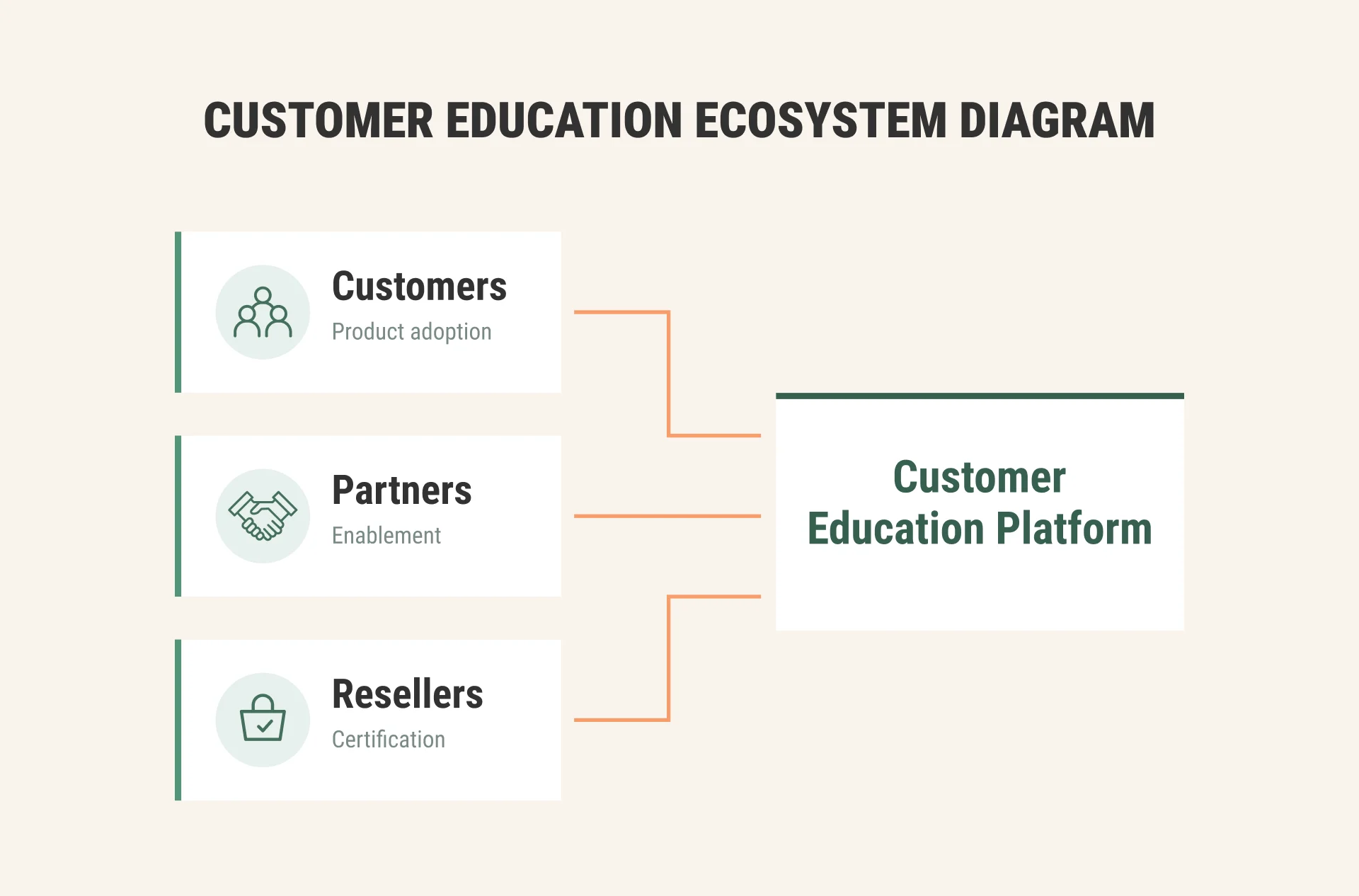
A customer education platform is a purpose-built LMS for customer training. Call it a product training platform for the people outside your company: the place where customers, partners, resellers, distributors, and franchisees go for onboarding, product training, certifications, partner enablement, and self-service answers.
An internal HR-focused LMS was never built for this crowd. Customer education demands multi-tenancy, branded portals, e-commerce, CRM integrations, SSO single sign-on, and learning path certifications, plus analytics that report on product adoption, support volume, churn reduction, and NRR rather than compliance headcounts.
Hosting courses is the easy part. What a strong customer education LMS really gives you is a branded customer learning portal: somewhere people figure out your product, prove they know it, come back when it changes, and grow from first login into advanced use.
Why Product Companies Invest in Customer Education
Product companies invest in customer education because adoption is no longer guaranteed after purchase. In the subscription economy, SaaS and product companies have to earn usage again and again. The customer may have signed. The product may be technically available. Still, the business result only appears when users understand what to do.
Customer education supports four business outcomes.
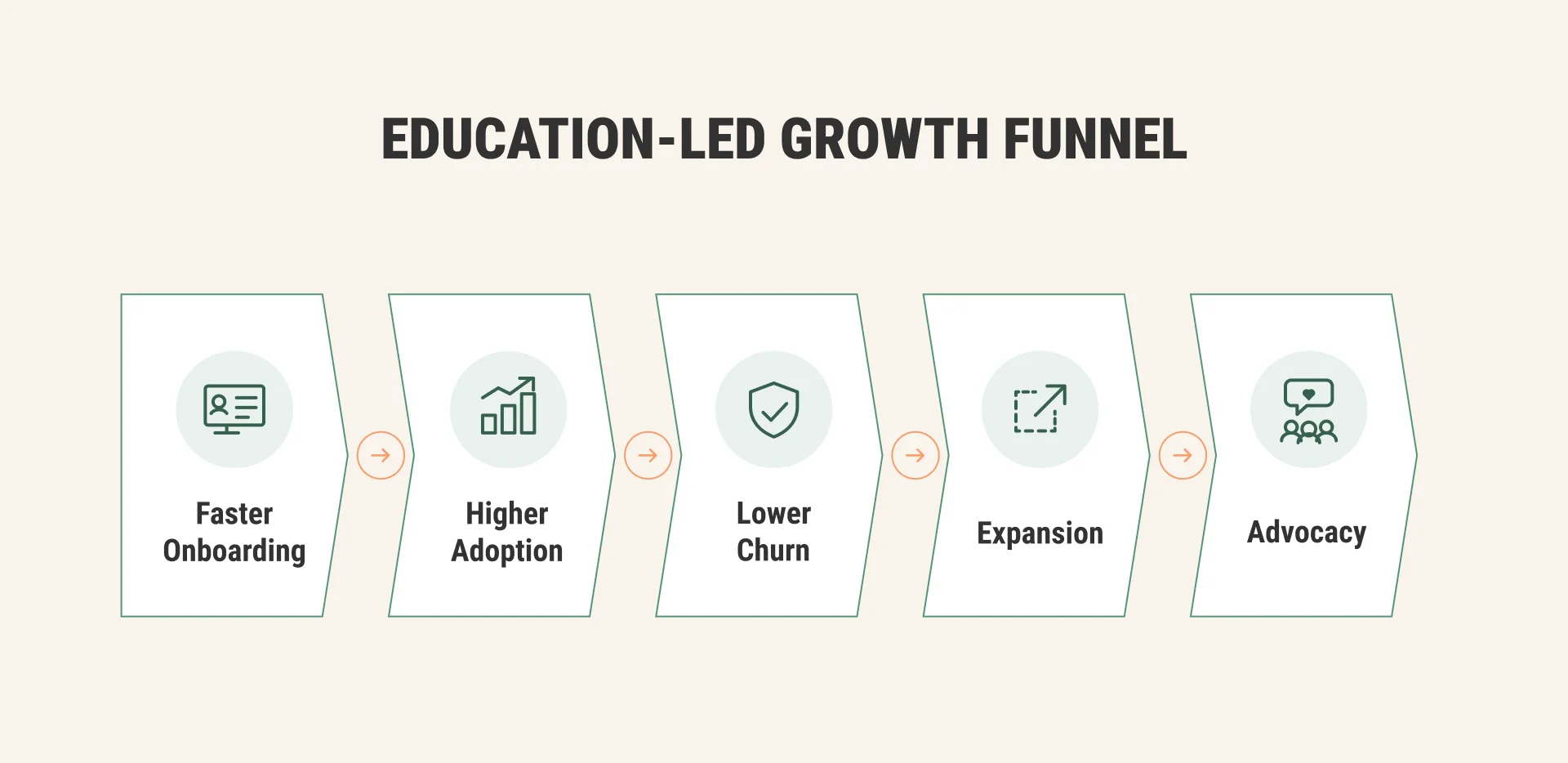
Product adoption. Educated customers usually reach meaningful product use faster. They learn core workflows, not just interface labels. This matters for customer training product adoption because many products fail after purchase through underuse, not outright rejection.
Support deflection. Customer education reduces repeated how-to questions. Check N Click’s 2026 customer education strategy guide gives an example metric where customers who completed an advanced admin certification submit 30% fewer Tier 1 support tickets. It is not a universal guarantee, but it shows the kind of evidence a program should be built to measure.
Retention. Education becomes more valuable when it is embedded into onboarding and ongoing enablement. Check N Click’s Customer Education Metrics Guide: Proving ROI (2026) lists a roughly 7.4% retention lift among commonly reported customer education benchmarks. The guide recommends treating this figure as a directional reference and validating the result against trained and untrained customer cohorts.
Expansion revenue. The same guide also lists a 6.2% revenue increase tied to stronger adoption and expansion motions. That is where customer education ROI starts to matter to CCOs, revenue leaders, and product teams. Completion rate and enrollment still matter, but they do not finish the argument.
Education-led growth works alongside product-led growth. Product-led growth asks the product to help users discover value. Education-led growth adds a learning layer around that product so customers know which workflows matter and how to move into deeper adoption.
Who Needs a Customer Education Platform?
A customer education platform is most useful when a company has more than one external audience to train. A single product tutorial page may be enough for a simple tool. A product company with customers, partners, resellers, franchisees, and regional teams needs something more structured.
Customers
Customers need onboarding, product training, self-service support, feature adoption paths, and advanced certification. A customer onboarding LMS track might teach new admins how to configure permissions, while an LMS for SaaS customer training can then guide power users through reporting, automation, and advanced workflows.
Partners
Partners need enablement. A partner training LMS or partner enablement platform can support sales training, implementation training, co-branded learning paths, and certification before a partner is allowed to deliver services or register deals.
Resellers and Franchisees
Resellers and franchisees need consistent brand knowledge, product updates, compliance training, regional certification, and proof that the right people completed the right courses. A partner enablement platform can give each reseller tier its own content, rules, and reporting while still letting the product company manage the full program centrally.
This is where a multi-tenancy model matters. One extended enterprise LMS can support customers, resellers, franchisees, partners, and distributors without mixing their content, branding, permissions, or reports.
Key Features of a Customer Education Platform
A feature list is useful only when each feature is connected to business value.
Multi-tenancy and branded portals. Separate environments for customer segments, partner tiers, regions, or product lines let each group see the content that fits them. A customer academy LMS should support a brand academy portal, not a generic course catalog that feels disconnected from the product.
Learning paths and certifications. Customer education should guide users from onboarding to power user status. Partners may need sales certification, implementation certification, or annual recertification. Digital badges and certifications make progress visible and easier to verify.
eCommerce integration. Some companies offer free onboarding but sell advanced training, certification exams, course bundles, or partner accreditation. Stripe or PayPal ecommerce workflows help a customer training platform support paid education programs. Raccoon Gang’s eCommerce integration services can help teams connect payments to learning access.
CRM integration. Training data becomes more useful when it appears in the tools Customer Success and revenue teams already use. Salesforce or HubSpot CRM integration can enrich account records with course completion, certification status, product role, and engagement patterns. An LMS Salesforce integration for customer training helps teams compare learning activity with account health and renewal signals.
SSO single sign-on. External users will not tolerate unnecessary login friction. SSO lets customers and partners enter the learning portal through familiar identity providers.
SCORM, xAPI, and LTI. SCORM helps import existing course packages. xAPI supports more detailed learning behavior tracking. LTI connects third-party tools. A serious customer education LMS should support SCORM xAPI LTI because customer-facing training often grows from many content sources.
Analytics and reporting. The reporting question is not only “Who completed the course?” It is “Did training reduce tickets, speed up activation, increase feature use, improve NPS score, or support NRR?” Customer education metrics should connect learning events to product and business outcomes.
Mobile-first access. Field teams, distributors, service partners, and resellers may not sit at desks. Mobile access helps learners complete training when they are close to the work.
White-label branding. White-label LMS customer training matters because the academy should feel like part of your product experience, not a rented vendor page.
Customer Education Use Cases by Industry
Customer education looks different across product categories, but the goal stays the same: train external audiences so they can use, sell, support, or maintain the product well.
| Industry | Customer education use case | Concrete outcome |
| SaaS companies | Onboarding new users, certifying admins, training power users | Faster time-to-value, stronger feature adoption, lower churn risk |
| Hardware and manufacturing | Product knowledge for distributors, compliance certification for resellers, field technician training | Fewer setup errors, better partner readiness, safer field operations |
| Pharmaceutical and healthcare | HCP education, regulatory training, product usage guidance, CME-related workflows where applicable | More consistent knowledge delivery and better audit readiness |
| Financial services | Advisor certification, partner training, product updates, compliance learning | Controlled access to regulated information and proof of completion |
| Technology and cybersecurity | Implementation partner certification, MSSP enablement, admin training | Better delivery quality and fewer escalation-heavy support requests |
A customer success training platform earns its keep when the product itself raises the stakes.
“Customer education matters most for products that change how people work. If your product is complex, ships updates every month, or is risky to use incorrectly, training stops being a nice-to-have. It becomes part of the product.”
— Sergiy Movchan, Co-founder and eLearning Strategist, Raccoon Gang
How to Measure Customer Education ROI
Customer education ROI should separate activity metrics from value metrics.
Activity metrics tell you whether the program is being used:
- course starts;
- completion rate;
- enrollment;
- time spent;
- assessment scores;
- digital badges and certifications earned.
These are useful, but they do not settle executive conversations. Ten thousand completions may look impressive and still fail to show business value.
Value metrics connect education to outcomes:
- faster time-to-value;
- support ticket deflection;
- feature adoption rate;
- churn reduction;
- Net Revenue Retention;
- expansion revenue;
- NPS score change;
- customer health score movement.
We recommend a cohort-based approach: compare trained and untrained customers by lifecycle stage, product behavior, and business outcomes while controlling for attributes such as tier, region, and customer size.
A practical four-metric model works well.
- Time to first value. How quickly do trained customers reach the first success milestone compared with untrained customers?
- Support ticket deflection. Do trained customers submit fewer Tier 1 tickets, especially around the topics covered by training?
- Net Revenue Retention. Do trained accounts renew and expand at higher rates than similar untrained accounts?
- Feature adoption rate. Do trained users activate advanced features more often than users who skipped training?
This is where customer education becomes a growth function. The academy is not valuable because it contains courses. It is valuable because it changes customer behavior in ways the business can see.
Customer Education Platform vs Generic LMS
Many product companies begin with a generic LMS because it is already available. That may work for a small pilot. It usually becomes limiting when the audience becomes external, segmented, and revenue-connected.
| Criterion | Generic LMS | Dedicated customer education platform |
| Primary audience | Internal employees | External users, partners, customers |
| Multi-tenancy | Limited or custom | Core requirement |
| Branded portals | Often limited | White-label per segment |
| eCommerce | Usually absent or secondary | Built for paid courses and certifications |
| CRM integration | HR-oriented or basic | Salesforce, HubSpot, Gainsight, product data |
| Reporting focus | Completion tracking | NRR, adoption, churn, support deflection |
The stronger option is not always a closed, dedicated vendor. Open edX can combine the flexibility of a generic LMS with many customer education platform requirements: branded customer learning portal, course commerce, integrations, multi-audience delivery, analytics, and no per-user license fees.
Canvas may also be a valid option, especially for companies already using the Canvas environment or looking for a familiar SaaS LMS model. Raccoon Gang is an Open edX Official Partner and an official Canvas LMS partner, and our company implements both platforms depending on audience model, compliance requirements, integration needs, and ownership preferences.
Open edX as a Customer Education Platform
Open edX customer education makes sense when external training needs to grow without per-user pricing becoming a budget problem. That matters because customer education audiences can be unpredictable. A partner academy may have 500 active learners this quarter and 20,000 after a new reseller program launches.
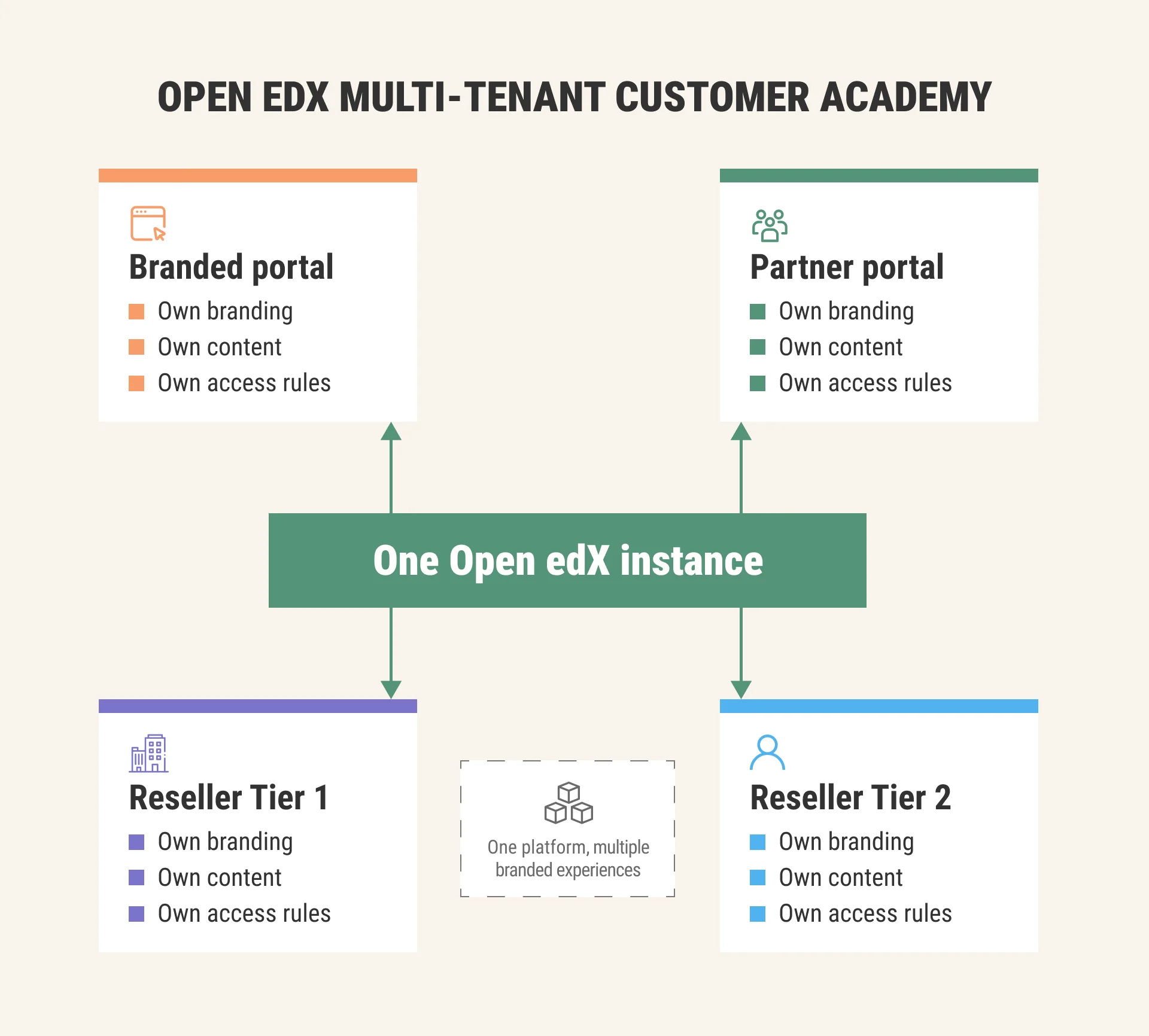
Open edX can be implemented as a multi-tenant customer academy using organization structures, branded portals, access rules, custom theming, e-commerce, APIs, and analytics. In practice, this means one Open edX instance can support multiple customer segments or partner tiers, each with its own branding, content rules, permissions, and reports.
Key strengths include:
- Multi-tenant academy setup. One platform can serve different audiences without forcing them into one shared experience.
- White-label capability. Custom domains, custom UX, branded course pages, and segment-specific portals make the academy feel owned by the product company.
- Open-source economics. No per-user licensing fees can be important when external learners number in the tens of thousands.
- eCommerce support. Paid courses, subscriptions, bundles, and certification programs can connect to payment workflows such as Stripe and PayPal.
- LTI, SCORM, and xAPI support. Teams can import existing content and connect specialist learning tools.
- Open APIs. Raccoon Gang’s Open edX API integration services help connect Open edX with Salesforce, HubSpot, Gainsight, BI tools, and custom CRM systems.
- Analytics. xAPI event streams and platform data can feed BI tools such as Power BI, Tableau, or Looker.
The scale logic is already visible in Raccoon Gang’s portfolio. For a global media institute, our team migrated learning from a legacy system that had reached 120,000 registered users at its peak onto a custom Open edX platform built for up to 20,000 concurrent users, complete with eCommerce, analytics, and gamification.
The EBRD Policy Academy shows another model: our instructional designers transformed 24 hours of policy and investment seminar material into an 8-hour self-paced Open edX program with 84 instructional videos, built to support 600+ concurrent learning sessions.
How Raccoon Gang Builds Customer Education Platforms
Raccoon Gang handles full-cycle customer education platform delivery: strategy, architecture, content, launch, integrations, analytics, and ongoing support. That way, customers can focus on education strategy and product knowledge instead of platform infrastructure.
Our team usually covers seven areas.
Discovery and scoping. We work with CCOs, product teams, Customer Success, L&D managers, and IT leaders to map audience tracks, business goals, risks, and platform requirements.
Platform architecture. Our professionals design the academy structure: Open edX multi-tenant setup, Canvas where it fits better, branded portals, permissions, user roles, language needs, and content rules.
Integrations. We connect learning data with Salesforce, HubSpot, Gainsight, SSO providers, payment gateways, BI tools, and product analytics systems.
Content production. Instructional designers and course development specialists help turn product knowledge into onboarding paths, certification programs, partner training, microlearning, assessments, and update courses.
eCommerce setup. Paid certification programs, course bundles, subscription tiers, Stripe/PayPal ecommerce flows, and access logic can be added where education is part of the revenue model.
Analytics. We can configure xAPI learning records, custom dashboards, NRR and adoption reporting, support deflection dashboards, and completion analytics.
Ongoing support. Customer education platforms need updates, course releases, integrations, monitoring, and regular Open edX upgrades. Our team supports platform evolution after launch.
Over the years, our team has delivered 200+ eLearning projects and supported millions of learners worldwide. Raccoon Gang’s broader eLearning business solutions include LMS implementation, course production, integrations, and ongoing support across Open edX, Canvas, and related learning technologies.
You can also explore Open edX services, customer onboarding, and case studies to see how platform engineering, instructional design, and analytics come together.
Conclusion
Customer education is no longer optional for product companies competing on retention and adoption. In a subscription economy, SaaS, hardware, healthcare, financial services, and cybersecurity companies cannot rely only on support teams and one-off onboarding sessions.
A dedicated customer education platform gives external users a place to learn, certify, return for updates, and move into deeper product value. For partners and resellers, it becomes the partner enablement platform that protects brand quality and delivery standards. For revenue leaders, it connects education to churn reduction, product adoption, support deflection, and Net Revenue Retention.
Open edX provides a strong technical foundation for large-volume customer education: branded portals, open-source ownership, flexible integrations, e-commerce options, and multi-audience architecture. Canvas may also be the right fit for companies that prefer its SaaS model or already work inside that environment. Raccoon Gang provides the implementation expertise across both.
FAQ
What is a customer education platform?
How is a customer education platform different from an internal LMS?
What does customer education ROI look like?
Can Open edX be used as a customer education platform?
How do you train partners and resellers at scale?
What integrations does a customer education platform need?
How much does a customer education platform cost?



- TL;DR
- What Is a Customer Education Platform?
- Why Product Companies Invest in Customer Education
- Who Needs a Customer Education Platform?
- Key Features of a Customer Education Platform
- Customer Education Use Cases by Industry
- How to Measure Customer Education ROI
- Customer Education Platform vs Generic LMS
- Open edX as a Customer Education Platform
- How Raccoon Gang Builds Customer Education Platforms
- Conclusion