







The Customer Onboarding Process, as Zendesk describes onboarding, is the stretch between sign-up and successful product use, the goal being to teach customers how to get value from what they bought.
Which is why this stage deserves more scrutiny than acquisition gets. Closing a deal proves the promise was attractive; onboarding proves it was true. Planhat draws a line worth borrowing here: onboarding covers the whole journey from contract to first value, while implementation is just the technical delivery work sitting inside it.
TL;DR
Customer onboarding should carry new customers from purchase to first value, then into adoption and long-term success. The best customer onboarding practices combine clear milestones, role-based training, education content, automation, analytics, and clean handoffs between Sales, Customer Success, Professional Services, and Product Education.
At a Glance
- A strong customer onboarding process opens with discovery and planning, then works through configuration, training, activation, and success review.
- Onboarding customers stays repeatable as your base grows only if three things exist: a shared customer onboarding plan, a clear customer onboarding strategy, and success criteria somebody can actually measure.
- Behind those sits your platform stack — CRM, customer education platform, LMS, product analytics, customer success platform.
What Is Customer Onboarding?
Customer onboarding is the structured process of helping new customers understand, configure, use, and gain value from a product, service, or platform. That is the customer onboarding definition. The customer onboarding meaning that matters day to day is blunter: onboarding converts a signature into a working relationship. So what is customer onboarding in business terms? A bridge between promise and proof.
Now, to define client onboarding — same logic, different room. Professional services firms, agencies, and banks tend to say client onboarding, meaning account setup, stakeholder alignment, document collection, and handover. SaaS and education teams usually say customer onboarding instead, because setup was never the finish line. Adoption is.
What does customer onboarding mean for each team?
| Team | What onboarding means |
| Customer Success | Reaching first value and moving toward renewal |
| Product Education | Teaching workflows, not features |
| Professional Services | Configuration, migration, integrations |
| Support | Fewer repeat how-to questions |
| Product | Learning where users struggle early |
| Revenue teams | Protecting retention, opening expansion |
Weak programs ask whether the customer attended training. Better ones ask whether they can now reach the outcome they paid for.
Why Is Customer Onboarding Important?
Why is customer onboarding important? The weeks after purchase are the most fragile stretch of the entire relationship. Expectations peak. Internal attention peaks. And the product has yet to prove a single thing.
Bad onboarding stretches time to value and fills your support queue. Users stall. Meanwhile, the executive who approved the spend starts wondering whether they should have.
The importance of customer onboarding also shows up in survey data: Wyzowl reports that 86% of people say they would stay more loyal to a business that invests in onboarding content after purchase. Content alone does not rescue retention. It does shape how a product feels once the sale is over.
Four outcomes ride on a strong new customer onboarding process:
- Adoption. Customers learn the workflows that matter, not just where the buttons are.
- Retention. Customers who reach value early have real reasons to stay.
- Expansion revenue. Confident customers add teams, use cases, and advanced features.
- Support reduction. Clear training and self-service content cut repeat questions.
The costliest failure here is not the customer flooding your inbox with questions. It is the one who stopped asking.
Customer Onboarding Lifecycle
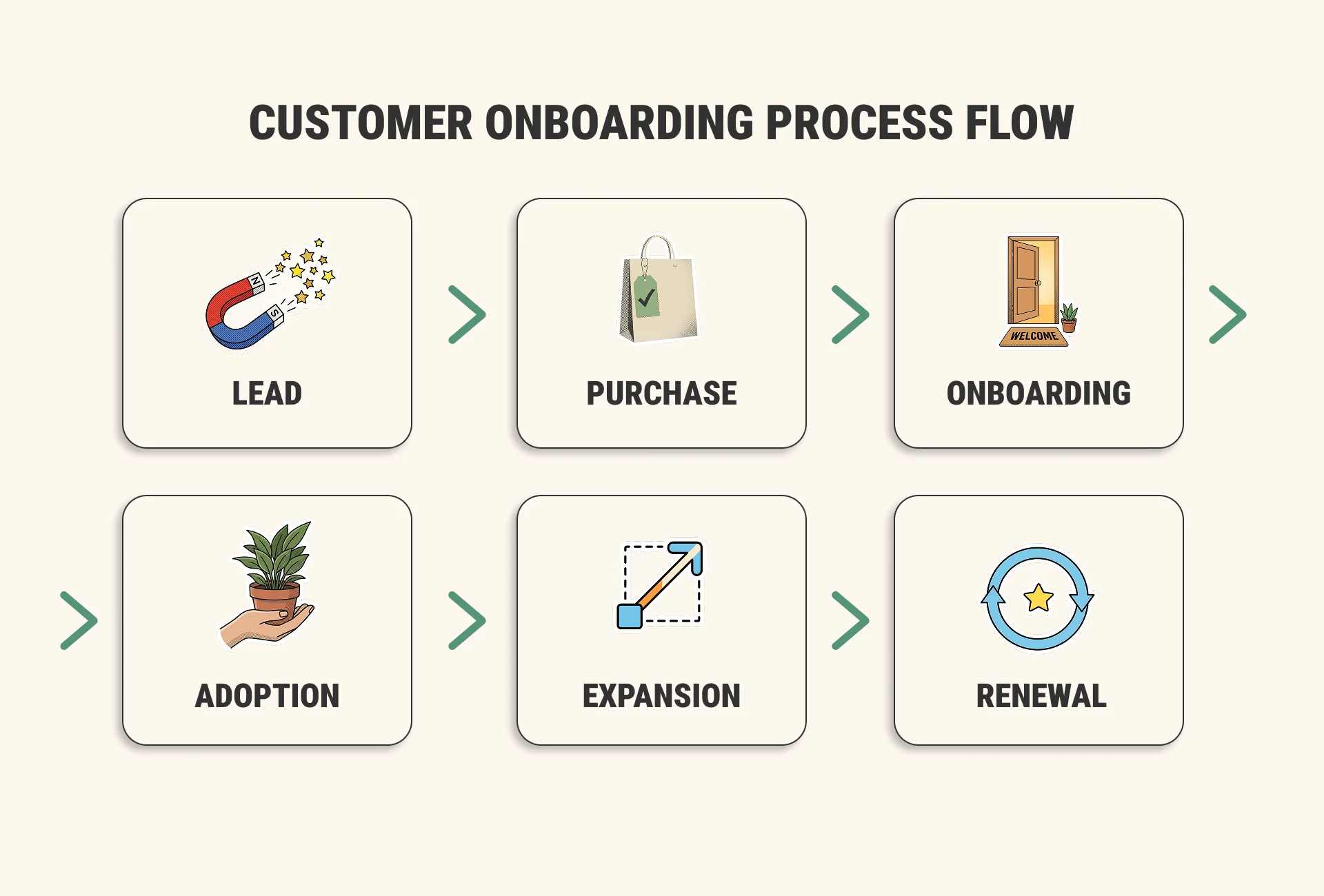
The customer onboarding lifecycle spans purchase through renewal — wider than any checklist, longer than implementation alone.
Most versions of the client onboarding lifecycle run like this:
- Purchase. The sales promise has to become an operating plan.
- Kickoff. Teams confirm goals, stakeholders, scope, and the first value target.
- Implementation. Configuration, migration, integrations, and permissions.
- Training. Users learn workflows, roles, reports, and success behaviors.
- Product adoption. Customers use the product in real conditions.
- Expansion. New teams or partner groups join once value is visible.
- Renewal. Customer Success uses adoption data to support the conversation.
Duration swings hard by segment. Planhat puts self-serve tools at days, mid-market setups at two to six weeks, and enterprise deployments at 30 to 90 days or more.
None of that argues for one universal timeline — only for making each path visible, measurable, and anchored to whatever value that customer signed up for.
Customer Onboarding Process Flow
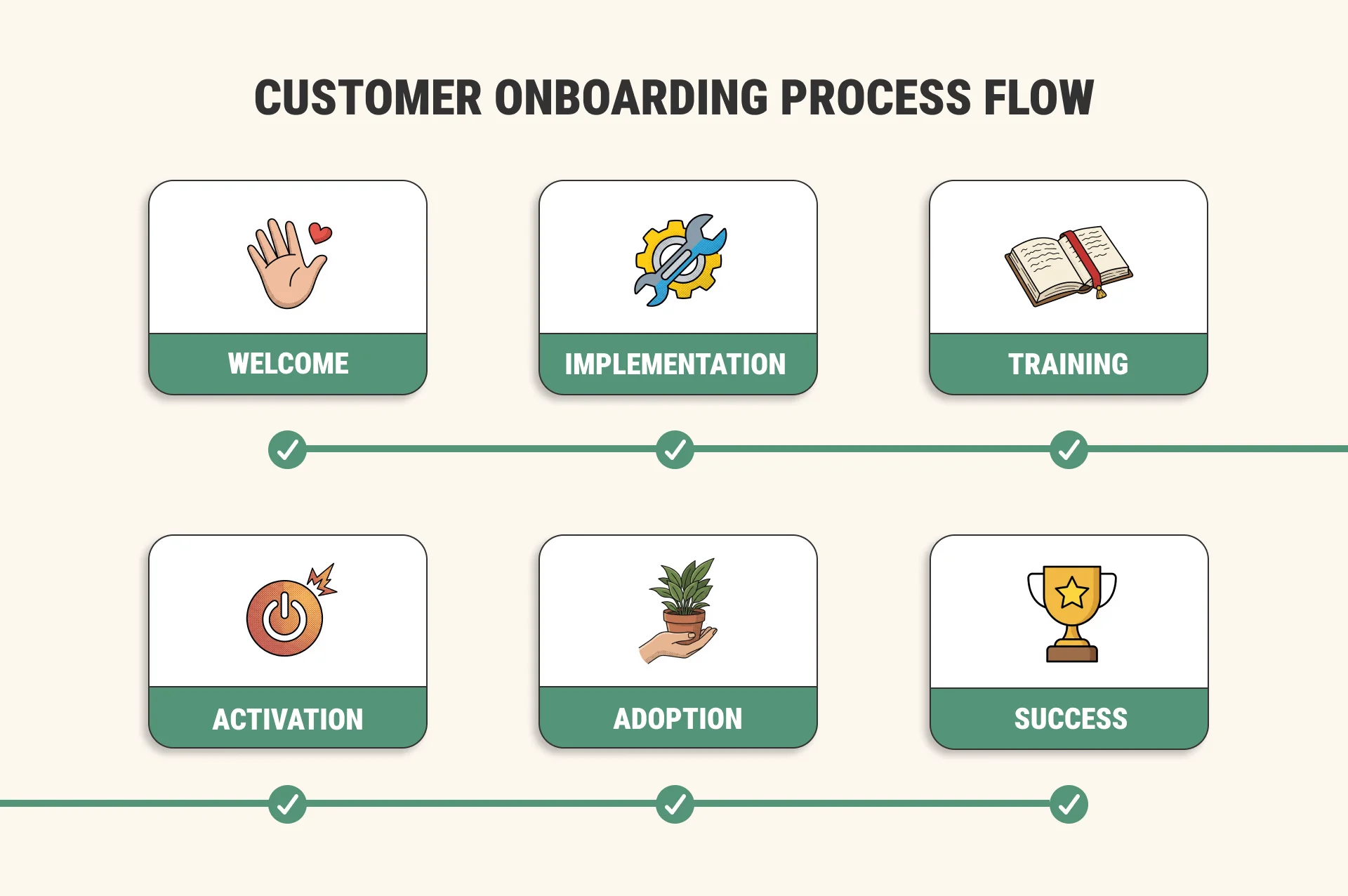
Your customer onboarding process flow is the operational sequence after purchase: simple enough that customers can follow it, detailed enough that your team can run it.
1. Discovery
What did they buy, why, who else needs to be in the room, and what would make this a win? Onboarding a customer well means capturing business goals, user groups, success metrics, use cases, technical dependencies, and — the part teams skip — what the customer owes you by when.
2. Planning
Your customer onboarding plan turns all that into a shared route: timeline, deliverables, milestones, owners, training needs, review dates. Bigger accounts need governance on top. Who approves integrations? Who owns rollout on the customer side? Who breaks a tie when things stall? Sort that out and your onboarding pipeline becomes something the team can see, not something buried in one inbox.
3. Configuration
Account setup, permissions, branding, workflows, data import, integrations, roles. Customer onboarding and implementation overlap here — which is exactly where the common mistake lives: treating configuration as the finish line. A platform can be fully live while every user stares at it, unsure what to click.
4. Training
Role and workflow first, feature list never. Admins, managers, end users, partners, executives: each group needs a different thirty minutes.
A disciplined training design process earns its keep at this stage. Clear objectives, short modules, practice tasks, knowledge checks: all of it outperforms the ninety-minute product tour. Our instructional design work with NASA on the Open Science 101 curriculum ran on that principle — 5 modules, 25 lessons, 12.5 hours of content, sequenced so learners progress deliberately rather than wander.
5. Activation
First dashboard built. First campaign launched. First integration syncing cleanly. Activation is the first genuinely useful thing a customer does, and you should define it before training starts — otherwise your team ends up celebrating course completions while the customer is still waiting on value.
6. Success Review
Adoption data, training completion, open blockers, ticket volume, next steps. A success review tests whether onboarding delivered what was promised — the moment onboarding customer success starts feeding renewal instead of hoping for it.
Mapping the customer onboarding journey
A process flow captures what your team does. A journey map captures what the customer lives through. Set the onboarding customer journey against your flow and the gaps surface fast.
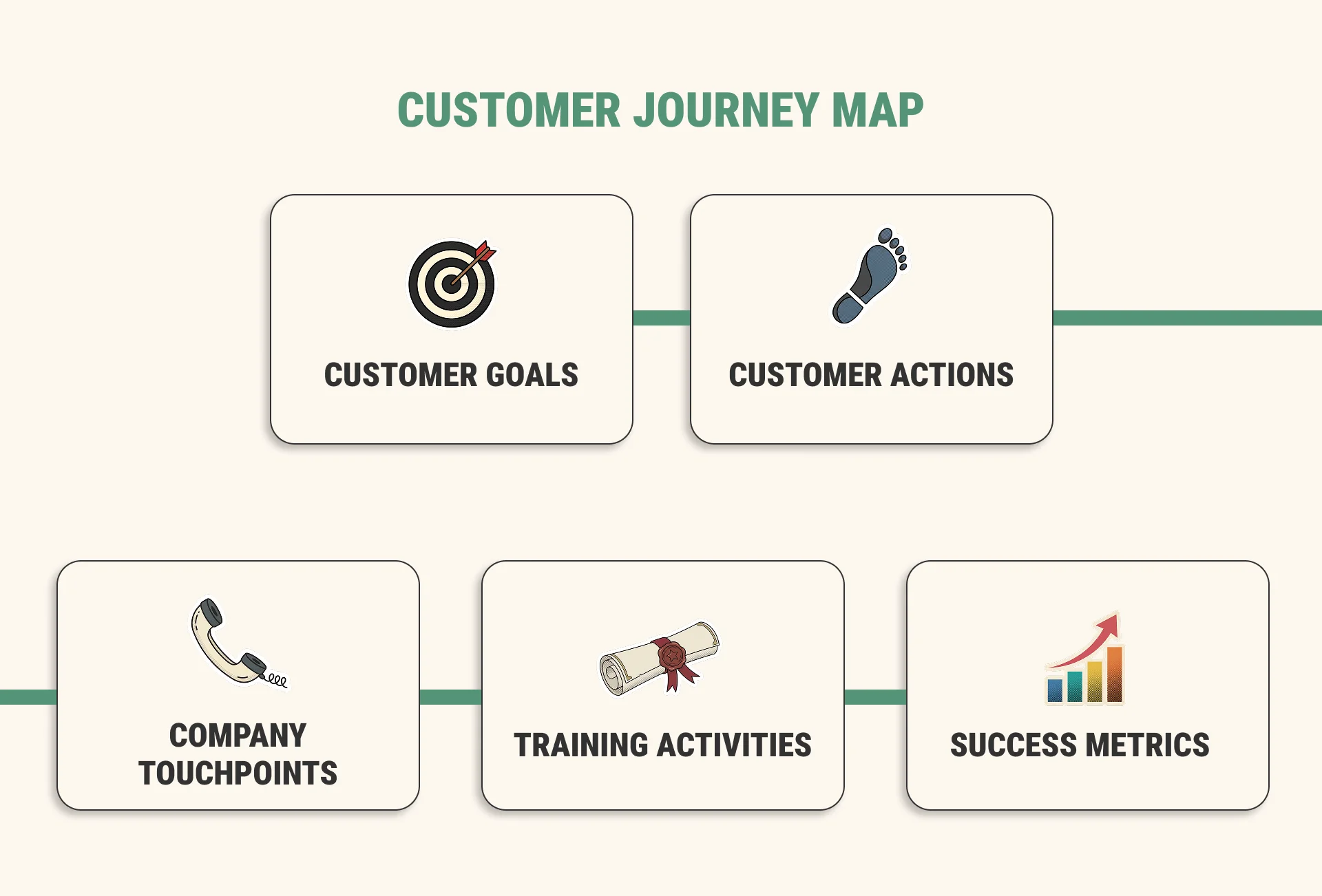
Five rows across your stages: customer actions, customer goals, your touchpoints, training activities, success metrics. Read the blanks, not the boxes. Three internal touchpoints with no training activity beside them usually explains a support spike eight weeks later.
Customer Onboarding Strategy
A customer onboarding strategy is how you get different customers to value without reinventing the route each time. Five questions define it. Which segments need separate paths? What counts as first value for each? Which early actions predict adoption? What training does each role need? And which metrics prove any of it worked?
Plenty of teams still run the unwritten version: the CSM explains everything live. Fine for your first twenty customers. Past that, it collapses, and CSM onboarding quality starts depending on which colleague picked up the account.
Segmentation holds up better:
| Segment | Best-fit onboarding model |
| Self-serve | Automated guides, in-app help, short learning content |
| Mid-market | Group training, CSM check-ins, learning paths, reviews |
| Enterprise | Kickoff, implementation plan, integrations, role-based academy |
| Partners | Certification paths, enablement content, partner portal |
Decide too what stays human. Alignment, blockers, and success planning deserve people. Explanations you have given forty times belong in courses, videos, and knowledge base articles.
Customer Onboarding Plan
Where strategy sets direction, the customer onboarding plan does the bookkeeping that keeps onboarding new customers on track: what happens, when, run by whom, measured how. Timeline, milestones, customer responsibilities, internal owners, training activities, success metrics, risks, handover notes.
Share it early — customers should not be guessing at their own obligations. Two weeks covers a simple rollout; enterprise plans stretch past 90 days. Clarity beats length either way. Nobody should have to ask what happens next.
Customer Success Onboarding
Customer success onboarding is the relationship layer, tying what the customer wants to the work that gets them there.
Typical scope for the customer success onboarding process: kickoff prep, stakeholder alignment, success plan creation, check-ins, adoption review, renewal readiness. Carrying all of it alone is where teams come unstuck. Onboarding customer success works best as three functions in step.
Customer Success owns the relationship, success plan, health signals, and long-term adoption.
Customer Education owns learning paths, training content, academy structure, and certification.
Professional Services owns configuration, migration, integrations, and go-live.
Split those across disconnected systems and the customer absorbs every seam — the same question asked twice, two conflicting timelines. Share onboarding data and usage signals between them, and the journey turns manageable.
Enterprise Client Onboarding
Enterprise client onboarding is harder for one structural reason: your customer is not a person. It is sponsors, admins, security reviewers, IT managers, team leads, end users, and occasionally a partner network sitting behind all of them.
So the work expands: stakeholder mapping, a governance model, security and legal review, integration and migration planning, role-based access, change management, admin and end-user training, executive reporting.
Coordination is the real bottleneck. Procurement lives in one team, IT in another, training somewhere else. An onboarding plan that fails to connect them just documents the delay. A customer education platform earns its budget precisely here. Each audience gets a route of its own: admins learn configuration, managers learn reporting, end users learn daily workflows, and Customer Success can finally see who is stuck.
We built exactly this for AISL Harrow, a network of international schools. Four audiences — Educators, Parents, Students, School Operations — each move through their own role-based navigation, with multilingual support and unified logins spanning Tencent Cloud and Azure. Swap the labels for admins, end users, and partners: the architecture transfers straight into enterprise software onboarding.
Customer Onboarding Process Examples
Customer onboarding process examples vary by industry, though the underlying job never changes: move the customer from expectation to working value.
| Industry | Customer onboarding example |
| SaaS | A project tool walks admins through workspace setup, trains users by role, then tracks first project creation. CXcherry cites Duolingo’s animated walkthrough as a consumer onboarding pattern worth borrowing. |
| Healthcare | A digital health platform trains clinic admins, providers, and support teams separately, with compliance built into each path. |
| Manufacturing | A partner portal teaches distributors product catalogs, warranty workflows, and documentation. |
| Education | An EdTech platform trains school leaders, instructors, learners, and parents through separate paths. |
| Financial services | A fintech platform combines compliance setup, permission training, and audit-ready documentation. |
Public-sector work runs on the same architecture. For the EBRD Policy Academy, our team compressed 24 hours of expert-led seminar material into an 8-hour self-paced program on Open edX: 84 instructional videos, 125 assessment questions, hosted on Azure for staff and external stakeholders.
Not SaaS onboarding, granted. But the machinery is identical: structured content, platform delivery, analytics, support.
Customer Onboarding Automation
Customer onboarding automation exists so consistency does not depend on how much time a CSM has this week.
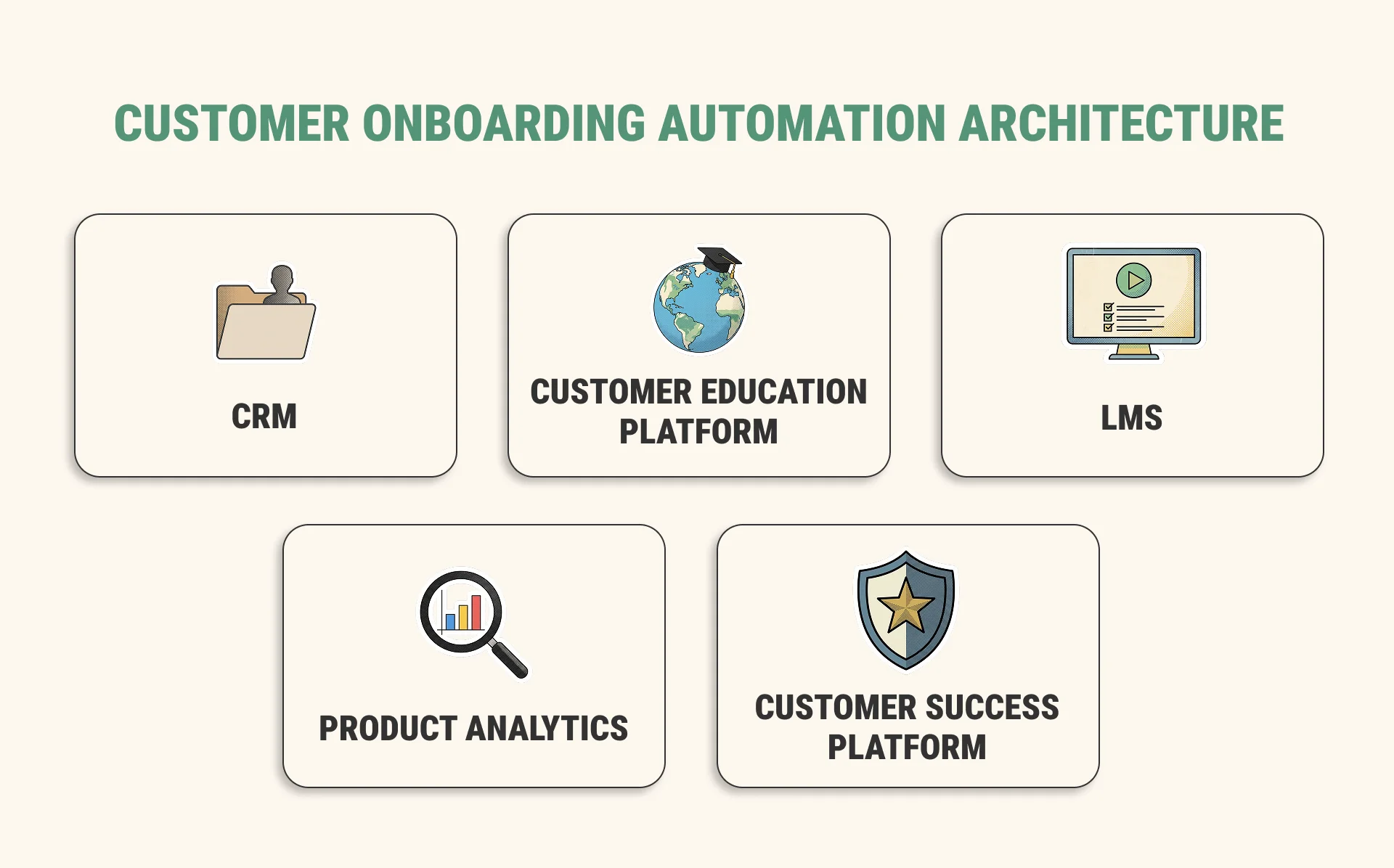
A working setup usually includes:
- CRM. Pushes customer details, segment, and owner into the onboarding pipeline.
- Customer education platform. Hosts onboarding paths, product courses, and certifications.
- LMS. Handles enrollment, progress, assessments, certificates, and reporting.
- Product analytics. Shows whether trained users actually adopt the workflows.
- Customer success platform. Combines learning progress, usage data, and CSM actions.
Pipefy frames automation the same way: CRM-connected processes, customer data moving between systems, handoffs that fire without anyone remembering to trigger them. Results follow.
On one nationwide gamified learning platform our team built, automated enrollment, progress tracking, gamification, and certification helped the customer issue 10 times more certificates than in the offline model. Our guide on how to automate the onboarding process walks through the mechanics.
None of this replaces the relationship. It clears out the friction that was never relational anyway: reminders, enrollments, progress tracking, status updates.
Common Customer Onboarding Mistakes
Most onboarding problems are unglamorous. They are also expensive.
- Too much information too early. Customers do not need every feature in week one. They need the shortest path to first value.
- No learning paths. One product walkthrough cannot serve admins, managers, end users, and partners equally.
- Poor handoffs. Sales, Professional Services, Customer Success, and Support each hold a piece of the story. Customers notice when context disappears between them.
- Undefined success metrics. If the first value is vague, nobody can prove it was delivered.
- No customer-facing visibility. Customers should see milestones, owners, and next steps, or onboarding feels like a black box.
- No improvement cycle. Onboarding data nobody reviews means the same blockers repeat on every account.
How Customer Education Platforms Improve Onboarding
A customer education platform does one structural thing: it converts guidance you keep repeating into learning that scales without you.
The value compounds with audience count: customers, admins, end users, partners, resellers, your own CSMs. Rather than book that same training call again, you build a customer onboarding program: role-based paths, short courses, product tutorials, knowledge checks, certificates, customer academies, partner education, learning analytics.
From there, a customer training LMS extends past onboarding entirely. Setup and activation first, then advanced workflows, certifications, expansion training. That continuity matters because customer digital adoption is never finished. People need help when they join, when features change, when new teams arrive.
Ask Customer Success practitioners in peer communities how to build onboarding from scratch and the advice converges: start with whatever repeats. A few reads help before committing to a platform. Our guide to LMS user engagement covers what actually keeps learners active inside a platform once the novelty wears off — the difference between courses people finish and courses people abandon.
Comparing top LXP features shows where learning experience platforms diverge from a classic LMS, and which of those capabilities matter for customer-facing education rather than internal training. And how to measure training ROI walks through building the measurement model itself, so you can prove the education program pays for its own budget rather than assuming it does.
How Raccoon Gang Helps Organizations Build Customer Onboarding Platforms
We build onboarding and education platforms where learning design, LMS implementation, integrations, and analytics operate as one system rather than four purchases.
Our team works across customer education platforms, Open edX, Moodle, Canvas, custom LMS development, instructional design, mobile learning, and learning analytics. Our customer onboarding services cover rapid LMS deployment, mobile app configuration, push notifications, content consulting, analytics, branding, and custom feature development.
Most of this work starts when ad hoc onboarding stops scaling. We are not replacing Customer Success — the point is to hand it better tools, cleaner data, and learning paths customers can follow without booking another call.
We can support:
- customer onboarding platform planning;
- customer and partner academy design;
- Open edX implementation, plus Moodle and Canvas services;
- instructional design for onboarding content;
- integrations with CRM, product analytics, and customer success systems;
- analytics dashboards for progress and engagement;
- platform support and content improvement.
Since 2015, our team has built learning platforms for NASA, the EBRD, Cybint’s 55,000-learner cyber education program, and TechSoup Romania’s migration of 20,000 users to Open edX. Every one of them required content design, platform engineering, and analytics to hold together as a single system.
Conclusion
Treat the customer onboarding process as the opening of customer success, not the paperwork closing a sale.
The welcome email starts a relationship. Implementation readies the system. Training explains the thing. But onboarding has only worked when a customer reaches first value, knows what comes next, and can see where full adoption leads.
Structure gets you there: discovery, planning, configuration, training, activation, success review. Education keeps you there, because no company growing at pace can run on live calls forever. Customer education platforms, LMS workflows, and analytics are what keep onboarding consistent without turning it cold.
Onboarding is where customers find out whether what they bought turns into something that works. Get that right and everything downstream starts from firmer ground.
FAQ
What is customer onboarding?
Why is customer onboarding important?
What are the stages of customer onboarding?
What is a customer onboarding process flow?
How do you automate customer onboarding?
What tools improve customer onboarding?




- TL;DR
- At a Glance
- What Is Customer Onboarding?
- Why Is Customer Onboarding Important?
- Customer Onboarding Lifecycle
- Customer Onboarding Process Flow
- Customer Onboarding Strategy
- Customer Onboarding Plan
- Customer Success Onboarding
- Enterprise Client Onboarding
- Customer Onboarding Process Examples
- Customer Onboarding Automation
- Common Customer Onboarding Mistakes
- How Customer Education Platforms Improve Onboarding
- How Raccoon Gang Helps Organizations Build Customer Onboarding Platforms
- Conclusion