










Measuring the ROI of learning and development helps organizations assess the business performance improvements achieved by their learning initiatives, such as increased productivity, lower turnover, improved operating efficiency and higher revenue. In order to effectively measure training ROI, many organizations have recently moved from viewing the number of people who complete a training program as evidence of its value to viewing it as insufficient and are instead looking for better measures of the return on their learning investment.
According to research from AIHR, organizations that apply structured ROI measurement frameworks are better positioned to align L&D strategies with business goals and executive expectations. Additional analysis from Docebo highlights that enterprises increasingly focus on measurable business impact rather than on vanity metrics like attendance or completion rates alone.
This shift has pushed organizations to improve their measurement of training ROI through advanced LMS analytics, operational KPIs, and business-aligned reporting frameworks. Companies that implement Open edX learning ecosystems with support from Raccoon Gang often prioritize measurable learning outcomes, advanced analytics visibility, and long-term business impact.
TL;DR
Training ROI measures the business value generated from training programs compared to the total cost of delivering them. Organizations calculate return on learning by comparing measurable gains: productivity improvements, reduced onboarding time, compliance improvements, or revenue growth against direct and indirect training expenses.
What Is Training ROI?
Training ROI refers to the measurable business value created by learning initiatives relative to training costs. The standard formula for calculating the ROI of training is:
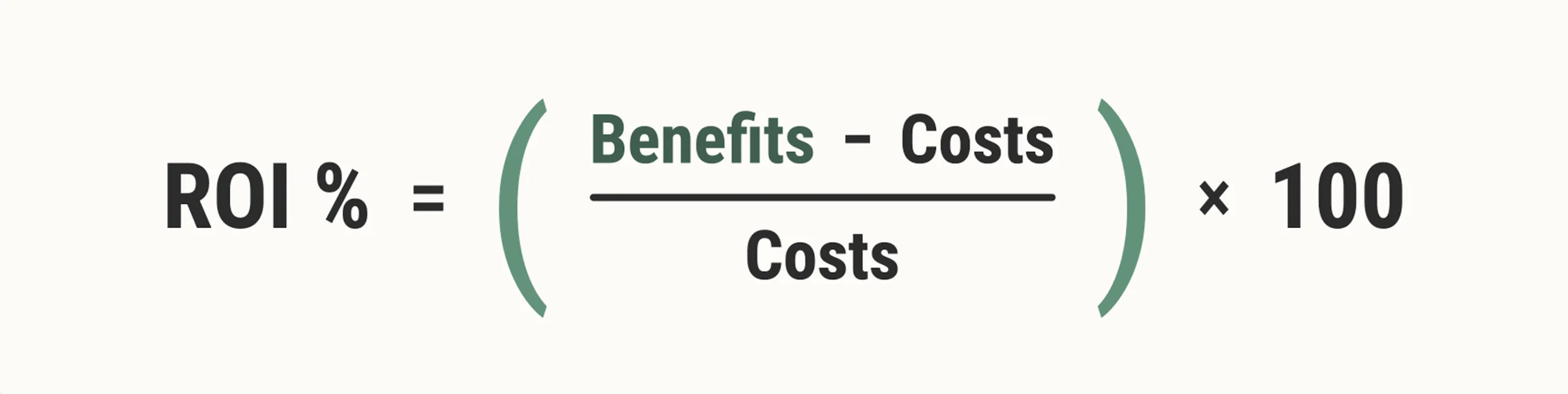
Learning ROI allows organizations to evaluate whether training programs contribute to measurable operational or financial improvements. Businesses use return-on-learning frameworks to evaluate onboarding programs, customer education initiatives, technical upskilling, leadership development, and compliance training. High-performing L&D teams increasingly focus on business impact metrics instead of vanity metrics such as attendance or completion rates alone.
The most effective training and development ROI strategies connect learning outcomes directly to business KPIs, including:
- productivity gains;
- reduced turnover;
- higher sales performance;
- fewer compliance incidents;
- faster onboarding;
- lower support costs;
- increased customer retention.
Organizations implementing Open edX ecosystems with Raccoon Gang often centralize analytics, learner data, and reporting workflows to improve ROI learning and development visibility across departments.
Why Measuring ROI Matters
Enterprise learning teams face increasing pressure to justify budgets and demonstrate business value. Measuring ROI helps organizations make smarter investment decisions while improving executive reporting and learning optimization strategies.
Budget justification
Training budgets often face scrutiny during economic uncertainty or operational restructuring. Measuring ROI of training helps L&D leaders demonstrate that learning investments contribute directly to organizational performance. Different types of employee training require different ROI frameworks, KPIs, and measurement timelines. For example, onboarding programs that reduce time-to-productivity can significantly lower operational costs while improving workforce efficiency.
Executive reporting
Executives expect measurable data tied to business outcomes. Modern L&D ROI reporting often includes operational metrics such as:
- employee retention;
- sales growth;
- compliance performance;
- productivity improvements;
- customer satisfaction.
ROI on learning and development translates training performance into financial language that business stakeholders understand.
Optimization decisions
Organizations also use training ROI metrics to identify which programs deliver the strongest business impact. Analytics-driven learning environments help teams improve content, delivery methods, and learner engagement strategies over time. Research from TalentLMS and D2L shows that organizations using structured ROI frameworks achieve stronger long-term learning outcomes and better executive alignment.
Training ROI Formula
The foundation of nearly every ROI method is the standard business ROI formula:
ROI (%) = [(Benefits − Costs) / Costs] × 100
This formula calculates return on investment training by comparing measurable benefits against total training costs.
Direct costs
Direct training costs may include:
- LMS licensing;
- instructor fees;
- course development;
- certification expenses;
- implementation costs;
- analytics tools.
Organizations working with Raccoon Gang frequently consolidate multiple fragmented learning systems into centralized Open edX ecosystems, helping reduce infrastructure duplication while improving reporting accuracy. Course production and eLearning content development costs often represent a significant portion of total training investment calculations.
Indirect costs
Indirect costs may include:
- employee training hours;
- reduced operational productivity;
- internal administration;
- support resources.
Many organizations underestimate these costs when calculating ROI in training programs.
Measurable gains
Training ROI calculations should focus on measurable business improvements such as:
- lower turnover;
- increased productivity;
- reduced compliance risk;
- higher sales conversion rates;
- reduced support tickets;
- faster onboarding;
- improved operational performance.
Research from Acorn and Kodo Survey highlights that organizations using structured KPI-based measurement frameworks produce more reliable ROI for training analysis. Many enterprise organizations also combine the Kirkpatrick Model with the Phillips ROI Methodology to improve business impact analysis and financial attribution.
How to Measure ROI in Learning and Development
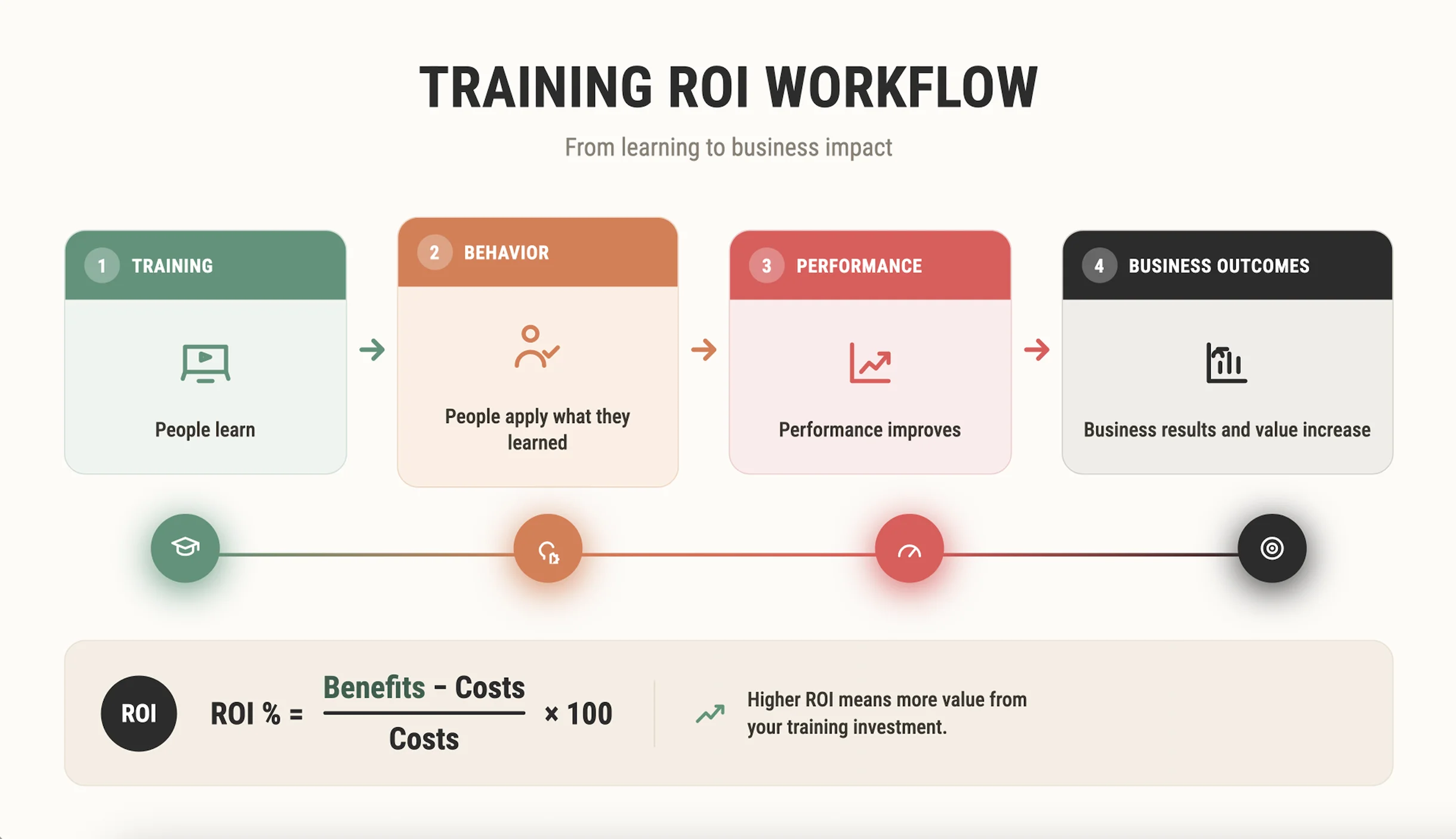
Organizations asking “how do you measure ROI?” should approach learning measurement as an ongoing operational process rather than a one-time reporting exercise.
Step 1: Define objectives
The first step in how to measure ROI in learning and development is identifying the business problem training should solve.
Examples include:
- reducing onboarding time;
- increasing sales productivity;
- improving customer retention;
- reducing compliance violations;
- improving software adoption.
Different employee training methods may produce different ROI outcomes depending on organizational goals, workforce structure, and learner engagement levels.
Step 2: Identify measurable KPIs
Strong training ROI metrics connect directly to operational performance indicators.
Examples include:
- revenue growth;
- support ticket reduction;
- employee retention;
- onboarding speed;
- customer satisfaction;
- productivity output.
Step 3: Collect baseline data
Organizations measuring ROI must establish baseline metrics before training begins. Without pre-training benchmarks, it becomes difficult to isolate business improvements accurately.
Step 4: Measure post-training outcomes
Post-training analysis may include LMS analytics, performance reviews, CRM data, operational reporting, and learner assessments.
Organizations implementing analytics-focused Open edX ecosystems through Raccoon Gang often integrate LMS reporting with HR systems, BI platforms, and CRM tools to improve visibility into training and development ROI.
Step 5: Calculate financial impact
This step converts operational improvements into measurable business value by assigning a financial impact to performance changes resulting from training initiatives.
Organizations may calculate savings from lower hiring costs due to improved employee retention, increased revenue driven by sales enablement programs, reduced support expenses through customer education initiatives, and lower compliance-related costs resulting from fewer violations or penalties.
Step 6: Calculate ROI
Once organizations identify total benefits and costs, they can calculate training return on investment using the ROI formula. This process helps enterprise L&D teams improve measuring ROI while supporting long-term business planning and executive reporting.
Training ROI Metrics
Organizations measuring ROI need reliable indicators that connect learning outcomes to business performance. The most effective training ROI metrics go beyond learner satisfaction surveys and focus on measurable operational improvements.
Completion rate
Completion rates remain one of the most common LMS metrics. They help organizations understand participation levels and learner engagement. However, completion data alone does not prove business impact. A training initiative may achieve high participation while producing minimal operational improvement. This is why organizations increasingly combine completion tracking with productivity, retention, and performance analytics.
Productivity improvements
Productivity is one of the strongest indicators of ROI training and development success.
Examples include:
- reduced onboarding time;
- faster task completion;
- improved workflow efficiency;
- reduced operational errors;
- increased output per employee.
Enterprise organizations frequently use Open edX analytics environments implemented by Raccoon Gang to monitor productivity trends across distributed learning programs.
Employee retention
Retention improvements can significantly influence ROI for learning and development initiatives.
Replacing employees often involves:
- recruitment costs;
- onboarding expenses;
- productivity losses;
- management overhead.
Leadership development and career advancement programs frequently improve retention rates, especially in competitive industries. Many organizations use employee retention training initiatives to improve engagement, reduce turnover, and strengthen long-term workforce stability.
Sales impact
Sales enablement programs often measure:
- revenue growth;
- lead conversion rates;
- shorter sales cycles;
- upsell performance;
- customer retention improvements.
These business outcomes help organizations strengthen return on training investment analysis.
Compliance performance
Compliance training programs often focus on risk reduction.
Relevant metrics may include:
- fewer compliance violations;
- lower audit failure rates;
- reduced legal exposure;
- improved reporting accuracy.
Organizations managing complex compliance environments through Open edX ecosystems supported by Raccoon Gang often centralize certification tracking, reporting workflows, and learner records to improve visibility into ROI on training.

Training ROI Calculator Example
A practical training ROI calculator example helps organizations understand how financial attribution works in real business scenarios. Imagine a company launches a customer support onboarding initiative designed to reduce ticket escalation rates and accelerate employee productivity.
Training investment
The total training cost equals $25,000.
This includes:
- LMS licensing;
- course creation;
- instructor costs;
- employee learning hours;
- analytics setup.
Business impact
After implementation, the organization measures several improvements:
- onboarding time decreases by 35%;
- support escalations drop by 22%;
- customer satisfaction improves;
- support teams resolve tickets faster.
Estimated annual savings equal $60,000.
ROI calculation
ROI (%) = [(Benefits − Costs) / Costs] × 100
The final training ROI equals 140%.
This means the organization generated 1.4 times the original investment in measurable business value. This type of training ROI calculator model is widely used in enterprise learning environments to support executive reporting and budget planning. Looking to build scalable LMS environments with measurable ROI tracking capabilities? Raccoon Gang helps organizations implement Open edX ecosystems with advanced analytics, reporting dashboards, and business-focused learning measurement frameworks.
Measuring ROI of Employee Training
Different employee learning programs require different approaches to ROI measurement. Organizations should align training ROI metrics with the specific business outcomes each initiative targets.
Onboarding programs
Onboarding initiatives often focus on:
- reducing time-to-productivity;
- improving employee confidence;
- lowering turnover;
- reducing manager supervision time.
The ROI of employee training in onboarding environments can often be measured within several months after implementation.
Leadership development
Leadership programs usually produce longer-term business outcomes.
Organizations commonly measure:
- employee retention;
- team productivity;
- internal promotions;
- engagement improvements;
- management effectiveness.
According to ATD, leadership learning initiatives frequently require long-term tracking to measure the full return on investment of employee training impact.
Compliance training
Compliance-focused learning programs typically measure risk reduction rather than direct revenue generation.
Relevant KPIs may include:
- reduced legal exposure;
- fewer policy violations;
- improved certification completion;
- reduced audit failures.
Organizations using Open edX implementations developed by Raccoon Gang often automate compliance reporting workflows and certification management to improve operational efficiency and visibility into ROI for training programs.
Customer Training ROI
Customer education initiatives have become increasingly important for SaaS companies, enterprise software providers, healthcare organizations, and higher education institutions.
Customer training ROI focuses on measurable business improvements, such as:
- reduced support costs;
- increased product adoption;
- lower churn;
- improved customer retention;
- stronger onboarding outcomes;
- increased expansion revenue.
For many software companies, customer education programs directly influence long-term profitability.
When users understand products more effectively, organizations typically see:
- fewer support tickets;
- faster onboarding;
- higher engagement;
- increased feature adoption.
Research from TalentLMS shows that customer education initiatives frequently improve operational efficiency while reducing customer success costs.
Organizations implementing customer learning portals with Raccoon Gang often use Open edX to centralize onboarding, product certification, self-service learning, and customer enablement programs within scalable enterprise learning environments.
Common Mistakes in Measuring ROI
Assessing the return on investment (ROI) from training and performance solutions has become a challenge for many organizations because they base their conclusions and actions on incomplete and incorrect data from their training measurements.
Relying on surveys only
When determining the value of training for an organization, many fail to measure its ROI. The biggest problem with measuring ROI for training is that most organizations focus on qualitative measures and learners’ experiences during training (for example, satisfaction surveys). However, the ROI of training is based on the return the organization sees, not on learners’ experience during training.
Measuring a positive score on a course does not automatically mean that employees have become more productive, better employees, or made any other improvements that positively impact the organization’s operations. The skills that employees acquire in a course can be very easily not applied in their daily work.
Missing baseline data
Measuring the return on investment (ROI) of training and development programs is a notoriously difficult task for many organizations. One of the key reasons for this is the lack of baseline data prior to a learning initiative. Without a measure of employees’ performance before they complete a training program, it is impossible to compare their behavior and contribution to the organization with what they do after completing the training.
Measuring ROI for training is extremely unreliable, as there is no hard evidence linking the time, effort and money invested in a learning initiative to the resulting business outcomes. By setting up key metrics at the start of a learning program, one can accurately measure progress during and after the program.
Tracking vanity metrics
Many L&D teams are today tracking the wrong metrics, the so-called ‘vanity metrics’. These numbers look good at first sight, but they don’t say anything about the business value a training program can add. Clicks, attendance rates, course starts, and completion rates of learners – there is more to measuring the impact of a learning program than tracking these numbers.
L&D measures clicks, attendance rates, course starts and completions to appear to show that their learning programs are delivering results for the organization. These will be the numbers of clicks on learning portals, workshop attendance and starts and completions of online courses, etc. The impression is given that the learning programs are being ‘used’ by employees, that they are ‘engaged’ with the learning provided by the organization.
Instead of tracking vanity metrics such as the number of clicks on learning platforms, course completion rates, or other measures of learner engagement, organizations must track the key performance indicators that reflect the business outcomes their learning programs are designed to deliver. In order to measure the ROI of training, L&D must measure the training against a set of operational KPIs, such as increased levels of productivity, improved levels of employee retention,
Ignoring long-term impact
Some training will have a longer-term impact than others. Thus, leadership development, onboarding strategies, customer education strategies etc., will require a longer-term measurement approach to establish a calculation for ROI.
Measuring the return on investment of training programs aimed at improving employee performance over the long term, such as leadership development, onboarding optimization and customer education, requires a long-term measurement framework.
Businesses can be misled into underestimating the full value their learning strategies can bring to the organization when they measure only short-term results.
LMS Analytics and ROI Measurement
One of the biggest challenges of training and development for organizations today has been to measure ROI. With modern Learning Management Systems (LMS) the learning environment has now become a measurement tool. It enables organizations to not only measure the skills their employees and their other training features like assessment and certification, and also how they translate to business performance.
Advanced learning environments track employees’ interaction with training material, their skills development, their performance on assessments, their certification completion as well as the overall training effectiveness and the business performance improvements resulting from learning initiatives.
Data provided by today’s Learning Management Systems (LMS) are used by organizations to measure the ROI of their training. However, the use of such data does not stop at measuring the number of people taking a course of study. It is also used to measure the trends in performance of learners as well as find out where there are skills gaps in the workplace and other related issues.
In order to measure the impact of training, the L&D team can use L&D-related features in the LMS, like the engagement dashboard of learners, learner analytics, performance measurement and assessment reporting. The L&D team can then measure the impact of training of employees and which training programs are having the biggest operational impact.
While reports from the LMS are a good starting point for the return on investment, most of the time this data alone is not sufficient to do the calculation. In the context of Enterprise 2.0 platforms, in addition to the LMS, there are other systems, for example, HR systems, CRM systems, Business Intelligence systems, and reporting systems that are integrated to the LMS in order to measure the performance of workforce and the business results in more details.
This data can then be connected to real organization KPI’s such as decreasing employee turnover, increasing productivity, improving sales performance, complying with regulations, and increasing customer satisfaction.
Having an Open edX environment with Raccoon Gang integrated into your Learning Management System (LMS) also allows for strong visibility into training and development ROI across departments
Raccoon Gang supports organizations running Open edX environments with similar structures for their analytics architecture.
- executive dashboards;
- KPI reporting;
- automated learner analytics;
- compliance tracking;
- operational performance analysis.
Our professionals help organizations align learning data with measurable business outcomes rather than isolated training activity metrics. Organizations evaluating Canvas LMS ROI often focus on analytics visibility, operational efficiency, learner engagement, and administrative automation benefits.
How Raccoon Gang Helps Organizations Measure Learning ROI
Successful learning ROI measurement requires more than deploying online courses. Organizations need scalable infrastructure, analytics visibility, operational integrations, and measurable reporting frameworks. Raccoon Gang helps enterprises, universities, healthcare providers, and EdTech organizations implement Open edX ecosystems designed for measurable business impact.
Our experts support organizations through:
- LMS implementation
- Open edX customization
- analytics setup
- learner reporting
- certification tracking
- KPI dashboard development
- CRM and HR integrations
- scalable learning architecture optimization.
Raccoon Gang also helps organizations design learning measurement frameworks aligned with operational goals and executive reporting requirements. For enterprises focused on measuring ROI at scale, our team helps connect learning activity directly to measurable business performance indicators.
Conclusion
Training ROI has become a critical measurement framework for enterprise learning teams. Organizations can no longer rely on completion rates or satisfaction surveys alone when evaluating learning effectiveness. Understanding how to measure ROI in learning and development helps organizations connect training investments to measurable operational outcomes like productivity, retention, compliance performance, customer success, and revenue growth.
The most effective ROI strategies combine clear business objectives, measurable KPIs, baseline data collection, LMS analytics, financial attribution models, and ongoing optimization.
Organizations that approach training as a measurable business investment gain stronger visibility into workforce performance and long-term organizational impact. With scalable Open edX environments, analytics frameworks, and implementation expertise from Raccoon Gang, organizations can build learning ecosystems that support measurable business outcomes and long-term return on learning initiatives.

- What Is Training ROI?
- Why Measuring ROI Matters
- Training ROI Formula
- How to Measure ROI in Learning and Development
- Training ROI Metrics
- Training ROI Calculator Example
- Measuring ROI of Employee Training
- Customer Training ROI
- Common Mistakes in Measuring ROI
- LMS Analytics and ROI Measurement
- How Raccoon Gang Helps Organizations Measure Learning ROI
- Conclusion