








Choosing a learning platform is the easy part. The harder question comes several months later, when someone asks what the investment is actually producing. For Canvas LMS customers, that question surfaces consistently, and understanding Canvas LMS ROI depends far less on the platform than on what was built around it.
Canvas provides the infrastructure; what goes into it, how it’s configured, and whether anyone is measuring the right things — that’s where the return gets made or lost.
This article focuses on the practical side: what drives Canvas ROI, how to measure it, and where the real leverage points are.
What Is LMS ROI?
LMS ROI is the financial and operational return an organization gets from its learning management system investment. It measures total costs — licensing, implementation, content development, and administration — against outcomes like reduced training spend, faster employee performance, lower turnover, and improvements in the business metrics that training is meant to influence.
What Is Canvas LMS?
Canvas LMS is a cloud-based learning management system developed by Instructure, widely used across higher education and corporate training programs worldwide. For a full overview of the platform, see our guide to Canvas LMS.
How Canvas LMS Impacts ROI
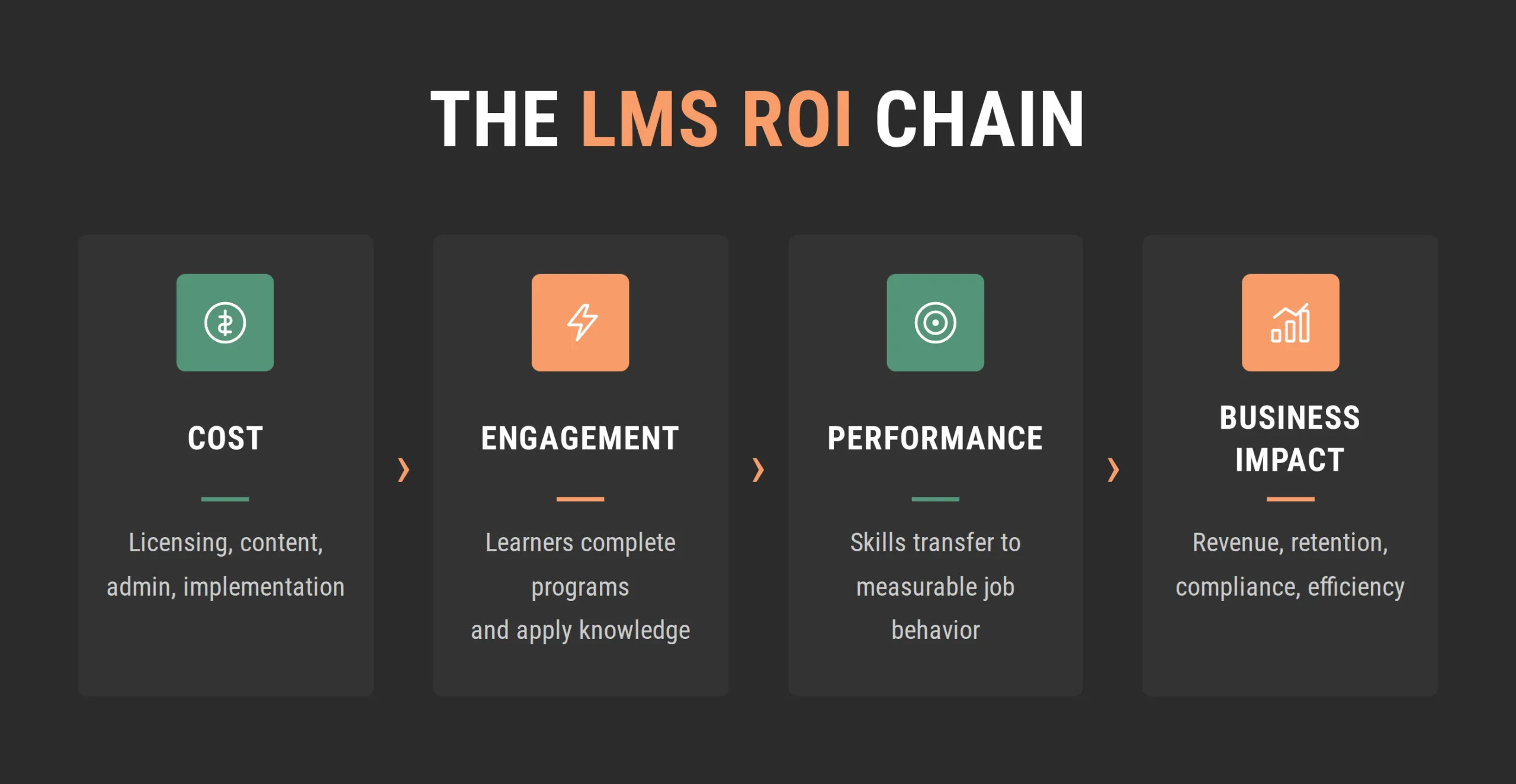
ROI from an LMS comes from three places: reducing the cost of delivering training, improving what that training produces, and generating data that makes both visible to the people who need to see it.
Canvas’s architecture addresses all three, though none of it happens automatically. The platform’s usability keeps learners from dropping off mid-program, which directly affects whether the content investment pays off. The analytics layer captures learner behavior in more detail than most organizations put to use. The integration layer means learning data can connect to the HR and performance systems where business decisions actually get made.
The organizations that get the most from Canvas configure the platform around measurement from the start, not just delivery. When learning data connects to the systems where business decisions get made, the ROI case becomes visible.
Key Drivers of Canvas ROI
Increased Learner Engagement
Every learner who drops off a program mid-way represents content development cost with no return. It’s one of the most common ways LMS investments underdeliver without anyone noticing until the data is reviewed.
Canvas’s course layout, mobile accessibility, and communication tools reduce that drop-off rate. According to LinkedIn’s 2024 Workplace Learning Report, platform friction is among the most frequently cited reasons for low engagement in digital programs. Removing it has a measurable effect on completion — and completion is the minimum condition for any downstream ROI.
Faster Time-to-Competence
The relevant question for any business is how quickly someone reaches the point where they can perform. Canvas’s course pathing, prerequisite logic, and progress visibility give managers a clearer picture of where learners actually are in their development — which is information that most LMS-generated reports don’t surface clearly.
For onboarding specifically, ramp-up time has a direct cost that organizations can calculate. Building programs around specific competency milestones — with Canvas structured to track progress toward those milestones — is what makes that calculation possible.
Reduced Administrative Overhead
Enrollment management, completion tracking, certificate issuance, reporting — this work takes time, and in organizations that haven’t automated it, that time adds up across every program, every cohort, every quarter.
Canvas handles the operational layer:
- Automated enrollment triggers
- Bulk updates and self-registration workflows
- Reporting dashboards that don’t require manual assembly
- Certificate issuance at scale
The savings per task are modest. Across a full program portfolio running year-round, they accumulate into a meaningful reduction in administrative overhead.
Scalable Training Delivery
Per-learner cost drops as delivery scales. Canvas handles the infrastructure side of this without requiring proportional headcount increases in training or IT.
For organizations with distributed workforces, compliance requirements across multiple jurisdictions, or partner training programs that span regions, the ability to scale delivery without scaling cost is what makes the LMS investment defensible to finance.
Integration Efficiency
Completion data that stays inside the LMS doesn’t inform decisions. Canvas connects to HRIS platforms, CRM systems, and performance management tools through LMS integration standards — LTI and open APIs — so learner progress and assessment results can surface in the systems where managers actually work.
Data-Driven Decision Making
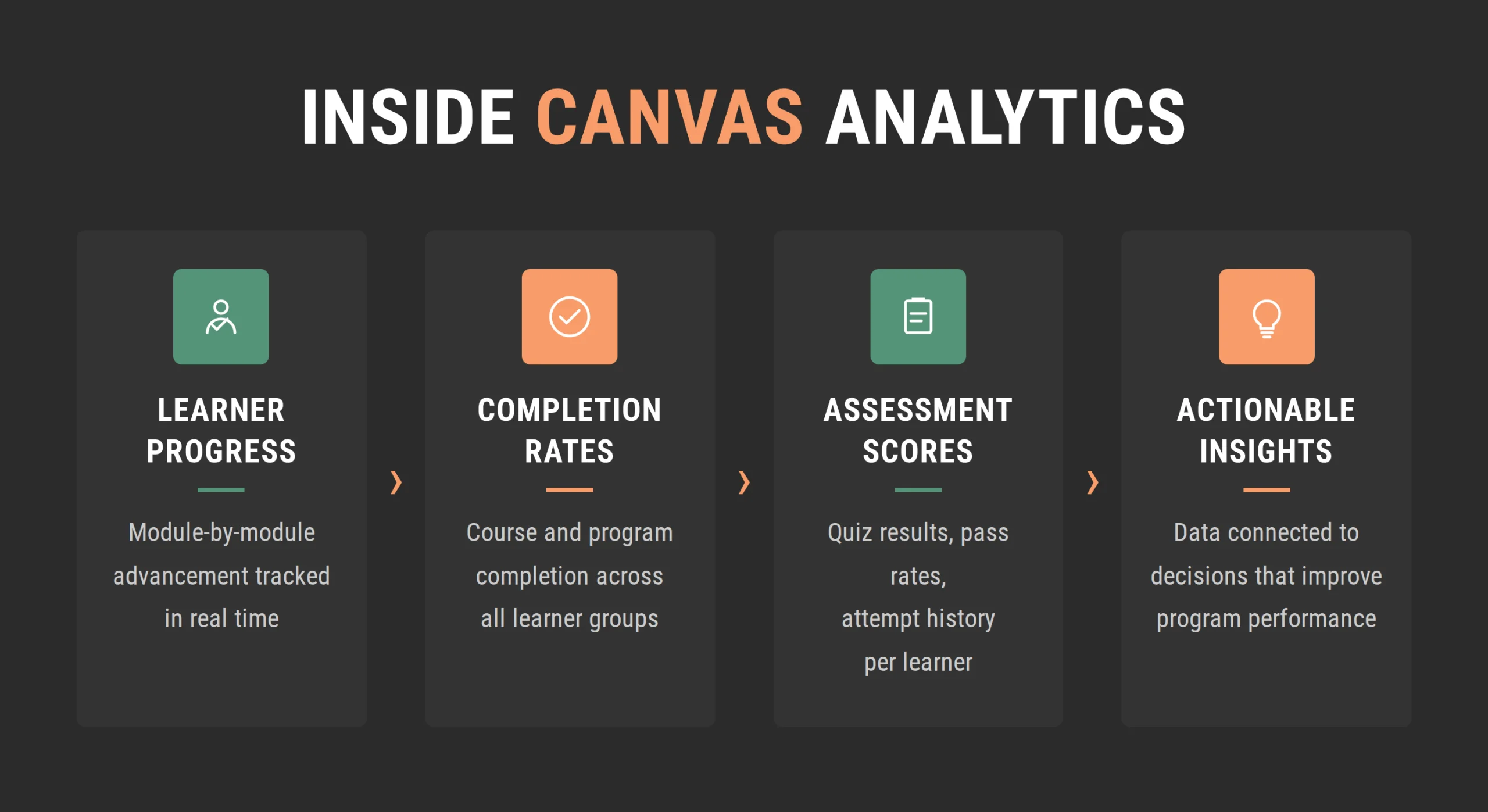
Canvas captures time-on-task, quiz scores, module completion, discussion activity, and assessment results at a granular level. Most organizations collect this data. Few have a framework for acting on it.
How to Measure ROI on LMS Platforms
Measuring LMS ROI means tracking both sides of the investment with precision about which metrics actually reflect business outcomes.
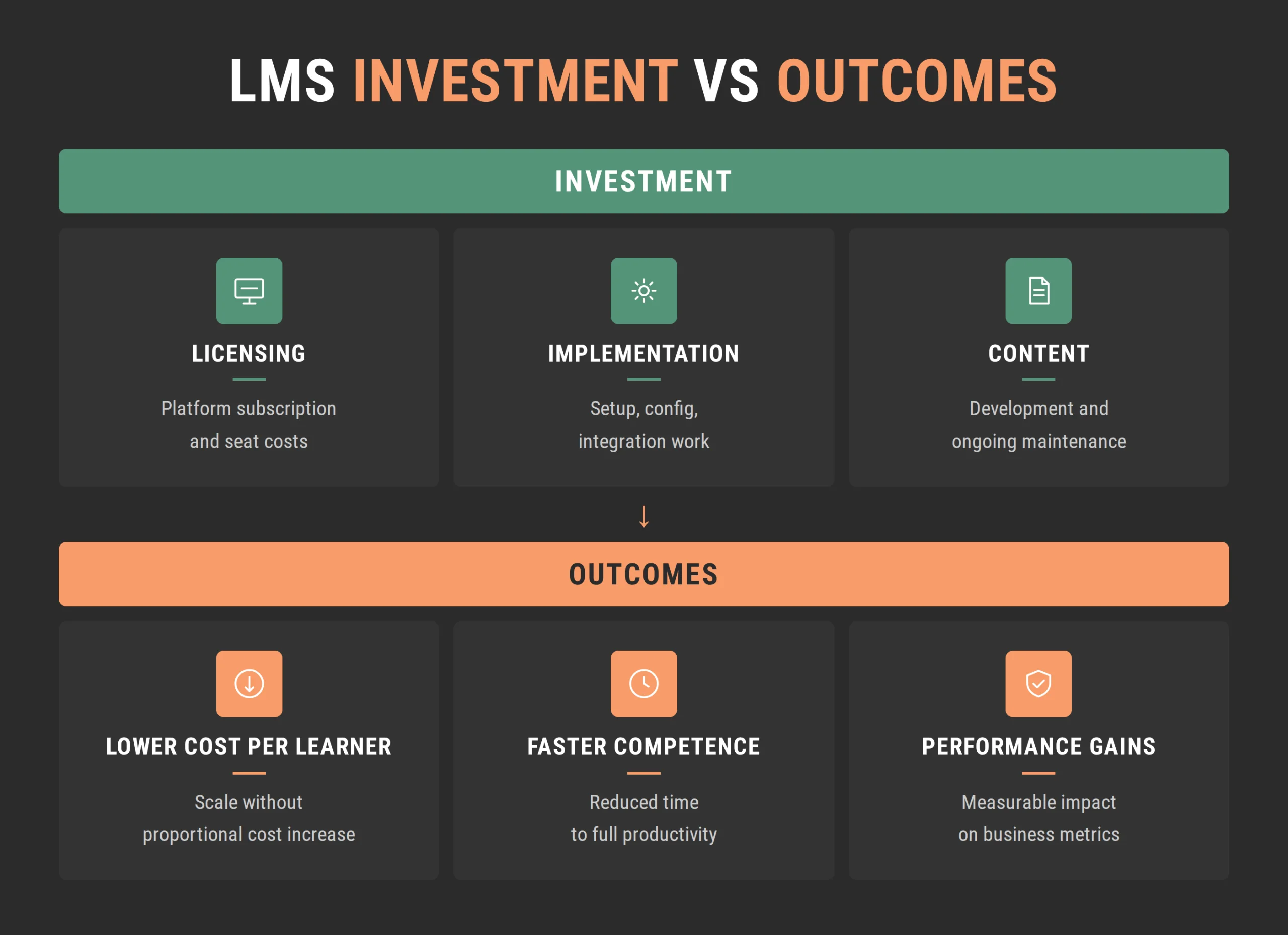
Cost components:
- Platform licensing (Canvas uses institutional or per-seat pricing — our Canvas pricing breakdown covers what to expect).
- Implementation and configuration.
- Content development.
- Ongoing administration and support.
- Integration development.
Benefit metrics:
- Reduction in per-learner training cost compared to previous delivery method.
- Time-to-competence improvement for key roles.
- Compliance completion rates and audit documentation.
- Performance changes in trained populations: sales conversion, error rates, customer satisfaction scores.
- Avoided costs: travel, venue, contractor facilitation.
The Kirkpatrick model provides a useful measurement structure. Levels 1 and 2 — learner reaction and knowledge acquisition — are measurable inside Canvas. Levels 3 and 4 require connecting Canvas data to external performance systems. Most organizations measure the first two. The ROI case that holds up to scrutiny from leadership requires all four.
Before any content goes into Canvas, identify two or three business metrics the program is supposed to move. Build the measurement framework around those. If the program claims to affect sales performance, the analytics configuration should be designed to support that claim with data.
Canvas ROI vs Other LMS Platforms
The ROI comparison between Canvas and other platforms comes down to which cost and capability profile fits the organization’s situation. Raccoon Gang works across three primary platforms — Canvas, Moodle, and Open edX — and the right choice depends on what the organization actually needs.
Canvas offers predictable costs, vendor-managed infrastructure, and a faster path to deployment. The LMS ROI return on investment case for Canvas is strongest when speed and operational simplicity are the primary requirements — organizations that need a reliable, well-supported environment without the overhead of managing platform infrastructure.
Moodle is open-source and highly customizable, with a large global community and a wide plugin ecosystem. It suits organizations that need flexibility in how the platform is structured and are willing to invest in configuration and maintenance to get there.
Open edX is built for scale and complex learning architectures. It delivers strong long-term ROI for organizations that need deep customization, branded learning environments, or full ownership of their platform deployment and infrastructure.
Canvas LMS ROI for Different Use Cases
Corporate Training
In onboarding and compliance contexts, Canvas ROI comes primarily from automation and auditability. Automated enrollment, role-based learning paths, and certificate tracking reduce administrative cost while giving compliance teams the documentation they need. The calculation is relatively concrete: staff time saved, plus cost per completion compared to previous delivery methods.
Higher Education
For universities, ROI shows up in faculty adoption rates, reduced IT overhead, and student retention. Retention is financially significant — each percentage point of improvement carries measurable revenue implications for institutions. Canvas’s usability affects retention through engagement patterns that correlate with course completion rates.
Enterprise Learning Programs
Global rollouts and partner training programs have a distinct ROI profile. The primary driver is coordination cost — the overhead of running consistent training across regions, business units, or external partners. Canvas’s sub-account structures, multi-language support, and enterprise integrations address this directly. At scale, reducing coordination overhead is where the investment case gets made.
How to Maximize ROI from Canvas LMS
The organizations that see strong returns from Canvas share a few consistent practices:
- Connect training goals to business metrics before content development starts. An undefined outcome can’t be measured.
- Configure analytics around the questions leadership actually asks. Default reporting describes activity; configured reporting describes impact.
- Integrate Canvas with the systems where performance data lives. Completion data inside a closed system doesn’t reach the people who need it.
- Build a review cadence into the program lifecycle. Canvas data is most valuable when it drives the next program iteration.
- Treat platform deployment as a design decision. Configuration choices made at setup determine what’s measurable later.
How Raccoon Gang Helps Maximize LMS ROI
Our team works across LMS architecture, integration strategy, analytics configuration, and content alignment through our LMS consulting services. Before configuration begins, we work with organizations to define what ROI should look like in their specific context — which metrics matter, which systems need to connect, and what the measurement framework looks like before content goes live.
Our professionals have supported Canvas implementations across corporate training programs, university deployments, and enterprise partner academies. The specifics vary considerably; the approach to building measurable outcomes into the platform setup stays consistent.
Conclusion
Canvas LMS gives organizations a capable foundation for delivering training at scale. Whether that produces ROI comes down to decisions made before the first course goes live — how the platform is configured, what it connects to, and whether a measurement framework exists to capture what the training actually produces.
The organizations that get a strong Canvas LMS ROI treat implementation as a strategic decision. If you’re evaluating Canvas or looking to improve returns on an existing deployment, our team is glad to help you work through what that looks like.
FAQ
What is LMS ROI?
LMS ROI measures the return an organization gets from its learning management system investment against total costs: licensing, implementation, content, and administration. Meaningful ROI requires connecting platform outputs to business outcomes: performance improvement, cost reduction, faster time-to-competence, or measurable changes in the metrics the training was designed to influence.
How do you measure ROI on an LMS?
Identify the business metrics the training is meant to influence before the program launches. Track cost inputs against outcome metrics: time-to-competence, performance improvement, compliance rates, and avoided costs. The Kirkpatrick model provides a useful structure across four levels: reaction, learning, behavior change, and business impact. Connecting LMS data to external performance systems is what makes Levels 3 and 4 measurable.
Does Canvas LMS provide good ROI?
Canvas provides strong ROI in contexts where speed of deployment, ease of administration, and integration breadth are the primary requirements. The return depends on how the platform is implemented, what it’s configured to measure, and whether programs are built around specific business outcomes.
What affects LMS ROI the most?
Implementation quality, measurement rigor, and integration depth. A well-configured platform connected to the right systems—with analytics tied to business metrics and a process for acting on the data—produces returns that are visible to leadership.
How can organizations maximize LMS ROI?
Define business outcomes before content development. Integrate the LMS with HR and performance systems. Configure analytics around the questions leadership actually asks. Build iteration into the program lifecycle and treat platform configuration as part of the learning design.