







Organizations pour enormous resources into corporate training every year. A significant chunk of that investment produces little to no measurable change in how people perform — and the reasons usually have nothing to do with budget or talent. Most training programs simply get built without a real design process behind them.
The training design process is what changes that. This guide covers what it is, how it works, and what it looks like when applied properly.
What Is Training Design?
Training design is the process of building learning experiences around a specific outcome — what someone needs to be able to do, know, or decide differently after the training is over.
In practice, a lot of training skips this entirely. Content gets assembled around what a subject matter expert knows, or what a previous program covered, or what fits in a two-hour window. Training design meaning, at its most practical, is the discipline of making sure every piece of a program traces back to a real need.
What Is the Training Design Process?
The training design process is how you build training systematically, with a clear rationale behind every decision. It starts with a problem, works through how people will learn what they need to learn, and ends with evidence that something actually changed.
The process is closely connected to instructional design — a field that brings learning research into program development alongside content expertise. When people ask what is training design process in a practical context, the short answer is: it’s the set of decisions that connects what an organization needs to what a learner walks away with.
Training Design Process: 7 Steps
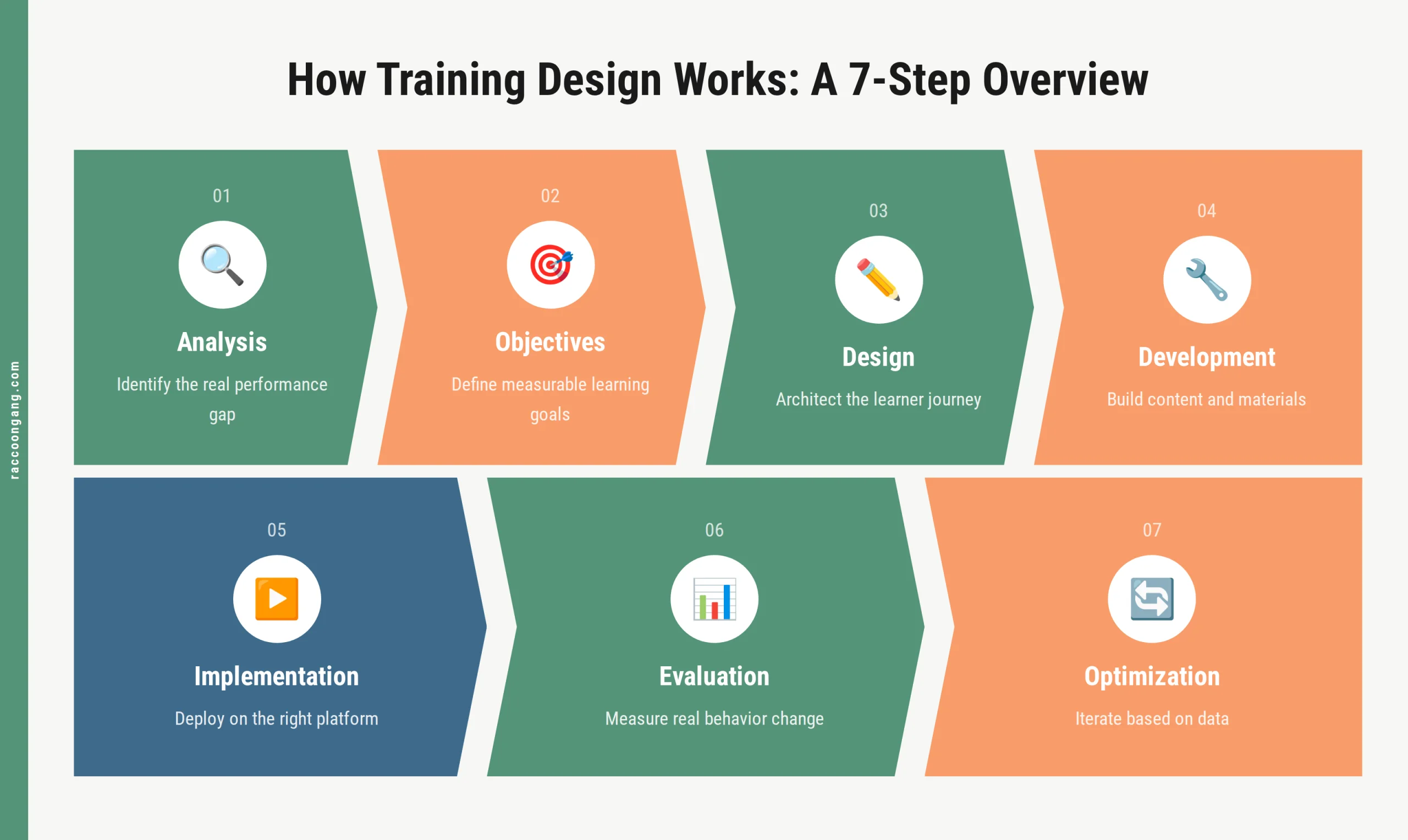
Step 1: Needs Analysis
The first step training design process is built on is analysis — and it’s the one most teams are tempted to skip in favor of building something visible faster. That instinct is worth resisting.
Needs analysis is about diagnosing the actual problem before prescribing a solution. Training only addresses certain causes of a performance gap — unclear expectations or a broken process require different interventions entirely, and identifying that early saves significant time and budget. The analysis covers three levels: organizational (what does the business need to change?), task (what do people need to do differently?), and individual (who’s the audience, and what do they already know?).
For the EBRD Policy Academy, our specialists started with exactly this kind of analysis — the existing content was solid, but the delivery format wasn’t reaching external audiences across multiple regions. The program was restructured into interactive e-modules on Open edX®, which made the knowledge base accessible to thousands of learners across EBRD shareholder countries.
Step 2: Define Learning Objectives
With the need diagnosed, the next step is being specific about what the training has to accomplish.
Learning objectives get treated as a formality more often than they should. Vague objectives — “participants will understand data privacy” — look reasonable on paper but give designers, learners, and evaluators almost nothing to work with. A useful objective tells a designer what to build, tells a learner what to focus on, and tells an evaluator what to measure. “Apply the four-step escalation process when handling a suspected data breach” does all three.
This step also sets the ceiling for what evaluation can do later. If the objective wasn’t written clearly enough to test, you won’t be able to tell whether the training worked.
Step 3: Design the Learning Experience
This is the architectural phase, where you decide how learning actually unfolds. What format? In what sequence? How much in one session before learners need a break or a practice opportunity?
Aligning training design with learning process principles starts here. Cognitive load research tells us content needs to be chunked and sequenced. Spaced repetition tells us a single exposure rarely produces durable learning. Both have direct implications for how a program gets laid out.
The learner journey matters too. Where does motivation typically dip, and why? Programs that ignore this tend to lose people right in the middle — which is often where the most critical content lives. For programs combining online and in-person components, our guide on blended learning covers how to think through that structure.
Step 4: Develop Content
Now you build the actual materials. Written content, video scripts, interactive scenarios, assessment items, facilitator guides — all developed according to the specifications from the design phase.
This is the most time-consuming and resource-heavy part of the whole process, which is exactly why the steps before it matter so much. Architectural changes mid-development, like restructuring the sequence, rethinking the format, and rewriting objectives cost far more than the same changes would have cost on paper two weeks earlier.
For instance, NASA needed a 5-module Open Science 101 curriculum built from highly technical scientific materials — and delivered within 3 months. Our specialists worked through the content development phase with NASA subject matter experts, converting that material into interactive e-modules that went on to reach researchers and scientists worldwide.
Step 5: Implement Training
The fifth step in the training design process is where the program reaches actual learners. Platform configuration, content upload, learner communication, facilitator preparation — the details here are unglamorous but they matter. How the LMS is configured directly shapes what learners experience inside it, which is why implementation is treated as part of the learning work, not a handoff.
Step 6: Evaluate Performance
Completion rates and satisfaction scores are the easiest things to collect and they say relatively little about whether training produced any real change.
The Kirkpatrick model adds two more levels that actually matter: behavior change on the job, and impact on business results. These are harder to measure, which is the real reason they get skipped. Skipping them also means having no way to know whether the program was worth building.
Step 7: Optimize and Improve
The training design process 7 steps model isn’t a straight line from start to finish — it loops. Evaluation reveals what’s working and what isn’t, and that information feeds back into the program.
Maybe a module has consistently low scores. Maybe completion drops off at a predictable point. Maybe the assessment isn’t distinguishing strong performers from weak ones. Whatever the data shows, the program improves — or it should.
Organizations that treat a program as finished when it launches tend to keep running programs that underdeliver. Iteration is how training gets better at doing what it’s supposed to do.
Instructional Design in Training and Development
Instructional design in the training and development process is what gives training its scientific footing. It’s a discipline rooted in how people actually learn, informed by decades of cognitive and educational research.
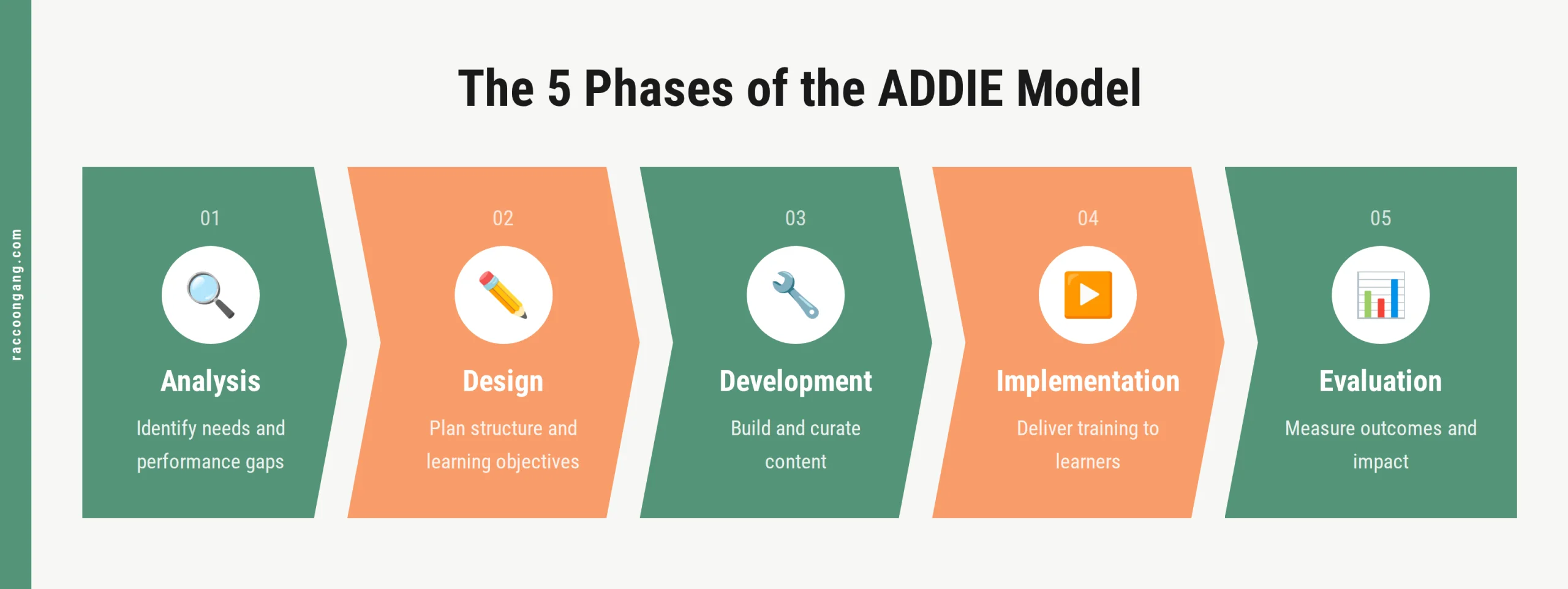
ADDIE is the most widely used framework: Analysis, Design, Development, Implementation, Evaluation. It maps closely to the seven steps above and gives cross-functional teams a shared vocabulary. Other models serve different needs: SAM builds faster iteration cycles into the process, Bloom’s Taxonomy guides decisions about content depth and assessment complexity.
The value in any of these frameworks is consistency and intentionality. When a team has a shared methodology, decisions get made faster and the final program is more coherent. Our guide on how to create an instructional design storyboard is a practical entry point into how this looks day-to-day.
Aligning Training Design with Learning Process
Learning happens through retrieval, application, feedback, and repeated exposure over time. A program designed around these realities looks structurally different from one built around a content outline. In practice, that means:
- Sequencing from foundational to complex, so each concept has something to build on.
- Spreading practice across sessions rather than packing it into one block.
- Building in feedback loops so learners know where they stand.
- Designing assessments that require active retrieval and application.
Engagement is a design variable too. Difficulty and pacing need to match the audience — our professionals treat that as a core design decision on every program we support.
Training Design Examples
Three training design sample scenarios from different contexts.
Onboarding Program
New hire onboarding typically has a clear business goal — reduce time to productivity. The design challenge is that new employees are absorbing a lot simultaneously: company culture, tools, processes, role expectations. Programs built around that reality sequence content deliberately, separate what needs immediate attention from what can come later, and use practice scenarios tied to actual job tasks.
Leadership Training
Leadership development programs usually target managers at a specific transition point — most commonly, individual contributors moving into people management for the first time. Management skills develop through application, which means the design needs to account for structured practice, peer learning, and evaluation frameworks that measure behavioral change over time.
Compliance Training
Compliance programs operate under a specific constraint: the audience knows the training is mandatory. Design that acknowledges this — and connects regulatory requirements to situations learners actually face in their roles — produces measurably better retention than programs built around abstract rule presentation.
What a Well-Designed Training Program Leads To
A well-designed training program often leads to outcomes that extend well beyond LMS metrics. Three show up consistently.
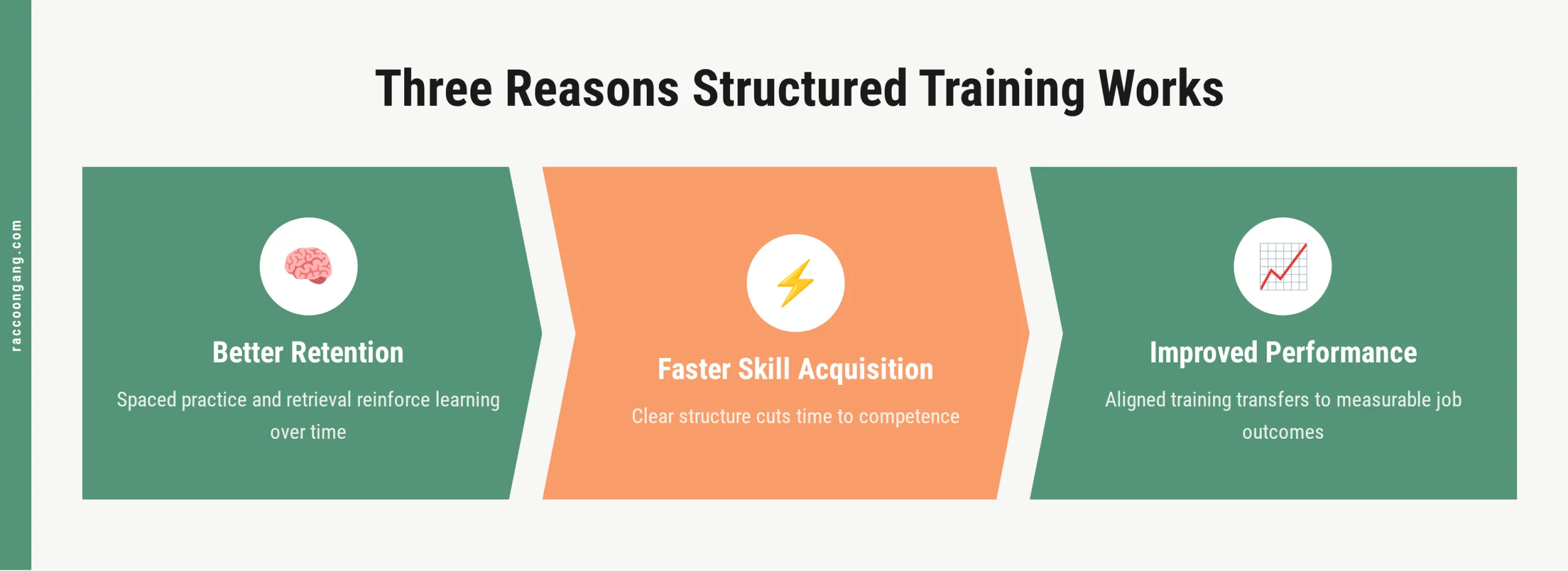
Better Retention
When learners move through well-sequenced programs, they retain more, because content is delivered in a way that works with how memory actually functions. Spaced practice, retrieval exercises, and real-world application all reinforce learning in ways that matter long after the program ends.
Faster Skill Acquisition
Clarity of purpose reduces wasted time. When learners know what they’re working toward and the path through a program is well-structured, they reach competence faster. Our customers report this consistently after training is rebuilt with intentional design — the path through it is clearer, and clarity accelerates learning.
Improved Performance
When training maps to what people actually do on the job, skills transfer. That shows up in whatever the organization tracks: quality metrics, safety compliance, customer satisfaction, revenue. Improved performance is ultimately the reason training exists.
Common Mistakes in Training Design
Most training failures trace back to design, not learners.
Unclear Objectives
Programs built on vague objectives have no clear destination. Designers fill time, learners disengage, and without testable objectives there’s no way to evaluate whether the program worked or improve it if it didn’t.
Content Overload
The instinct to be thorough is understandable. The result is usually a program too dense to learn from. Cognitive overload reduces retention regardless of content quality. Good design involves knowing what to cut, and sometimes that’s the harder part of the job.
Lack of Measurement
Without measurement, programs run unchanged regardless of whether they work. Evaluation needs to be designed in from the beginning — the questions you want answered after the program launches need to shape how the program gets built, but not get added as a final task.
Training Design and LMS Platforms
A program built with intention still needs infrastructure to reach learners and generate useful data. An LMS handles the operational layer — enrollment, delivery, tracking, reporting — but it also determines what learning data gets captured and how.
That matters because evaluation depends on it. If the platform isn’t configured to track the right things from the start, there’s no way to measure whether the program worked. Assessment formats, progress checkpoints, learner pathways — these all need to be mapped to the program’s learning objectives during the design phase.
How to Improve Your Training Design Process
There’s no single fix that makes training design better overnight. But most teams that struggle with program quality are tripping over the same handful of things — and they’re fixable.
- Start with the business problem — let content follow from there.
- Write objectives that are specific enough to test.
- Sequence content intentionally — foundational before complex.
- Design for application — what learners will actually do on the job.
- Build evaluation criteria before development starts.
- Pilot before full rollout and adjust based on real data.
- Track outcomes, including behavioral change and business impact.
- Use every program cycle to improve the next one.
The difficulty is doing this consistently, especially under timeline pressure. A clear process is what makes that possible.
How Raccoon Gang Supports Training Design
Raccoon Gang brings together instructional design, LMS implementation, and learning architecture to help organizations build training that produces results.
Our professionals cover the full cycle:
- Needs analysis and objective development.
- Content production and learning architecture.
- Platform configuration and implementation.
- Post-launch evaluation and iteration.
Our customers and partners stay in the process throughout — because iteration and long-term improvement require genuine partnership.
Conclusion
A lot of organizations know their training could work harder for them — and have a sense of where the gaps are, but no clear methodology for closing them. That’s where a structured design process makes the difference: it gives teams a consistent way to diagnose problems, build purposefully, and measure what comes out the other side.
The training design process is how serious L&D teams operate across every program they build. If that’s the direction your organization is moving in, it’s worth talking to our team.
FAQ
What is the training design process?
The training design process is a structured approach to building training programs that produce specific outcomes. It connects organizational goals to learning objectives, and learning objectives to content, delivery, and evaluation, so that training solves the problem it was built to solve.
What are the 7 steps of training design?
Needs analysis, defining learning objectives, designing the learning experience, developing content, implementing training, evaluating performance, and optimizing the program. Each step feeds into the next, and evaluation loops back into needs analysis — the process is continuous.
What is instructional design in training?
Instructional design is the discipline of applying learning science to program development. It provides the methodological foundation for training design, which ensures that decisions about content, sequence, and assessment are based on evidence about how people learn.
Why is training design important?
Because without it, training tends to be organized around content rather than outcomes. Intentional design is what connects a learning program to a business result.
How do you design a training program?
Start with needs analysis to understand the actual performance gap. Write objectives that are specific and testable. Design the learning experience around how people acquire and retain skills. Build content based on that structure. Implement on a platform configured to support it. Evaluate against the objectives you set. Improve based on what the data shows.

- What Is Training Design?
- What Is the Training Design Process?
- Training Design Process: 7 Steps
- Instructional Design in Training and Development
- Aligning Training Design with Learning Process
- Training Design Examples
- What a Well-Designed Training Program Leads To
- Common Mistakes in Training Design
- Training Design and LMS Platforms
- How to Improve Your Training Design Process
- How Raccoon Gang Supports Training Design
- Conclusion