











LMS user engagement is the gap between a platform people log into and a platform people actually use. Most teams discover that gap months after launch, when completion rates stall and nobody can quite explain why.
Logins are happening, courses are loading, and nothing’s technically broken — learners simply aren’t finishing modules or coming back on their own. Engagement isn’t the same as usage. A learner can log in five times a week and never engage with anything meaningful, clicking through screens, killing time on a mandatory module, closing the tab the moment the progress bar hits 100%.
Real engagement shows up in different signals, like how long people stay on content, whether they return without being reminded, and whether they interact with anything beyond the next button.
Four things shape whether engagement happens at all:
- Learning design
- Platform UX
- Communication
- Analytics
Get one wrong, and the other three can’t fully compensate, which is why our team builds engagement into LMS environments from the start.
TL;DR
- LMS user engagement measures how actively learners interact with content — far beyond simple login frequency.
- It’s driven by four factors: learning design, UX, communication, and analytics.
- It directly predicts completion rates, retention, and training ROI.
- Most platforms suffer from low LMS adoption because of fixable issues: weak onboarding, content overload, no personalization, missing feedback loops.
- Fixing engagement means auditing real usage data, segmenting learners, redesigning paths, and treating the whole thing as a system you revisit on a schedule.
What Is LMS User Engagement?
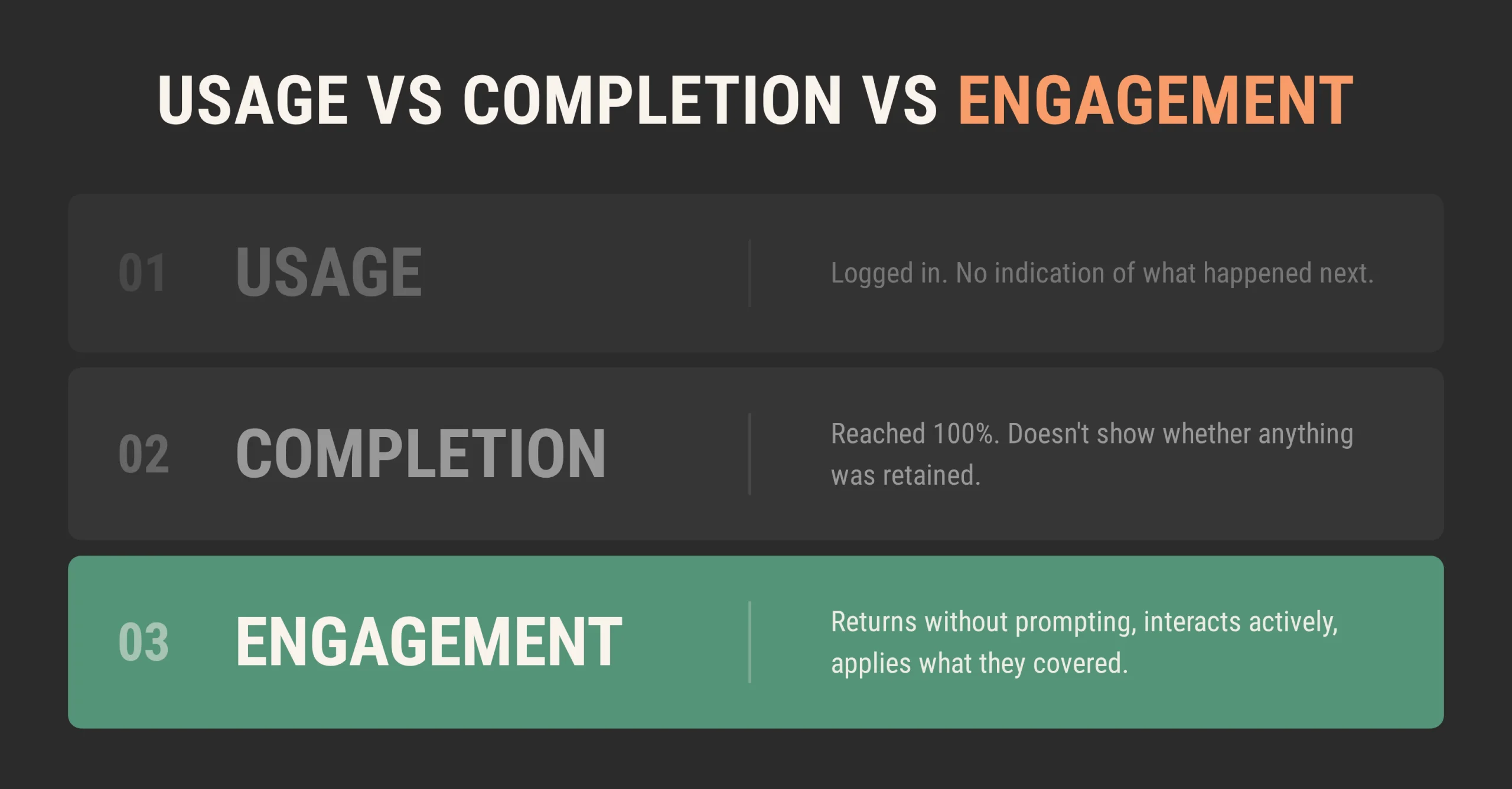
LMS user engagement measures how actively learners interact with content — not how often they log in or whether they technically finish a course. It’s the difference between someone clicking through to a completion checkbox and someone who’s actually absorbing what’s in front of them.
For a refresher on what an LMS actually does, that’s worth starting with first.
There are three separate things people tend to lump together:
- Usage — someone logged in. That’s it. Could mean anything from deep engagement to opening a tab and walking away.
- Completion — someone finished a course. Useful, but completion can happen through pure compliance pressure with zero retention behind it.
- Engagement — someone is actively interacting with content: spending real time on it, returning without prompting, participating in discussions, applying what they covered.
Only one of these correlates reliably with whether learning actually sticks — engagement.
A learner who races through slides to hit a completion checkbox has technically finished the course and learned almost nothing. A learner who comes back to revisit a module, tests themselves, asks a question in a discussion thread — that’s a different signal entirely, even if their timeline looks slower on paper.
Engagement is a leading indicator. Completion tells you what happened after the fact. Engagement tells you, in real time, whether the content is doing its job.
Why LMS Engagement Matters
Low engagement doesn’t stay contained to a dashboard nobody checks. It shows up downstream, in numbers people do care about.
- Completion rates. Courses with strong engagement signals — interaction, return visits, active participation — finish at meaningfully higher rates than passive, click-through content. People don’t abandon things they’re actually invested in.
- Skill acquisition. Passive consumption produces weak recall. Learners who engage with scenarios, practice tasks, or spaced repetition retain more of what they covered. That holds true across corporate training, higher education, and external programs alike — only the content format changes.
- In a corporate setting, employee engagement lms metrics tend to track closely with broader retention numbers. People who feel invested in their growth path are less likely to be job-hunting six months later.
- Program ROI. A learning program with high LMS adoption but low engagement is, functionally, a sunk cost — people are present but not absorbing anything transferable to their actual work.
- This is exactly what the Kirkpatrick Model is built to expose. It evaluates training across four levels — Reaction, Learning, Behavior, and Results — and low engagement tends to choke the pipeline somewhere between Learning and Behavior, before any business result shows up.
- Abandonment. Disengaged learners don’t just finish slower. A portion of them stop coming back at all, which quietly erodes the case for the platform itself at renewal time. Continuous learning only happens where engagement is already present.
Why Is LMS Engagement So Low?
None of this happens by accident. Every low-engagement LMS got there through a series of specific decisions — usually made early, and never revisited.
- Poor onboarding. Learners get dropped into a platform with no orientation, no quick win in the first session. First impressions set the tone for everything after.
- Overloaded courses. Someone tried to fit a semester’s worth of content into three modules. Cognitive load goes up, attention goes down.
- Weak UX and navigation. If finding the next lesson takes four clicks, friction does the rest of the damage on its own.
- No personalization. Every learner gets the identical path regardless of role or prior knowledge. A new hire and a five-year veteran sitting through the same onboarding module is a missed system decision.
- No feedback or progress visibility. Learners with no sense of where they stand disengage faster than learners who can see a path forward.
- One-size-fits-all content. Built for an “average” learner who doesn’t actually exist. It under-serves beginners and bores advanced learners at the same time.
- None of these issues are about learner motivation. That’s good news — platform decisions can be revisited far more easily than anyone’s willingness to try.
Key Factors That Drive LMS User Engagement
Once the obvious failure points are out of the way, engagement comes down to a smaller set of recurring factors. These show up across corporate training, higher ed, and external programs alike.
- Clear learning goals. Learners who know what they’re working toward — and why — engage differently than learners dropped into content with no stated destination.
- Relevant, role-based content. A sales rep and a finance analyst shouldn’t sit through the same generic compliance module if their actual risk profile is different. Relevance is one of the cheapest engagement levers available, and most platforms underuse it.
- Microlearning and modular structure. Shorter, focused units outperform long-form modules for both attention and completion. A 6-minute lesson fits into a gap in the day. A 45-minute one waits for “later,” which often means never.
- Interactivity and practice. Passive video and reading don’t build retention the way applied practice does. Quizzes, branching scenarios, simulations — anything that asks the learner to actually do something with the material.
- Progress visibility and feedback. Visible progress bars, scores, and milestones give learners a reason to keep going. Silence is the enemy here.
- Social and collaborative elements. Discussion boards, peer review, cohort-based pacing — these add accountability that solo, self-paced content can’t replicate.
- Consistent communication. Reminders, nudges, and check-ins outside the platform itself keep lms user engagement alive between sessions — especially for asynchronous programs.
LMS Features That Improve Engagement
Design principles need a platform that can actually execute them. Here’s how specific features translate into learner behavior.
- Gamification (badges, points, challenges) taps into completion motivation and competitive instinct. Used well, it nudges learners to finish “just one more module.” Used carelessly, it turns into noise learners tune out within a week. We’ve covered the mechanics of LMS gamification in more depth if you’re weighing whether it fits your program.
- Learning paths and playlists replace a flat list of courses with a guided sequence. Instead of learners guessing what to take next, the platform tells them — removing a small but real source of drop-off.
- Personalized recommendations surface content based on role, prior activity, or skill gaps. The platform does the relevance work automatically.
- Notifications and reminders pull disengaged learners back before they fully drift away. Timing matters more than frequency.
- Mobile access matters more than most programs account for. Learners who can pick up a lesson during a commute are far more likely to maintain momentum.
- Analytics dashboards close the loop — for admins tracking where engagement breaks down, and for learners who can see their own progress.
- Each feature changes one specific behavior. None of them work in isolation, and none of them substitute for the learning design underneath.
Learning Design Strategies for Better LMS Engagement
Features set the ceiling. Design determines whether anyone gets close to it. A gamified, mobile-friendly course built on weak instructional design is still a weak course — just one with badges attached.
- Scenario-based learning puts learners inside a realistic situation instead of handing them a list of facts. Harder to build than a slide deck. Also the format learners remember six months later.
- Problem-based tasks ask learners to solve something instead of simply recalling it. Active problem-solving builds stronger retention pathways than passive reading does.
- Short assessments spaced throughout a course — not just at the end — catch gaps in understanding early, while there’s still time to address them.
- Reflection and feedback loops give learners a moment to process what they just covered before moving to the next module. Skipping this step is one of the most common causes of “completed but didn’t retain anything.”
- Spaced learning — content revisited over days or weeks instead of crammed into one sitting — is one of the better-documented ways to improve long-term retention.
- Design matters more than features. A platform can have every feature on the list above and still produce low LMS adoption if the courses inside it are dull, overloaded, or disconnected from what learners actually need.
How Do You Measure Learner Engagement in an LMS?
You can’t fix what you’re not measuring correctly. Most LMS dashboards default to metrics that look good without meaning much.
- Active users vs. registered users. Registration counts everyone who was ever given an account. Active users — people who logged in and did something in a meaningful window — tell you who’s actually there. The gap between these two numbers is often the first warning sign.
- Session frequency and duration. How often learners return, and how long they stay. Short, frequent sessions usually beat long, rare ones — they fit into a gap in someone’s day.
- Completion vs. drop-off. Where in a course do people stop? A drop-off concentrated at one specific module points to a design problem with a clear, fixable address.
- Content-level engagement. Which lessons get rewatched, which get skipped, where learners pause or rewind. This is where the real diagnostic data lives.
- Path progression. Whether learners move through a sequence in order, or jump around and stall. Erratic patterns usually point to a structural issue in how the path was built.
- Vanity metrics fail because they describe activity without describing value. A spike in logins right before a compliance deadline tells you people are afraid of missing a deadline — not that the program is working.
How to Improve LMS User Engagement Step by Step
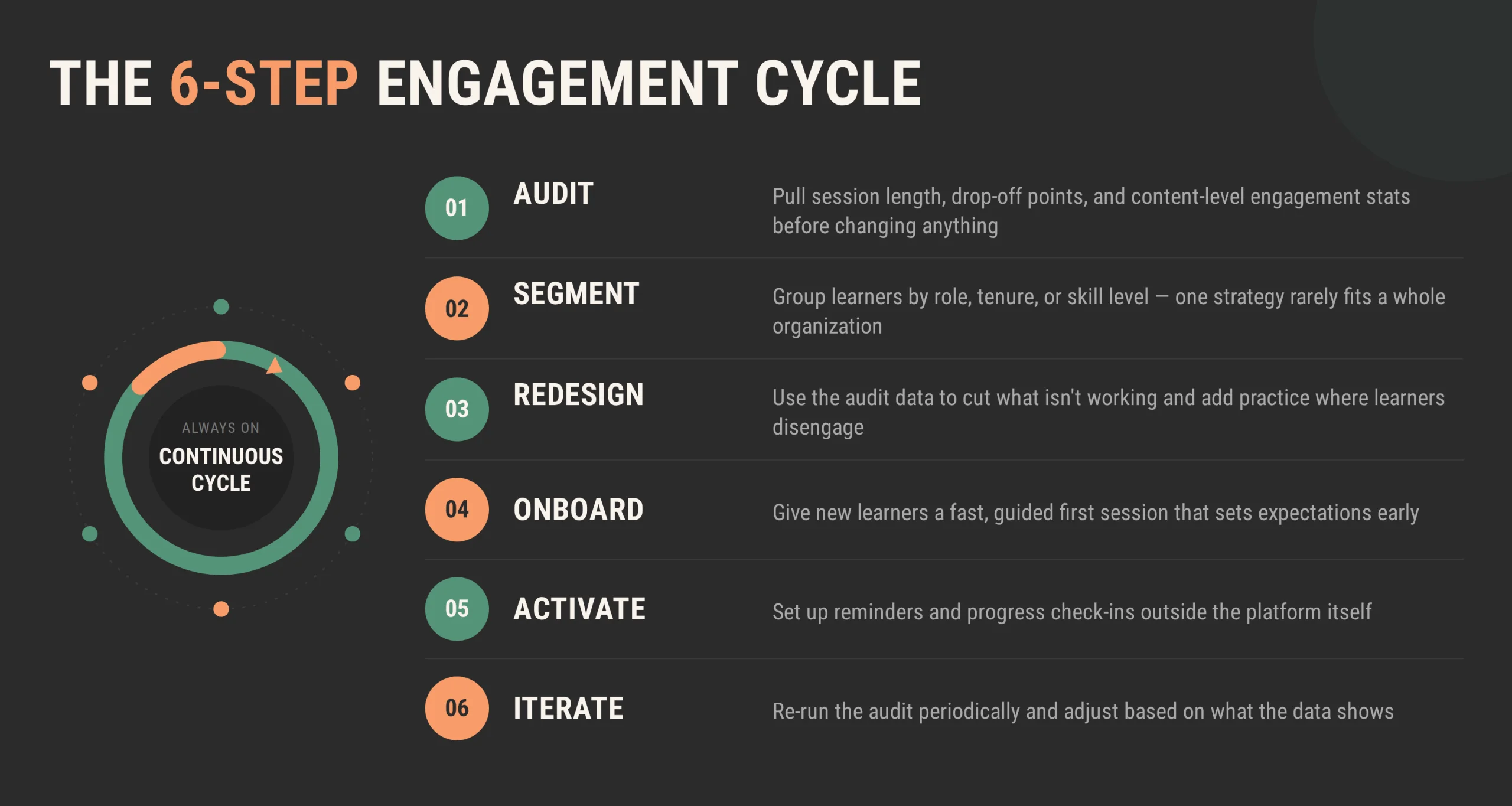
A practical framework, in the order it actually needs to happen. This is also roughly how to increase LMS engagement on a platform that’s already live and can’t be rebuilt from scratch.
- Audit current engagement data. Pull session length, drop-off points, and content-level stats before changing anything. You need a baseline.
- Segment learners. Group by role, tenure, or skill level. A single LMS engagement strategy rarely fits a whole organization.
- Redesign learning paths. Use the audit data to cut what isn’t working and add practice where learners are disengaging. If the platform itself turns out to be the bottleneck, that’s the point where it’s worth comparing an LMS against an LXP.
- Improve onboarding. Give new learners a fast, guided first session. The first 10 minutes set expectations for every session after it.
- Activate communication flows. Set up reminders and progress check-ins outside the platform itself.
- Test and iterate. Treat LMS optimization as an ongoing cadence, not a one-time fix. Re-run the audit periodically and adjust based on what the data actually shows.
This is close to the process our team runs during LMS implementation projects: diagnostic first, design changes second, communication built in from the start. When the diagnosis points to a platform-level limitation, custom LMS development becomes part of the conversation.
Conclusion
LMS user engagement comes down to design and strategy, which means it’s something teams can actually diagnose, measure, and fix. The organizations that get this right treat it that way, building in a regular measurement cadence because engagement drifts on its own if nobody’s watching, then re-tuning based on what the data shows.
That ongoing attention is what keeps engagement from quietly decaying months after a successful rollout, long after the launch excitement has worn off.
FAQ
What is LMS user engagement?
A measure of how actively learners interact with content inside a learning platform — time on task, return visits, participation — as opposed to simple login counts or completion checkboxes.
Why is LMS engagement important?
It predicts outcomes that logins and completions don’t: skill retention, behavior change, and ultimately the ROI of the training program.
How can I increase user engagement in my LMS?
Start with an audit of current engagement data, then address the specific gaps it surfaces — usually onboarding, content structure, personalization, or communication.
What LMS features improve engagement the most?
Personalized learning paths, progress visibility, and mobile access tend to move the needle most. However, features only work on top of solid learning design.
How do you measure LMS engagement?
Through active-user rates, session frequency and duration, content-level interaction, and drop-off points — not total logins or course views alone.
Why is LMS engagement so low?
Usually a combination of weak onboarding, content overload, generic one-size-fits-all paths, and a lack of visible progress or feedback.
What is a good LMS engagement rate?
There’s no universal benchmark — it depends heavily on program type and audience. The more useful approach is tracking your own trend over time, against your own baseline.




- TL;DR
- What Is LMS User Engagement?
- Why LMS Engagement Matters
- Why Is LMS Engagement So Low?
- Key Factors That Drive LMS User Engagement
- LMS Features That Improve Engagement
- Learning Design Strategies for Better LMS Engagement
- How Do You Measure Learner Engagement in an LMS?
- How to Improve LMS User Engagement Step by Step
- Conclusion