Professional credentials expire, regulations change — and between these pressures and the need to stay current, working professionals face constant demands for documented learning that fits into packed schedules. Continuing education platforms have become essential infrastructure for organizations that can’t afford manual processes breaking down during audits.
Today, the challenge isn’t finding an LMS for continuing education — there are plenty of options available. The difficulty lies in choosing one that still works three years from now, when enrollment doubles or certification requirements evolve. This guide covers what matters when building a professional development infrastructure that scales, based on our experience at Raccoon Gang helping organizations make these decisions.
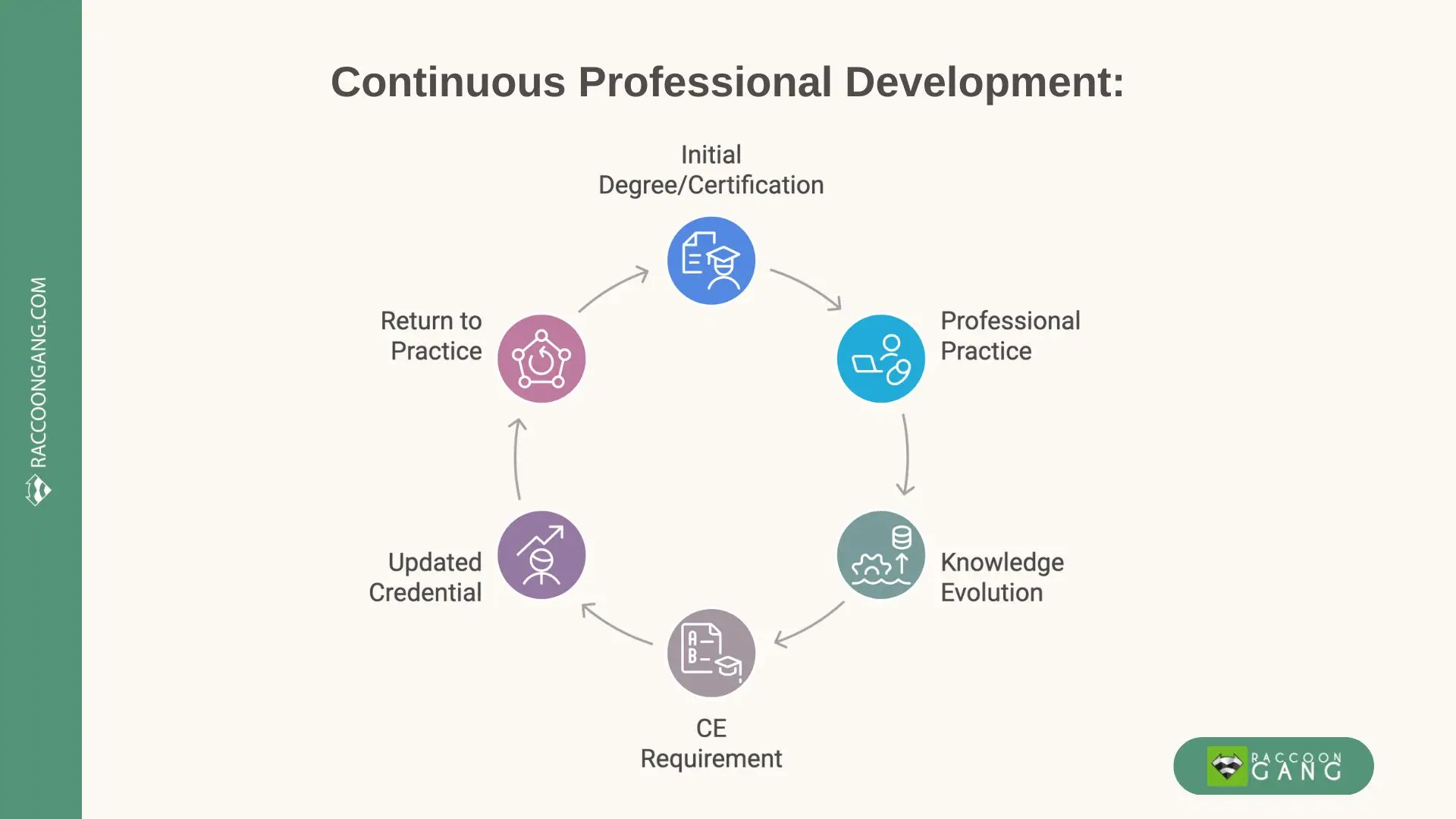
A visual snapshot of how modern learning platforms bring flexibility, structure, and measurable progress to continuing education — helping professionals learn on their own terms.
What Is Continuing Education?
Continuing education makes sure professionals keep their knowledge and credentials current throughout their careers. The truth is that what you learn at the start can become old as your field grows. For instance, nurses do infection control training when medical rules change, accountants take ethics courses to keep their CPA licenses, real estate agents learn about new rules as housing regulations change, developers get certifications as tech changes, and so on.
Professionals do this while working, dealing with family, and everything else. Education happens when they can fit it in — on the way to work, during lunch, or in the evening after everything else. Most working professionals fit online learning for professionals into these available moments throughout their day.
At Raccoon Gang, we help institutions deliver continuing education through Open edX® services and create flexible lifelong learning software that adapts to professionals’ schedules and organizations’ compliance requirements.
Why Organizations Need an LMS Platform for Continuing Education
Most continuing education programs start with spreadsheets and email, which works fine initially. Growth eventually breaks these systems — manual enrollment can’t keep pace, certificate requests overwhelm employees, and audit preparation becomes a multi-day scramble through scattered files. A continuing professional education LMS addresses these breaking points by automating registration, tracking, and credentialing, which reclaims significant employee time.
But the benefits extend beyond saved hours. McKinsey research shows that companies developing strong digital learning capabilities outperform competitors by two to six times in total shareholder returns, which suggests that learning infrastructure directly impacts business performance.
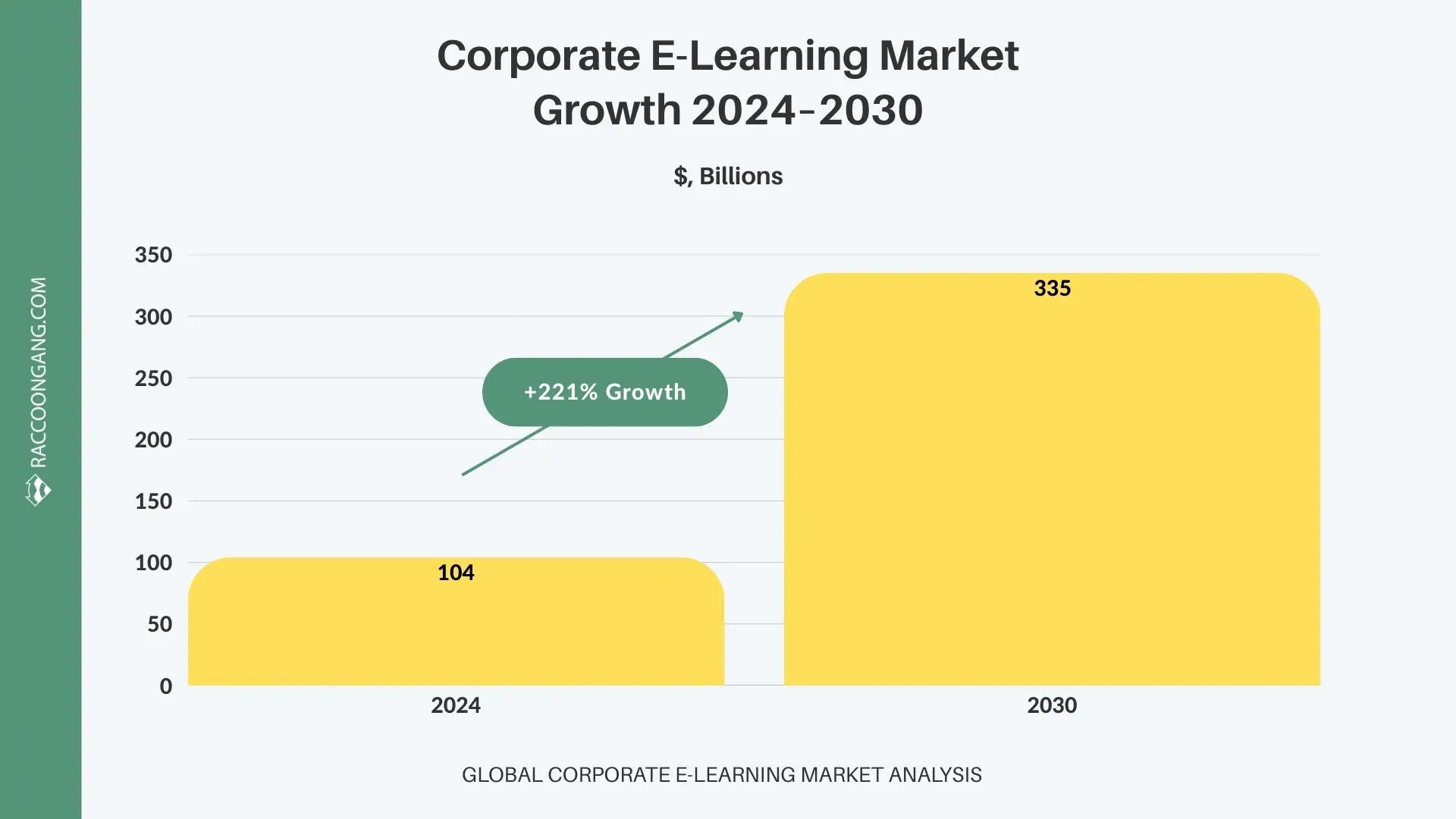
The financial benefits of LMS for continuing education extend to new revenue opportunities as well. This infrastructure enables revenue models that manual systems make impossible. Associations and training companies can finally offer member pricing, bulk discounts, and subscriptions at scale, opening opportunities to monetize professional development. The corporate e-learning market’s trajectory — from $104 billion in 2024 to a projected $335 billion by 2030 — reflects how many organizations are capitalizing on this shift.
For regulated industries, however, the compliance advantage often matters most. Licensing boards regularly request verification that specific individuals completed specific training by specific deadlines. Organizations with proper compliance training LMS systems generate these reports instantly; those without spend days reconstructing records from multiple sources. For healthcare, legal, and financial services organizations, that capability shift represents meaningful risk mitigation.
Core Features of an LMS Platform for Continuing Education
Generic learning systems look similar until you use them for continuing education. Then differences become obvious through daily friction. Here are the essential capabilities that any effective continuing education platform should have.
Credential Management
An effective LMS platform for continuing education handles certificates, licenses, and designations — each with different validity periods, renewal requirements, and prerequisites. The system calculates credit accumulation, sends alerts before expiration, and maintains historical records for audits. This certification management LMS capability eliminates the need for parallel tracking outside the system. Without this, organizations maintain separate spreadsheets that defeat the purpose of having a centralized platform.
Mobile Accessibility
Professionals rarely have dedicated time at desks for training. Effective adult education LMS platforms deliver complete experiences on phones: adaptive video streaming for varying bandwidth, touch-optimized assessments, native app discussions, and direct certificate downloads. Systems that require desktop switching for key functions create completion barriers. When professionals must “finish this later on a computer,” that completion often never happens, making read-only mobile access a significant liability for program success.
Payment and Pricing
Organizations charging for online continuing education courses need robust commerce infrastructure — shopping experiences, payment processing, automatic enrollment, receipt generation, and refund management. Professional associations require additional layers: member pricing differentiation, group discounts for corporate purchases, course bundling, and promotional code management.
Reporting
Different stakeholders need different views of program data, and effective platforms deliver these without manual exports. Program managers track enrollment and revenue trends, instructional designers analyze completion patterns to improve curriculum, compliance officers generate audit documentation for regulators, and learners download transcripts for licensing boards. A proper CE learning management system should produce these reports directly rather than requiring spreadsheet assembly or IT support.
System Integration
Integration determines whether an LMS reduces work or simply relocates it between systems. Platforms need bidirectional connections with membership databases, CRMs, payment processors, and credentialing system registries so information flows automatically. When integration works properly, enrollments update CRMs, completed courses sync with credential databases, and payments connect to accounting systems without manual data entry, eliminating the redundant work that defeats the purpose of having a centralized system.
Content Compatibility and Standards Compliance
Continuing education programs typically combine internally created courses, licensed expert content, and curated professional resources. Platform support for SCORM, xAPI, and LTI standards allows seamless integration of materials from any source without conversion work or compatibility issues. Standards-based platforms also prevent vendor lock-in, giving organizations flexibility to change content providers as regulations evolve or better materials emerge.
Raccoon Gang’s Open edX-based solutions support all these capabilities through customizable modules designed specifically for professional training platform requirements. Our implementations include automated CEU management system functionality, mobile-optimized interfaces, integrated payment processing, and comprehensive reporting tools that satisfy both regulatory compliance and business intelligence needs.
Top Continuing Education Platforms in 2026
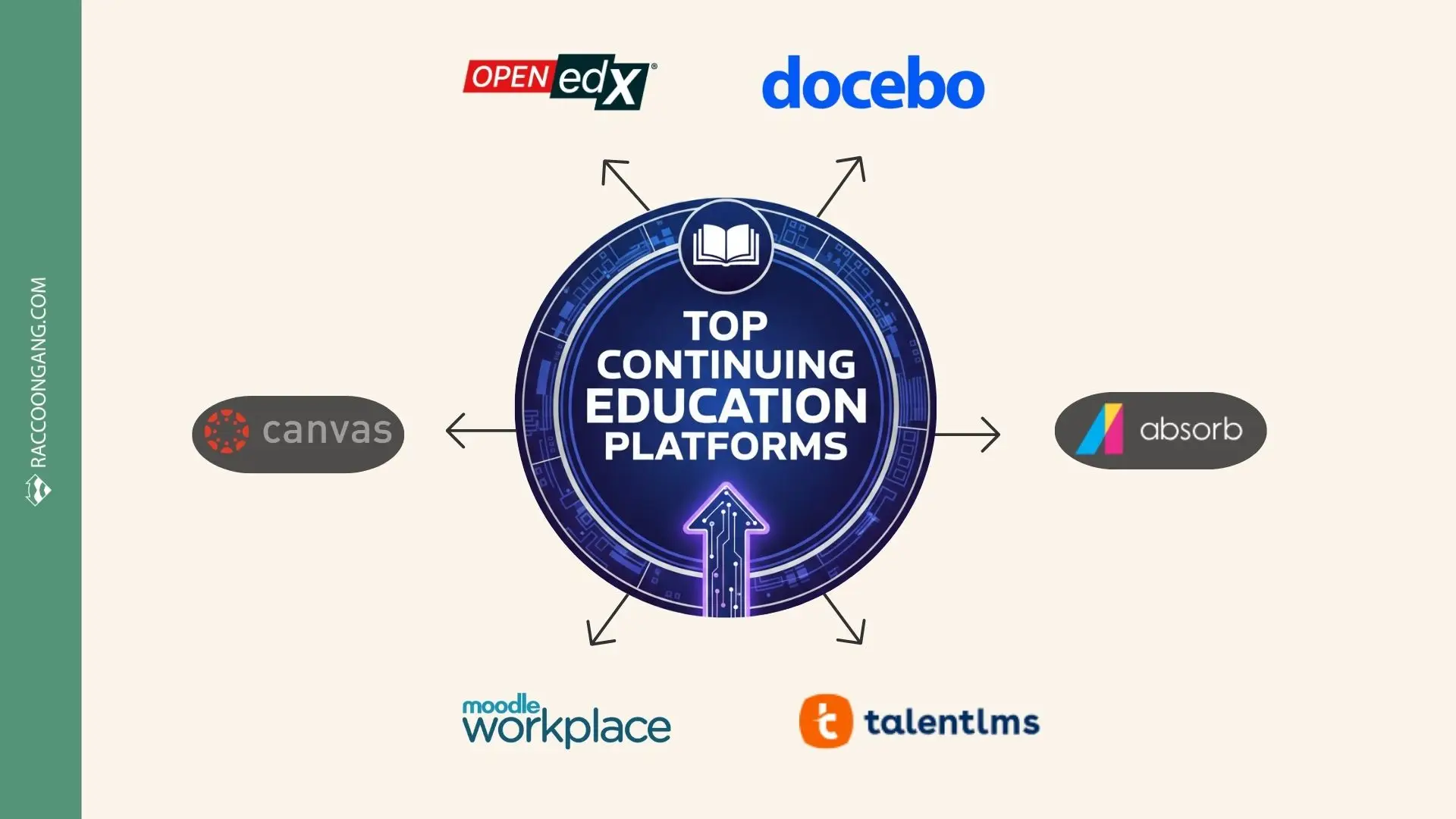
Choosing the right platform depends on how well it matches your organization’s technical capacity, growth trajectory, and specific requirements. The market has consolidated around platforms serving distinct needs, from highly customizable open-source solutions to rapid-deployment commercial products.
Open edX
Open edX LMS provides complete architectural control, which explains why Harvard, Western Governors University, and Fortune 500 companies use it for certificate programs and compliance training. Organizations configure every aspect of the learner experience, credential workflows, and interface design without vendor limitations.
The flexibility matters for continuing education because programs often need specialized workflows that commercial platforms don’t support. One association might require stackable credentials, while another needs integration with state licensing databases. Open edX-based solutions handle both through custom development.
As a case in point, Raccoon Gang migrated a global media institute to an Open edX platform, scaling their platform from an overwhelmed legacy system to successfully serving 120,000 professionals worldwide. We implemented custom eCommerce, real-time analytics, and gamification features that drove measurable results: increased completion rates, improved learner engagement, and reliable performance handling 20,000 concurrent users with 98% uptime.
Moodle Workplace
Moodle Workplace extends the familiar Moodle platform with enterprise capabilities designed for professional development and continuing education. Its built-in certification management handles recurring training requirements common in healthcare, legal, and regulated professions.
The platform’s Dynamic Rules automate credential assignments based on roles, trigger automatic enrollment in subsequent requirements, and send expiration reminders without manual tracking. Multi-tenancy lets association learning management systems serve different member categories while each maintains separate branding and content.
Moodle’s extensive plugin ecosystem means you can add functionality for specialized needs, and organizations often partner with Moddle services providers to get the platform configured exactly how they need it. It works well for mid-sized to large organizations wanting enterprise features with flexibility to adapt as programs evolve.
TalentLMS
TalentLMS prioritizes deployment speed, which enables organizations to launch programs in days rather than months. The platform handles fundamental requirements well — content delivery, certificates, payment processing, and mobile access.
Recent AI features help create courses faster, though these capabilities continue maturing. The interface requires minimal training for administrators and learners. The trade-off comes with customization — organizations needing significant modifications or complex integrations encounter limitations quickly.
TalentLMS works best for small to mid-sized organizations with straightforward requirements and limited technical resources. Organizations anticipating rapid growth or complex workflows should consider whether the platform’s simplicity will become a constraint.
Absorb LMS
Absorb LMS is usually chosen by large companies that have complex internal structures and the budget to support a heavier system. It looks good, is easy to navigate, and works well when training needs to be rolled out across different teams, departments, or regions.
It also includes AI tools that help speed things up, such as assigning courses automatically or suggesting content based on what people do or need. Reporting is one of its stronger points and is often used by both training teams and compliance teams to keep track of progress and meet regulatory requirements.
The investment matches the capabilities — smaller organizations typically struggle to justify the pricing. Absorb makes sense for large companies where continuing education represents a significant business line with complex administrative requirements.
Litmos
Litmos emphasizes content creation by bundling authoring tools, video hosting, and mobile applications. Organizations creating most curriculum internally find advantages in this integrated approach, plus access to a pre-built content library.
The interface makes course creation accessible to subject matter experts without instructional design backgrounds. Mobile apps provide offline access for field-based professionals. However, integration capabilities lag behind more sophisticated platforms.
Litmos suits organizations prioritizing content development efficiency over deep customization. Companies needing extensive workflow automation or specialized credentialing may find it constraining.
Canvas
Canvas dominates higher education and has expanded into professional development, creating advantages for universities offering both academic and professional programs. The interface feels familiar to millions who used Canvas during formal education.
Professional development features have grown but remain secondary to Canvas’s academic focus. The platform proves less effective for non-academic providers requiring specialized certification workflows or automated compliance reporting.
Canvas works best for educational institutions extending into professional development markets. Standalone continuing education providers often find that purpose-built platforms offer better workflow alignment.
Docebo
Docebo brings artificial intelligence to the forefront of the LMS for professional development space. The platform’s learning intelligence features automatically recommend content, predict skill gaps, and personalize learning paths based on role requirements and performance data.
The social learning capabilities encourage peer knowledge sharing through discussion forums, user-generated content, and collaborative spaces. For organizations building learning communities, Docebo’s social features create engagement beyond traditional course consumption.
Docebo’s strength also lies in creating scalable learning experiences for distributed workforces. The platform suits mid-to-large enterprises focused on building learning cultures rather than simply checking compliance boxes. Pricing reflects the sophistication — expect enterprise-level investment for enterprise-level capabilities.
How to Choose the Right LMS
Platform selection requires balancing immediate operational needs against projected program evolution over a three-year horizon. Solutions optimized for current requirements frequently become constraints as programs mature.
Organization Size and Goals
Document operational workflows comprehensively. Map your complete continuing education delivery process — enrollment mechanisms, certification triggers, renewal procedures, and inter-system data flows. This analysis distinguishes genuinely necessary platform capabilities from superficially attractive features that provide minimal operational value. Organizations consistently underestimate workflow complexity until systematic documentation reveals dependencies and requirements that weren’t initially apparent.
Focus on how complex the structure is, not only on how many people are learning. Training 2,000 workers on basic rules is way different than giving certifications with levels and specialties to 500 pros. Look at how your program is set up now and how you might add levels, tracks, and rules later. Usually, making the program fancier puts more stress on the platform than just adding more learners.
Integration Needs
Assess technical capabilities realistically. Open-source platforms provide extensive customization potential but necessitate either substantial internal technical expertise or partnerships with implementation specialists like Raccoon Gang. Commercial platforms bundle vendor support with accelerated deployment timelines but constrain customization possibilities. Plans for expanding internal technical teams frequently materialize more gradually than projected — base platform decisions on current organizational capacity rather than aspirational roadmaps.
Validate integration reliability through customer references. Catalog every required system connection — membership databases, CRM platforms, payment processors, credentialing registries, accounting systems. Verify that candidate platforms support these integrations through direct conversations with current customers managing similar technical ecosystems. Operational integration performance frequently diverges from vendor specifications and documentation.
Reporting and Compliance Tools
Regulated professions require specific documentation for licensing boards and accrediting bodies. Evaluate whether platforms can generate the exact reports your regulators require without custom development. Test this with sample data during demos — generic reporting capabilities often fall short of specific compliance requirements.
Beyond compliance, assess whether the platform provides actionable business intelligence. Can you track enrollment trends, revenue by course category, completion rates by demographic, and learner satisfaction scores? Distance education tools should inform strategic decisions, not just satisfy auditors.
Technical Capacity and Support
Assess your organization’s realistic technical capacity. Open-source platforms provide extensive customization potential but necessitate either substantial internal technical expertise or partnerships with implementation specialists like Raccoon Gang. Commercial platforms bundle vendor support with accelerated deployment timelines but constrain customization possibilities. Plans for expanding internal technical teams frequently materialize more gradually than projected — base platform decisions on current organizational capacity rather than aspirational roadmaps.
Total Cost of Ownership
Calculate comprehensive total cost of ownership. Subscription fees represent one component of platform investment. Incorporate implementation services, data migration, administrator training, ongoing management resources, and anticipated customization requirements into budget projections. Platforms commanding premium subscription fees occasionally deliver lower total ownership costs through minimal additional development requirements, while attractively priced licensing models may necessitate extensive customization that eliminates apparent savings.
Raccoon Gang offers LMS consulting services to help organizations navigate these decisions, bringing experience from dozens of continuing education program software implementations across healthcare, professional associations, and corporate training environments.
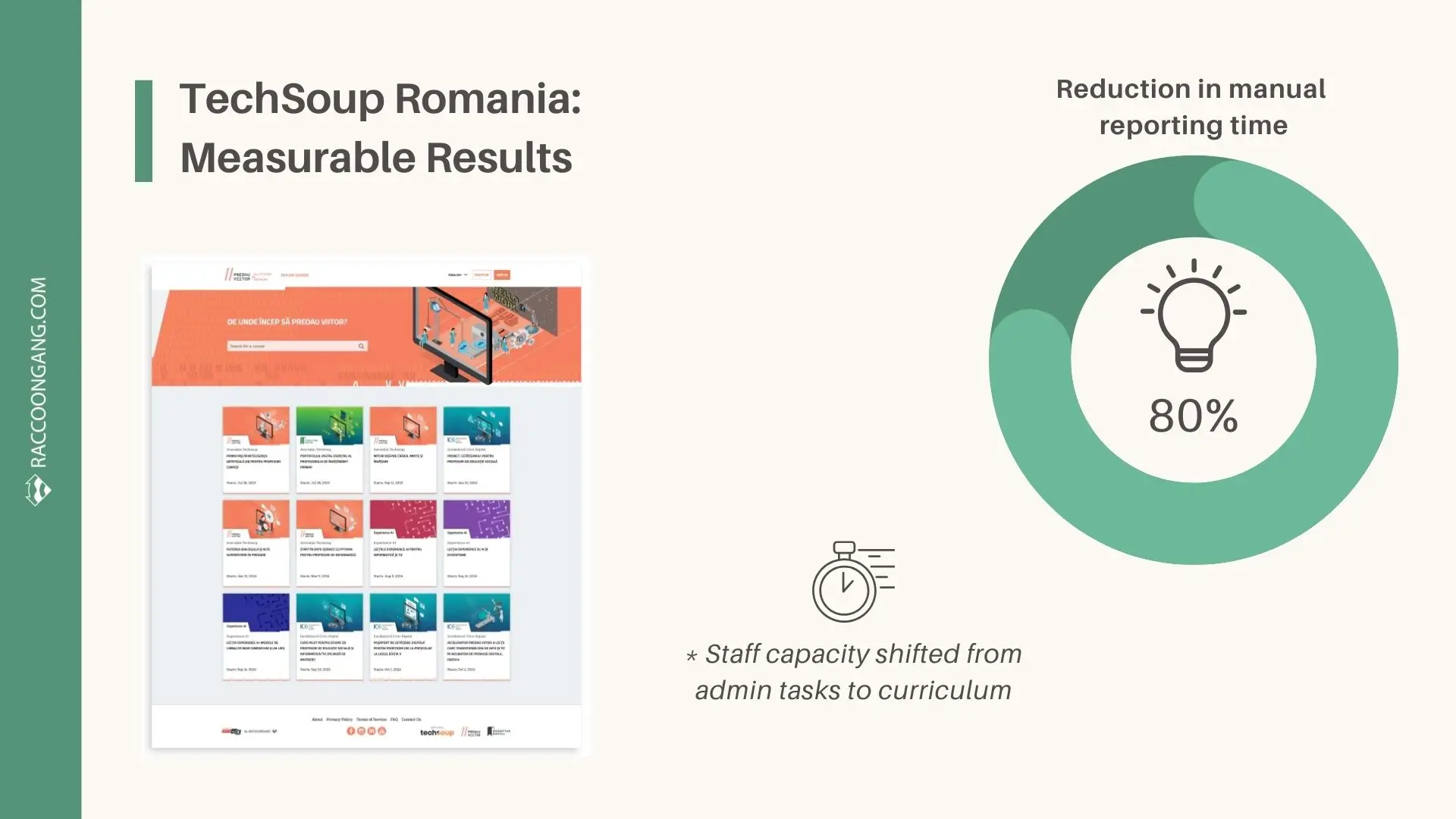
After implementing a centralized learning platform, TechSoup Romania reduced manual reporting time by 80% and shifted staff focus from administration to curriculum development.
Case Example: Implementing an LMS for Continuing Education with Raccoon Gang
TechSoup Romania provides free professional development to 20,000 educators through seasonal cohorts of 2,000 teachers each spring and autumn. Their WordPress-based system created a significant administrative burden — employees spent hours on manual reporting, progress tracking, and coordinating communications across disconnected platforms.
Raccoon Gang migrated TechSoup to a unified Open edX platform that consolidated both systems while preserving critical socio-demographic data for grant reporting. The new platform achieved an 80% reduction in manual reporting time, automated student progress tracking, and streamlined email communications. TechSoup’s team shifted from administrative tasks to curriculum development and direct teacher support.
The platform also enabled programmatic improvements, including peer review activities, self-evaluation exercises, and community discussions that build professional networks among geographically distributed teachers. As a result, course launches accelerated, and comprehensive analytics now reveal engagement patterns that help TechSoup identify which professional development approaches work best.
The Future of Continuing Education
The gap between how continuing education works today and how professionals actually want to learn is closing. Here are the shifts already happening.
- Personalized learning that understands context. AI is finally moving beyond “you might also like” recommendations to genuinely useful guidance. Systems analyze what professionals actually do in their work and suggest courses addressing real gaps. Physical therapists specializing in sports medicine see different updates than those focused on pediatrics. Accountants serving retail clients get different tax guidance than those handling manufacturing. This personalization means professionals spend less time sorting through irrelevant content and more time learning what actually applies to their practice.
- Learning in minutes. Busy professionals are abandoning marathon courses for focused microlearning that delivers specific skills quickly. A safety manager needs updated fall protection guidance, not an entire recertification course covering topics they already know. Platforms that track these small units and stack them toward larger credentials win because they respect that professionals learn during available moments, not dedicated blocks of time.
- Credentials that can’t be faked. Digital badges with cryptographic verification are replacing PDF certificates that anyone could modify. When a licensing board or employer needs to verify credentials, they get instant confirmation instead of making phone calls or trusting suspicious documents. What began as experimental is becoming standard practice as professions tackle credential fraud seriously.
- Education embedded in daily tools. The best continuing education doesn’t force professionals to leave their workflow. Doctors learn about new treatments inside the EHR systems they use all day. Engineers access updated specifications directly in their design software. This embedded approach requires platforms capable of delivering content through APIs, but the completion rates justify the technical investment because learning happens naturally rather than as a separate task.
- Lifelong learning ecosystems. The future is all about learning that never stops. Think of it as a system where you can collect credentials, skills easily move between jobs, and your learning history goes with you everywhere. These systems link up colleges, associations, bosses, and groups that give out credentials through systems that all work together. This way, learning counts no matter where you do it. People can then build up their learning records to prove they know their stuff in different situations and with different types of credentials.
Raccoon Gang builds these capabilities into Open edX implementations as clients need them — personalized AI recommendations, microlearning tracking, blockchain-verified credentials, and API-based delivery. Organizations don’t need to wait years for vendors to add these features to their roadmaps.
Conclusion
Continuing education became an essential infrastructure requiring sophisticated credentials and compliance management. Choose platforms matching your complexity — specialized tools for standard needs, Open edX for custom workflows.
Raccoon Gang builds systems for organizations outgrowing simpler platforms, working as partners who understand the technology that enables your vision.
FAQ
What is an LMS for continuing education?
An LMS for continuing education is a learning platform designed for professional development, certification management, and compliance training. Unlike academic systems, it tracks CEUs with expiration dates, manages credentialing workflows, integrates with licensing databases, and generates compliance documentation. It serves working professionals who need flexible access around their jobs.
What are the top continuing education platforms?
Popular platforms for continuing education include Open edX, which is flexible and easy to customize; Moodle Workplace, which offers features for businesses; TalentLMS, known for quick setup; and Absorb LMS, which is a more high-end option. The best choice depends on program complexity, technical requirements, integrations, and whether you need customization beyond standard features.
What features should an LMS platform include?
A strong LMS for continuing education should support credential tracking with alerts, mobile access, reporting, payments, CRM integrations, and common content formats. Some platforms also include AI-driven course recommendations, digital credentials, and microlearning to support ongoing professional growth.
How can an LMS improve continuing education?
An LMS makes continuing education programs easier to manage by reducing manual work, spreadsheets, and errors. It creates clear records for audits and renewals, improves course accessibility, and helps more learners complete programs—leading to smoother scaling and better long-term participation.
Why is Open edX strong for continuing education?
Open edX is a strong option for continuing education because it offers full control and flexibility. You are not limited by vendor restrictions, and its architecture supports complex certification workflows. Open APIs allow integrations with other systems, and the platform scales easily as learner demand grows.



- What Is Continuing Education?
- Why Organizations Need an LMS Platform for Continuing Education
- Core Features of an LMS Platform for Continuing Education
- Top Continuing Education Platforms in 2026
- How to Choose the Right LMS
- Case Example: Implementing an LMS for Continuing Education with Raccoon Gang
- The Future of Continuing Education
- Conclusion