







Choosing an LMS development company is a multi-year commitment — the wrong pick means locked-in architecture, missed integrations, and expensive migrations later. Since 2015, Raccoon Gang has built and supported 150+ LMS projects for universities, enterprises, and nonprofits across 30+ countries, serving 1.5M+ learners. This guide reflects what we’ve learned about separating vendors who deliver from those who just demo well.
Key takeaways:
- The right LMS development company depends on your scope — custom build, open-source extension, or SaaS plus customization.
- 7 criteria matter more than demos: architecture, integrations, security, delivery track record, UX, support model, and upgrade policy.
- 10 vendors ranked by technical risk — with a scoring rubric you can use in your first vendor calls.
This shortlist showcases the best LMS developers as of 2026. We’ll use practical criteria (and a few hard-won lessons from the field).
As demand for custom LMS builds keeps climbing, 8 out of 10 teams want platforms that fit their branding today, tailored user roles, and portals that match how people actually learn at work.
Our list covers LMS development teams for SMBs and enterprise programs. It also includes greats of all time Open edX and Moodle specialists, such as Raccoon Gang — we’ve contributed to the open-source community since 2015, and that work shows up in what our customers run in production.
Now, let’s get down to business.
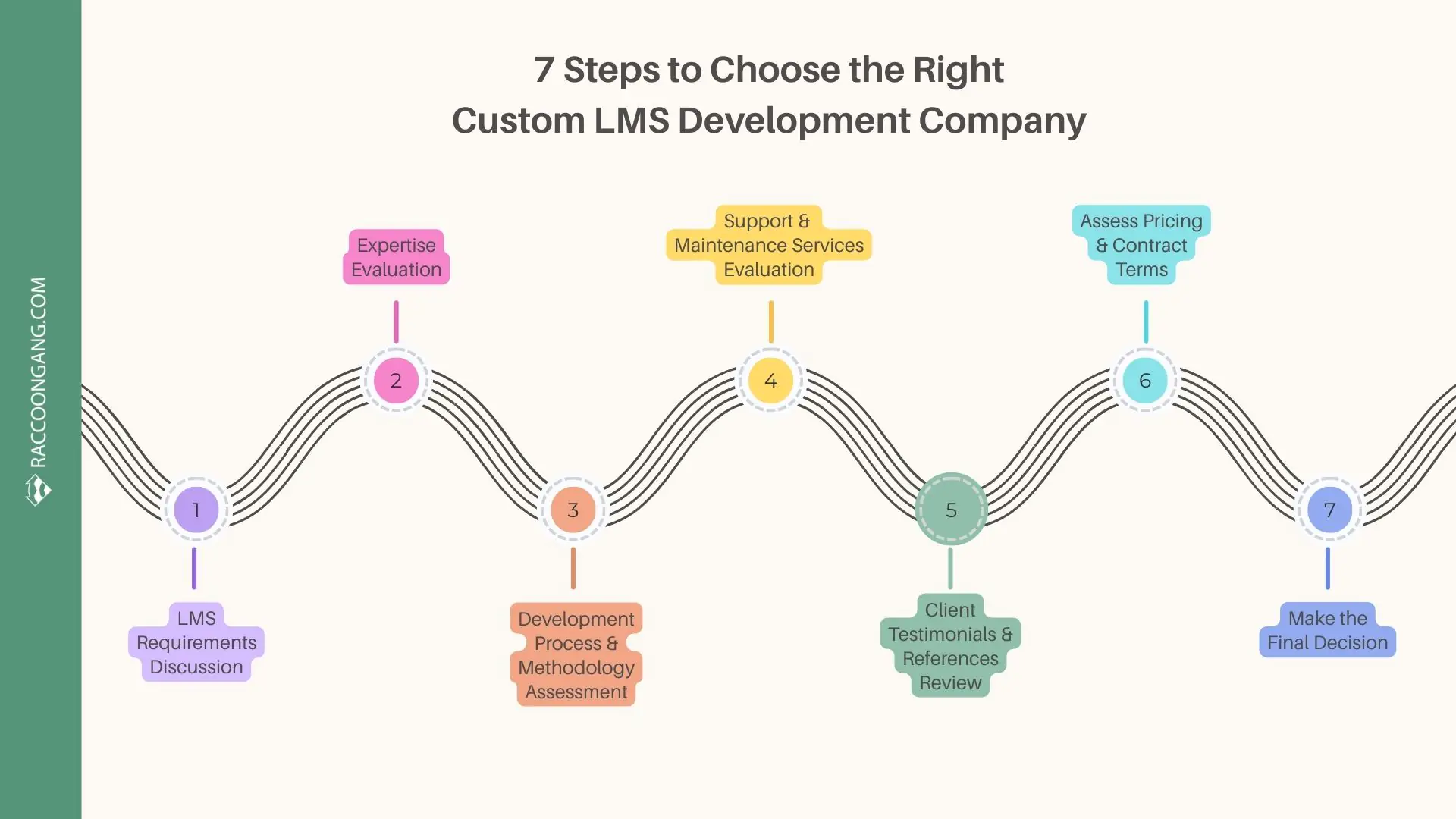
A quick checklist to compare LMS solution companies beyond the demo — expertise, process, support, and contract details.
What Makes a Great LMS Development Company?
Different LMS solution companies have their own advantages and disadvantages. What criteria will help separate the wheat from the chaff? A good demo? Not likely. A situation where your HRIS sync remains stable? Yes, that’s already warmer. Can your platform withstand peak loads during mandatory compliance week? Yes, it’s much hotter.
Here’s the selection criteria we recommend using to spot the best LMS developers and LMS consulting companies:
- Technical expertise (Python, React, Open edX or other LMS, cloud engineering)
We advise you to talk to the LMS providers on your shortlist about Python services, React front ends, Open edX internals (or Moodle/Totara/Canvas integrations), and cloud work that includes CI/CD, observability, and cost control.
- Enterprise-grade LMS architecture experience
If your goal is an enterprise-level learning solution, be sure to discuss with the LMS consulting companies you’re interested in topics such as multi-tenant setups, heavy reporting, search, video, and analytics. Your goal is to find out: if your learner count jumps from 2,000 to 20,000, will the system scale cleanly?
- UX/UI design that matches learning behavior
Let us tell you a secret of a well-known trick. If your learners ask questions like “Where do I click?”, your platform’s UX/UI design is poor. What’s the real secret? Experienced LMS development teams test flows with real learners and design for admins too.
- Mobile development (iOS/Android learning apps)
Mobile learning is a big milestone in the future development of LMS platforms. Ask the vendor if they support mobile solutions with native apps, support offline learning, and handle push notifications.
- Security and compliance expertise (FERPA, GDPR, SAML, LTI)
Make sure the vendor you choose knows how to set up SAML/SSO properly, implement LTI the right way, and handle data governance for FERPA and GDPR. Believe us, as practice shows, this is more important than any other fancy feature that salespeople added to the proposal.
- Ongoing support and consulting
Strong LMS consulting companies help you plan releases, manage upgrades, improve adoption, and keep performance steady.
Best LMS Development Companies (2026 Edition)
In this list, you’ll find two categories on purpose: custom LMS development companies (they build and extend platforms) and learning management system providers (they sell an LMS product as the LMS vendor).
So, meet 10 companies that can help you choose, customize, build from scratch, and integrate the tools you need into your LMS. Here is our list of the best LMS developers.
Aristek Systems — from platform blueprint to scaled delivery
Aristek Systems is a company focused on long-term custom development with an explicit focus on the LMS/eLearning ecosystem.
Aristek Systems Services:
- Dedicated team
- IT audit services
- Code review
- Web development
- Mobile development
- Software integration
When to choose Aristek Systems
This is your LMS vendor if you are looking for a custom platform plus an experienced engineering bench.
Raccoon Gang — from LMS development to fascinating customization
Since 2015, Raccoon Gang has built and maintained Open edX and Moodle platforms for universities, enterprises, and nonprofits — 150+ LMS projects across 30+ countries, with 1.5M+ learners on platforms the team supports in production. Clients include Harvard, NASA, EBRD, and the University of Washington. You can review specific builds in the case studies section. You can read more about the company’s projects in the business cases section.
If your criterion for choosing a partner for LMS development is open source, Raccoon Gang is your guaranteed win. Platforms based on Open edX, Moodle, Canvas, and everything will work exactly as you need. The Raccoon Gang team will help you choose the option relevant to your organization, offer budget-optimized features, and develop a solution within a clear deadline.
Raccoon Gang Services:
- Open edX setup, custom feature development, and migration
- Moodle services and Canvas development
- Mobile app development (iOS/Android, offline support)
- Customization and comprehensive theming
- AI Assistants and RG Gamification
- 300+ integrations (SSO/HRIS/CRM/LTI/xAPI/SCORM)
- Managed hosting and long-term support
Best for: Organizations that need long-term ownership of an open-source LMS — Open edX or Moodle builds, upgrades, migrations, custom features, managed hosting, and ongoing support. A poor fit for plug-and-play SaaS rollouts with minimal customization.
When to choose Raccoon Gang
Open edX builds, upgrades, migrations, custom features, hosting, and long-term support, Moodle-related services, and Canvas development.
Raccoon Gang as a Moodle LMS Development Company
Beyond Open edX, Raccoon Gang provides Moodle LMS development — including custom plugin development, Moodle Workplace implementations, HRIS/SSO integration, and managed hosting. For organizations that need Moodle’s open-source flexibility with full-service implementation support, Raccoon Gang provides end-to-end implementation including development, hosting, and ongoing support. See Moodle Services
Raccoon Gang for AI LMS Development
Raccoon Gang builds AI-powered features into Open edX and Moodle platforms — including the RG AI Assistant (integrated into Open edX courses for on-demand learner support), AI-driven content recommendations via xAPI event analysis, and adaptive learning sequences using Open edX’s conditional content engine. For organizations evaluating an AI LMS development company, Raccoon Gang’s AI work is embedded in the LMS platform rather than bolted on as a third-party chatbot. See AI Assistant
Raccoon Gang for LMS App Development
Raccoon Gang develops native iOS and Android LMS apps for Open edX — including offline learning, push notifications, video streaming, xAPI tracking, and deep link integration with course content. The AISL Harrow Academy mobile app serves 3,000–6,000 learners across Asia. See Mobile App Development
Inoxoft — from requirements to a working LMS
As an LMS development company, Inoxoft creates different digital solutions. Solutions from Inoxoft are most relevant for startups and small to medium-sized companies.
Inoxoft Services:
- Web And Mobile Application Development
- Quality Assurance
- Discovery Phase Facilitation
- UI/UX Design
- Analytics Solutions
When to choose Inoxoft
If you are interested in a custom learning platform and prefer a single delivery team.
Riseapps — from prototype to mobile-first learning
Riseapps develops custom EHR systems, patient portals, and AI virtual assistants.
Riseapps Services:
- End-to-end product development
- IT team extension
- AI integration and consulting
- Legacy system modernization
When to choose Riseapps
This is your vendor if you are looking for experience developing specifically Healthcare and Telemedicine solutions.
Docebo — from enterprise rollout to integration muscle
Docebo automates learning programs to scale and reduce manual tasks. The company was the first in the industry to embrace machine learning and generative AI.
Docebo Services:
- Migration
- Learning Management
- Content Creation
- AI Virtual Coaching
- Learning Design
- Custom reporting
- Support
When to choose Docebo
This is your vendor if you are looking for a learning platform that’s built for business.
Kaltura — from video library to learning video
Kaltura provides AI-infused, video-first digital experiences for customers and employees.
Kaltura Services:
- Platform training
- AI classes
- Campus events
- Virtual classroom
- LMS video
- Lecture capture
When to choose Kaltura
This is your vendor if you need serious video workflows inside an LMS (higher ed, training-heavy orgs, blended learning).
TalentLMS — from zero to live courses in days
TalentLMS is regularly included on lists of learning management system providers for SMB and mid-market training.
TalentLMS Services:
- Platform management
- Features
- Integrations
When to choose TalentLMS
This is your vendor if you need to go live quickly with a cloud LMS and avoid heavy engineering.
Paradiso Solutions — from LMS basics to a long list of connectors
Paradiso is an eLearning solutions provider. The company provides integrations and mobile learning as selling points.
Paradiso Services:
- Custom LMS Development
- Custom Course Development
- Managed Learning Services
When to choose Paradiso
This is your vendor if you want a ready LMS plus a big menu of third-party integrations.
Absorb LMS — from mandatory training to proof you can export
Absorb LMS is a well-known commercial platform with clear statements around compliance.
Absorb LMS Solutions:
- Performance development
- Employee onboarding
- Employee upskilling
- Product training
- Customer education
When to choose Absorb LMS
This is your choice if you need compliance, reporting, and an enterprise-ready security posture.
Adobe Learning Manager — from internal training to Adobe-stack fit
Adobe Learning Manager is a “suite-friendly” enterprise LMS option when you already live in Adobe’s ecosystem.
Adobe Learning Manager Features:
- AI in learning
- Personalized learning
- Blended learning
- Learning experience platform
- Headless LMS
- Gamification
When to choose Adobe Learning Manager
This is your option if you want an LMS with strong security features and SSO support.
Comparing LMS Development Companies and LMS Providers
| Company | Total | Architecture | Integrations | Security | Delivery | UX | Support | Best for |
| Raccoon Gang | 86 | 9 | 9 | 8 | 8 | 8 | 9 | Open edX / Moodle custom builds & long-term support |
| Docebo | 85.5 | 9 | 9 | 9 | 8 | 8 | 7 | Enterprise SaaS, AI-driven learning programs |
| Adobe Learning Manager | 83.5 | 9 | 8 | 9 | 8 | 7 | 8 | Adobe-stack orgs, enterprise SSO |
| Kaltura | 80.0 | 8 | 8 | 9 | 8 | 7 | 7 | Video-heavy programs, higher ed |
| Absorb LMS | 79.0 | 8 | 8 | 8 | 8 | 7 | 8 | Compliance & certification programs |
| Inoxoft | 78.0 | 8 | 8 | 8 | 8 | 7 | 7 | Custom builds for SMB, single delivery team |
| Riseapps | 72.5 | 7 | 7 | 8 | 8 | 7 | 6 | Healthcare & telemedicine LMS |
| TalentLMS | 72.0 | 7 | 8 | 7 | 7 | 7 | 7 | Fast SaaS rollout, SMB training |
| Aristek Systems | 70.5 | 8 | 7 | 6 | 7 | 7 | 7 | Custom platform + engineering bench |
| Paradiso Solutions | 66.5 | 7 | 8 | 6 | 6 | 6 | 6 | Ready LMS + wide integration catalog |
💡 Disclaimer: Scores are our editorial take based on public info at the time of writing. Use this as a shortlist tool — still run technical due diligence, security review, and reference checks for your use case.
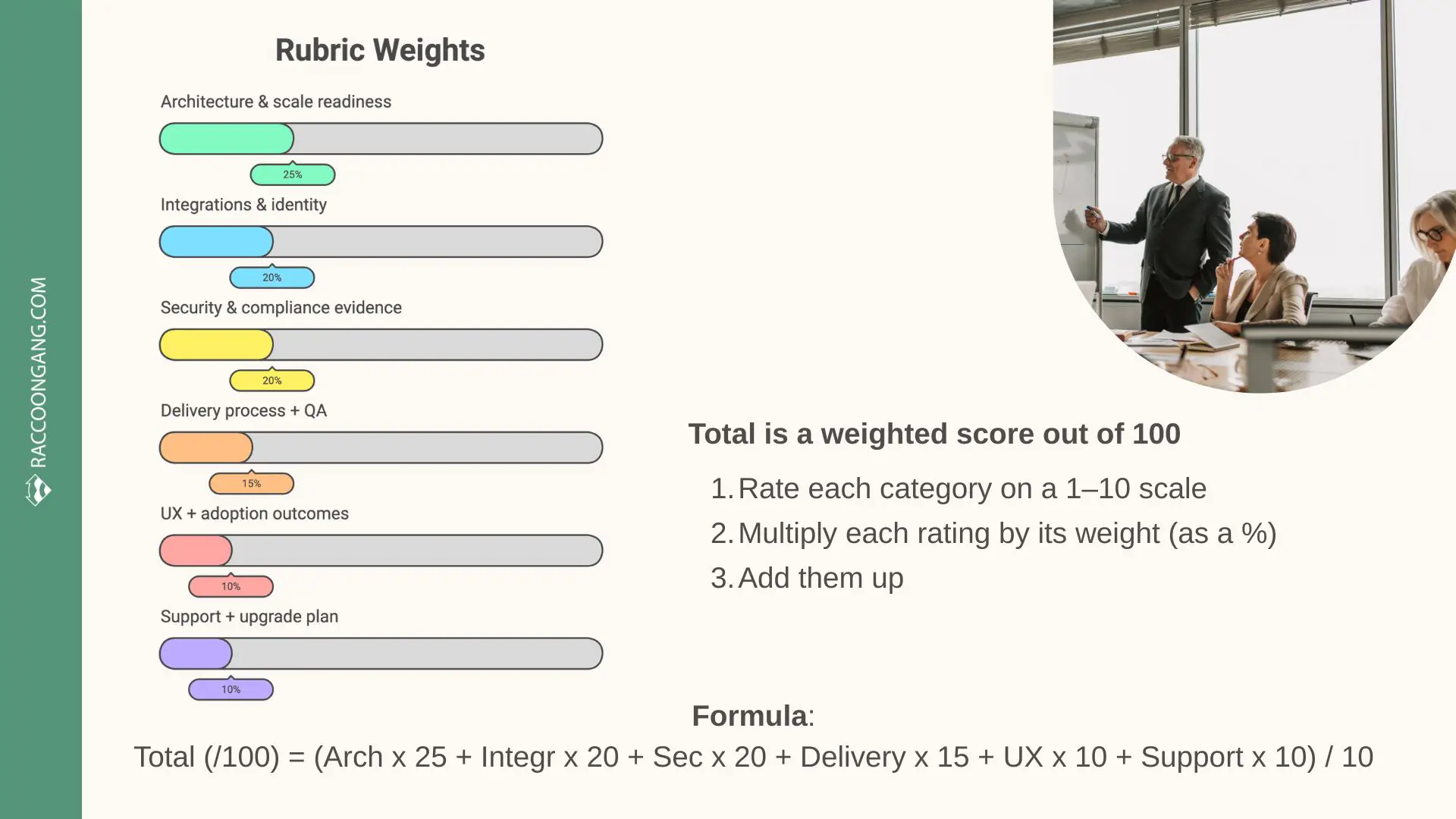
A simple way to rank LMS vendors by risk: score six areas, apply the weights, and compare totals like-for-like.
Best LMS Development Companies by Region
LMS Development Companies in Europe
European organizations evaluating LMS development companies in Europe typically prioritize GDPR compliance by design, EU data residency options, and proximity for timezone-aligned support. European-based or Europe-operating LMS development companies on this list:
- Raccoon Gang — headquartered in Tallinn, Estonia (EU); development teams in Ukraine; hosting available in EU data centers (AWS EU regions). ISO/IEC 27001:2022 certified. Has delivered LMS projects for EBRD and European academic institutions.
- Aristek Systems — Central/Eastern European engineering team; custom LMS and eLearning platform development.
- Inoxoft — Eastern European development company; custom builds for SMB organizations.
Types of LMS Solutions Companies Can Build
“LMS” can take many forms, depending on your goals, vision, and budget. Below, we’ve compiled the main categories of LMS solutions teams will build in 2026—and what custom LMS development usually looks like in each. Let’s take a look at what’s what.
- Custom-built LMS platforms. This type of platform has your workflows and reporting built into it. In practice, multi-tenant portals, billing, and deep integrations are often the pieces that complete the picture of custom solutions.
- Open edX–based solutions. Open-source LMS solutions such as Open edX, Moodle, and others can support your requirements for branding, SSO, LTI tools, custom reports, and, most importantly, scalable hosting.
- Corporate training platforms. These platforms are still LMSs, but they’re sharpened for onboarding and internal training. Role-based paths, due dates, manager dashboards, HRIS/CRM sync, and audit-friendly exports are often standard parts of this type of solution.
- University LMS solutions. This type of learning solution usually includes SIS integration, accessibility, proctoring, plagiarism tools, and LTI ecosystems. These needs are typical for educational institutions, so developers often build them as part of the core setup.
- Learning Experience Platforms (LXPs). Learning experience platforms often look and feel similar to popular social or multimedia sites. LXP software delivers personalized learning experiences and helps users discover new learning opportunities across desktops and mobile apps.
- Microlearning platforms. This type of platform is designed for short, repeatable lessons. In our experience, this type of learning solution is often delivered through mobile apps.
- Compliance and certification systems. This type of platform focuses on required training and includes functionality to issue certificates.
- Training platform development services. Training platform development services cover the end-to-end engagement of designing, building, configuring, and launching a learning platform — as distinct from purchasing an off-the-shelf LMS. Organizations choose dedicated training platform development when:
- Standard LMS platforms can’t support their specific workflow (e.g., multi-tenant franchise training, proprietary compliance logic, external partner certification)
- Deep integration with existing systems (HRIS, CRM, SIS, proprietary databases) is required from day one
- Data ownership and infrastructure control are organizational requirements (open-source or self-hosted)
- The training program is a commercial product (paid courses, certification, partner education) rather than internal-only
Raccoon Gang provides full-service training platform development — from requirements and architecture through implementation, integration, testing, and managed hosting — on Open edX and Moodle. See Custom LMS Development Services
How to Choose the Right LMS Development Company
- Start by defining the scope
We recommend deciding if you need a custom build, a ready-made LMS, or a hybrid (an LMS vendor plus custom work). If you can’t explain the scope in two sentences, your estimates will wobble later.
- Write the integrations list
In our experience, it is better to list what must work from day one as soon as possible: HRIS, CRM, SSO, SCORM, LTI, xAPI. Then ask the vendor to describe the integration route (native connector, API, middleware) and who owns it when something breaks.
- Put numbers on scalability requirements
The best way to predict scalability is to write: learners today, learners in 12–24 months, and peak moments (compliance week, semester start, partner onboarding). A good LMS development company will explain how they test load and where the system bottlenecks first.
- Treat support and maintenance like part of the product
We like to assume you’ll still be using this LMS two years from now. That’s why it’s important to define support services clearly. The best LMS consulting companies focus on monitoring, response targets, escalation, and upgrade policy.
- Match industry specialization to your risk
If SIS, accessibility, and LTI ecosystems are essential for Higher ed, then HRIS sync, manager reporting, and audits will be a must-have for Corporate training. Strong e-learning consultants will help you determine which cohort of solutions your LMS will belong to.
- Get clear on content authoring needs
Ask how the vendor handles templates, quizzes, video, and versioning so updates don’t turn into copy-paste chaos.
- Ask for data security evidence, then stay quiet
Good top consultants will show documents and processes; weak ones will give you confident sentences with nothing behind them.
How to Hire an LMS Development Company: 7 Questions to Ask Before Signing
Knowing which LMS development companies to shortlist is step one. Knowing what to ask before you sign is where most teams lose time and budget. Here are 7 questions that separate capable vendors from those who look good on a slide.
- “Show me a platform you’ve run for 2+ years at our scale.” Anyone can launch. Sustained production support is where LMS development companies either prove themselves or start making excuses.
- “Who specifically will work on our project — and who is their backup?” Agencies often sell with senior talent and deliver with juniors. Get names, not org charts.
- “How do you handle LMS upgrades without breaking customizations?” This is where cheap custom work gets expensive. Good teams have a defined upgrade-safe development pattern.
- “What does your incident response look like at 2 am on a compliance deadline?” The answer tells you everything about their actual support model, not the one in the proposal.
- “Can you show us a load test result at 3× our current peak?” Scalability claims need evidence. Ask for a test report, not a promise.
- “How do you handle GDPR/FERPA data requests for learner data?” If there’s a pause here, this is a risk. Data governance needs to be a process, not improvisation.
- “What’s your offboarding process if we need to switch vendors?” A confident vendor answers this question clearly. A locked-in vendor gets uncomfortable.
If you use this checklist in your first vendor call, you’ll feel the difference fast. The right team gives clear answers. The wrong team sells vibes.
Why Raccoon Gang Is One of the Best LMS Development Companies
If your shortlist includes Open edX, the real question isn’t “can they launch a platform?” It’s “can they run it at scale, keep it upgradeable, and support it when the stakes are high.” Raccoon Gang has spent 10+ years building and supporting learning platforms for global universities and enterprise teams, so the work is less theory and more production habits.
“We’re a strong fit for open-source LMS platforms that need long-term ownership, integrations, and scale — and a poor fit for plug-and-play LMS rollouts with minimal customization.”
— Oleksandra Nabokina, Director of Commercial Operations at Raccoon Gang.
- Open edX specialization: 150+ projects, 1.5M+ learners, clients including Harvard, NASA, EBRD, University of Washington.
- Upgrade-safe customization: custom roles, branded learner experiences, and integrations.
- Mobile learning apps: iOS/Android builds for programs.
- Analytics that answer real questions: dashboards and reports.
- Engagement mechanics: gamification and personalized learning features.
- Support & maintenance: monitoring, incident response, and planned upgrades.
Conclusion
Picking an LMS development company in 2026 comes down to one thing: can they ship a platform that survives real life—integrations, peak load, security reviews, and the next upgrade cycle. That’s why we ranked vendors by risk, mapped the main types of LMS solutions, and shared a practical checklist you can use in your first calls. The “best” LMS development company is the one that matches your scope and can prove it with evidence — not the one with the most features on a slide. Custom builds win when you need ownership and control; SaaS wins when you need speed and minimal engineering. Define which camp you’re in before your first vendor call.
If you want a second set of eyes, talk to Raccoon Gang. We can help you validate architecture and integration plans, or build and support an Open edX-based LMS designed for long-term ownership and scale.
FAQ
What does an LMS development company do?
What are the best LMS development companies in 2026?
How do I choose a custom LMS development company?
What technologies are used to develop LMS solutions?
Are custom LMS solutions better than SaaS LMS platforms?
How can Raccoon Gang help with custom LMS development?




- What Makes a Great LMS Development Company?
-
Best LMS Development Companies (2026 Edition)
- Aristek Systems — from platform blueprint to scaled delivery
- Raccoon Gang — from LMS development to fascinating customization
- Inoxoft — from requirements to a working LMS
- Riseapps — from prototype to mobile-first learning
- Docebo — from enterprise rollout to integration muscle
- Kaltura — from video library to learning video
- TalentLMS — from zero to live courses in days
- Paradiso Solutions — from LMS basics to a long list of connectors
- Absorb LMS — from mandatory training to proof you can export
- Adobe Learning Manager — from internal training to Adobe-stack fit
- Comparing LMS Development Companies and LMS Providers
- Best LMS Development Companies by Region
- Types of LMS Solutions Companies Can Build
- How to Choose the Right LMS Development Company
- How to Hire an LMS Development Company: 7 Questions to Ask Before Signing
- Why Raccoon Gang Is One of the Best LMS Development Companies
- Conclusion