







Custom LMS vs SaaS LMS comparisons usually start with feature lists and end with pricing. Let’s dive deeper. Which deployment model will cost less over the next five years? License fees are only one variable. Integration projects, customization, vendor lock-in, support, upgrades, DevOps, compliance, and migration costs often have a much bigger impact on the final budget.
The research tells the story. Thirty-seven percent of organizations want to replace their LMS, and nearly half plan to do it within the next year because their current platform no longer supports business growth, integrations, or reporting requirements.
Meanwhile, the global SaaS LMS market continues to grow, with 2026 estimates ranging from $31.6 billion to $35.2 billion. Yet most “best LMS” articles still compare products instead of helping enterprise buyers choose the right ownership model.
After more than a decade of designing, implementing, and customizing enterprise learning platforms, we’ve found that organizations should evaluate three paths: a SaaS LMS, a custom-built LMS, and a managed open-source LMS. Most buying guides overlook the third option.
This article compares all three through the lens of ownership, flexibility, and 5-year TCO, helping you identify which model best fits your organization.
Key Takeaways
- Choose the deployment model before choosing the LMS platform. The wrong architecture usually costs more to replace than the wrong feature set.
- SaaS delivers the fastest launch. Managed open source often lowers five-year TCO as learner numbers and integration needs grow. Custom LMS fits highly specialized or commercial products.
- Evaluate long-term ownership instead of subscription costs only. Licensing, maintenance, integrations, platform operations, and future changes all contribute to the total cost of ownership.
- Growth changes the business case. An LMS that fits 500 learners may become expensive or restrictive at 5,000 or 25,000 learners.
- Use a structured decision framework. Learner volume, compliance, integrations, operational capacity, and business goals should drive every build vs buy LMS decision.
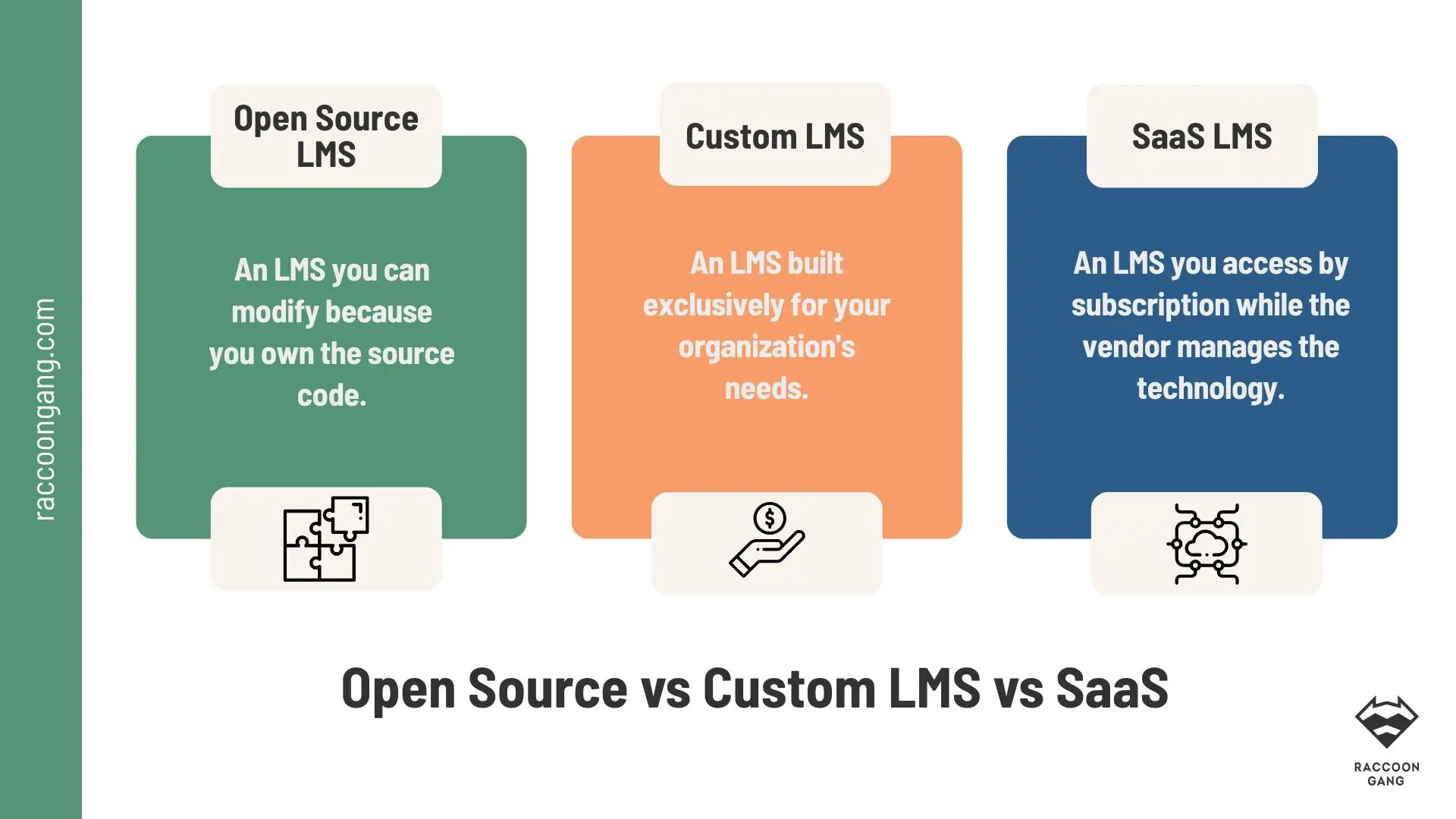
What Is a SaaS LMS?
A SaaS LMS (learning management system) is a cloud-hosted platform. Instead of installing and maintaining the software on its own infrastructure, an organization accesses it through a subscription. In this model, the vendor manages the infrastructure while your team uses the platform to deliver and manage learning. With a SaaS LMS software as a service model, hosting, security, software updates, backups, and uptime all remain the vendor’s responsibility rather than yours.
Among the best-known SaaS vendors are Docebo, TalentLMS, Cornerstone, and 360Learning.
- Pricing model: Most charge either an annual subscription or a per-user licensing fee.
- Standard deployment: Typically 4–8 weeks.
- Enterprise deployment: Usually 8–16 weeks when SSO, HRIS, CRM, ERP, or other business system integrations are required.
One of the biggest advantages of a SaaS LMS is faster deployment. It also reduces operational overhead. At the other end of the scale, your organization adopts the vendor’s release schedule, product roadmap, and operating model. As a result, you have less control over how and when the platform evolves.
What Is a Custom LMS?
A custom LMS refers to a learning platform built specifically for one organization. Depending on the project scope, it can be developed from scratch or created through extensive API extensions.
“Every custom LMS should solve a business problem that standard platforms can’t. Otherwise, you’re paying to rebuild features you already could have bought.”
— Volodymyr Chekyrta, Engineering Manager, Raccoon Gang
If we put a SaaS platform and a custom LMS side by side, the custom platform offers greater control over every feature, data model, user experience, and integration.
Based on Raccoon Gang’s implementation experience, typical custom LMS cost enterprise projects include:
- Development cost: From $30,000 for an MVP scope to $200,000+ for an enterprise-grade platform.
- Ongoing maintenance: Plan for 15–20% of the initial development cost per year to cover DevOps maintenance, security updates, infrastructure, bug fixes, and platform enhancements.
- Data ownership: Your organization retains full control over the platform, including custom LMS data ownership, integrations, and future development priorities.
What Is an Open Source LMS?
An open source LMS is the third deployment model organizations should consider. Unlike proprietary platforms, its source code is publicly available. Any organization can deploy, customize, and extend the platform without paying any licensing fees.
An open source LMS can be deployed in one of two ways:
- Self-hosted
- Managed open source LMS
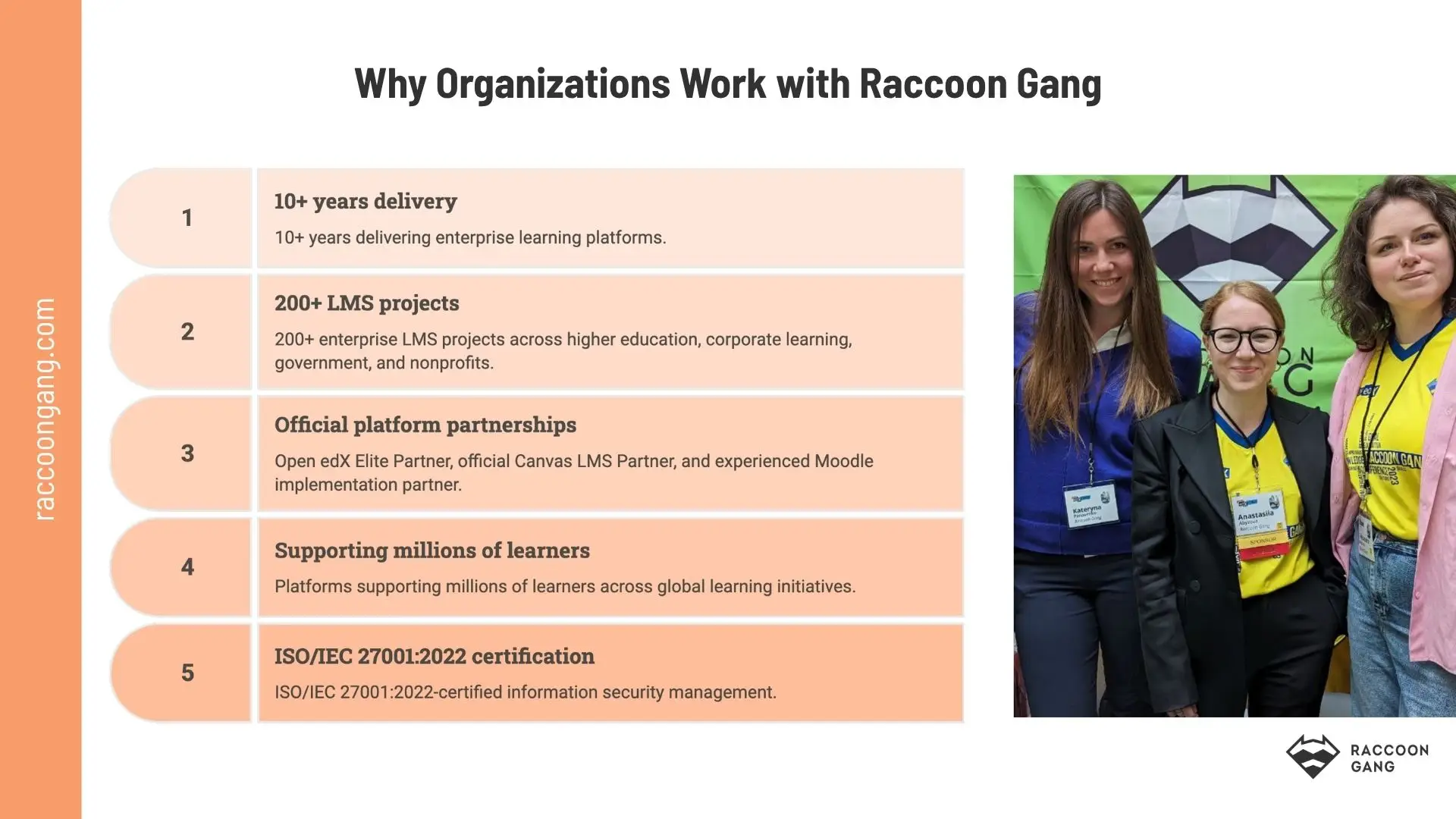
After more than 10 years, 200+ enterprise LMS projects, and platforms supporting millions of learners, we’ve seen managed open source LMS become the preferred choice for organizations balancing flexibility, compliance, and operational complexity. Raccoon Gang is an Open edX Elite Partner, an official Canvas LMS partner, and also provides consulting and support for Moodle platforms.
“When comparing an open source LMS vs SaaS LMS, the biggest difference isn’t the technology. The most expensive LMS is the one that makes every future change slow, expensive, or dependent on someone else.”
— Volodymyr Chekyrta, Engineering Manager, Raccoon Gang
So where should you start? Comparisons like Open edX vs SaaS LMS or Moodle vs SaaS LMS only become useful when all options are evaluated against the same criteria. Every enterprise LMS build or buy decision should be measured against business goals, technical requirements, and a 5-year TCO model. Before putting the options side by side, let’s examine the strengths, limitations, and best-fit scenarios for each deployment model individually.
When Does a SaaS LMS Make Business Sense?
A SaaS LMS makes the most sense when your organization prefers the vendor to operate the platform. Fast deployment is another advantage. Predictable subscription costs also make planning easier. The model works best when deep customization and infrastructure control are not priorities.
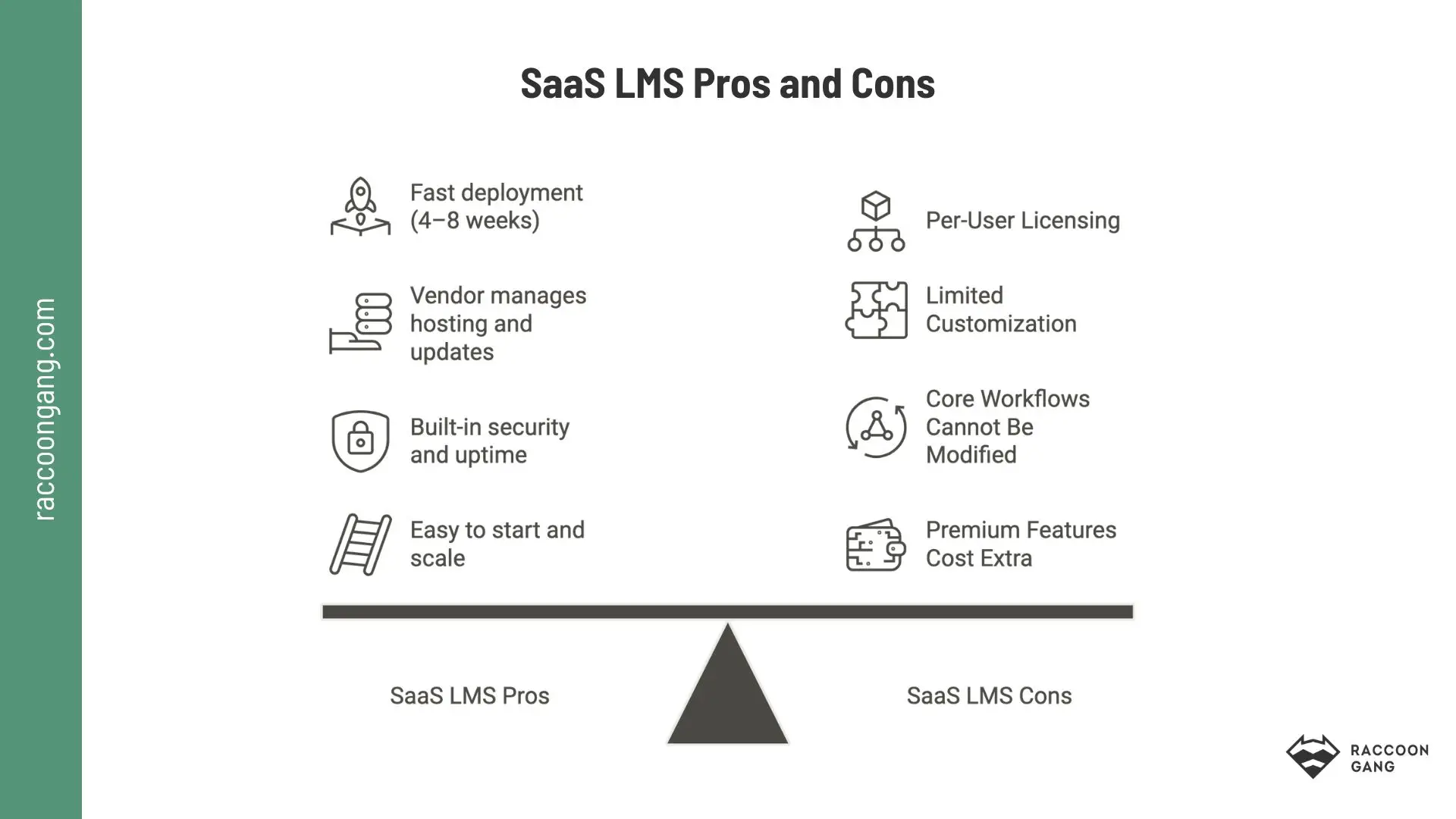
SaaS LMS platforms reduce operational effort but often trade flexibility and long-term licensing costs for deployment speed.
SaaS is usually the right choice when:
- Standard employee training
- Limited IT resources
- Common business integrations
- Vendor manages the platform
- Built-in AI updates
Reconsider SaaS when:
- Per-user pricing grows with adoption. Most SaaS platforms charge $10–$100 per user per year. Enterprise subscriptions often range from $25,000 to $100,000+ annually, making costs increase as learner numbers grow.
- LMS vendor lock-in enterprise becomes a concern. Vendor lock-in rarely starts with user accounts. It usually appears during migration, when organizations discover limits around data portability, reporting history, integrations, or custom workflows. Exit terms should be negotiated before signing the contract.
- Your business depends on custom workflows, proprietary data models, or deep integrations that extend beyond the vendor’s supported capabilities.
- GDPR, HIPAA, FINRA, or internal security policies require greater control over infrastructure and data residency.
- SaaS LMS hidden costs begin to accumulate. Before signing, verify whether onboarding, implementation, custom branding, migration, advanced reporting, premium support, storage, API limits, and other professional services are included in the subscription.
Best fit
Organizations with fewer than 2,000 learners are often a strong fit for SaaS. Standardized training processes and limited IT or DevOps capacity point in the same direction. That recommendation also reflects the broader market, where 93.47% of LMS deployments were cloud-based in 2025. If all three conditions apply, SaaS is usually the right place to start.
“SaaS delivers the fastest path to launch. The real question is whether it will still be the most economical path after your organization doubles in size.”
— Natalia Boikiv, Delivery Director, Raccoon Gang
When Is a Custom LMS Worth the Investment?
A custom LMS makes business sense when the learning platform becomes part of your business strategy rather than another software subscription. Every feature is built around your organization instead of adapting your organization to the platform. The trade-off is equally important. As vendor lock-in disappears, internal team ownership becomes one of the biggest long-term commitments.
A custom LMS is usually the right choice when:
- Unique business processes
- Legacy system integrations
- Commercial LMS product
- Complete data ownership
- Unlimited learner growth
Reconsider custom development when:
- Custom LMS cost enterprise: Development starts at approximately 400–500 engineering hours for an MVP. Enterprise-grade platforms typically require $80,000–$200,000+ before additional requirements expand the scope.
- Time-to-market is critical: Most enterprise projects require 6–12+ months before production launch.
- Internal ownership becomes permanent: Unlike SaaS, the biggest long-term risk is rarely vendor lock-in. It’s internal team lock-in, where future updates, architecture decisions, and technical debt depend on your engineering team.
- Engineering capacity is limited: Every custom LMS development enterprise project requires ongoing ownership of the codebase, infrastructure, security, and future enhancements.
- Maintenance is part of the budget: Plan for 15–20% of the initial development cost each year to support security patches, upgrades, and new functionality.
Best fit
A custom LMS becomes a rational investment at 25,000+ active learners. It also makes sense when your platform requires three or more proprietary workflow integrations. Building a commercial LMS product is another strong reason to choose custom development. At that point, custom LMS vs SaaS becomes a question of custom LMS data ownership, product differentiation, and long-term economics.
Comparison Table: SaaS vs Custom vs Open Source + Managed
In the table below, you can find direct answers to why custom LMS vs SaaS LMS is no longer the only enterprise decision. You will also see a different angle: open-source LMS vs. SaaS LMS.
| Enterprise Decision Criteria | SaaS LMS | Custom LMS | Open Source + Managed Partner |
| Licensing cost | Annual subscription | None | None |
| Implementation time | 4–8 weeks (8–16 enterprise) | 6–12+ months | 6–12 weeks (typical) |
| Upfront investment | Low | High ($80K–$200K+) | Moderate |
| Per-user cost at scale | Increases with each learner | No licensing fees | No licensing fees |
| Customization depth | Configuration only | Unlimited | Extensive platform customization |
| Data ownership | Vendor-controlled environment | Full ownership | Full ownership |
| Vendor lock-in risk | Higher unless exit terms are negotiated | Low vendor lock-in, higher internal dependency | Lower vendor lock-in with partner support |
| GDPR & data residency | Depends on vendor options | Full control | Full control |
| HRIS / CRM / ERP integration | Supported connectors and APIs | Unlimited | Standard + custom integrations |
| Ongoing maintenance | Vendor-managed | Internal engineering team | Managed by implementation partner |
| Time to go-live | Fastest | Longest | Faster than custom, more flexible than SaaS |
| Best for | Standard corporate training | Commercial LMS products and highly specialized workflows | Organizations needing ownership without running platform operations |
* For many enterprises, the LMS total cost of ownership enterprise depends on three factors: avoiding recurring licensing fees, reducing the need for an in-house platform engineering team, and keeping the flexibility to adapt the LMS as business requirements change. Let’s talk about 5-Year LMS TCO in the next block.
5-Year LMS TCO: Where Enterprise Costs Actually Come From
Now let’s talk about money. This section equips you with the numbers that matter before choosing an LMS. Many organizations compare licensing costs before signing a contract and stop there. Based on more than 200 enterprise LMS projects, we’ve seen a different picture.
Five years later, licensing often represents only one part of the investment. Infrastructure, integrations, maintenance, and future platform changes all affect the LMS total cost of ownership enterprise.

Illustrative estimates based on typical enterprise pricing, implementation, infrastructure, maintenance, and support. Actual costs vary depending on platform, deployment scope, hosting model, integrations, and vendor contracts.
What changes as organizations grow?
500 learners
At this scale, SaaS usually offers the lowest barrier to entry. Organizations with up to 500 learners typically spend less on platform operations, while SaaS LMS hidden costs remain manageable. Low learner volumes also keep subscription costs under control.
2,000 learners
Once organizations grow beyond 2,000 learners, the financial picture starts to change. Per-user licensing increases every year. Managed open-source platforms scale without recurring licensing fees. For many organizations, this is where the LMS total cost of ownership enterprise begins to favor a managed open-source approach.
10,000 learners
Above 10,000 learners, subscription fees often grow much faster than infrastructure costs. Managed open source and custom LMS cost enterprise models become more economical because every new learner does not increase licensing costs. At this stage, the discussion shifts from subscription pricing to long-term operating costs.
Decision Framework: Which LMS Model Fits Your Business?
After comparing custom LMS vs SaaS LMS, the next question becomes much simpler: Which deployment model fits your organization today? The following questions mirror the evaluation framework we use during enterprise LMS build or buy consulting projects, so you could use them too.
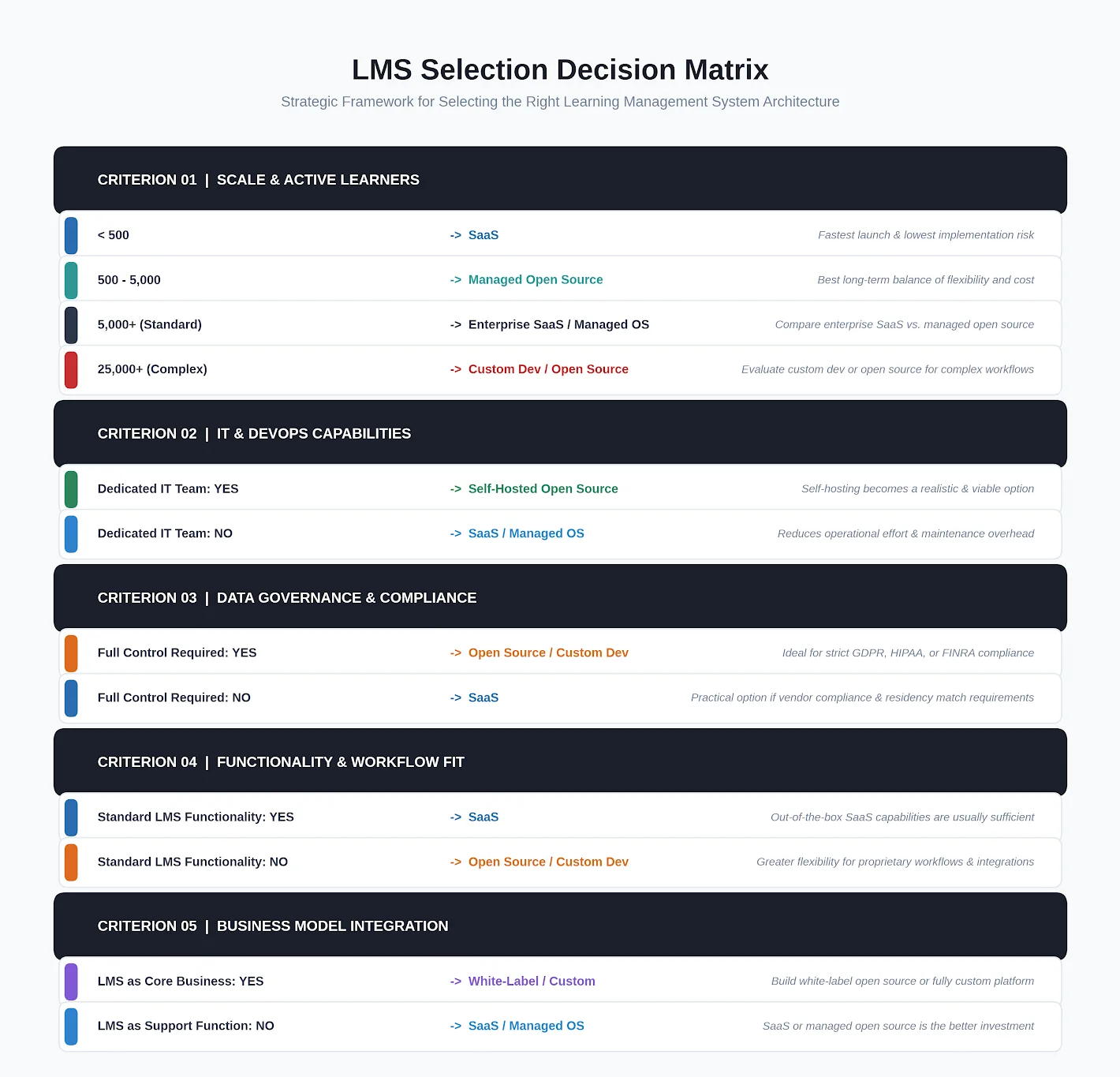
Treat each criterion as a filter. The more answers that align with one model, the stronger your deployment choice becomes. Start at Criterion 1 and move down the matrix.
1. How many active learners will use the platform?
- Fewer than 500 → SaaS usually offers the fastest launch and the lowest implementation risk.
- 500–5,000 → A managed open-source LMS often delivers the best long-term balance between flexibility and cost.
- 5,000+ with standard training → Compare enterprise SaaS with managed open source.
- 25,000+ with multiple proprietary workflows → Evaluate custom development or open source.
2. Do you have a dedicated IT or DevOps team?
- Yes → Self-hosted open source becomes a realistic option.
- No → SaaS or a managed open-source partner will usually reduce operational effort.
3. Does your organization require full control over learner data?
- Yes → Prioritize open source or custom development, especially for GDPR, HIPAA, or FINRA environments.
- No → SaaS remains a practical option if the vendor’s compliance and data residency terms meet your requirements.
4. Will standard LMS functionality support your business?
- Yes → SaaS is usually sufficient.
- No → Open source or custom development provides greater flexibility for proprietary workflows and enterprise integrations.
5. Is the LMS part of your business model?
- Yes → Consider a white-label LMS built on open source or a fully custom platform.
- No → SaaS or managed open source is usually the better investment.
A final reality check
Every build vs buy LMS decision comes down to the same question: Will your business benefit more from owning the platform or from operating it with minimal overhead? If your priority is an implementation timeline of 4–8 weeks, SaaS often wins. If your roadmap extends over many years, ownership, scalability, and long-term flexibility usually deserve more weight than launch speed alone. Before approving a custom LMS, define a clear MVP scope. Many organizations later discover they needed far fewer custom features than they originally expected.
Open Source LMS Options: Open edX, Moodle, Canvas
Choosing between Open edX vs SaaS LMS, Moodle vs SaaS LMS enterprise, or open source LMS vs custom LMS is only the first decision. The platform will require upgrades. Business requirements will change. Your operating model should be ready for both.
| Open edX | Moodle | Canvas | |
| Best suited for | Enterprise learning, customer education, large-scale training | Corporate compliance, certifications, higher education | Higher education, professional education |
| Typical strengths | Massive scalability, XBlocks, APIs, multi-tenancy | Extensive plugin ecosystem, structured learning, flexibility | Modern UX, LTI 1.3 ecosystem, simple administration |
| Ideal when… | You expect complex learning ecosystems and future customization | You need rapid configuration with proven learning workflows | Learner experience and interoperability are top priorities |
| Open-source advantage | Full ownership and customization | Full ownership and customization | Full ownership and customization |
| Raccoon Gang expertise | Open edX Elite Partner (10+ years) | Moodle implementation & consulting | Official Canvas LMS Partner |
* More than 200 enterprise LMS projects have shown us that no platform succeeds in every situation. The right choice depends on business goals, available resources, and long-term operating plans. That’s why we assess those factors before recommending Open edX, Moodle, or Canvas.
How Raccoon Gang Helps Enterprises Evaluate and Implement LMS Platforms
After reading this guide, you’ve probably reached one conclusion: choosing an LMS platform and choosing the right deployment model are two different decisions. That’s where LMS consulting services enterprise become valuable.
“Raccoon Gang has been a great partner that has helped us with multiple web development projects. Their experience with hosting Open edX instances, implementing LTI integrations, and general experience developing education applications has been especially valuable.” — Andrew Ang, Harvard
We start with the deployment model
- LMS consulting services enterprise. We compare SaaS, managed open source, and custom deployment models before your organization commits budget or selects a platform.
- Open edX implementation partner. Deploy Open edX, customize the platform, integrate SSO, SAML, HRIS, CRM, ERP, and analytics, then deliver biannual platform upgrades.
- Canvas implementation. Configure SIS and SSO, implement LTI 1.3, deploy Canvas Catalog for continuing education, and connect Canvas with your existing systems.
- Moodle implementation. Build corporate learning environments with custom branding, compliance workflows, HRMS integration, and enterprise reporting.
- Custom LMS development services. When standard platforms cannot support your business requirements, we extend Open edX as a foundation instead of rebuilding common LMS functionality from scratch.
- Managed hosting and long-term support. Monitor infrastructure, apply security updates, manage platform upgrades, and maintain uptime, so your team can focus on learning rather than platform operations.
Recent implementation examples
You can find more of our cases in the Raccoon Gang’s Portfolio.
- EBRD Policy Academy. Multi-region Open edX implementation supporting compliance and policy education across 38 countries, including interactive e-learning content and secure cloud hosting.
- NASA Open Science 101. SCORM-based course production and Open edX implementation supporting global open science education with interactive learning experiences.
Before every implementation begins, Raccoon Gang always helps organizations validate architecture, integrations, compliance requirements, ownership model, and long-term operating costs.
Conclusion
Every custom LMS vs SaaS LMS discussion eventually leads to a broader enterprise LMS build or buy decision. The right answer depends on learner growth, integration complexity, data residency requirements, and the resources available to operate the platform over the next five years.
SaaS delivers the shortest implementation timeline (4–8 weeks) and the lowest operational effort. Custom platforms provide maximum control for organizations building white-label LMS products or supporting proprietary business processes. Between them, open source LMS vs SaaS LMS offers an alternative that combines platform ownership with partner-managed operations, uptime SLA, and long-term flexibility.
One final recommendation. Look beyond today’s feature list and per-user licensing fee. Ask how easily your learner data can be exported, whether data portability is guaranteed, and how the platform will support future SCORM, xAPI, and LTI integrations. Those questions often have a greater impact on long-term success than any individual feature available today.
At Raccoon Gang, we help organizations answer those questions before implementation begins.
FAQ
What is the difference between a custom LMS and a SaaS LMS?
SaaS launches in 4–8 weeks. Custom projects often take 6–12+ months. One favors speed. The other favors control.
What is a SaaS LMS?
A SaaS LMS runs in the cloud. You pay a subscription. Most platforms charge $10–$100 per user yearly. The vendor manages operations.
Is an open source LMS free?
The software is free. Licensing fees disappear. Hosting and support still cost money. Ownership stays with your organization.
When should an enterprise build a custom LMS?
Start around 25,000+ active learners. Complex integrations matter too. Commercial LMS products often justify custom development.
What are the hidden costs of a SaaS LMS?
Licensing is only one expense. Migration costs appear later. Premium features cost extra. Per-user fees grow every year.
How does an open source LMS compare to SaaS in total cost of ownership?
SaaS costs less initially. Open source scales without licensing. Many organizations see lower five-year TCO after 2,000 learners.
What is a managed open source LMS?
You own the platform. A partner manages operations. No DevOps team is required. Your staff stays focused on learning.
Which LMS model is best for regulated industries such as healthcare, finance, or government?
Compliance drives the decision. GDPR, HIPAA, and FINRA matter. Open source offers greater infrastructure control. Data residency stays configurable.
Can Open edX replace a SaaS LMS for corporate training?
Yes. Open edX serves 100M+ learners globally. Customer education fits well. Enterprise training scales easily.




- What Is a SaaS LMS?
- What Is a Custom LMS?
- What Is an Open Source LMS?
- When Does a SaaS LMS Make Business Sense?
- When Is a Custom LMS Worth the Investment?
- Comparison Table: SaaS vs Custom vs Open Source + Managed
- 5-Year LMS TCO: Where Enterprise Costs Actually Come From
- Decision Framework: Which LMS Model Fits Your Business?
- Open Source LMS Options: Open edX, Moodle, Canvas
- How Raccoon Gang Helps Enterprises Evaluate and Implement LMS Platforms
- Conclusion