TL;DR
- The difference between Moodle LMS and Moodle Workplace is architectural, not feature-based.
- Moodle LMS offers maximum flexibility but requires stronger internal governance and technical ownership.
- Moodle Workplace introduces built-in enterprise structures such as multi-tenancy and hierarchical role management.
- At small to mid scale, Moodle LMS can remain cost-efficient.
- At enterprise scale, Workplace often reduces administrative fragmentation and long-term operational risk.
- The right choice depends on how much structural complexity your organization needs to manage over the next 3–5 years.
Our e-learning specialist recently conducted his own investigation and found that 6 out of 10 people who are interested in Moodle come to compare Moodle LMS vs Moodle Workplace.
We were not surprised by this conclusion, because Moodle appears in both situations: when it comes to an LMS and when it comes to a Workplace solution. What is the difference? Why are Moodle LMS and Moodle Workplace similar and, at the same time, it is two independent options?
We involved our internal specialists who implement solutions based on Moodle to help you clearly understand one fact: Moodle Workplace is not a replacement, but a different solution.
So, here is our article on how to choose between the two options — the one that best suits your case — and not just decide who is “more Moodle”: the LMS or the Workplace. After all, the wrong choice will be imperceptible only in the first year. And after 2–3 years, the wrong choice may slowly increase the administrative load, limit scalability, or create compliance gaps.
Let’s define your safer long-term investment together.
What Is Moodle LMS?
To better show you what Moodle LMS is, we will not repeat the definition of an LMS, as we are sure you already know it. Instead, let’s focus on Moodle itself.
As for Moodle LMS, it is a free, open-source learning management system. “Free” in this case means that you can download and deploy the platform yourself. The platform is licensed under the GNU GPL. While the model reduces licensing costs, it also places more operational responsibility on the organization — including hosting, maintenance, and plugin compatibility.
Moodle gives flexibility — but also transfers operational responsibility to the organization.
Moodle LMS has historically been positioned as a universal LMS for education and training: the platform focuses on courses, pedagogical activities, and assessments, and it supports distance and blended learning.
Regardless of the organization in which you want to use Moodle as a learning system — universities or schools, or perhaps a training provider — you will have at your disposal the following hierarchical structure built around courses:
- Site — settings, authentication, roles
- Categories — course grouping (faculty, department, program)
- Courses — content, activities, grades, completion
- Enrollments — manual, self, cohorts, integrations
- Plugins — extra features and integrations
* The video demonstrates Moodle Workplace 4.0 in the role of a customisable enterprise learning management platform for workplace onboarding, learning, and compliance training.
What Is Moodle Workplace?
When we talk about Moodle Workplace, the clearest definition here would be that it is a separate commercial product based on Moodle LMS. Moreover, this is a specific version of Moodle for corporate training at the enterprise level that introduces subscription fees but provides structured support and enterprise-focused architecture, reducing long-term operational uncertainty.
Moodle Workplace reduces administrative load and risk by standardizing corporate processes.
Moodle Workplace is Moodle LMS with an enterprise layer on top — like a standard building expanded into a full business center. It keeps the course-based Moodle core, then adds the following things:
- Multi-tenancy — separate tenants within one platform
- Organizational structure — departments, positions, job roles
- Programs — structured learning paths
- Certifications — with recertification logic
- Automation — rule-based actions
- Delegation — extended admin roles
- Reporting — tenant-aware analytics
Difference Between Moodle and Moodle Workplace (Quick Summary)
Now that we have looked at the two Moodle platform options, let’s clearly draw a line between them. It’s time to unveil the main difference between Moodle LMS and Moodle Workplace.
While they share the same technical foundation, the real difference appears in operational responsibility and long-term risk exposure.
- Moodle LMS → education-first, course-centric, open source
Moodle LMS typically serves educational institutions well through a combination of plugins, integrations, and internally designed processes.
- Moodle Workplace → corporate-first, program-centric, subscription-based
Moodle Workplace includes built-in tools for training in complex organizations (branches, franchises, partner or supplier programs). It also keeps data separated and makes responsibilities clearer.
One important nuance for B2B L&D: Moodle LMS and Moodle Workplace are not mutually exclusive “by domain.” You can use Moodle LMS for corporate training, but you will rely more on process design, plugins, and integrations to get the enterprise features that Moodle Workplace offers out of the box.
“Choosing between Moodle and Workplace is less about features and more about how much complexity your organization is prepared to manage internally.”
— Raccoon Gang LMS Expert.
Using Moodle LMS for enterprise training can work — much like using a versatile multitool for a full renovation. It’s capable. But as the project grows, the effort, coordination, and risk of inefficiencies increase.
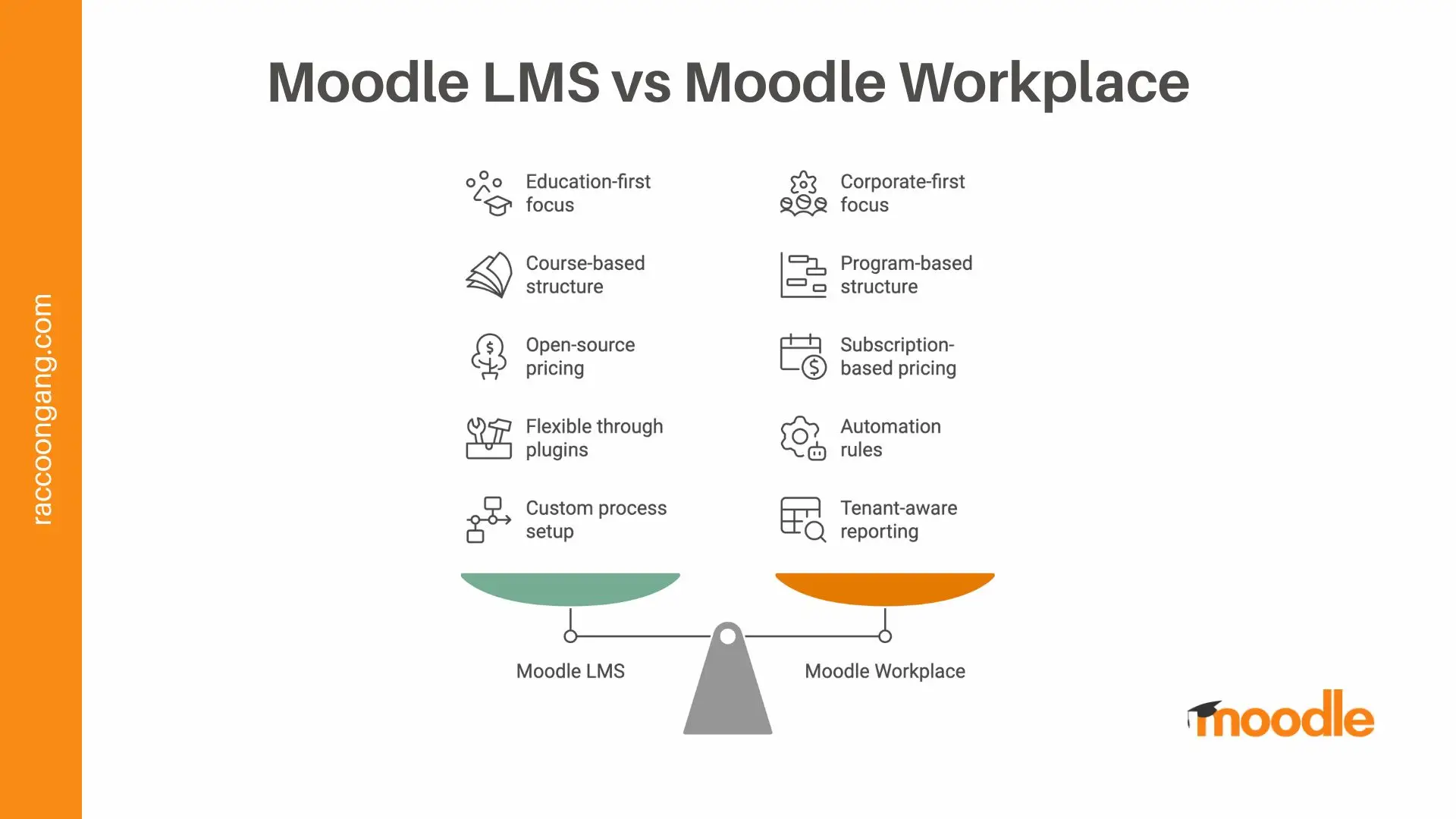
Visual comparison of Moodle LMS and Moodle Workplace highlighting structural differences, pricing models, automation, and reporting capabilities.
Moodle LMS vs Moodle Workplace: Feature Comparison
Let’s contrast Moodle LMS vs Workplace and view them through the prism of not just features, but also operational risk and long-term scalability.
| Risk Domain | Moodle LMS | Moodle Workplace | Business Implication |
| Audience & Primary Use Case | Education-first, course-centric. Flexible for corporate with configuration. | Corporate-first, program-centric. Built for structured enterprise training. | If your model revolves around academic courses, LMS fits naturally. If you manage departments, compliance cycles, or partners, Workplace reduces structural friction. |
| Learning Structure | Courses are the core unit. Learning paths require plugins or manual setup. | Programs (learning paths) are native. Certifications and recertification are built in. | Complex learning journeys require more manual orchestration in LMS. Workplace standardizes structured progression. |
| Scalability Infrastructure | No native multi-tenancy. Requires custom architecture or separate instances. | Built-in multi-tenancy with tenant isolation. | Multi-brand or multi-client environments scale cleaner with Workplace. LMS scaling increases admin complexity. |
| Automation & Admin Load | Automation depends on plugins and custom rules. More manual admin work. | Rule-based automation included (enrollments, certifications, notifications). | Higher automation reduces operational overhead and HR dependency. |
| Governance & Role Management | Standard role system. Advanced delegation requires configuration. | Extended delegation model aligned with organizational hierarchy. | Workplace simplifies distributed administration across departments or regions. |
| Compliance & Certification Tracking | Certificates via plugins. Recertification logic requires setup. | Native certifications with renewal cycles and tracking. | Compliance-heavy industries benefit from built-in certification control. |
| Reporting & Dashboards | Core reports + plugin extensions. Cross-entity reporting requires customization. | Tenant-aware reporting with separation by organization unit. | Workplace reduces reporting conflicts in multi-entity environments. |
| User & Organizational Management | Users managed mainly at course/category level. Org structure requires custom modeling. | Built-in organizational hierarchies (departments, job roles). | Workplace aligns training with real org charts out of the box. |
| Customization & Extensibility | Fully open source. High flexibility with development. | Built on Moodle core with enterprise additions. | LMS gives maximum architectural freedom. Workplace prioritizes operational efficiency. |
| Licensing Model | Open source (GNU GPL). Hosting and development costs apply. | Commercial subscription. | LMS may reduce license costs but increase implementation effort. Workplace shifts cost to subscription with lower structural build effort. |
Moodle LMS vs Moodle Workplace: Use Cases
As your organization grows in complexity, you need stronger structural control. That’s exactly where the difference between Moodle LMS and Moodle Workplace becomes clear.
Moodle LMS makes sense if:
- You are a small company with a limited learner base
- You have in-house development resources or a technical partner
- You need high flexibility and custom workflows
- Your training structure revolves around individual courses
- You can manage processes manually or through plugins
In this case, Moodle LMS gives you architectural freedom. You design the structure yourself.
Moodle Workplace makes sense if:
- You operate across multiple departments, regions, or brands
- You must handle regulatory reporting or recurring certifications
- You plan for organizational growth or partner expansion
- You need structured programs instead of isolated courses
- You want automation to reduce admin workload
In the case of Moodle Workplace, it supports scale without rebuilding your structure later; this is an advantage that is hard to ignore.
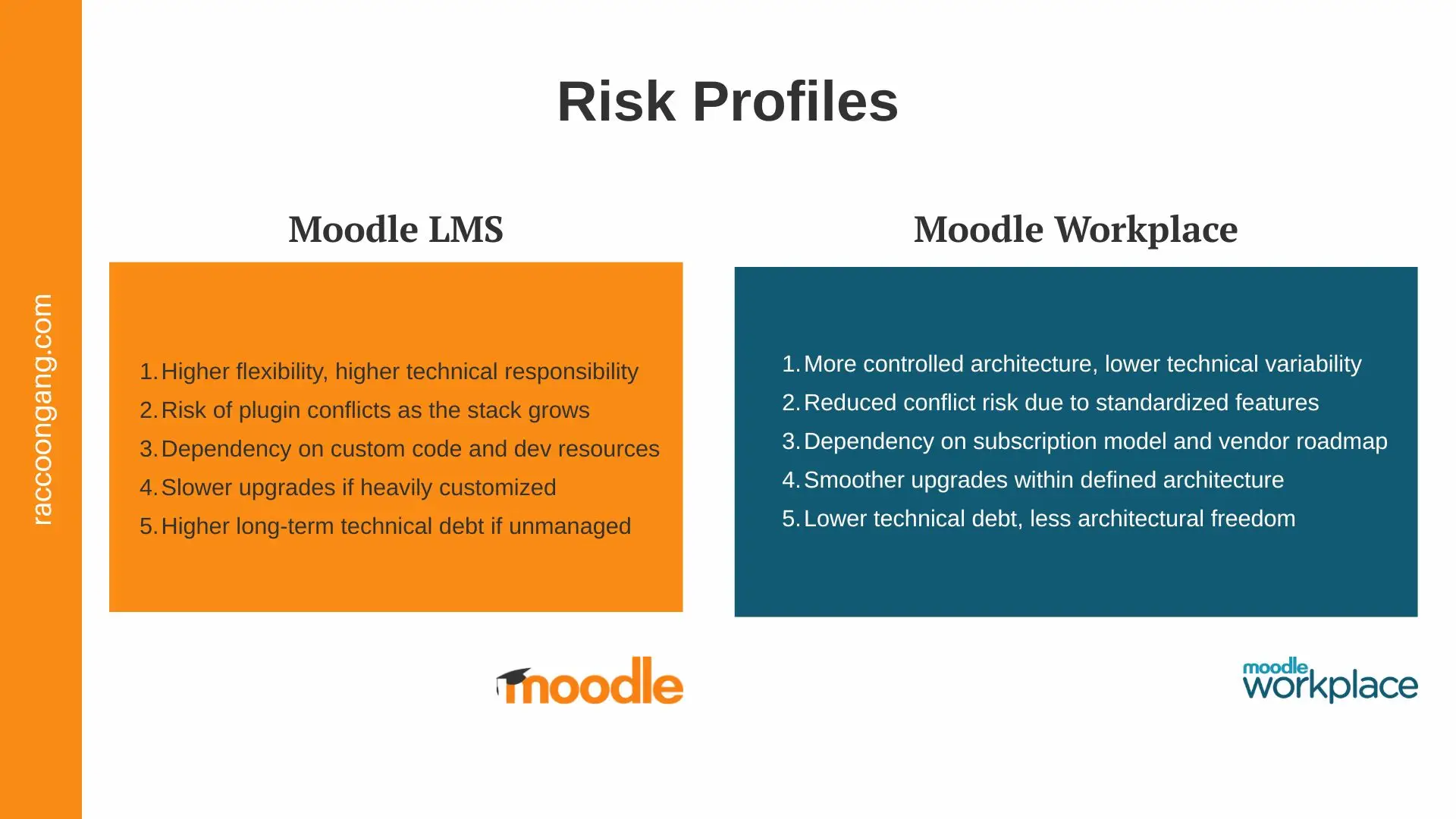
Risk profile comparison between Moodle LMS and Moodle Workplace highlighting flexibility, technical debt, upgrade complexity, and architectural control.
Customization and Extensibility: Flexibility vs Architectural Responsibility
In our practice, we have almost never met customers who are not looking for at least minimal customization for their LMS. It doesn’t matter whether it’s a private course for 50 students or a large platform for employee training — everyone wants their logo, colors, and other brand elements on the default template. And while flexibility often becomes the deciding factor, it also makes the choice harder.
Moodle LMS
Moodle LMS gives you maximum flexibility because you control the platform:
- Plugins — add features as needed
- Custom development — build workflows around your process
- Full code access — change almost anything
That flexibility equals freedom. At the same time, it creates predictable risks:
- Plugin conflicts as the stack grows
- Dependency on custom code (harder upgrades, harder handover)
- Technical debt that increases maintenance costs over time
To keep Moodle LMS running smoothly and without interruptions, make sure you have in-house dev resources or a long-term technical partner.
Moodle Workplace
Moodle Workplace follows a different logic. It provides:
- Predefined enterprise features
- A more controlled architecture
- Less need for heavy customization
So here you sacrifice some customization freedom in exchange for a more robust structure. The architecture becomes more limited overall, but it reduces instability and long-term maintenance pressure.
To avoid getting into the unknown streams, remember this: Moodle LMS prioritizes flexibility, and Moodle Workplace prioritizes control and operational stability.
Licensing, Costs, and Total Cost of Ownership
While Moodle LMS is often perceived as “free” and Moodle Workplace as “subscription-based,” the real financial difference becomes visible only when analyzing total cost of ownership over a 3–5 year horizon.
| Cost Dimension | Moodle LMS | Moodle Workplace |
| Licensing | Open-source (no core license fee) | Subscription-based licensing |
| Hosting & Admin | Internal | Partner-supported / structured |
| Maintenance & Extensibility | High internal load | Built-in enterprise features |
| Scalability & Governance | Growing complexity | Predictable at scale |
| Long-Term Flexibility | High | Structured, less customizable |
Get some notes in the margins.
- Moodle LMS offers flexibility but increases operational responsibility.
- Workplace reduces internal coordination risk via built-in enterprise features.
- Long-term cost is influenced more by administrative and technical effort than by licensing alone.
When Moodle LMS is Better — and When Moodle Workplace Is the Safer Choice
We are approaching the finale, and if you are still undecided about the answer to the question “Which one should you choose?”, here is a quick checklist.
Choose Moodle LMS if you:
- run education-first or simple corporate training
- can rely on plugins and custom work
- can accept more manual admin and basic reporting
- have dev resources for customization and upgrades
Choose Moodle Workplace if you:
- train across multiple departments, regions, or brands
- need automation, structured programs, and stronger reporting
- manage certifications and recurring compliance cycles
- plan growth and want a more controlled setup over 3–5 years
In the Moodle LMS vs Moodle Workplace equation, the choice comes down to complexity + risk tolerance.
How Raccoon Gang Helps with LMS Selection, Development, and Implementation
With over 10 years of experience in developing and implementing learning solutions, our specialists understand the differences between leading LMS platforms such as Open edX, Moodle, and Canvas. When you contact us, you get guidance — not just a proposal.
- We will help you choose the right LMS for your case, not simply offer the most expensive option.
- We will help you adapt, migrate, and develop learning content from scratch.
- We will share real implementation experience from projects for NASA, the EBRD, and other large organizations, so you can learn from proven approaches.
Conclusion: Making a Choice You Can Defend
Congratulations — you are one step closer to a more informed choice in an equation with two variables: Moodle LMS and Moodle Workplace.
Finally, I’d like to advise you once again to look at this decision through the next 3–5 years. Will the model you choose support your business, or will it turn into an investment with a minus sign?
Use this rule of thumb:
- Moodle LMS will justify your expectations and every dollar invested if your training stays course-based and your structure stays simple.
- Moodle Workplace becomes a growth driver if you need to train across departments or regions, face compliance requirements, and require automation and reporting to keep moving forward.
Choose wisely, because if you look only at license costs, you risk making an unfounded decision.
FAQ
What is the difference between Moodle LMS and Moodle Workplace?
Is Moodle Workplace less flexible than Moodle LMS?
Can Moodle LMS be used for corporate training?
Is Moodle Workplace open source?
Can I migrate from Moodle LMS to Moodle Workplace?




- TL;DR The difference between Moodle LMS and Moodle Workplace is architectural, not feature-based. Moodle LMS offers maximum flexibility but requires stronger internal governance and technical ownership. Moodle Workplace introduces built-in enterprise structures such as multi-tenancy and hierarchical role management. At small to mid scale, Moodle LMS can remain cost-efficient. At enterprise scale, Workplace often reduces administrative fragmentation and long-term operational risk. The right choice depends on how much structural complexity your organization needs to manage over the next 3–5 years. Our e-learning specialist recently conducted his own investigation and found that 6 out of 10 people who are interested in Moodle come to compare Moodle LMS vs Moodle Workplace. We were not surprised by this conclusion, because Moodle appears in both situations: when it comes to an LMS and when it comes to a Workplace solution. What is the difference? Why are Moodle LMS and Moodle Workplace similar and, at the same time, it is two independent options? We involved our internal specialists who implement solutions based on Moodle to help you clearly understand one fact: Moodle Workplace is not a replacement, but a different solution. So, here is our article on how to choose between the two options — the one that best suits your case — and not just decide who is “more Moodle”: the LMS or the Workplace. After all, the wrong choice will be imperceptible only in the first year. And after 2–3 years, the wrong choice may slowly increase the administrative load, limit scalability, or create compliance gaps. Let’s define your safer long-term investment together. What Is Moodle LMS? To better show you what Moodle LMS is, we will not repeat the definition of an LMS, as we are sure you already know it. Instead, let’s focus on Moodle itself. As for Moodle LMS, it is a free, open-source learning management system. “Free” in this case means that you can download and deploy the platform yourself. The platform is licensed under the GNU GPL. While the model reduces licensing costs, it also places more operational responsibility on the organization — including hosting, maintenance, and plugin compatibility. Moodle gives flexibility — but also transfers operational responsibility to the organization. Moodle LMS has historically been positioned as a universal LMS for education and training: the platform focuses on courses, pedagogical activities, and assessments, and it supports distance and blended learning. Regardless of the organization in which you want to use Moodle as a learning system — universities or schools, or perhaps a training provider — you will have at your disposal the following hierarchical structure built around courses: Site — settings, authentication, roles Categories — course grouping (faculty, department, program) Courses — content, activities, grades, completion Enrollments — manual, self, cohorts, integrations Plugins — extra features and integrations * The video demonstrates Moodle Workplace 4.0 in the role of a customisable enterprise learning management platform for workplace onboarding, learning, and compliance training. What Is Moodle Workplace? When we talk about Moodle Workplace, the clearest definition here would be that it is a separate commercial product based on Moodle LMS. Moreover, this is a specific version of Moodle for corporate training at the enterprise level that introduces subscription fees but provides structured support and enterprise-focused architecture, reducing long-term operational uncertainty. Moodle Workplace reduces administrative load and risk by standardizing corporate processes. Moodle Workplace is Moodle LMS with an enterprise layer on top — like a standard building expanded into a full business center. It keeps the course-based Moodle core, then adds the following things: Multi-tenancy — separate tenants within one platform Organizational structure — departments, positions, job roles Programs — structured learning paths Certifications — with recertification logic Automation — rule-based actions Delegation — extended admin roles Reporting — tenant-aware analytics [cta-green t="Not Sure Which Moodle Version Fits You?" d="Book a call with our team and get a clear recommendation based on your training model, org structure, and growth plans."] Difference Between Moodle and Moodle Workplace (Quick Summary) Now that we have looked at the two Moodle platform options, let’s clearly draw a line between them. It’s time to unveil the main difference between Moodle LMS and Moodle Workplace. While they share the same technical foundation, the real difference appears in operational responsibility and long-term risk exposure. Moodle LMS → education-first, course-centric, open source Moodle LMS typically serves educational institutions well through a combination of plugins, integrations, and internally designed processes. Moodle Workplace → corporate-first, program-centric, subscription-based Moodle Workplace includes built-in tools for training in complex organizations (branches, franchises, partner or supplier programs). It also keeps data separated and makes responsibilities clearer. One important nuance for B2B L&D: Moodle LMS and Moodle Workplace are not mutually exclusive “by domain.” You can use Moodle LMS for corporate training, but you will rely more on process design, plugins, and integrations to get the enterprise features that Moodle Workplace offers out of the box. “Choosing between Moodle and Workplace is less about features and more about how much complexity your organization is prepared to manage internally.” — Raccoon Gang LMS Expert. Using Moodle LMS for enterprise training can work — much like using a versatile multitool for a full renovation. It’s capable. But as the project grows, the effort, coordination, and risk of inefficiencies increase. [caption id="attachment_15317" align="aligncenter" width="1920"] Visual comparison of Moodle LMS and Moodle Workplace highlighting structural differences, pricing models, automation, and reporting capabilities.[/caption] Moodle LMS vs Moodle Workplace: Feature Comparison Let's contrast Moodle LMS vs Workplace and view them through the prism of not just features, but also operational risk and long-term scalability. Risk Domain Moodle LMS Moodle Workplace Business Implication Audience & Primary Use Case Education-first, course-centric. Flexible for corporate with configuration. Corporate-first, program-centric. Built for structured enterprise training. If your model revolves around academic courses, LMS fits naturally. If you manage departments, compliance cycles, or partners, Workplace reduces structural friction. Learning Structure Courses are the core unit. Learning paths require plugins or manual setup. Programs (learning paths) are native. Certifications and recertification are built in. Complex learning journeys require more manual orchestration in LMS. Workplace standardizes structured progression. Scalability Infrastructure No native multi-tenancy. Requires custom architecture or separate instances. Built-in multi-tenancy with tenant isolation. Multi-brand or multi-client environments scale cleaner with Workplace. LMS scaling increases admin complexity. Automation & Admin Load Automation depends on plugins and custom rules. More manual admin work. Rule-based automation included (enrollments, certifications, notifications). Higher automation reduces operational overhead and HR dependency. Governance & Role Management Standard role system. Advanced delegation requires configuration. Extended delegation model aligned with organizational hierarchy. Workplace simplifies distributed administration across departments or regions. Compliance & Certification Tracking Certificates via plugins. Recertification logic requires setup. Native certifications with renewal cycles and tracking. Compliance-heavy industries benefit from built-in certification control. Reporting & Dashboards Core reports + plugin extensions. Cross-entity reporting requires customization. Tenant-aware reporting with separation by organization unit. Workplace reduces reporting conflicts in multi-entity environments. User & Organizational Management Users managed mainly at course/category level. Org structure requires custom modeling. Built-in organizational hierarchies (departments, job roles). Workplace aligns training with real org charts out of the box. Customization & Extensibility Fully open source. High flexibility with development. Built on Moodle core with enterprise additions. LMS gives maximum architectural freedom. Workplace prioritizes operational efficiency. Licensing Model Open source (GNU GPL). Hosting and development costs apply. Commercial subscription. LMS may reduce license costs but increase implementation effort. Workplace shifts cost to subscription with lower structural build effort. Moodle LMS vs Moodle Workplace: Use Cases As your organization grows in complexity, you need stronger structural control. That’s exactly where the difference between Moodle LMS and Moodle Workplace becomes clear. Moodle LMS makes sense if: You are a small company with a limited learner base You have in-house development resources or a technical partner You need high flexibility and custom workflows Your training structure revolves around individual courses You can manage processes manually or through plugins In this case, Moodle LMS gives you architectural freedom. You design the structure yourself. Moodle Workplace makes sense if: You operate across multiple departments, regions, or brands You must handle regulatory reporting or recurring certifications You plan for organizational growth or partner expansion You need structured programs instead of isolated courses You want automation to reduce admin workload In the case of Moodle Workplace, it supports scale without rebuilding your structure later; this is an advantage that is hard to ignore. [caption id="attachment_15316" align="aligncenter" width="1920"] Risk profile comparison between Moodle LMS and Moodle Workplace highlighting flexibility, technical debt, upgrade complexity, and architectural control.[/caption] Customization and Extensibility: Flexibility vs Architectural Responsibility In our practice, we have almost never met customers who are not looking for at least minimal customization for their LMS. It doesn’t matter whether it’s a private course for 50 students or a large platform for employee training — everyone wants their logo, colors, and other brand elements on the default template. And while flexibility often becomes the deciding factor, it also makes the choice harder. Moodle LMS Moodle LMS gives you maximum flexibility because you control the platform: Plugins — add features as needed Custom development — build workflows around your process Full code access — change almost anything That flexibility equals freedom. At the same time, it creates predictable risks: Plugin conflicts as the stack grows Dependency on custom code (harder upgrades, harder handover) Technical debt that increases maintenance costs over time To keep Moodle LMS running smoothly and without interruptions, make sure you have in-house dev resources or a long-term technical partner. Moodle Workplace Moodle Workplace follows a different logic. It provides: Predefined enterprise features A more controlled architecture Less need for heavy customization So here you sacrifice some customization freedom in exchange for a more robust structure. The architecture becomes more limited overall, but it reduces instability and long-term maintenance pressure. To avoid getting into the unknown streams, remember this: Moodle LMS prioritizes flexibility, and Moodle Workplace prioritizes control and operational stability. [cta-orange t="Still Choosing Between Moodle LMS and Workplace?" d="Book a strategy call and get a clear recommendation based on your structure, risks, and growth plans."] Licensing, Costs, and Total Cost of Ownership While Moodle LMS is often perceived as “free” and Moodle Workplace as “subscription-based,” the real financial difference becomes visible only when analyzing total cost of ownership over a 3–5 year horizon. Cost Dimension Moodle LMS Moodle Workplace Licensing Open-source (no core license fee) Subscription-based licensing Hosting & Admin Internal Partner-supported / structured Maintenance & Extensibility High internal load Built-in enterprise features Scalability & Governance Growing complexity Predictable at scale Long-Term Flexibility High Structured, less customizable Get some notes in the margins. Moodle LMS offers flexibility but increases operational responsibility. Workplace reduces internal coordination risk via built-in enterprise features. Long-term cost is influenced more by administrative and technical effort than by licensing alone. When Moodle LMS is Better — and When Moodle Workplace Is the Safer Choice We are approaching the finale, and if you are still undecided about the answer to the question “Which one should you choose?”, here is a quick checklist. Choose Moodle LMS if you: run education-first or simple corporate training can rely on plugins and custom work can accept more manual admin and basic reporting have dev resources for customization and upgrades Choose Moodle Workplace if you: train across multiple departments, regions, or brands need automation, structured programs, and stronger reporting manage certifications and recurring compliance cycles plan growth and want a more controlled setup over 3–5 years In the Moodle LMS vs Moodle Workplace equation, the choice comes down to complexity + risk tolerance. How Raccoon Gang Helps with LMS Selection, Development, and Implementation With over 10 years of experience in developing and implementing learning solutions, our specialists understand the differences between leading LMS platforms such as Open edX, Moodle, and Canvas. When you contact us, you get guidance — not just a proposal. We will help you choose the right LMS for your case, not simply offer the most expensive option. We will help you adapt, migrate, and develop learning content from scratch. We will share real implementation experience from projects for NASA, the EBRD, and other large organizations, so you can learn from proven approaches. [cta-green t="Don't Get Lost at the Crossroads Between Moodle LMS and Workplace?" d="Book a consultation with our experts and get clear LMS guidance."] Conclusion: Making a Choice You Can Defend Congratulations — you are one step closer to a more informed choice in an equation with two variables: Moodle LMS and Moodle Workplace. Finally, I’d like to advise you once again to look at this decision through the next 3–5 years. Will the model you choose support your business, or will it turn into an investment with a minus sign? Use this rule of thumb: Moodle LMS will justify your expectations and every dollar invested if your training stays course-based and your structure stays simple. Moodle Workplace becomes a growth driver if you need to train across departments or regions, face compliance requirements, and require automation and reporting to keep moving forward. Choose wisely, because if you look only at license costs, you risk making an unfounded decision. [faq title="FAQ"] [faq-item question="What is the difference between Moodle LMS and Moodle Workplace?"] In business terms, Moodle LMS provides you with flexibility with more configuration effort, while Moodle Workplace reduces operational design work in complex corporate environments. [/faq-item] [faq-item question="Is Moodle Workplace less flexible than Moodle LMS?"] Yes. Speaking directly, Moodle LMS has more customization freedom because it is open source. In addition, you can always use an extensive plugin ecosystem. Moodle Workplace is about structural predictability and enterprise governance. For you, it means less flexibility, but more architectural control and operational stability. [/faq-item] [faq-item question="Can Moodle LMS be used for corporate training?"] You can use Moodle LMS for corporate training. Many organizations do it. The question is: is it dedicated? The business implication is clear: Moodle LMS can work well for corporate use, but as complexity increases, operational effort and maintenance responsibility also increase. [/faq-item] [faq-item question="Is Moodle Workplace open source?"] Moodle Workplace is a commercial product built on the Moodle core. Official Moodle Partners distribute it under a subscription model based on your needs. [/faq-item] [faq-item question="Can I migrate from Moodle LMS to Moodle Workplace?"] Yes, you can start with Moodle LMS and move to Workplace later. Remember that early planning reduces structural rework and operational disruption. [/faq-item] [/faq]
- What Is Moodle LMS?
- What Is Moodle Workplace?
- Difference Between Moodle and Moodle Workplace (Quick Summary)
- Moodle LMS vs Moodle Workplace: Feature Comparison
- Moodle LMS vs Moodle Workplace: Use Cases
- Customization and Extensibility: Flexibility vs Architectural Responsibility
- Licensing, Costs, and Total Cost of Ownership
- When Moodle LMS is Better — and When Moodle Workplace Is the Safer Choice
- How Raccoon Gang Helps with LMS Selection, Development, and Implementation
- Conclusion: Making a Choice You Can Defend