Education technology providers are multiplying fast. This is happening against the backdrop of the expansion of digital learning. Add to this the progress of AI in the last couple of years, and you will see the result.
What awaits us in 2026? We could see that the market continues to grow. Its growth will occur in two directions at once: more learners to serve, and more data to prove what changed after training.
This is not an easy time for buyers. Education Week reports that some school districts accessed an average of 2,739 distinct ed-tech tools in a single school year. Today, you need to understand the differences between LMS and LXP platforms and have basic knowledge of learning analytics and LRS stacks. Then you choose the tools around that core: content platforms, authoring tools, and, in many cases, mobile learning apps built for short bursts.
Yes, choosing the right EdTech solution provider is not easy, but it is necessary. You’re not buying a UI — you’re buying a system that must survive integrations, security reviews, and scale spikes. And we’ll help you with that.
At Raccoon Gang, we support organizations as a technology and implementation partner: we design, integrate, and run learning platforms (especially open-source ecosystems). That is why we have prepared our material.
What you’ll get from this article
- A clear picture of what EdTech solution providers actually deliver — and what they should own after go-live
- A quick map of the main EdTech solution types, so you can match each one to your training and reporting needs
- A 2026 shortlist of top EdTech solution providers, grouped by the jobs they do best
- A buyer-ready selection kit: the questions to ask, the red flags to spot early, and a simple checklist to compare options side by side
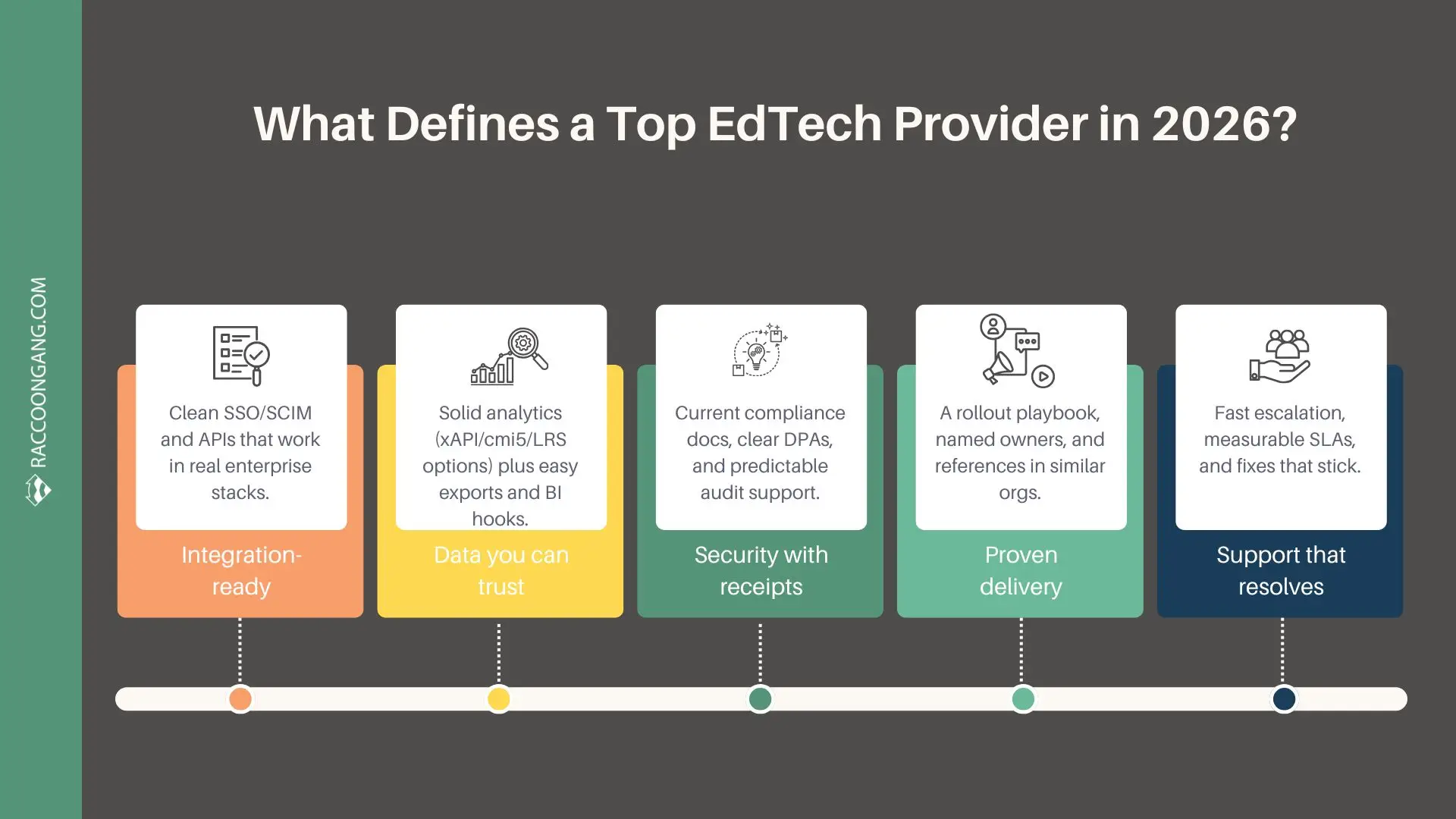
A quick “reality check” for vendor demos: five signals that a provider will still perform after go-live.
What Are EdTech Solution Providers?
EdTech solution providers are educational technology companies. These companies build and support learning systems. When you need to connect your stack (e.g., SSO, HRIS/SIS, CRM, analytics), an EdTech solution provider can help you with this type of project. And the provider can keep it stable as audiences, regions, and requirements change.
This is where they differ from content-only vendors. Content vendors mainly sell libraries or courses you can plug into an existing platform. Education technology vendors sell the infrastructure that controls delivery, access, tracking, reporting, and audit trails—plus the implementation work that makes it function in your environment.
“Upskilling is the reason people are shopping for education technology providers right now. You need to launch role-based training fast, track skills and completions as they happen, and show — with data — what improved as job requirements keep moving.”
— EdTech specialist at Raccoon Gang.
Next, we’ll map the main types of education technology solutions, so you can quickly see where each category fits and what it typically owns.
Types of Education Technology Solutions
1. Learning Management Systems (LMS).
An LMS, by default, can run the operational side of training. When the best LMS development companies create your EdTech solution, you receive the tool to manage enrollments, assignments, completions, certificates, and compliance reports.
2. Learning Experience Platforms (LXP).
An LXP is a tuned LMS that focuses on discovery and personalization. The unique features of LXP are recommendations, playlists, skills paths, and content aggregation from many sources. One such solution was a сustom LXP for an association of international academic institutions.
3. Virtual classrooms & video learning.
These educational technology tools are designed to handle live sessions and video delivery. Scheduling, attendance, recordings, chat, polls, and basic engagement signals can all be implemented within the appropriate solution.
4. Assessment and proctoring tools.
Assessment platforms manage item banks, quizzes, exams, and scoring logic. On the other side of the scale are proctoring tools that add identity checks and exam integrity controls.
5. Analytics & AI-driven learning tools.
These solutions add features such as dashboards, skill inference, early risk signals, and automated content tagging or recommendations for learning systems.
6. Custom education software development.
Pick custom development when your edtech solutions need rules you can’t set in the admin panel. Separate portals for brands. Tight roles and permissions. Reports built around your KPIs.
Pro tip: It also fits when learning lives inside your product. And the UX must match your interface, not a template.
Top 10 EdTech Solution Providers (2026 Edition)
As much as we would like to avoid a list of logos, it is inevitable when we are talking about the search for the best edtech companies. However, for your convenience and easier comparison of all the competitors, we have grouped education technology providers by what they actually deliver: an ed tech platform, open-source implementation, or custom builds that fit messy reality.
Open-source–based solution providers
Raccoon Gang
Raccoon Gang builds, customizes, and supports Open edX and Moodle ed tech platforms, with a focus on implementation that survives scale and integration work. Teams bring them in when they want open-source control.
- The company’s core offerings include Open edX development and hosting, along with Moodle consulting, integrations, migrations, and ongoing support.
- The company’s primary audience includes higher education institutions, enterprise L&D teams, nonprofits, and public-sector learning programs.
- The strengths of the company that you can appreciate are custom workflows and complex integrations.
- The limitation is that if you only need a quick, plug-and-play SaaS rollout with minimal customization, the company’s expertise may be more than you need, which may be reflected in the price.
Catalyst IT
Catalyst IT delivers managed Moodle LMS implementations for education and enterprise teams. The company focuses on stable production operations, and it also supports customization, migrations, and long-term support.
- The company’s core offerings include Moodle hosting and managed services, along with customization, development, training, and support.
- The company’s primary audience includes K–12 organizations, higher education institutions, and enterprise teams, and it also works with government and public-sector programs.
- The strengths of the company that you can expect are certified Moodle partner delivery, a strong hosting-and-support model, and long-term Moodle specialization.
- The limitation is that the company fits best when Moodle is your core platform choice.
BeezNest
BeezNest supports organizations that launch learning sites on Chamilo LMS. The company covers implementation, customization, hosting, and support.
- The company’s core offerings include Chamilo LMS implementation and customization, along with training, support, and managed hosting plans.
- The company’s primary audience includes higher education institutions, enterprise teams, and nonprofits.
- The strengths of the company that you can expect are deep Chamilo specialization, official-provider positioning, and packaged hosting plus services for teams that don’t want to run infrastructure in-house.
- The limitation is that this option makes sense when Chamilo is your platform choice, while it won’t help much if your shortlist centers on Open edX, Moodle, or SaaS suites.
LMS & LXP vendors
Instructure (Canvas + ecosystem)
Instructure provides Canvas LMS and positions it for K–12, higher education, and business or government programs. Canvas fits teams that expect to connect many tools.
- The company’s core offerings include the Canvas LMS, along with add-ons and broad integrations.
- The company’s primary audience includes K–12 organizations, higher education institutions, and enterprise or government teams.
- The strengths you can expect from Instructure include a large integration ecosystem, proven scale, and mature LMS workflows.
- The limitation is that Canvas works best as the core LMS, and you may still need specialist tools for skills analytics, proctoring, or advanced credentialing.
D2L (Brightspace)
D2L provides Brightspace and positions it as an LMS that can support learning from school through workforce training. The platform fits teams that value structured course delivery and institutional features.
- The company’s core offering includes the Brightspace LMS.
- The company’s primary audience includes K–12 organizations, higher education institutions, and enterprise teams.
- The strengths of D2L you can expect include a broad educational footprint, a strong LMS core, and coverage across multiple learning scenarios.
- The limitation is that, like most LMS-first stacks, you will often add separate tools for content production workflows or deeper business intelligence.
Docebo
Docebo targets enterprise learning programs that train employees, customers, and partners in one place. The platform often appeals to teams that want AI-driven recommendations and automation.
- The company’s core offerings include an enterprise LMS and a broader learning platform layer.
- The company’s primary audience includes enterprise organizations.
- The strengths of the company that you can expect are multi-audience training support, enterprise-grade features, and AI-assisted personalization options.
- The limitation is that the platform fits enterprise operations.
Cornerstone OnDemand
Cornerstone OnDemand sits in the enterprise talent and learning space and offers both LMS and LXP capabilities. The platform fits organizations that want learning tied closely to skills and workforce development workflows.
- The company’s core offerings include an enterprise LMS and an LXP layer.
- The company’s primary audience includes enterprise organizations.
- The strengths of the company that you can expect are a mature enterprise feature set, a strong skills focus, and content aggregation options.
- The limitation is that the platform tends to suit larger organizations and teams with lean admin capacity.
Global EdTech platforms
Google for Education
Google Workspace for Education provides a shared layer for school communication, collaboration, and classroom workflows through tools such as Classroom, Drive, and Gmail. Many institutions treat it as the default daily operating system for teaching and coordination rather than a standalone LMS.
- The company’s core offerings include education productivity tools and classroom management features that act as a platform layer.
- The company’s primary audience includes K–12 organizations and higher education institutions.
- The strengths of the company that you can expect are broad adoption and fast setup for collaboration and day-to-day classroom routines.
- The limitation is that most schools still pair it with an LMS and specialist tools for assessment, proctoring, and deeper learning analytics.
Custom EdTech development companies
Inoxoft
Inoxoft works as an EdTech software development partner that builds custom LMS and LXP products, along with learning applications that can include AI-related features. Teams usually choose this route when they need a platform shaped around their workflows and data rules, not a vendor’s default setup.
- The company’s core offerings include custom platform development for LMS/LXP systems and learning apps.
- The company’s primary audience includes enterprise organizations and EdTech businesses, and it also supports education teams that are building their own platforms.
- The strengths of the company that you can expect are a strong custom build capability and a focus on modern platform engineering.
- The limitation is that custom development puts more responsibility on product ownership, so you will need clear governance, backlog control, and a long-term maintenance plan.
Hurix Digital
Hurix Digital provides a mix of learning technology, LMS services, and digital content solutions for education and enterprise use cases. Teams often work with Hurix when they want one partner to handle both platform delivery and content production in the same program.
- The company’s core offerings contain LMS services, learning technology, and content solutions.
- The company’s primary audience includes K–12 organizations, higher education institutions, and enterprise teams.
- The strengths you can expect from the company include broad coverage across content and platform services.
- The limitation is that, because the company spans multiple service lines, you should confirm who owns each area (platform, content, and analytics) and define what “done” means in the statement of work.
Comparison Table: Leading EdTech Solution Providers
| Company | Solution Type | Target Audience | Key Features | Customization Level | Pricing Model |
| Raccoon Gang | Open-source LMS services (Open edX, Moodle) | Higher ed, enterprise, nonprofits, public sector | Integrations (SSO/data), custom workflows, hosting, support | High | Project-based + support/hosting (service contract) |
| Catalyst IT | Moodle services partner | K–12, higher ed, enterprise, public sector | Managed Moodle hosting, migration, support, and training | Medium–High | Services contract (project + managed services) |
| BeezNest | Chamilo LMS provider | Higher ed, enterprise, nonprofits | Chamilo implementation, hosting, support, training | Medium | Services + hosting plans |
| Instructure (Canvas) | SaaS LMS + ecosystem | K–12, higher ed, enterprise/government | LMS workflows, integrations marketplace, admin tooling | Low–Medium | SaaS subscription (often per user/institution) |
| D2L (Brightspace) | SaaS LMS | K–12, higher ed, enterprise | Structured course delivery, institutional tooling, and reporting | Low–Medium | SaaS subscription (often per user/contract) |
| Docebo | Enterprise learning platform | Enterprise | Multi-audience training, automation, and AI-assisted recommendations | Low–Medium | SaaS subscription (enterprise contract) |
| Cornerstone OnDemand | Enterprise LMS + LXP | Enterprise | Skills-focused learning, content aggregation, talent workflows | Low–Medium | SaaS subscription (enterprise contract) |
| Google for Education | Collaboration + classroom layer | K–12, higher ed | Classroom workflows, file collaboration, and communication stack | Low | Subscription tiers (education licensing) |
| Inoxoft | Custom EdTech development | Enterprise, EdTech businesses, education orgs | Build-to-spec LMS/LXP/apps, integrations, product engineering | High | Project-based (build) + optional support retainer |
| Hurix Digital | Learning tech + LMS services + content | K–12, higher ed, enterprise | Platform services plus content production support | Medium | Services contract (scope-based) |
Disclaimer: This table reflects publicly available information and typical positioning at the time of writing. Pricing, packaging, and feature availability can change, so for a detailed proposal and exact scope, contact each provider directly. You can contact Raccoon Gang right here 👈
How to Choose the Right EdTech Solution Provider
We have prepared this checklist for you. We are convinced that it will work for most education technology solutions. Use it like a roadmap for decision-making.
- Step 1. Start with clear learning goals and use cases. We recommend defining who you train, what “done” means, and what proof you must show (completions, skills, certifications, audit reports).
- Step 2. Don’t ignore scalability and performance needs. Trust us, estimating peak concurrent users, video load, exam traffic, and reporting spikes will reduce future downtime.
- Step 3. Check integration with your existing systems. The best practice here would be to list every system that touches identity and data, then confirm SSO, provisioning, and data flows before you talk about UI.
- Step 4. Decide whether customization is essential when you compare customization vs SaaS limitations. If your workflows are standard, SaaS can work well.
- Step 5. We recommend requesting security documentation, DPA terms, hosting details, and incident processes early. This is what we do during project implementation for our partners.
- Step 6. Ask about long-term support. At this step, you should confirm how you’ll exit — data export, content portability, and what you keep if you switch later.
The Role of Custom Development in EdTech Solutions
Let’s be honest: every off-the-shelf tool looks tidy in a demo. What happens next? Your real process walks in and starts asking rude questions. A demo is not the same as a live platform. So why is custom development sometimes the only viable option? We counted 4 such “whys“. Here they are.
Why #1: Your workflows don’t fit the template
The reason custom development becomes necessary is that many learning programs run on approvals, exceptions, and role-based rules that a standard admin panel can’t express. This is where an ed-tech platform starts to fight your process instead of supporting it.
Why #2: Your learners don’t follow one path
The reason off-the-shelf flows break down is that different audiences need different journeys, pacing, and reinforcement. This is why a single generic experience often turns into friction for learners and extra manual work for admins.
Why #3: Your integrations and data pipelines must hold up under pressure
The reason teams build custom work is that an edtech solution has to connect to SSO, HRIS/SIS, CRM, and reporting tools without relying on exports and one-off fixes. This is what keeps dashboards honest and automation reliable.
Why #4: Your branding and UX need real control
The reason custom development matters is that a template UI can clash with your product experience or internal standards, and learners notice fast. This is why teams choose custom UX when they need the platform to feel native, not bolted on.
How Raccoon Gang Supports EdTech Solutions
Why is Raccoon Gang one of the best edtech companies? For more than 10 years, the company has been developing solutions in the field of e-learning. Today, eLearning trends affect such technological solutions as gamification, microcredentials, etc. The company helps to implement all these solutions.
Raccoon Gang is ready to help you with developing and supporting the EdTech solutions you want to realize.
- Custom EdTech platform development
- Open edX–based learning solutions
- LMS/LXP consulting and implementation
- Performance, scalability, and UX optimization
- Long-term support and evolution
Conclusion
Thank you for reading this material. If we talk about one thing that we want you to take with you, let it be this: the best provider choice in 2026 is rarely about the longest feature grid.
So compare providers on metrics you can prove in a pilot. We can recommend tracking time to the first real integration (SSO and provisioning). Also, you can count admin hours per 1,000 learners per month.
Then run a couple of uncomfortable tests. Watch support resolution time for high-severity issues. They may reply quickly. They won’t always fix fast.
Ask how you will exit. They should show export formats, ownership terms, and what breaks on day one after you leave. If they can explain this clearly, they usually ship cleaner work. They’ve done it before, and it shows.
FAQ
What are EdTech solution providers?
What services do education technology companies offer?
How do I choose the best EdTech company for my needs?
What is the difference between an EdTech platform and a custom solution?
Can EdTech solution providers build custom learning platforms?




- What Are EdTech Solution Providers?
- Types of Education Technology Solutions
- Top 10 EdTech Solution Providers (2026 Edition)
- Comparison Table: Leading EdTech Solution Providers
- How to Choose the Right EdTech Solution Provider
- The Role of Custom Development in EdTech Solutions
- How Raccoon Gang Supports EdTech Solutions
- Conclusion