








In May 2026, Coursera completed its combination with Udemy. Together, the two platforms reach more than 290 million registered learners, although their course experiences remain separate for now. That says nothing about whether short online courses teach better, and a great deal about how much of a student’s attention is already spoken for, which is the backdrop to every university vs MOOC course design conversation happening on campus this year.
Deans of Online Programs and Directors of Digital Learning Innovation own this problem, and it usually lands as an enrollment number long before it lands as an LMS ticket. For any institution working to help higher ed compete with EdTech platforms, the first move is triage. Pacing, mobile access, interactivity, and feedback are fixable inside an academic year. Credit, faculty access, cohort community, and recognized credentials are assets to defend.
TL;DR
EdTech courses win on ease. They are quicker to start, simpler to continue on a phone, and easier to slot around a shift or a school run. Universities should meet that bar, then lean hard on what Coursera cannot issue: credit, faculty time, a cohort, and a credential an employer already recognizes.
Fix the courses where poor digital design creates the greatest enrollment or completion risk first.
At a Glance
- MOOC: short for massive open online course, a format built to enroll very large numbers of remote learners, usually with flexible or self-paced access.
- EdTech Platform: any commercial service selling or distributing courses, assessments, credentials, or learning tools outside a campus.
- Mobile-Friendly Course Design: course material, navigation, media, activities, and submissions that hold up on a phone screen as well as a laptop.
- Self-Paced Learning: study that follows the learner’s own schedule, with no fixed weekly release calendar.
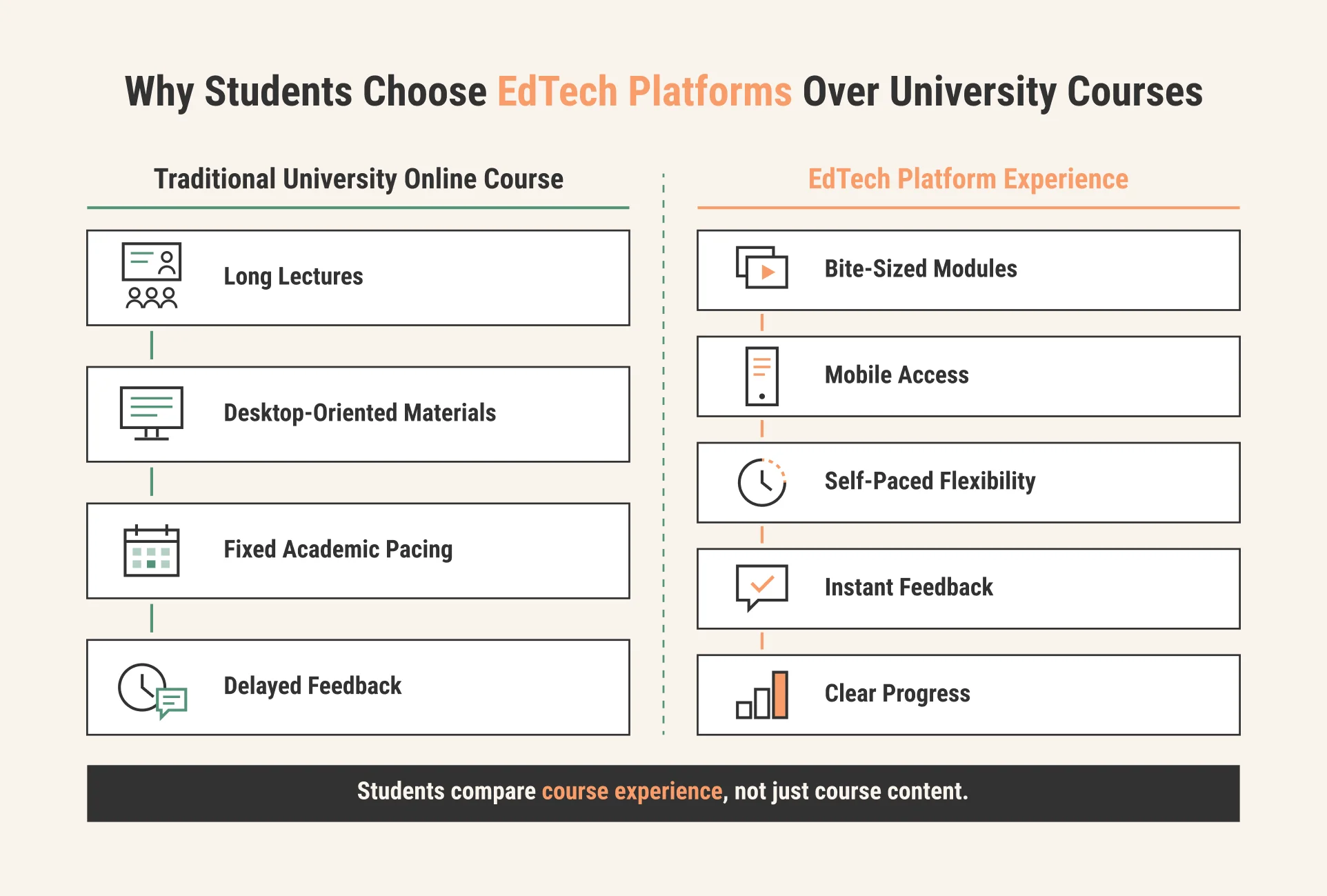
The competitive gap is often less about academic quality than about pacing, mobile access, feedback, and how quickly learners can begin.
Why Students Are Choosing Coursera, Udemy, and LinkedIn Learning Over University Courses
A learner comparing similar subjects may see two very different experiences.
The university course might start next semester. The Coursera course is available today.
The university course might hand that student a recorded 75-minute lecture, several PDFs, a discussion requirement, and one assignment due Friday. Udemy chops comparable material into short videos that download for the train. LinkedIn Learning does the same. Coursera runs some courses to an instructor’s calendar and some entirely self-paced, and either way the phone works.
This is the practical student expectations for online learning gap. Students increasingly expect:
- immediate access;
- clear progress;
- shorter content units;
- usable mobile navigation;
- feedback soon after an activity;
- the ability to stop and resume without getting lost;
- some control over pacing.
Flexibility is doing most of the work in that list. A student fitting study between a shift and a childcare pickup makes a scheduling decision before making an academic one. EDUCAUSE research on student technology experience keeps landing on the same finding: convenience and the ability to manage coursework alongside work and family shape which formats students choose.
Price, brand, and the promise of a specific career skill matter too. But design decides the comparison whenever two courses appear to teach similar material and one is easier to fit into daily life.
For broader context on the companies shaping these expectations, our overview of major EdTech companies covers that market separately. Here, the useful question is narrower: what are these platforms teaching university teams about course experience?
What EdTech Platforms Get Right About Course Design
The fairest competitive response begins by acknowledging where these platforms are good.
They reduce the cost of starting. A learner sees a course, enrolls, and begins. Very little distance separates intent from action. Universities often cannot remove admissions, prerequisites, or academic calendars, but they can inspect how much unnecessary friction remains after a student already has permission to learn.
Progress is visible. Good platforms constantly answer three questions: where am I, what have I completed, what comes next? That sounds basic. It is surprisingly easy to lose inside a university course assembled from folders, lecture recordings, readings, and assignment links.
Feedback happens frequently. Short quizzes, checkpoints, and practice activities create a responsive course. Students do not wait two weeks to discover they misunderstood the previous unit.
The course fits the screen. These platforms have spent a decade competing for learners who move between laptops, tablets, and phones, and they treat that as a product requirement rather than an accessibility afterthought. Video has chapters. Navigation survives a narrow screen. A learner who opens the app for eleven minutes between meetings can still complete something meaningful. Universities are measured against that experience whether they chose the comparison or not.
That is the design bar institutions face when they try to compete with EdTech platforms in higher ed. It does not mean every lecture should become a five-minute video. It means students now know what polished digital learning feels like.
Where University Courses Fall Behind
The problem is rarely faculty expertise. Usually it is the packaging around it.
Lecture capture becomes the course. Recording a strong lecture preserves valuable teaching, but a recording of classroom instruction remains a recording of classroom instruction. A student watching alone at 11:30 PM misses the pauses, questions, and room dynamics that made the original class work.
Materials age without a redesign cycle. Courses accumulate PDFs, links, old slides, and duplicate instructions. Nobody decides to create a stale course. It happens one semester at a time.
The academic calendar controls everything. Some learning genuinely requires a cohort schedule. Other activities do not. Locking every reading, practice task, and foundational module to weekly release dates creates artificial friction, particularly for working and adult learners.
This is where competition for university online course enrollment becomes partly a course-experience problem. For the tactical sequencing layer, see our guide to structuring an online course. The competitive question here is which of those problems is costing the institution attention, continuation, and enrollment.
Mobile-Friendly Course Design: Meeting Students Where They Actually Learn
Mobile access is no longer an optional companion to online learning. It is part of the course.
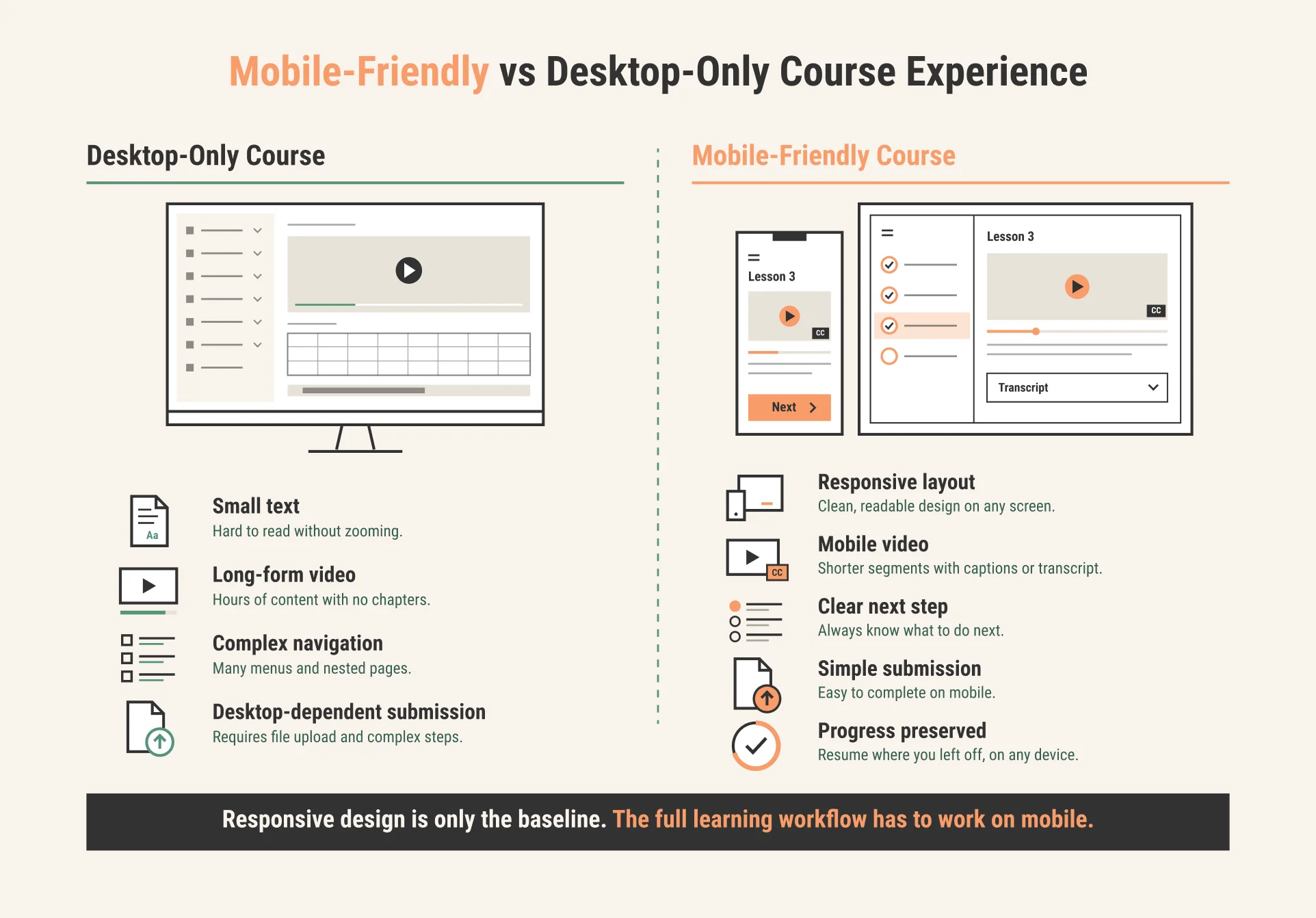
A useful mobile-friendly course design for a university has to survive more than a responsive homepage. Students should be able to find the next activity, read core content without horizontal scrolling, play video reliably, use captions and transcripts, check deadlines, view feedback, submit reasonable assignments, and resume where they stopped.
A university can have a technically responsive LMS and still fail this test. A 25-column table embedded as a PDF is not mobile-friendly. Neither is a two-hour lecture with no chapters, an instruction sheet that requires zooming, or navigation that sends learners through six menus to reach the next task.
We met this problem directly at King Khalid University, one of Saudi Arabia’s largest public universities, with close to 60,000 students. Its KKUx platform offers accredited certificate programs to learners aged 16 to 45 and older, and serves more than 2,500,000 visits per month. Because most of that audience reaches the platform from a phone, the project required iOS and Android applications carrying the platform’s customized Open edX functionality into mobile, including Arabic translation and correct right-to-left orientation.
Our team has also worked on the current Open edX mobile application itself, including offline access, progress, push notifications, calendar integration, course navigation, and SSO. As our Engineering Manager Volodymyr Chekyrta puts it, mobile problems usually begin before the app: content has to be created for mobile behavior, and the technical layer has to support how learners actually study.
That is what a modern online learning experience at a university requires.
Modern Design Elements That Help Universities Compete
Universities should borrow design discipline from EdTech without copying its identity.
Modular content. A module can still belong to a rigorous 12-week course. It simply needs a clear purpose, so students know what they must learn, what activity follows, and how the piece connects with the whole.
Flexible pacing where the curriculum allows it. Self-paced course design in higher education does not mean abandoning academic structure. A university might keep seminars, projects, labs, and graded discussions on a shared schedule while opening foundational readings, recorded explanations, and low-stakes practice earlier. Students gain flexibility, and the cohort stays intact. We used a similar model building a continuous-education platform for a public research institution: self-paced career courses on Open edX, integrated with the university’s existing LMS, with learner progress, grading, and instructor reporting.
Interactive checkpoints. Use interaction where it changes learning behavior. A prediction before a lecture segment. A short case before a reading. A decision point inside a professional scenario. A knowledge check before students enter a difficult topic.
Clear progress and feedback. Students should not reverse-engineer the course structure from the syllabus every time they log in. A university course experience redesign should make progress, prerequisites, unfinished tasks, and feedback visible.
For institutions evaluating the platform side of this work, our higher-education LMS guide covers the systems behind online university delivery.
Playing to What Universities Uniquely Offer
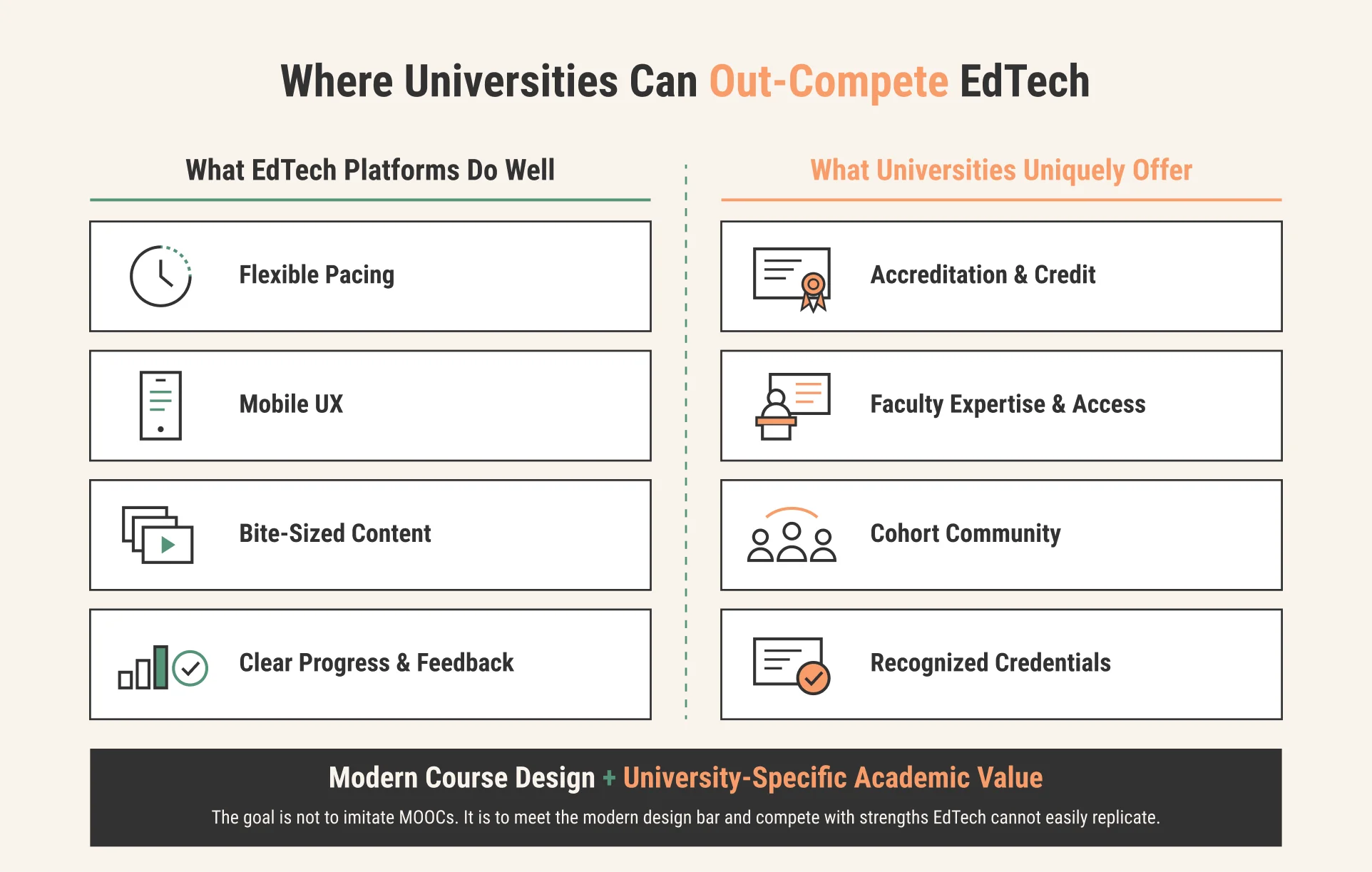
Universities make a strategic mistake if they answer MOOCs by trying to become MOOCs. Coursera, Udemy, and LinkedIn Learning have strong digital product patterns. A university has different assets.
Formally recognized credit. A platform certificate and university credit do not carry the same institutional meaning. Class Central’s analysis of Coursera’s catalog makes a related point: university-partnered content built the platform’s reputation, and the third-party courses that now dominate new additions attract a fraction of the enrollments that established partners do. Academic recognition and a modern course experience reinforce each other.
Faculty expertise and access. Students should receive more than a recorded expert. Office hours, feedback, seminars, research connections, and project supervision are difficult to reproduce in very large open courses.
Cohort community. Universities create repeated relationships. Peers meet again, projects continue, faculty remember students, and academic networks form across months or years instead of one isolated course.
Recognized institutional identity. Universities confer degrees, credit, professional legitimacy, alumni identity, and access to an academic community.
This is where the strategy becomes stronger:
EdTech-quality digital design + university-specific academic value
That is how universities can compete with EdTech platforms in higher ed without pretending the two models are the same.
Where to Start: Prioritizing Which Courses to Modernize First
Begin where poor design carries the highest institutional cost.
Score candidate courses against four factors and modernize the highest totals first:
| Factor | What to measure | Why it matters |
| Exposure | Annual enrollment, plus whether a close equivalent exists on a major platform | A course nobody can substitute is under less competitive pressure, whatever its design |
| Leakage | Withdrawal, non-completion, and repeat-attempt rates | Shows where the institution is already losing students it enrolled |
| Friction | Mobile behavior, navigation complaints, dependence on long recordings | Identifies problems design work can actually fix |
| Consequence | Whether the course gates progression into later modules or a strategic program | A blocked prerequisite costs an institution far more than one disappointing elective |
A required first-year course with 900 students, a 22% withdrawal rate, four hours of unchaptered lecture video, and a popular commercial equivalent outranks a beloved 30-student seminar every time, however much the seminar deserves attention on other grounds.
Then confirm the diagnosis in the data. Where do learners stop? Which activities create repeated failure? Do mobile learners behave differently? Our analytics work covers progress funnels, activity reports, assessment difficulty, learner-level paths, and withdrawal patterns, because redesign is stronger when teams locate the friction instead of guessing.
The objective goes past a general wish to retain students in online courses. It is to decide which design problems drive avoidable loss and spend modernization budget there first. Start with one high-enrollment, high-friction course and use it as the reference model for the next wave.
How Raccoon Gang Helps Universities Compete Through Better Course Design
We work on both sides of this problem: the course itself and the technology delivering it.
That matters because a university can redesign content beautifully and still place it inside a weak mobile experience. It can also install a modern LMS and fill it with lecture recordings and PDFs.
Our work covers course experience audits, instructional design, content transformation, mobile-friendly materials, interactive activities and assessment, Open edX implementation and customization, Moodle and Canvas work, mobile learning, analytics, LMS integrations, and migration with ongoing platform support.
Our instructional design services connect learning objectives, course structure, activities, assessment, and platform behavior instead of treating content production as a separate publishing task.
We also have direct experience with university delivery. For one public research institution, we built a self-paced continuing education environment integrated with the university’s existing LMS. For King Khalid University, we extended the learning experience onto iOS and Android because mobile use already dominated. And through Open edX community projects, our engineers have shaped platform-level mobile functionality used well beyond a single institution.
This combination matters in the university vs MOOC course design discussion. We have built the same delivery patterns that make large online platforms attractive: self-paced courses, mobile applications, analytics, interactive components, and large online audiences. University projects then add requirements those platforms never face, around academic structure, institutional systems, instructor workflows, and recognized credentials.
You can explore more examples in our case-study library or read our Open edX platform guide for the technical side.
Conclusion
Universities do not need to become MOOC platforms. They do need to acknowledge what Coursera, Udemy, LinkedIn Learning, and similar products have changed.
Students know what immediate enrollment feels like. They know what a clear progress bar feels like. They know what it is like to continue a course on a phone, receive quick feedback, pause for three days, and return without wondering where they were.
That raises the bar for university vs MOOC course design.
The answer preserves faculty depth, academic standards, cohort learning, and accreditation, then pairs them with a digital course experience that no longer feels a generation behind. That is how higher ed can compete with EdTech platforms on design while competing on something much harder to copy: the value of the university itself.
FAQ
Why are students choosing platforms like Coursera or Udemy over university courses?
What does EdTech course design do better than traditional university courses?
How important is mobile-friendly design for university online courses?
Can universities compete with MOOCs without copying their format?
Which university courses should be modernized first?
What do universities offer that EdTech platforms can’t replicate?



- Why Students Are Choosing Coursera, Udemy, and LinkedIn Learning Over University Courses
- What EdTech Platforms Get Right About Course Design
- Where University Courses Fall Behind
- Mobile-Friendly Course Design: Meeting Students Where They Actually Learn
- Modern Design Elements That Help Universities Compete
- Playing to What Universities Uniquely Offer
- Where to Start: Prioritizing Which Courses to Modernize First
- How Raccoon Gang Helps Universities Compete Through Better Course Design
- Conclusion