
Most companies now have ESG policies. They announce carbon reduction targets, publish sustainability reports, and talk about social responsibility. However, PwC surveyed over 5,000 employees and found that nearly half don’t consider their company’s ESG work until after they’ve dealt with their paycheck and benefits.
Most organizations run into the same problem — they don’t clarify what ESG means for employees in their specific roles. This guide explains ESG in business context, examines each of the three pillars, and outlines how to build an environmental, social, and governance policy that translates into real action.
What is ESG? Meaning & Components
ESG stands for Environmental, Social, and Governance. These three factors measure how a company operates when you look past profit numbers.
- The environmental factor tracks the impact on the planet — carbon emissions, energy consumption, waste, and water usage.
- The social factor looks at the treatment of people — employees, customers, suppliers, and communities.
- The governance factor checks if leadership makes ethical decisions and maintains accountability.
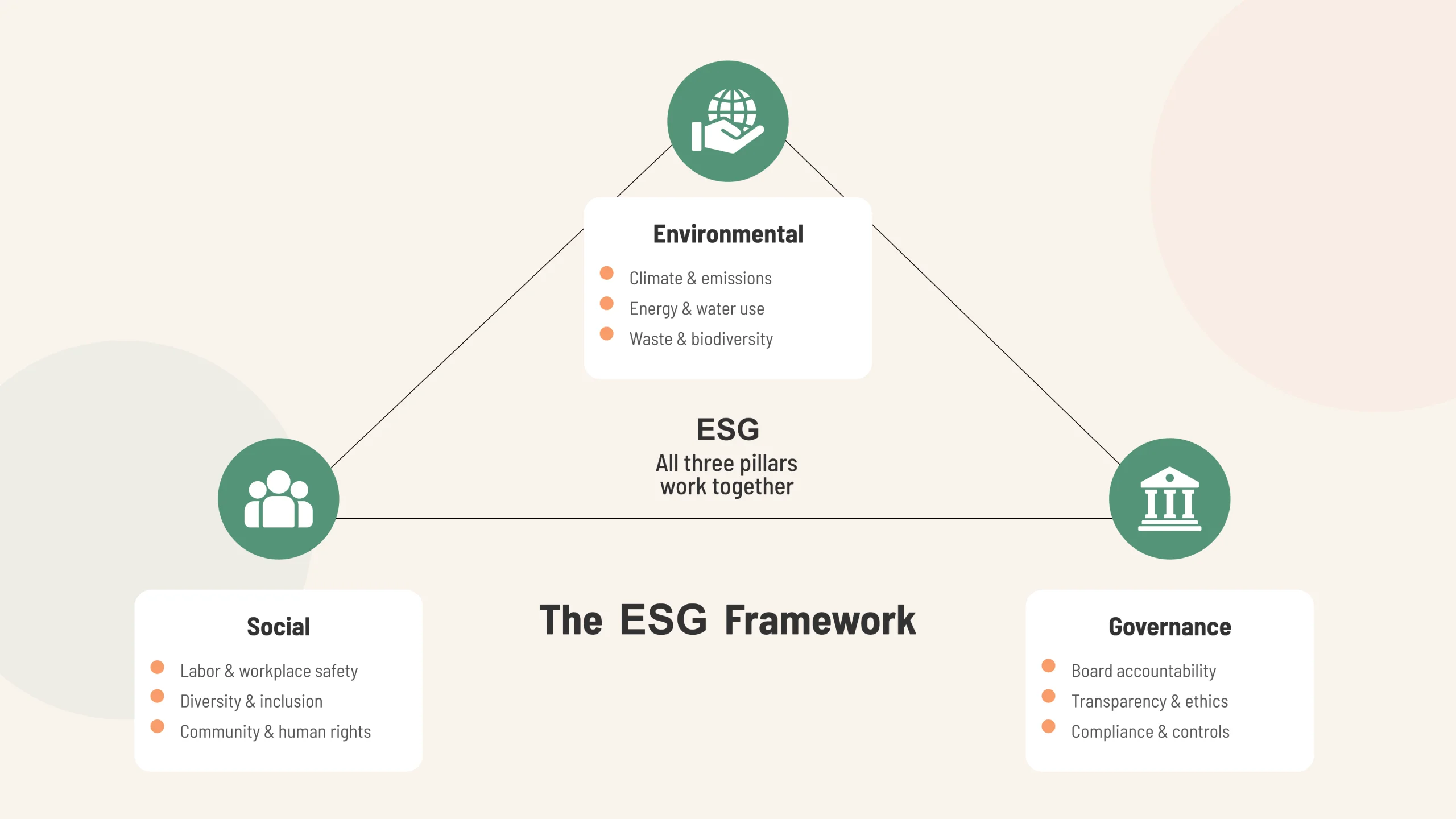
The ESG framework connects Environmental, Social, and Governance pillars to explain how sustainability topics work together.
What is ESG in Business?
In business, ESG provides a framework for measuring and managing impact beyond financial performance. ESG in business connects three areas: environmental footprint, treatment of people, and ethical leadership practices.
Stakeholders rely on ESG when evaluating companies now. Investors review ESG ratings as part of their decision-making process. Customers factor sustainability into brand choices. Employees consider company values when selecting employers. Regulators require transparency on these issues.
Research from Deloitte in 2024 shows ESG has become standard in company evaluation. PwC notes that financial factors alone no longer drive value — ESG considerations influence investment decisions, regulatory compliance, and long-term strategy.
Environmental, Social, and Governance in Practice
The three ESG pieces don’t look the same in practice.
Environmental work comes down to stopping the damage to the planet. This means setting science-based emissions targets and switching to renewable energy. A lot of companies run efficiency programs because they help in two ways: lower costs and less carbon. They work on reducing waste and try to protect ecosystems around where they’re operating. Most track the basics: how much energy they’re using, water consumption, what percentage of waste gets diverted instead of going to landfills, and their carbon emissions.
Social practices are trickier because you have to actually build fairness into how the company runs day-to-day. Decent wages and not getting people injured seem obvious. But people also want to know there’s somewhere to go, not just lateral moves. In this context, it’s important to make sure your workplace functions for people from different backgrounds instead of just hiring them and hoping it works out. However, responsibility doesn’t end with direct employees — what your suppliers and contractors do also reflects on you whether you’re paying attention or not.
Governance is what holds everything together. Boards work better when they have diverse perspectives, and ESG should get reviewed regularly instead of being an annual checkbox. Executive compensation is interesting — it should tie to sustainability performance, not just how much profit you made. Good audits catch misleading reporting and prevent greenwashing. Transparent communication matters a lot, especially when you’re honest about falling short of your targets.
Benefits of ESG for Organizations
Good ESG performance creates real advantages across your business.
Investor Attraction and Access to Capital
How you perform on ESG affects whether investors want to work with you. Companies with strong ESG ratings get lower borrowing costs because their credit ratings improve and interest rates drop. Investors also pay more for these companies — there’s a premium for strong ESG performance. ESG-focused funds manage trillions in assets and they’re actively hunting for companies that meet sustainability criteria. Another thing: strong ESG performance seems to stabilize stock prices when markets get chaotic.
Risk Management and Crisis Prevention
Environmental, social, and governance assessments help companies spot problems before they explode. Climate assessments show which suppliers are sitting in flood zones or facing water shortages. You can diversify or help them adapt before your operations get disrupted. Social audits uncover labor practices that might trigger boycotts or strikes — fixing these quietly costs way less than managing a public scandal. Regular governance reviews catch weak controls or conflicts of interest before they turn into fraud cases or leadership disasters.
IBM research found something interesting: companies with solid ESG practices handled COVID-19 better, as they had already mapped out their vulnerabilities and had backup plans ready to go.
Operational Efficiency and Cost Reduction
ESG initiatives often pay for themselves. Energy efficiency upgrades cut utility bills while reducing emissions — some companies see their energy costs drop 20-30% from ESG improvements. Waste reduction through circular economy practices can turn disposal costs into revenue when you repurpose materials. Water conservation lowers costs, which matters more as scarcity increases. ESG assessments also tend to reveal inefficiencies in operations that nobody noticed before.
Talent Attraction and Retention
People choose companies based on whether the values match. If your ESG performance holds up to scrutiny, recruiting gets easier. Younger professionals in particular won’t ignore bad environmental or social records. People stay when they believe their work does something beyond generating profit.
Long-term Business Resilience
Organizations that integrate environmental, social, and governance practices into operations create more durable businesses. They’re prepared for regulatory changes rather than reacting to them at the last minute. They capture market share as consumer preferences shift toward sustainability. They also benefit from stakeholder relationships built on trust when times get difficult.
Challenges in ESG Adoption
Companies face several barriers when implementing ESG programs.
Implementation Costs
ESG strategy requires upfront investment — in technology for tracking, systems for reporting, personnel with expertise, and employee training. Smaller organizations struggle to allocate resources toward initiatives without immediate financial returns. The question becomes: invest now in ESG infrastructure or wait until regulations force the issue?
Data Collection Complexity
ESG reporting needs accurate data pulled from operations and supply chains. Companies struggle because there are multiple frameworks to deal with (GRI, SASB, TCFD, CSRD), and each one has different requirements. Older systems weren’t built to track ESG metrics. Getting reliable data from the supply chain is tough to verify.
Harrow International School faced similar integration issues — 10 separate legacy platforms across different Asian regions, each with different login protocols and data structures. We unified everything into one system that maintained 98% uptime. ESG data challenges are similar: environmental metrics live in one system, social data in another, governance information somewhere else, and you need all of it working reliably when stakeholders ask for reports.
Greenwashing Risk
Stakeholders scrutinize ESG claims carefully. Companies announcing net-zero targets face questions: Where is the science-based plan? What’s the progress timeline? Who verifies the data? Organizations risk credibility damage when sustainability statements don’t match operational reality. This shows why is ESG important as a genuine framework — stakeholders demand authentic commitment with measurable progress, not marketing language.
The Training Gap
Lack of understanding is the biggest issue. Environmental, social, and governance policies fall apart when employees don’t grasp how ESG applies to their work, managers can’t connect what people do to sustainability targets, and training doesn’t reach everyone. Learning platforms address this. When UCLA partnered with Raccoon Gang on their adaptive learning project, their course completion rates improved by 320% because the platform identified knowledge gaps and addressed them directly. ESG training follows the same principle: identify where understanding breaks down and provide targeted education.
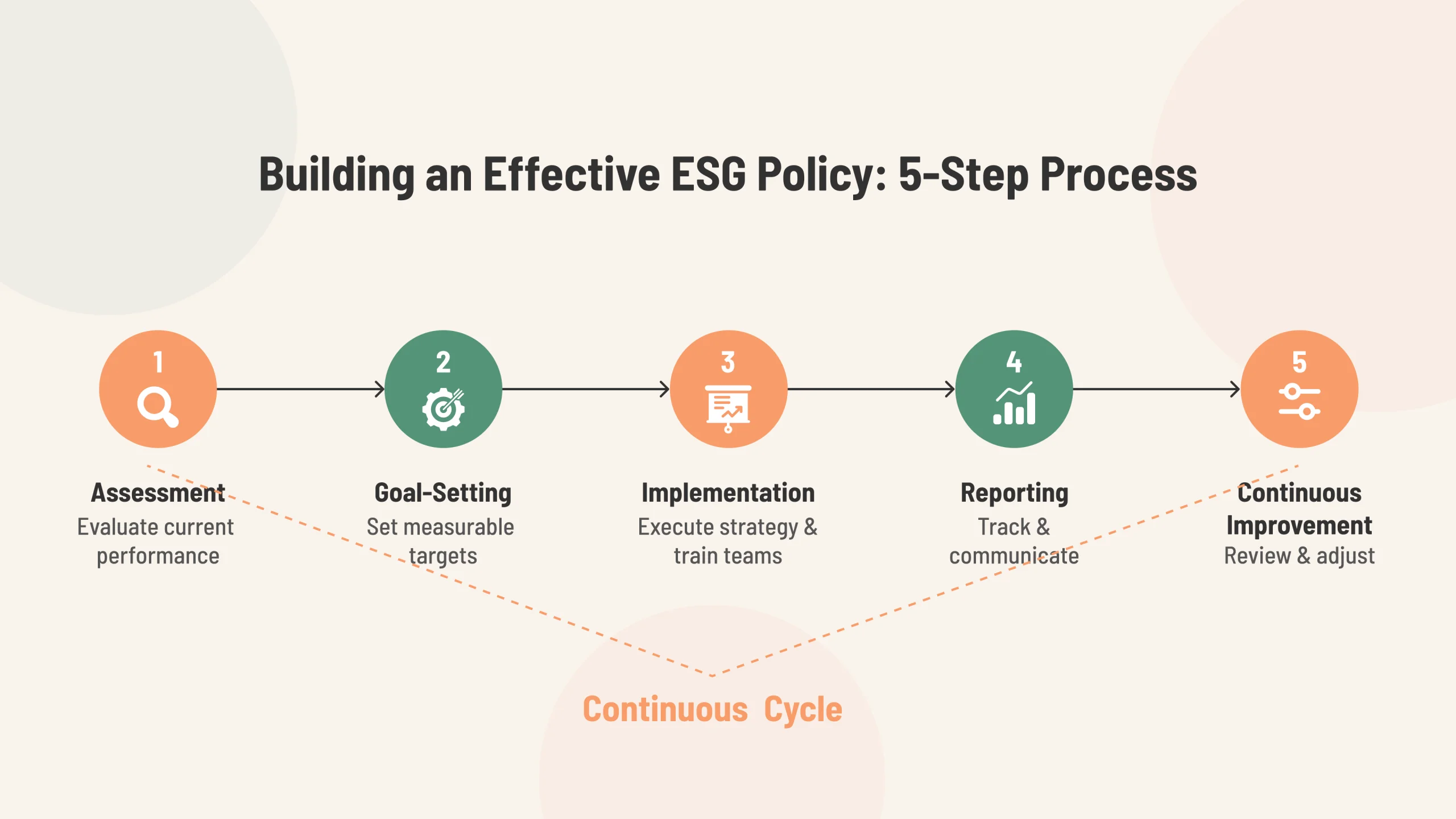
A 5-step process for building an effective ESG policy: assess performance, set targets, implement, report, and continuously improve.
How to Build an ESG Policy
An environmental, social, and governance policy works best if it changes what people do. Here’s how to build one.
Step 1: Assessment
Start by looking at where you are now. Go through your operations and see how you’re doing on environmental, social, and governance issues. Figure out what issues matter most for your industry and the people who care about your company. Ask employees, customers, investors, and communities what they think is important. See how you stack up against competitors. Look at what regulations you need to follow in different places.
Step 2: Goal-Setting
Take what you found and turn it into objectives. Make targets specific and measurable with actual deadlines. Environmental goals need to be based on science. ESG social objectives should cover diversity, fair pay, and how you impact communities. Governance targets deal with who’s on the board and ethics programs. Set up KPIs so you can track whether things are getting better.
Step 3: Implementation
Make sure someone is responsible for each initiative. Give them what they need — money, people, technology. Work ESG into how the business already runs instead of treating it like something separate. Put structures in place to oversee everything.
As an example, Stanford experimented with 10,000 students to see if adaptive systems could reduce assessment load without compromising learning quality. For this goal, Raccoon Gang specialists built the platform that made it work at scale. The results showed students could demonstrate mastery with 60-70% fewer assessments.
Step 4: Reporting
You need ways to track progress and tell people about it. Pick frameworks based on who you are reporting to — GRI, SASB, TCFD, CSRD are options. Use technology to collect data automatically when you can. Make sure you can prove the numbers are accurate. Report regularly and be honest about what is working and what is not. Getting third parties to verify helps people trust the numbers.
Step 5: Continuous Improvement
Look at your strategy and how your organization is doing every few months. Change targets when the research updates, regulations change, or stakeholder expectations shift. Report honestly on both achievements and problems. When you miss targets, figure out why and use that information to improve. Observe what other organizations are doing in ESG — their methods and outcomes can inform your strategy.
Conclusion
Strong environmental social governance performance opens doors — access to capital, customers, talent, markets. Weak performance closes them. The stakes are rising.
Developing real ESG capability takes time. You need clear goals, resources, proper systems, and trained people. But mostly you need to embed it into how operations actually run instead of treating it like a separate thing.
Your environmental, social, and governance policy succeeds when it shifts decisions across the company. When product teams factor in environmental impact. When hiring managers make diversity a priority. When leaders choose ethics even under pressure. That level of integration doesn’t happen on its own. It requires focused effort, steady communication, and continued investment in building people’s ability to execute.