







Whether you are building a corporate training program, launching an online university course, or onboarding thousands of learners across time zones, the learning environment you design determines whether people complete, retain, and apply what they learn.
Research consistently shows that the environment shapes outcomes. Organizations with intentionally designed learning environments report measurably higher course completion rates, faster onboarding cycles, and stronger knowledge transfer to the job. The conditions are not a soft add-on to instructional design — they are a core variable in whether training works.
“When we design a learning environment — whether it’s a corporate academy or a university program — the first question is always the same: does the platform, the content structure, and the learner experience work together? When they do, completion rates go up, support tickets go down, and L&D teams stop firefighting and start improving. When they don’t, no amount of great content fixes the friction” — Raccoon Gang’s EdTech Architect
What Is a Learning Environment?
A learning environment is the mix of LMS, course structure, instructional design, and learner interaction. In corporate training, it covers how people find content, move through modules, receive feedback, and get help when progress stalls.
It also includes course sequencing, pacing, instructor presence, peer discussion, cohort design, and analytics. These pieces shape what learners did yesterday, what they do during a session, and what the L&D team changes next.
In a classroom, walls and schedules set many limits. Online and blended programs work differently. Teams design each touchpoint, track learner behavior, and improve the system with data.
While building a gamified LMS for a nationwide youth education initiative, our team saw this directly. Over four months, 7,000 learners were onboarded, 80% engaged deeply with interactive modules, and certificate completion increased tenfold — driven by intentional environment design: clear progress rules, instant feedback, and mobile-optimized access. The technology enabled it; the environmental design made it stick.
Elements of an Effective Online Learning Environment
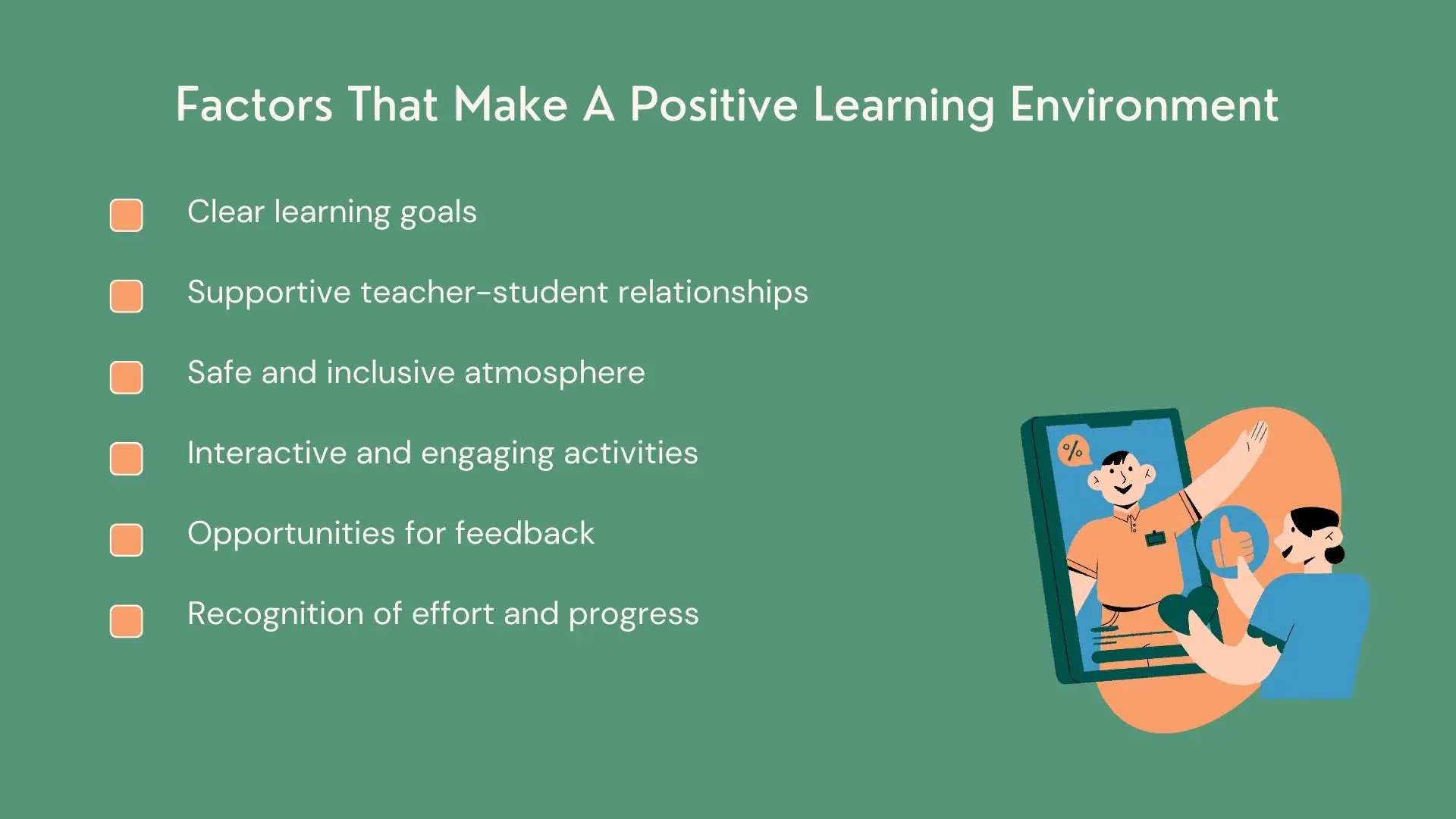
- Clear learning pathways and visible progress tracking
- Psychological safety to ask questions and attempt challenges without penalty
- Peer interaction — structured, not incidental
- Platform accessibility across devices, including mobile and offline
- Timely, specific feedback — automated where possible, human where it matters
- Flexible pacing with accountability checkpoints
- Analytics visibility for both learners and instructors
This comparison shows how traditional models emphasize structured face-to-face time, while modern environments prioritize adaptability, technology integration, and continuous feedback — key factors for effective learning today:
| Aspect | Traditional Learning Environment | Modern Learning Environment |
| Delivery Method | In-person classroom instruction | Blended learning with virtual classrooms and eLearning modules |
| Physical Space | Set seating and fixed schedules | Flexible seating, breakout areas, and online collaboration hubs |
| Technology | Chalkboard, overhead projector | Interactive whiteboards, simulators, and mobile-ready courses |
| Interaction | Teacher-led lectures and student Q&A | Peer-led forums, AI-assisted feedback, live polling, and scenario simulations |
| Assessment | Periodic exams and quizzes | Continuous checks with digital quizzes, analytics dashboards |
| Flexibility | Fixed timetable, slow schedule changes | On-demand microlearning, self-paced modules, and real-time updates |
Why Does the Learning Environment Matter?
Learner Engagement and Completion
Engagement comes from design choices. Learners continue when the LMS feels clear, modules stay short enough to finish, and progress markers show the next step.
Friction works the other way. Confusing menus, unclear instructions, or a weak mobile experience push learners out, even when the course content has value.
Organizations that audited and redesigned the learning environment alongside their content reported gains of 20–40% in completion rates without changing the lessons themselves. The environment carried the weight.
Knowledge Transfer and On-the-Job Application
Training rarely sticks when learners complete a course and return to work with no practice bridge. Strong environments build that bridge through spaced practice, scenario work, simulations, and manager-facing progress data.
A sales rep can rehearse an objection before the real client call. A technician can test a process before touching equipment. In compliance, onboarding, and sales enablement, teams can track the cost of each knowledge gap.
L&D Team Efficiency
A well-built learning environment cuts manual work for L&D teams. The LMS can manage enrollment, reminders, completions, and reports. Modular content also lets teams update one unit instead of rebuilding a full course.
RG Analytics shows who has fallen behind, which modules lose learners, and where the learning path creates drag. With that data, L&D teams fix weak points before they turn into program-wide problems.
Organizational Outcomes
At the program level, learning environment design appears in business metrics: shorter onboarding time, higher assessment scores, fewer compliance incidents, and more internal promotions after leadership training.
NASA’s Open Science 101 and Harvard’s executive leadership program, both built on Open edX, show how platform structure, content architecture, and analytics can work together at scale.
Examples of Effective Learning Environments
Based on our experience across corporate, academic, and nonprofit programs, here are three scenarios that show how intentional environment design produces measurable outcomes.
A Technical Skills Academy on Open edX
In a technical skills academy built on Open edX® Services, environment design operates at every level:
- Teams work through project-based modules with live LMS dashboards showing individual and cohort progress
- Custom xBlocks surface peer review sessions and collaborative problem-solving directly in the course flow
- Modular content structure allows the L&D team to update individual units without rebuilding entire programs
- By combining structured learning paths with instructional design services tailored to the learner’s role, the academy reduces time-to-competence and gives instructors clear visibility into where learners need support
A Corporate Training Studio
In a corporate training environment where employees rotate through scenario simulations, group workshops, and microlearning modules — all orchestrated via a customized Open edX backend and organized through online course development services:
- Real-time RG Analytics reports give managers visibility into team-level progress and individual drop-off points
- Instant knowledge checks, guided demos, and scenario-based labs ensure professionals practice new skills in context before applying them on the job
- LMS integration with HR systems automates enrollment and completion tracking, removing manual administration from the L&D team’s workload
A Fully Virtual Open edX Academy
A fully online academy can deliver the same quality of learning environment as an in-person program when designed intentionally:
- Learners choose between self-paced micro-modules, instructor-led webinars, and scenario-driven story-based animations, switching modes without losing progress
- Open edX mobile apps with offline access ensure distributed teams and remote learners maintain the same learning continuity as on-site participants
- By blending structured social interaction, gamified progress tracking, and rich analytics, the platform sustains engagement across cohorts and drives real-world skill application
How to Create an Effective Online Learning Environment
For online and blended programs, six design choices shape completion, skills practice, and L&D workload.
- Start with the learner journey, not the content catalog. Map how a learner finds the right course, enters it, understands the task, and sees success. Every extra click adds drag. At Raccoon Gang, instructional designers audit this path before they edit a module.
- Design for the real device. Many corporate learners study on mobile between meetings, shifts, or client work. If the LMS needs a desktop, the program loses people early. Open edX mobile apps with offline access help teams keep training available across locations.
- Build social learning into the course structure. Peer review, discussion prompts, and cohort progress views create accountability. Optional forums rarely carry the load. Put interaction inside the learning flow, where learners already work.
- Use analytics between cohorts. Completion reports show what happened. Drop-off by module, time-on-task, and assessment attempts show where the course leaked attention. L&D teams can then fix weak points before the next cohort starts.
- Match feedback to the learner’s timing. Feedback loses value after two days. Automated knowledge checks, rubric-based peer review, and AI-assisted grading help learners correct mistakes while the task still feels fresh.
- Modularize content for updates. Large courses age quickly. Small modules let teams revise, replace, or resequence content without rebuilding the full program. This matters in compliance, product training, and technical skills, where rules and tools keep changing.
“When we design a course, our first step is to map a clear learning roadmap in the LMS so that every learner knows exactly what the next goal is and can track their progress. Then we layer in open-ended projects and real-world scenarios that let people follow their curiosity and bring their ideas to life. That mix of structure and creative freedom keeps motivation high and makes sure every voice has a chance to be heard and valued.” — Raccoon Gang’s EdTech Architect
Psychological Safety in Online Learning
Psychological safety — the condition in which learners feel they can attempt challenges, make errors, and ask questions without social or professional penalty — is a measurable predictor of learning outcome quality, not a soft design preference.
In corporate and online learning environments, psychological safety manifests in specific design decisions:
- Anonymous knowledge checks before high-stakes assessments reduce the fear of visible failure and give learners accurate self-assessment data
- Assessment retry policies that allow two attempts without penalty lower anxiety without reducing rigor
- Instructor presence signals — a short video introduction, responsiveness in discussion forums, acknowledgment of common errors in cohort communications — establish that the learning environment has a human layer, not just automated content delivery
- Transparent grading rubrics communicated before the assignment begins, so learners understand what success looks like and can calibrate their effort accordingly
- Feedback framing that is specific, behavioral, and forward-looking — separating performance on this attempt from capability overall
In programs where psychological safety is low — typically visible in discussion forum participation rates and assessment retry rates — knowledge transfer to the job is consistently weaker, even when assessment scores are comparable.
Conclusion
An effective learning environment is not a single feature — it is the result of deliberate decisions about platform, content architecture, feedback design, social structure, and analytics. Each of these elements is measurable, and each can be improved.
The organizations that treat their learning environment as an ongoing design problem — rather than a one-time setup — consistently outperform those that focus solely on content quality. NASA, Harvard, and the organizations behind the gamified learning platform we built each demonstrate this: environment design at scale is achievable, and its impact is concrete.
Raccoon Gang designs and builds learning environments on Open edX for corporate, higher education, and nonprofit clients. This includes:
- LMS customization and development aligned to your instructional model and brand
- Mobile course delivery with offline support for distributed and field-based learners
- Gamification and simulation design for high-engagement programs
- Analytics integration to surface learner behavior data and drive program improvement
- Instructional design services for programs that need both content and environment built together
→ Reach out today, and let’s build the learning environment your team deserves.