







A retail LMS can be the reason a new store associate becomes productive in days. Or the reason they spend weeks searching for answers on the sales floor.
The hard truth is that retail training remains difficult to execute. Even with the growth of learning technologies. Several factors drive that challenge.
- Teams work across hundreds of locations.
- Employee turnover in retail remains stubbornly high.
Few industries have such a short connection between product knowledge, training, and customer experience as retail. Promotions, compliance requirements, and operating procedures change fast. Those changes quickly affect execution in stores, customer satisfaction, and revenue.
To address these challenges, investment in learning technology continues to grow. The retail LMS market is projected to reach $2.41 billion and expand at a CAGR of 18.6% through 2033.
According to the latest BLS data, the retail industry continues to experience 60% turnover rates that many other sectors would struggle to absorb.
One thing retail has in common with every other industry is that LMS selection should match the company’s growth stage, not a checklist of features.
- A system that works for 20 stores may struggle at 500 locations.
- A platform built for headquarters employees may create friction for deskless frontline teams.
How to choose the right LMS for retail?
The answer starts with understanding your biggest training bottleneck, your operating model, and where your organization is headed next. You’ll find those answers below.
TL;DR
- A retail LMS should solve store-level problems, not simply host courses.
- The best platform depends on your growth stage, training bottleneck, and operating model.
- Mobile access, role-based paths, reporting, integrations, and compliance tracking matter more than long feature lists.
- SaaS platforms usually launch faster, while open-source LMS options offer more control at scale.
- Open source fits enterprise retail when data ownership, customization, integrations, and long-term platform control become strategic.
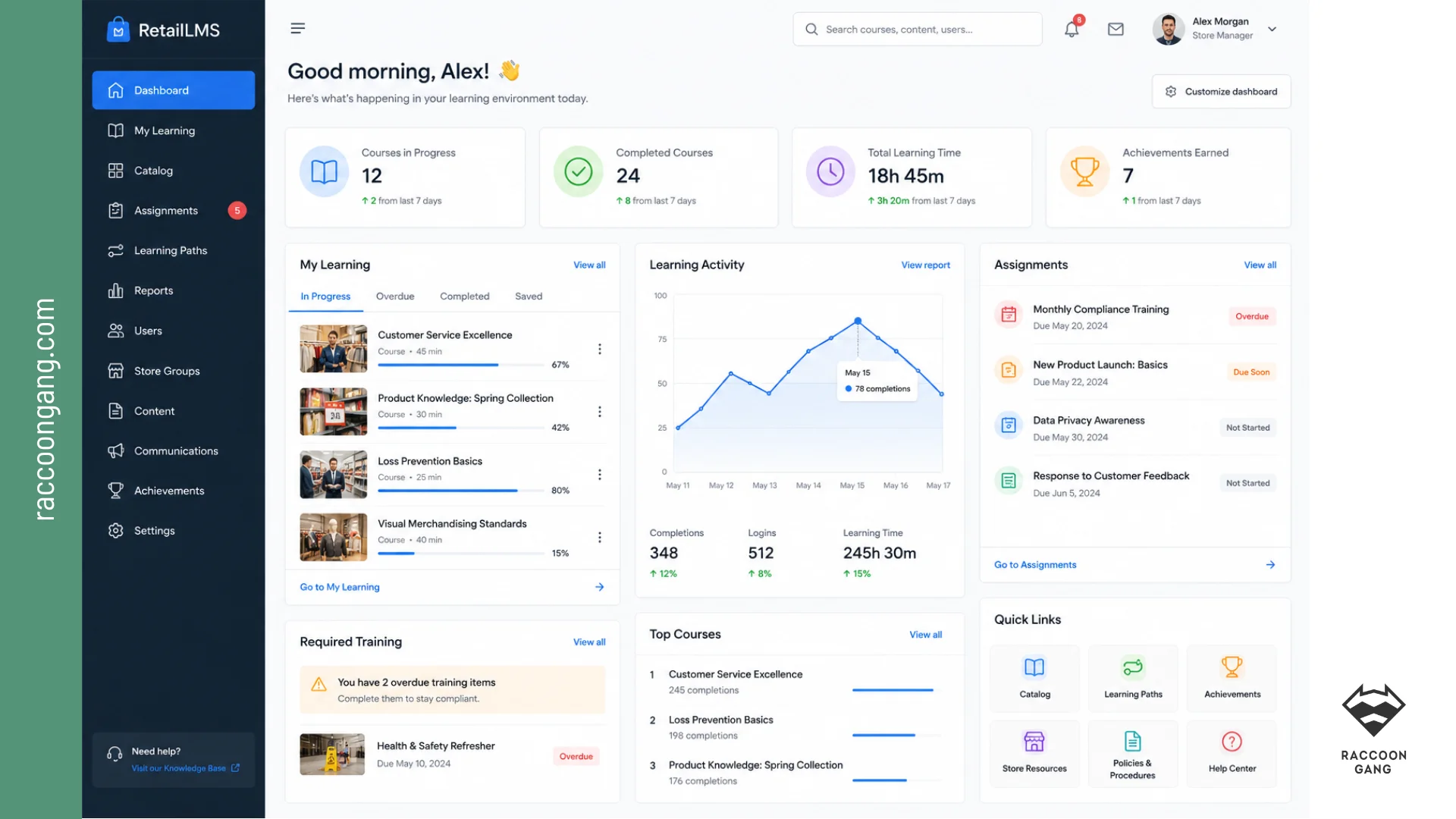
Retail managers gain real-time visibility into onboarding, compliance, and learning progress.
What Is a Retail LMS?
A learning management system for retail is a digital platform adapted and customized to train employees, partners, franchisees, and sometimes customers in one learning environment.
At first glance, a retail learning management system may look similar to any other LMS. Retail has different training requirements, so the platform needs several specific capabilities.
- Store associates often work on shared devices.
- Many employees do not have a corporate email address.
- Training must fit between shifts.
- The LMS should support mobile access.
Raccoon Gang’s instructional design team sees this pattern often. Retail companies usually have enough training content. Sometimes, too much. The real problem is timing. Can the right employee get the right knowledge before a product launch, a compliance check, or a customer question?
Research supports that concern: only 24% of frontline workers strongly agree they receive the training they need to succeed in their role.
What should retailers do with that data?
A modern retail LMS should support onboarding from day one. It should help teams manage compliance, product knowledge, certifications, and other training requirements at scale. Most importantly, it should improve store-level performance rather than simply serve as a repository for courses.
Why Retail Businesses Need LMS Platforms in 2026
The answer starts with the reality of retail operations.
New employees join every week. Add seasonal hiring, which creates sudden onboarding spikes. At the same time, product updates move from HQ to stores almost overnight, while compliance requirements vary by role, location, and region.
None of these challenges can be solved with PDF instructions alone. One-time classroom sessions rarely help either. Industry research shows that online learning can reduce training time by roughly 40-60% compared to traditional classroom training.
“Over the last 10 years, the Raccoon Gang team has worked with organizations that train thousands of learners across distributed environments. One lesson appears again and again: retail performance depends less on the amount of training available and more on how quickly employees can access and apply it.”
— Olha Turutova, Head of Instructional Design, Raccoon Gang
By the way, those numbers have a very practical meaning.
Because in retail, onboarding delays quickly turn into longer ramp-up times, more manager follow-ups, and inconsistent customer experiences across stores, retailers need training that can reach distributed teams quickly, scale during hiring peaks, and give managers visibility by store or region.
Those situations explain why many organizations should move from basic training tools to a dedicated LMS for retail as they grow.
A retail training platform may help organizations:
- Reduce manual follow-ups and administrative work.
- Deliver product updates consistently across all locations.
- Track compliance and prove who completed required training.
- Give headquarters and store managers a shared view of performance across the network through an LMS for multi-location retail.
Key Retail LMS Features That Solve Real Store Problems
Modern LMS retail solutions succeed when they solve operational problems, not when they simply offer the longest feature list.
| Feature | Retail Problem It Solves | Example in Practice |
| Mobile Learning | Employees rarely sit at a desk to complete training. | A cashier completes a 10-minute training module before a shift using a personal smartphone. |
| Microlearning | Long courses are difficult to fit into busy store schedules. | Associates review a new product launch in three short lessons instead of a one-hour course. |
| Role-Based Training | Different positions require different knowledge. | Store managers, cashiers, and department supervisors automatically receive different learning paths. |
| Learning Paths | New hires often receive inconsistent onboarding. | Every sales associate follows the same onboarding sequence regardless of store location. |
| Certifications & Recertification | Compliance requirements expire and require proof of completion. | Food safety or alcohol sales certifications automatically renew before expiration dates. |
| AI-Powered Learning Support | Training teams cannot manually create and update content fast enough. | AI converts new product information and SOP updates into learning materials and role-play scenarios. |
| Store-Level Analytics | Headquarters struggles to identify training gaps across locations. | Regional managers compare completion rates and certification status by store. |
| Offline Learning | Employees may have limited connectivity during work hours. | Training progress syncs automatically once the device reconnects to the internet. |
| Multi-Location Reporting | Retail chains need visibility across hundreds of stores. | HQ tracks onboarding, compliance, and product training performance by region. |
| Gamification | Training participation often drops after onboarding. | Employees earn badges, points, or leaderboard positions for completing learning activities. |
| Content Localization | Global retailers operate across multiple languages and regions. | Product training automatically appears in the local language of each market. |
* Features such as mobile learning, offline access, role-based assignments, and store-level reporting have become core requirements for a retail training platform.
AI is becoming increasingly important in retail learning, too. Leading platforms such as Docebo, Open edX, and Moodle now have AI tools for content creation and learning personalization. We will discuss it in the future section. Right now, let’s compare LMS-based and traditional training approaches.
Retail LMS vs Traditional Training: What Changes in Daily Operations
At the beginning of the article, we already mentioned that classroom sessions are far from the best way for retailers to run training. Why?
The main reason that tips the scales toward LMS for retail training over traditional training is speed: how quickly knowledge reaches employees.
When a traditional model is used, onboarding depends on store managers, experienced associates, printed materials, and classroom sessions. Training quality in this scenario is uneven and often different across locations. Product updates may take days or even weeks to reach every employee.
A retail LMS creates a more structured process:
- New hires follow the same onboarding path across locations.
- Product updates can be assigned across the network within hours.
- Compliance reminders run automatically.
- Managers stop chasing completions in spreadsheets.
Traditional onboarding often creates 5–10 manager touchpoints in week one. Retail LMS case studies show onboarding time can drop by 50–80%. Managers move from daily supervision to 3–4 structured check-ins.
Another important change is measurement.
Instead of measuring only attendance and course completion, as traditional training often does, modern retail organizations increasingly focus on operational metrics:
- Can a new associate become productive faster?
- Does every store receive the same product information?
- Are compliance requirements completed on time?
That is the main role of the LMS here. It becomes part of the operational infrastructure.
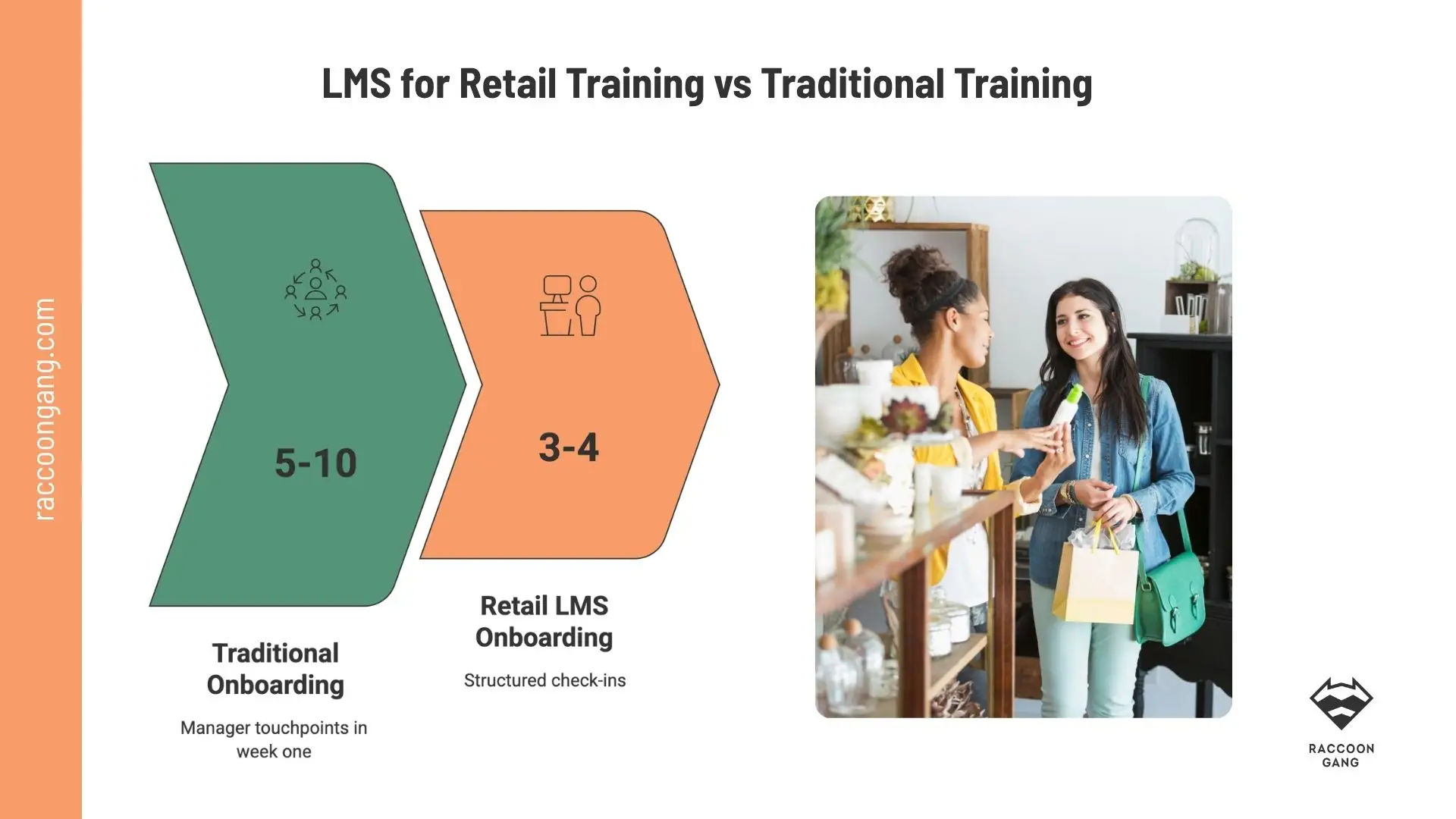
Structured LMS onboarding reduces manager involvement during the first week.
Employee Training LMS for Retail Teams: Role-Based Learning at Scale
An employee training LMS becomes truly valuable when it stops treating every employee the same.
A cashier, store manager, warehouse associate, and regional supervisor need different knowledge, different training schedules, and different performance goals. Too obvious? Yet many retailers still assign the same training content across multiple roles.
The best LMS for employee training solves this problem through role-based learning paths. New hires receive onboarding relevant to their position. Managers complete leadership and coaching programs. Compliance training reaches only the employees who need it.
Recent L&D analyses suggest that leadership and management capabilities already represent more than one-fifth of retail learning demand, as retailers move beyond product and process training.
That makes sense.
Store performance often depends on coaching, scheduling, feedback, and team engagement. Research links investment in management training with a 40% higher likelihood of exceeding sales targets.
That is why modern LMS for employee training platforms focus on delivering the right training to the right employee rather than delivering the same course to everyone.
Customer Training LMS Software for Retail Brands, Partners, and Franchisees
Many retail organizations train far more people than their employee count suggests.
Franchise owners. Store operators. Dealers. Resellers. Service partners. Sometimes even customers.
These audiences represent the brand, but they usually operate outside the company’s HR systems and management structure.
That is where customer training LMS software becomes valuable.
Instead of endless emails, piles of unopened PDFs, and occasional webinars, retailers can focus on structured onboarding, product certifications, sales enablement, and compliance training through a single platform.
Every partner receives the same product knowledge. Franchise location follows the same operating standards. Every reseller gets access to the latest updates.
For a retail brand, that means greater control without creating more administrative work.
Best Retail LMS Platforms in 2026
Before we compare platforms, let’s focus on the criteria that matter most in retail.
- Scalability — Can the platform support hundreds of stores and thousands of learners?
- Mobile Learning — Can employees complete training from personal or shared devices?
- Analytics — Can managers track onboarding, compliance, and certifications by store or region?
- Customization — Can workflows, branding, and learning experiences match your operating model?
- Deployment Model — Do you prefer a SaaS subscription or an open-source platform with greater control?
- Pricing Structure — Does the cost scale reasonably as your workforce grows?
Retail LMS Comparison
Different retail organizations need different LMS setups. Open-source platforms usually offer more flexibility. SaaS platforms typically deliver faster rollout. The best choice will depend on your concrete situation.
| Platform | Strengths | Limitations | Best fit for | Commercial model |
| Open edX | Highly scalable, open architecture, extensive customization, strong analytics ecosystem | Requires implementation expertise and ongoing management | Enterprise retail, franchise networks, large-scale employee and partner training | Open-source |
| Moodle | Flexible, large plugin ecosystem, strong compliance workflows, open-source | User experience often requires customization | Mid-size to enterprise retailers needing flexibility and control | Open-source |
| Totara | Enterprise learning, compliance management, certifications, workforce development, flexible customization | Smaller ecosystem than Moodle and Open edX | Enterprise retailers with complex compliance and workforce training needs | Open-source |
| Canvas | Intuitive interface, strong mobile experience, easy adoption | Less flexible than fully open-source platforms | Retail organizations prioritizing ease of use and rapid rollout | SaaS |
| Schoox | Built for frontline workforce training, strong mobile learning, skills tracking, retail-focused workflows | Less customization than open-source platforms | Less customization than open-source platforms | SaaS |
| Docebo | AI-assisted content workflows, extended enterprise training, strong reporting | Higher cost at scale | Retail brands training employees, partners, and customers | SaaS |
| TalentLMS | Fast deployment, simple administration, lower entry cost | Limited enterprise customization and governance | Small and growing retail chains | SaaS |
Quick Selection Guide
- Choose TalentLMS for small and growing retail chains that need a fast launch and simple administration.
- Choose Canvas for retail organizations that prioritize a polished user experience and quick adoption.
- Choose Docebo for retail brands investing in AI-powered learning, partner enablement, and customer education.
- Choose Open edX for enterprise retail training across employees, franchisees, partners, and customers with strong control over data, integrations, and platform development.
- Choose Moodle for organizations seeking open-source flexibility, compliance workflows, and moderate customization.
- Choose Schoox for multi-location retail teams that need frontline training, mobile access, and operational reporting.
- Choose Totara for enterprise retailers that need compliance management, certifications, and structured workforce development.
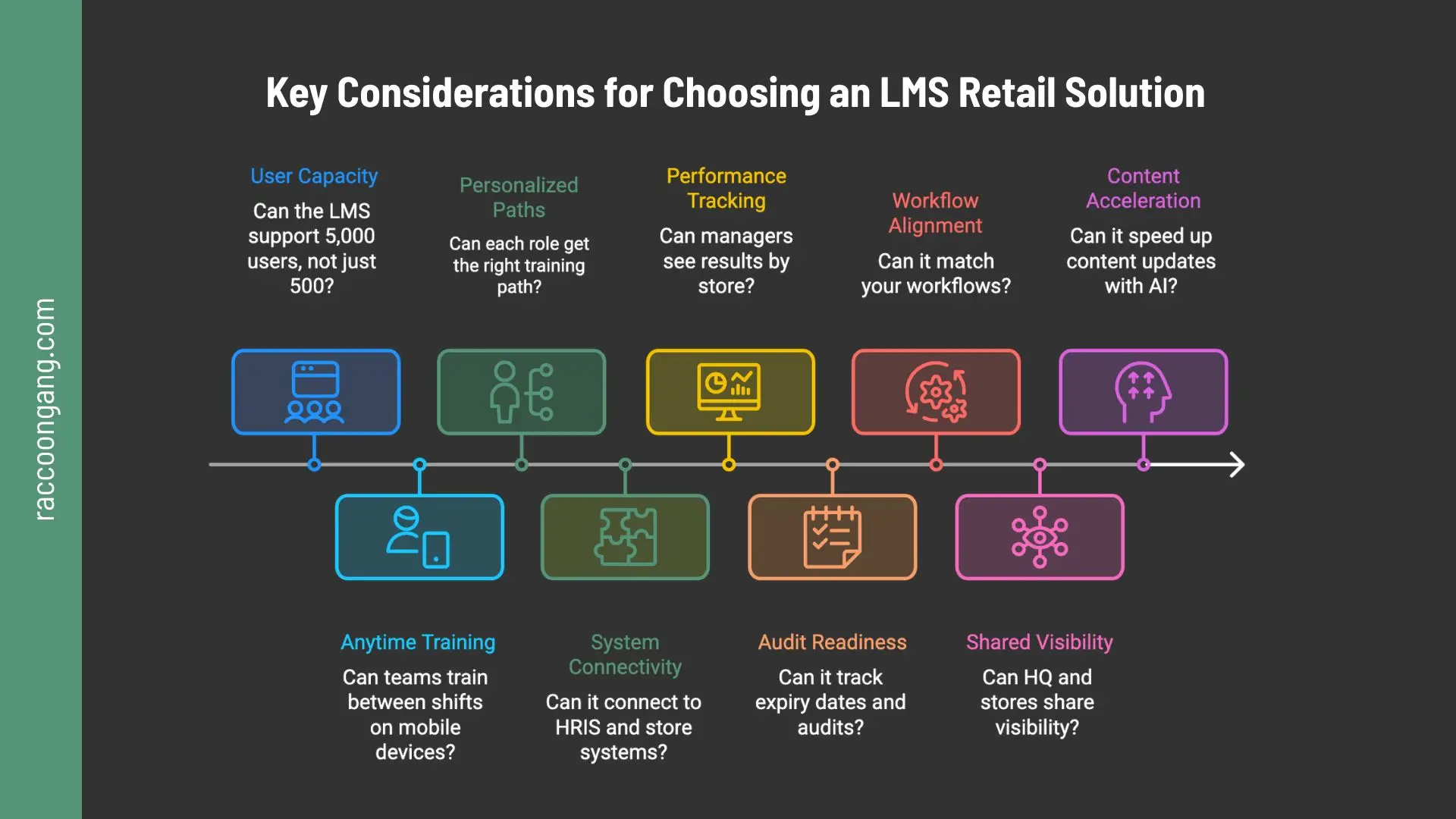
Evaluate retail LMS platforms by business requirements, not feature lists.
How to Choose the Right Retail LMS by Growth Stage
Most retailers start by comparing features. A better question would be: Can our LMS support the next stage of our retail business?
Use this quick framework to choose the right LMS retail solutions:
- Scalability — Can it support 5,000 users, not just 500?
- Mobile support — Can teams train between shifts?
- Role-based training — Can each role get the right path?
- Integrations — Can it connect to your HRIS and store systems?
- Reporting — Can managers see results by store?
- Compliance — Can it track expiry dates and audits?
- Customization — Can it match your workflows?
- Multi-location management — Can HQ and stores share visibility?
- AI support — Can it speed up content updates?
Open edX: An Open Source LMS for Retail Enterprises
Among open-source options, Open edX deserves special attention.
Many organizations begin their search looking for the best retail LMS software. As retail operations grow, the conversation usually changes. The focus moves toward ownership, integrations, reporting, multi-location governance, and long-term scalability.
An open-source LMS is a bit like clay. You can shape it around your business instead of reshaping your business around the platform.
“The strongest LMS implementations happen when the platform adapts to the business, not when the business adapts to the platform.”
— Volodymyr Chekyrta, Engineering Manager, Raccoon Gang
For organizations planning to support thousands of learners across stores, regions, franchisees, and external partners, Open edX is one of the strongest enterprise retail LMS options available.
Open edX supports employee onboarding, compliance training, partner education, franchise learning, certifications, and customer training from a single environment. Retailers can customize learning experiences, integrate workforce systems, and retain full control over their data and roadmap.
5 reasons why Open edX for retail?
- No per-user licensing fees as learner numbers grow.
- Full white-label branding and user experience customization.
- Unlimited scalability with the right infrastructure.
- Flexible integrations with HR, POS, CRM, ERP, and workforce management systems.
- Complete ownership of learning data and reporting.
As learner counts pass 1,000 or even 10,000 users, many retailers begin looking beyond subscription fees. Total cost of ownership, integration flexibility, and platform control become far more important.
That is exactly where an open source LMS for retail sector stands out.
Common Retail LMS Mistakes That Hurt Adoption
What seems perfect before launch often needs adjustment in production. Even the best retail LMS can fail. To avoid common LMS adoption mistakes in retail, keep these points in mind:
- If cashiers, managers, and warehouse teams all receive identical learning paths, engagement drops and onboarding takes longer because the content does not match their day‑to‑day work.
- If the LMS does not let frontline employees access training between shifts on mobile, completion rates fall.
- If managers can only see completions but not skill gaps, training problems stay invisible until they hit store performance metrics like conversion, basket size, or customer satisfaction.
- If employees receive long, “doze‑off” style courses instead of short, focused modules, they are more likely to click through than to actually change how they work on the floor.
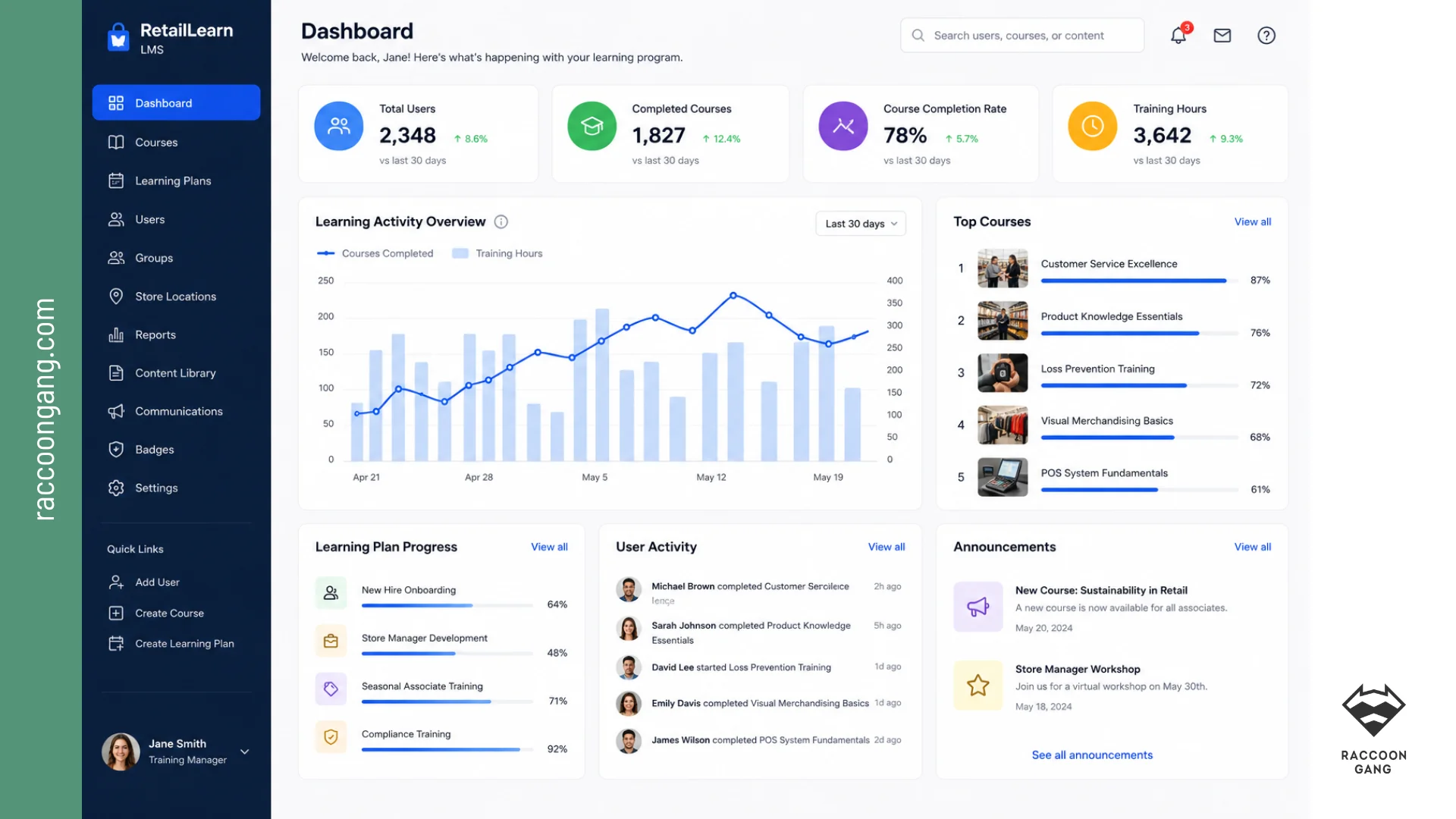
A retail LMS dashboard helps managers monitor learning across every store.
How Raccoon Gang Helps Retail Organizations Build LMS Ecosystems
Raccoon Gang has been building Open edX solutions since 2015. Our team also works with Canvas LMS and Moodle LMS. We have implemented more than 200 learning platforms. Our approach is clear. Start with the operating model. Then build the learning architecture around it.
For retail, that experience matters in four areas:
- White-label LMS
Create branded learning portals for different retail brands, franchise networks, or regions.
- Centralized content
Manage master courses from one place. Push product, compliance, and service updates across stores.
- Mobile learning
Give cashiers, store managers, and warehouse teams access to training between shifts.
- Analytics and integrations
Track progress, certification risks, and learning gaps. Connect the LMS with HR, POS, and operational systems.
Conclusion
The best retail LMS is rarely the platform with the longest feature list.
It is the platform that solves your biggest operational challenge today while supporting the business you expect to run tomorrow.
Before making a decision, ask one strategic question: what should become your system of truth for training — your HCM, your frontline operations stack, or your own learning platform?
That answer will narrow the shortlist faster than any generic feature comparison.
For some retailers, a SaaS platform will provide the fastest path to launch. For others, an open-source retail LMS may offer greater flexibility, control, and long-term value.
One thing stays true across every retail environment: training works best when the right knowledge reaches the right employee, partner, or customer at the right time.
FAQ
What is a retail LMS?
A retail LMS is built for training across stores, roles, and external audiences. Think onboarding, product updates, certifications, franchise learning, and partner education in one place.
What is the best LMS for retail training?
The best choice depends on scale. Smaller chains often need speed and simple admin, while enterprise retailers usually need deeper reporting, integrations, and governance.
How does an LMS help retail businesses?
It cuts manual work for managers. Instead of chasing completions in spreadsheets, teams can assign training, track progress, and spot gaps by store or role.
What features should a retail LMS have?
Mobile access matters first because many retail employees do not train at a desk. Add role-based paths, certifications, analytics, integrations, AI support, and multi-location management.
Which LMS platforms support customer training?
Open edX, Docebo, Moodle, and Canvas can support customer, partner, and franchise education. Your shortlist should depend on branding, audience size, integrations, and ownership needs.
What is the difference between a SaaS LMS and an open-source LMS for retail?
SaaS gives you a vendor-managed platform and faster launch. Open source gives you more control over data, branding, hosting, integrations, and future platform development.
Why do large retail chains choose Open edX?
Large chains often choose Open edX when learner numbers, integrations, and data ownership start to matter more than a quick setup. No per-user license fee also changes the cost conversation at scale.


- What Is a Retail LMS?
- Why Retail Businesses Need LMS Platforms in 2026
- Key Retail LMS Features That Solve Real Store Problems
- Retail LMS vs Traditional Training: What Changes in Daily Operations
- Employee Training LMS for Retail Teams: Role-Based Learning at Scale
- Customer Training LMS Software for Retail Brands, Partners, and Franchisees
- Best Retail LMS Platforms in 2026
- How to Choose the Right Retail LMS by Growth Stage
- Open edX: An Open Source LMS for Retail Enterprises
- Common Retail LMS Mistakes That Hurt Adoption
- How Raccoon Gang Helps Retail Organizations Build LMS Ecosystems
- Conclusion