









Instructional design for microcredential programs starts with a different constraint than degree-course design: every hour has to carry visible value.
The most recent national credential count identified 1,850,034 unique credentials in the United States, including 3,384 microcredentials and 486,352 certificates. In a market this crowded, a learner or employer needs to know what a short credential represents, not merely that somebody completed it.
The challenge for continuing education teams is speed. Employer requests, new certificate ideas, and curriculum updates often arrive faster than a small internal team can handle. Non-degree program design in higher ed therefore needs a repeatable production method: define the competence, decide what evidence proves it, build only the learning needed to reach it, and make sure the credential can connect with whatever comes next.
TL;DR
Design the credential from the competency outward, not from existing lectures inward. Employer partners should help define performance expectations before content is written; assessments should prove the skill the credential claims; and every module should be built with possible future stacking in mind.
For lean teams, reuse the design structure, not the content indiscriminately. Templates, modular learning units, defined review rounds, and clear SME responsibilities can shorten production without weakening academic rigor.
At a Glance
Microcredential: a short credential that recognizes a defined set of knowledge, skills, or competencies rather than a full degree program.
Stackable Credential: a credential designed to combine with other learning achievements into a larger certificate, pathway, or degree.
Competency-Based Design: a curriculum method that starts with what learners must be able to demonstrate and works backward into outcomes, practice, content, and assessment.
Employer-Aligned Curriculum: curriculum whose target skills and performance criteria are shaped with meaningful input from employers or industry partners rather than validated only after development.
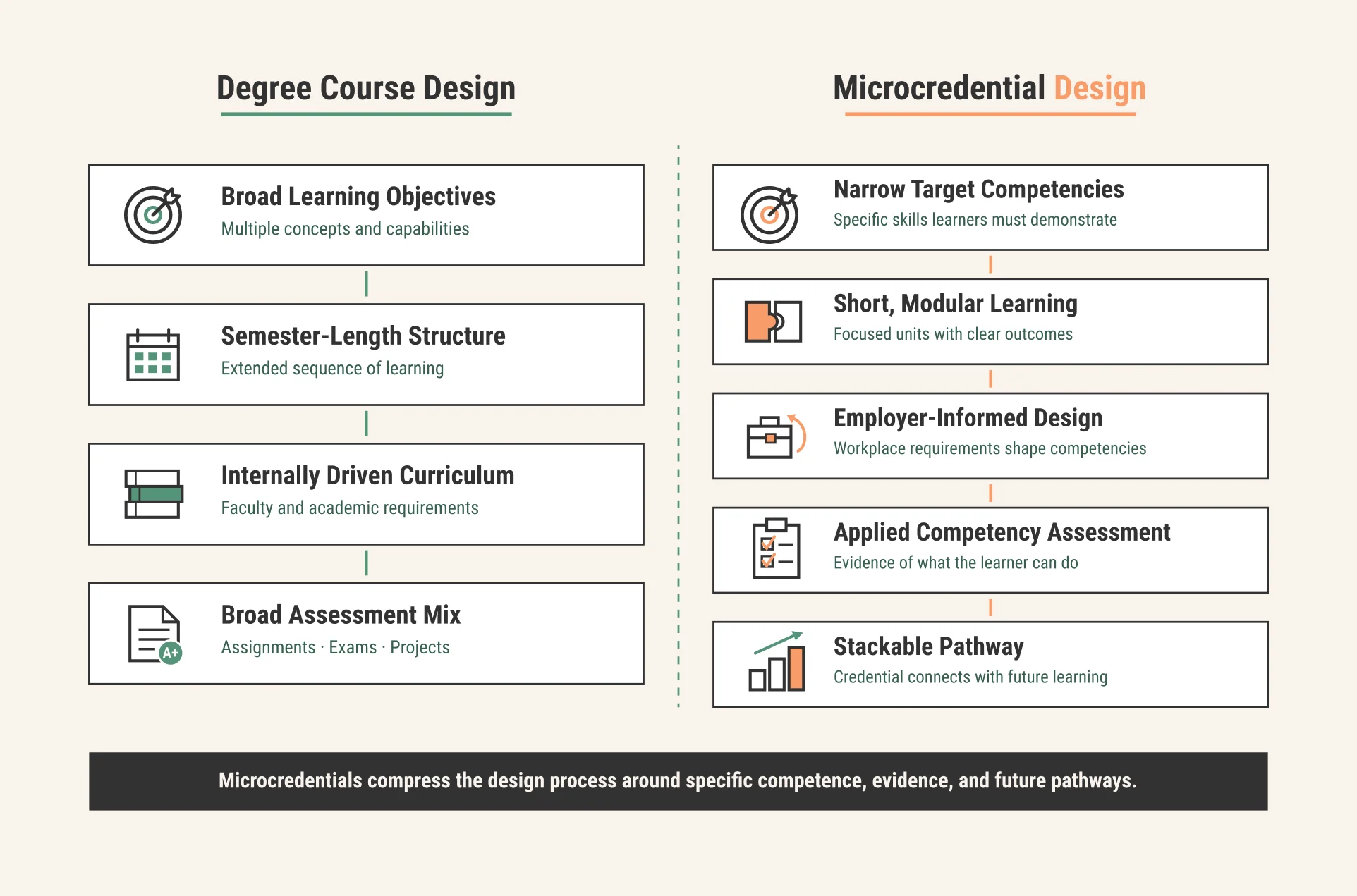
Microcredentials compress the design cycle around narrower competencies, applied assessment, employer input, and future pathways.
Why Microcredential Design Is a Different Discipline Than Degree Course Design
A degree course has room.
A faculty member can establish conceptual foundations, revisit ideas, assign exploratory work, hold discussions, and let competence develop across a semester.
A six-week professional certificate does not have the same luxury.
The learner may already hold a degree. They may have ten years of professional experience. They may be taking the program after work because one capability now separates them from a promotion, a new role, or a project requirement.
That changes three things.
Outcomes become denser
A broad course objective such as “develop knowledge of project risk” is difficult to defend inside a short credential.
A tighter outcome is easier to teach and assess:
Given a project scenario, identify material risks, prioritize them, and justify an appropriate response.
Now the design team knows what evidence it needs.
Learner context matters more
Designing certificate programs for working professionals means accounting for fragmented study time, existing expertise, immediate workplace application, and a lower tolerance for material that feels disconnected from the credential’s promise.
That does not mean making the program easier. It means making every activity easier to justify.
Employer legibility becomes part of curriculum quality
A degree has established signaling power. A new eight-week credential does not automatically have that advantage.
The curriculum therefore has to make its skill claim unusually clear. A national survey of 1,250 hiring managers found that role alignment matters: managers were more likely to see microcredentials as useful when they could connect them with specific jobs and skills.
Published guidance on microcredential design reaches a similar practical conclusion: clear outcomes, career relevance, and stackable pathways need to be visible from the start.
That is why short credentials need instructional design discipline from the first planning meeting.
For the broader business and implementation layer, we cover that separately in our guide to implementing continuing education at a university. Here, the concern is the curriculum itself.
Start From Competencies, Not Content
The fastest way to weaken a microcredential is to start with the material you already have.
The conversation often sounds familiar: “We already have these lectures.” “We have six faculty presentations.” “The department taught a similar elective last year.”
That existing content may save time later, but it should not define the credential. A microcredential needs to begin with the competency it promises to certify, then work backward into outcomes, assessment, practice, and only then the content required to support them.
Good competency-based curriculum design starts with the performance claim.
Ask:
What should a learner be able to do after earning this credential that we are willing to stand behind?
Then make the competency observable. “Understand data governance” is difficult to assess.
“Classify data according to policy, identify access risks, and recommend an appropriate control” gives the design team something concrete. A practical sequence looks like this:
Target competency → performance context → learning outcome → practice → assessment evidence → content
Content comes last for a reason.
Once the outcomes and evidence are visible, some source material will prove essential. Some will become optional. Some will have nothing to do with the credential.
That pruning matters in a skills-based curriculum for higher education. Short programs become bloated quickly when every SME protects their favorite topic.
| Competency | What must the learner do? | What practice prepares them? | What proves competence? | Where does it lead next? |
| Analyze operational risk | Evaluate a realistic case | Guided case analysis | Scenario response with rubric | Advanced risk credential |
| Apply privacy rules | Choose correct handling actions | Branching decisions | Applied case assessment | Data governance certificate |
| Interpret performance data | Diagnose an issue from a dataset | Worked examples + practice | Data interpretation task | Analytics pathway |
Our principles of instructional design guide covers objectives, assessment, sequencing, interaction, and feedback in more depth.
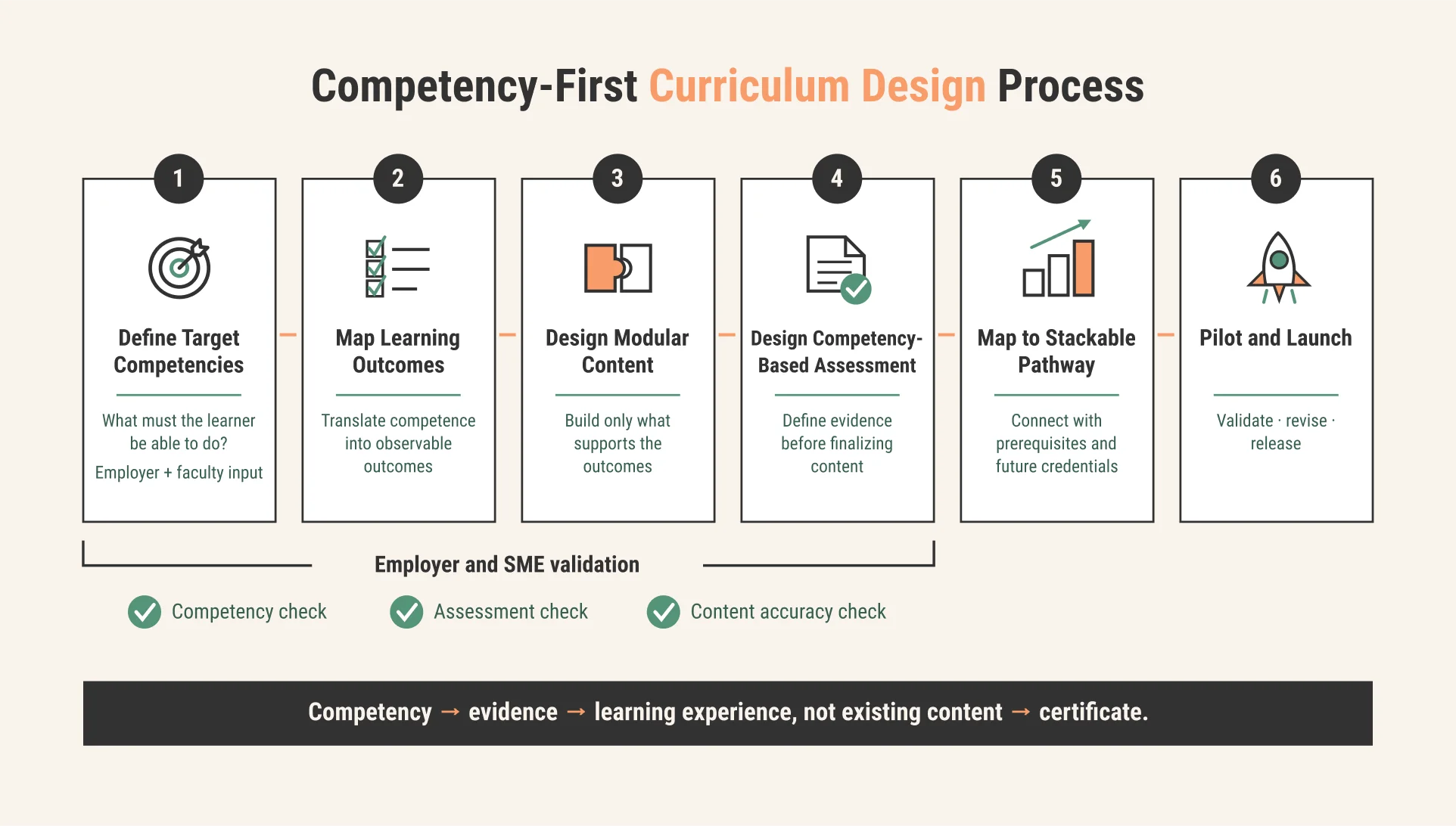
Microcredential development becomes easier to control when competencies and assessment evidence are defined before content production begins.
Employer-Aligned Curriculum Design: Build With Partners, Not Just for Them
Employer collaboration often arrives too late.
A university develops the curriculum, creates the assessments, then sends the finished outline to an advisory board and asks:
Does this look relevant?
That is consultation. It is not genuine employer-aligned curriculum design.
Bring employer or industry partners into the part of the process where their input can still change the program.
Ask about performance, not only topics
“Which subjects should we include?” tends to produce a long list.
Instead ask:
- What should someone in this role be able to do independently?
- Which mistakes tell you a person is not ready?
- What separates adequate performance from strong performance?
- Which tools, constraints, or regulations shape the work?
- What evidence would make you trust this credential?
Those questions expose the actual work. The instructional designer can then translate employer language into teachable and assessable outcomes.
Keep academic judgment in the room
Employer input does not mean outsourcing curriculum authority.
An employer may know the current workflow extremely well and still recommend content that is too narrow, vendor-specific, or temporary.
Faculty contribute disciplinary depth. Employers contribute workplace relevance. Instructional designers connect both to a learnable sequence.
Define review roles before production
A clean continuing education program design cycle might use three gates:
Gate 1: competency approval. Faculty and employer partners confirm the skill claim.
Gate 2: assessment approval. Reviewers confirm that the planned evidence matches that claim.
Gate 3: content validation. SMEs check accuracy after the learning experience has been structured.
Do not ask every stakeholder to review everything at every stage. That is how a six-week design cycle becomes a six-month email thread.
Design for Stackability Before the First Credential Launches
A microcredential may launch as a standalone offer. It should still know where it belongs.
That is the core idea behind stackable credential design.
Suppose a university plans three credentials:
- Credential A: Data Fundamentals
- Credential B: Applied Analytics
- Credential C: Data-Informed Decision Making
If each team designs independently, problems appear quickly. The same competency may be taught twice. Difficulty may jump unpredictably. One credential may use a rigorous applied project while another awards completion after basic quizzes.
Instead, map the credential family before building the pieces.
Establish shared competencies
Which capabilities belong to the entire pathway? Which are prerequisites? Which should deepen across levels?
Keep assessment rigor coherent
Stacking works poorly when credential titles imply progression, but the evidence does not. An introductory credential may test guided application. The next may require independent analysis. The next may require judgment in an ambiguous case. That progression should be deliberate.
Design transfer rules early
If three credentials may later count toward a larger certificate or degree, define what transfers and under what conditions before learners start accumulating them.
National credential transparency work treats relationships among credentials, competencies, courses, assessments, and pathways as first-class information rather than administrative detail. CTDL explicitly describes credentials, competencies, and their relationships to learning and work.
This article stays at the curriculum layer, but the design implication is straightforward:
A stack is an academic architecture before it becomes a credentialing feature.
For the larger strategic picture, see our continuing education overview. The implementation article linked earlier covers the business and operating layer.
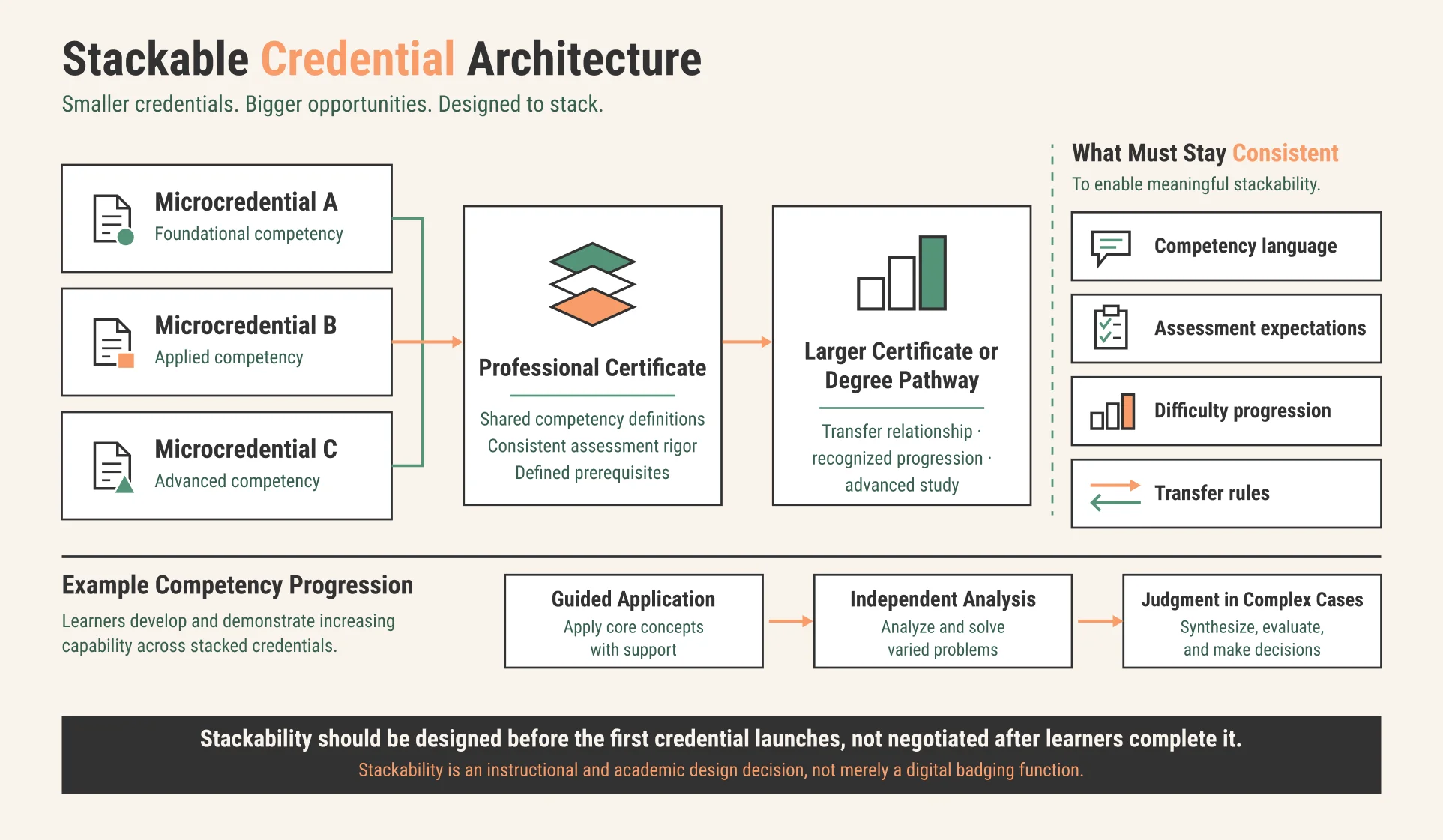
Stackability works best when credentials share competency definitions, assessment expectations, and clear transfer relationships from the start.
Assessment and Credentialing Design: Prove Competency, Not Completion
A credential makes a claim. The assessment has to defend it. Short programs often inherit assessment habits from ordinary online courses: watch the videos, answer multiple-choice questions, reach the passing score, download the certificate.
That may prove recall or persistence. It does not necessarily prove professional competence. Good badge and certificate assessment design asks what evidence would make the credential believable to someone outside the course.
For applied skills, that might mean:
- a realistic scenario;
- a work sample;
- a case analysis;
- a simulation;
- a project scored against a rubric.
A quiz still has a place. Use it where recall is genuinely the target.
Assessment criteria should also be visible before learners attempt the task. If the credential claims that somebody can “evaluate,” “design,” “diagnose,” or “recommend,” the rubric should describe what competent performance looks like.
The badge or certificate signals that the learner met the defined performance standard.
The technical standards behind digital badges and portable credentials are a separate subject. We cover Open Badges and related developments in Top eLearning Trends 2026 rather than turning curriculum design into a credential-technology discussion.
Build Faster Without Building a Large In-House ID Team
A Continuing Education unit may know exactly what it wants to launch and still hit the same constraint repeatedly:
There are more program ideas than people available to design them.
The answer is not to skip design. It is to make design repeatable.
Use one program blueprint
Create a reusable specification for competencies, outcomes, module structure, assessments, rubrics, employer review, SME review, accessibility, and QA.
The content changes. The production logic does not have to.
Build modular components
Reusable patterns reduce blank-page work. An employer case can follow one design pattern. A scenario can follow another. A skill demonstration can use a consistent rubric structure.
Modularity also makes later microcredential curriculum development easier because teams can revise one piece without rebuilding an entire course.
Give SMEs narrow review tasks
Do not ask an industry expert to “review the course.”
Ask them to validate competency accuracy, missing exceptions, workplace realism, terminology, and assessment consequences. Instructional designers should own the learning sequence.
We help our partners connect competencies, curriculum structure, and assessment from the start. This approach keeps production focused and ensures each credential supports measurable learning outcomes.
– Olha Turutova, Head of Instructional Design & e-Learning Content, Raccoon Gang
We used a rapid, iterative production approach on NASA’s Open Science 101 curriculum. The first five modules covered 25 lessons and were delivered in approximately 390 development hours, followed by further revision with scientific SMEs. The project eventually included 192 modular SCORM packages, making individual learning components easier to update without rebuilding the full curriculum.
The subject was different, but the production lesson carries over directly to launching certificate programs at a university: modular design, clear SME roles, and defined review cycles let a small internal team coordinate substantial content without doing every production task itself.
If internal capacity is the bottleneck, an outside instructional design partner can take responsibility for curriculum mapping, storyboards, assessment design, course production, media, and QA while faculty retain academic authority.
Common Instructional Design Mistakes in Non-Degree Programs
The most common failures usually appear before production begins. They come from designing short credentials as smaller degree courses rather than as focused programs with their own competency, assessment, and pathway logic.
| Common mistake | Why it causes problems | Better approach |
| Repackaging a degree course | Compressing a 14-week course into six weeks often preserves the original scope while removing the time learners need to process it. | Start again from the credential outcome. Keep only the content, practice, and assessment needed to support that outcome. |
| Inviting employers after the design is finished | If industry partners can no longer influence competencies or assessment, their role becomes endorsement rather than meaningful curriculum input. | Involve employer partners during competency definition and assessment planning, before content production begins. |
| Using vague competencies | Statements such as “knowledge of cybersecurity” tell employers little about what the credential holder can actually do. | Write observable competencies, such as “Assess a common access-control scenario and recommend an appropriate response.” |
| Designing every credential in isolation | Separate design decisions can create repeated content, inconsistent assessment rigor, awkward prerequisites, and weak stackability. | Map related credentials as a pathway, with shared competency language, progression, and transfer rules. |
| Confusing completion with competence | Completing modules proves participation, not necessarily the skill printed on the credential. | Use applied assessment evidence that matches the competency the credential claims to certify. |
These are curriculum problems, not LMS problems. For platform choices and credential workflows, use our separate LMS guide for continuing education.
How Raccoon Gang Helps Universities Design Microcredential and Certificate Programs
We approach instructional design for microcredential programs from the curriculum outward. The work can begin before there is a storyboard or finished syllabus. Our specialists can help with competency mapping, outcome writing, employer review structures, modular curriculum architecture, assessment planning, content production, accessibility, QA, and later course evaluation.
Our university work includes the Harvard Adaptivity Bridge, a project focused on adaptive learning within HarvardX. Tim McCabe, Director of Learning Technologies at the University of Washington, has also publicly endorsed our work, while Arizona State University is included in our university customer base.
Our team also built a continuous education solution for a leading public research institution around self-paced career courses, progress tracking, grading data, reporting, and integration with the university’s existing LMS.
The useful point is not the platform. It is the operating pattern: short professional programs need curriculum, assessment, faculty or SME input, production, and delivery to work as one coordinated process. Our instructional design services cover that curriculum and content layer. Universities that want examples across different program types can also review our case-study library.
Conclusion
The hardest part of non-degree program design in higher ed is not making the course shorter.
It is making the credential clearer. What can the learner do? Who helped define that competence? What evidence proves it? How does this credential connect with the next one? Can a working professional see why every module is there?
Strong instructional design for microcredential programs answers those questions before production accelerates:
- Start from competencies.
- Bring employer partners into the design early.
- Build assessment around applied evidence.
- Plan stackability before individual credentials become isolated islands.
- Then use modular production methods to move quickly without turning speed into academic compromise.
A certificate becomes credible when the learning, evidence, and credential all make the same claim.
FAQ
How is instructional design for microcredentials different from designing a degree course?
How do you design a certificate program with employer input?
What does it mean to design a credential for stackability?
How do you design assessments that actually prove competency for a badge or certificate?
How can universities launch new certificate programs without a large in-house instructional design team?
What are common mistakes universities make when launching microcredential programs?




- Why Microcredential Design Is a Different Discipline Than Degree Course Design
- Start From Competencies, Not Content
- Employer-Aligned Curriculum Design: Build With Partners, Not Just for Them
- Design for Stackability Before the First Credential Launches
- Assessment and Credentialing Design: Prove Competency, Not Completion
- Build Faster Without Building a Large In-House ID Team
- Common Instructional Design Mistakes in Non-Degree Programs
- How Raccoon Gang Helps Universities Design Microcredential and Certificate Programs
- Conclusion