







When another onboarding, compliance, or product training request lands on an already full L&D roadmap, only then do some organizations start thinking about how to outsource instructional design and meet the launch date.
We are almost certain that your team already manages stakeholder requests, LMS administration, learner data, and existing course portfolios. The pressure is real. Cognitive Market Research supports this point, forecasting that the global learning services outsourcing market will grow at a 5.60% CAGR from 2023 to 2030.
In which cases is outsourcing truly inevitable? When should you still rely on your internal team?
Looking ahead, we can say that you should keep learning strategy and institutional knowledge in-house when your team has enough capacity. Outsource when deadlines exceed internal bandwidth, the project requires specialist skills, or delayed training creates business risks.
We have prepared more details in the sections below. Keep reading, and you will gain a clear understanding of whether to outsource instructional design or keep it in-house. And what benefits and drawbacks each option will bring.
TL;DR
- Outsource when capacity or skill gaps delay delivery.
- Keep strategy, SME access, and approvals in-house.
- Hybrid models balance control, flexibility, and scale.
- Contractors suit focused, well-defined learning tasks.
- Agencies support complex programs with built-in QA.
- Confirm scope, ownership, costs, and success metrics.
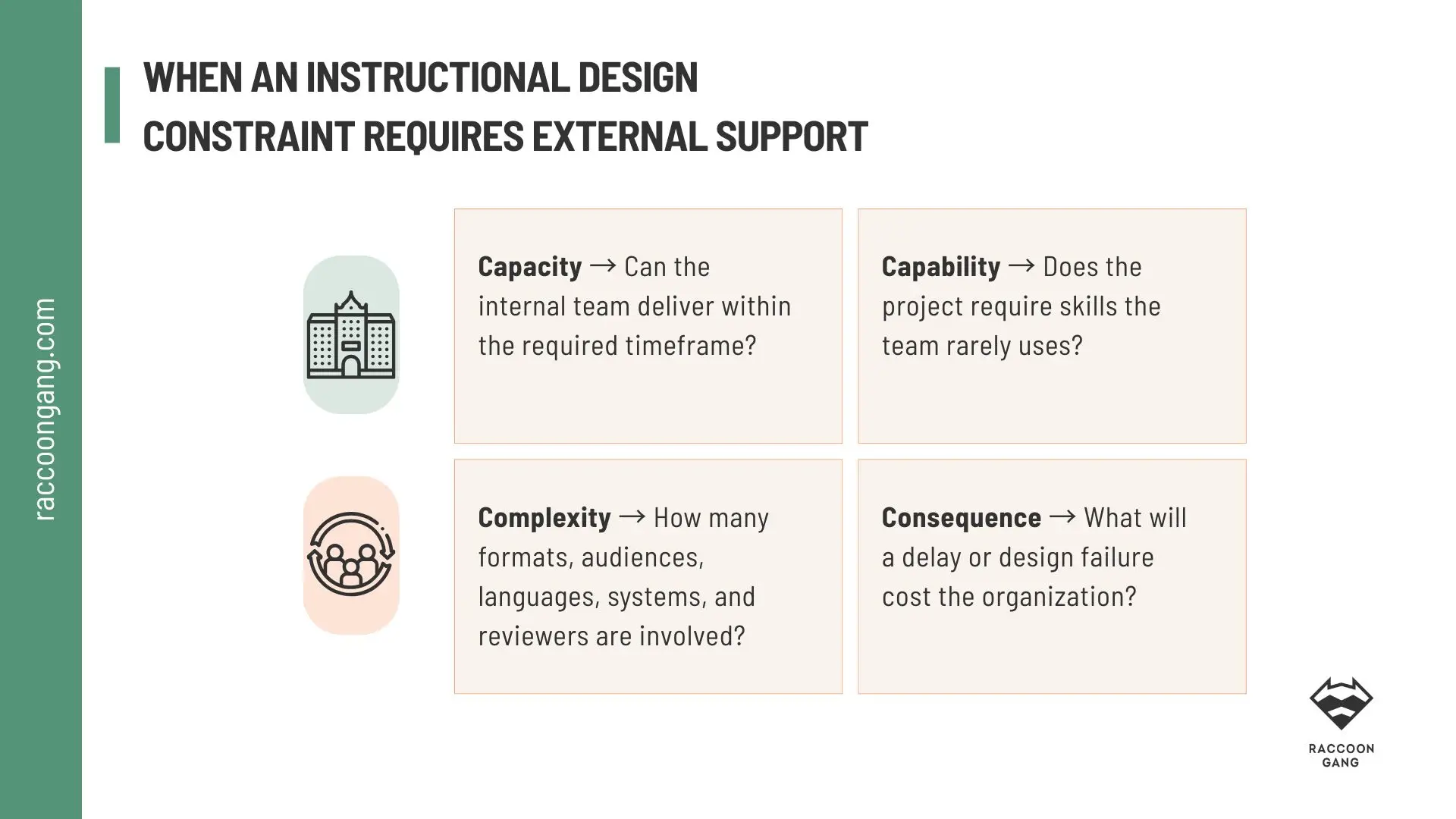
Several overlapping constraints create the strongest case for external support.
Why Instructional Design Becomes a Bottleneck
Most L&D teams carry the same burden on their shoulders. They plan onboarding, update compliance training, manage the LMS, and prepare product enablement at the same time. Every task competes for the same people and deadlines. Something will have to wait — and the backlog is probably full already.
The numbers support these thoughts. In a survey shared by Dr. Philippa Hardman, 38% of instructional designers had turned down work because of capacity constraints. Development and implementation also consumed 37.7% of the average project’s time and budget — the largest share of the workflow.
Four pressures usually slow course delivery:
- Limited capacity. The course backlog grows faster than the team can handle it.
- Competing priorities. Product launches, onboarding cycles, and compliance updates create uneven demand.
- SME dependency. Delayed input or sign-off can stop storyboards, assessments, scripts, and production.
- Rapid content requests. Fixed deadlines leave little time for design, development, review, and QA.
Consider the impact. HR needs onboarding before the next hiring cycle. Compliance faces a regulatory deadline. Sales expects product training before launch.
An instructional design agency can run parallel workstreams, create reusable templates, support multimedia production, and apply structured QA across a large course portfolio.
An instructional design contractor can add temporary specialist or production capacity under the internal team’s governance. In both models, the L&D team should retain SME access, business priorities, risk ownership, and final approval.
What Is Instructional Design Outsourcing?
Instructional design outsourcing means assigning part or all of a learning project to an external specialist or agency. Instructional design agencies and contractors help organizations execute their L&D plans. Many teams have used external support to close skill or capacity gaps. In practice, you can choose one of three engagement models for instructional design outsourcing:
- Project-based outsourcing. A provider manages a specific project. The client provides SME input and approves the work on time.
- Dedicated instructional design support. External specialists join the internal L&D team. The internal lead sets priorities and manages the work.
- End-to-end development. A partner handles the entire project, from needs analysis and storyboards to multimedia, localization, accessibility, QA, and LMS delivery.
“As corporate e-learning grows, organizations cannot hire every specialist in-house. E-learning outsourcing gives them access to instructional designers, developers, multimedia experts, and QA professionals when projects demand those skills.”
— Sergiy Movchan, Co-founder & eLearning Strategist at Raccoon Gang
Based on Raccoon Gang’s experience as an LMS developer and instructional design partner, a hybrid model often provides the right balance. The external team manages production, while the client retains business context, risk ownership, and final approval.
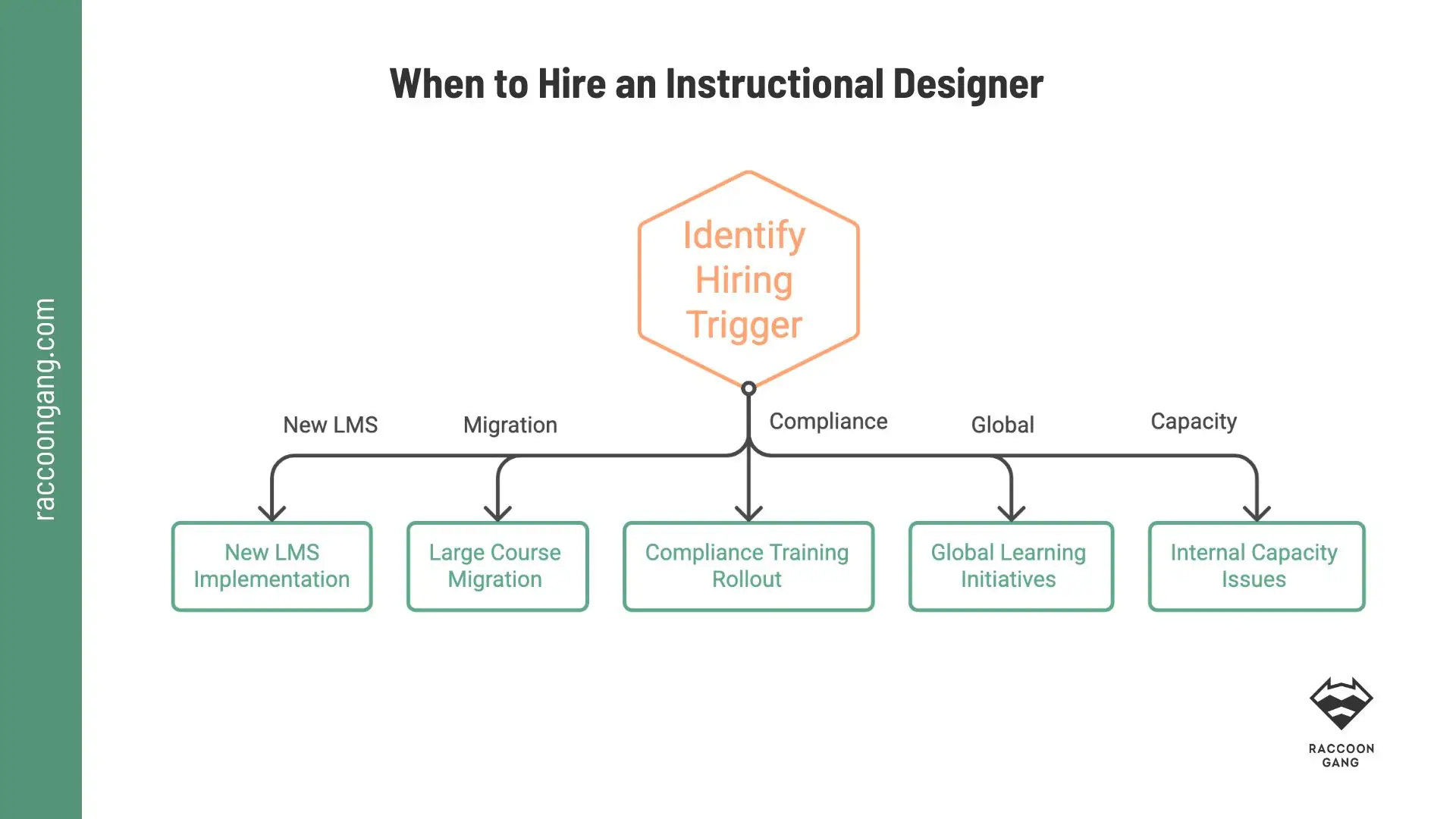
Multiple triggers may justify outsourced instructional design support.
When to Hire an Instructional Designer
So when should you hire an instructional designer? Bring one in when your project needs more than content uploaded to an LMS. This may include learning architecture, measurable objectives, assessments, accessibility, or a repeatable production process.
Five scenarios often justify that decision:
- New LMS implementation. Hire before teams finalize course templates, assessment rules, and publishing standards. Early decisions affect every course that follows.
- Large course migration. A designer can audit outdated materials, define migration priorities, standardize templates, and prevent teams from transferring weak legacy courses unchanged.
- Compliance training rollout. External expertise helps when the program requires repeatable updates, audit-ready records, scenario-based assessments, and clear review controls.
- Global learning initiatives. Multiple regions require localization workflows, accessibility checks, consistent learning goals, and parallel production across languages.
- Internal capacity issues. Staff augmentation works when strategy remains in-house, while the team needs temporary support with production, psychometrics, program management, or learning technology.
One warning from the research matters here: an instructional designer cannot fix delayed SME input or slow internal approvals. Keep stakeholder alignment, risk ownership, SME access, and final sign-off inside the organization.
Signs Your Organization Should Outsource Instructional Design
Are there signs that you should ask for help and bring in extra support while there is still time to deliver the course on schedule? The good news is yes. Use this checklist before the next course request enters an already crowded roadmap.
- Deadlines keep slipping. Storyboards, reviews, development, or QA regularly finish later than planned.
- SME reviews stop production. Designers spend days waiting for expert input, corrections, or approval.
- Course completion rates remain low. Learners leave before finishing, while assessments show weak knowledge retention.
- Demand has increased quickly. A merger, product launch, hiring cycle, or LMS rollout has created more work than the team can absorb.
- Specialist skills are missing. The project requires simulations, multimedia, accessibility, localization, psychometrics, or LMS expertise.
- The course backlog keeps growing. New requests arrive faster than the team clears existing work.
- Quality varies across courses. Different templates, assessment methods, and review processes create an inconsistent learner experience.
- Internal specialists spend most of their time producing assets. Strategic work, learner analysis, and stakeholder planning receive less attention.
Several checked boxes point toward instructional design outsourcing, usually through a hybrid model. Still, external support cannot repair unclear ownership or unavailable SMEs. Keep priorities, SME access, risk decisions, and final approval inside the organization; outsource the production or specialist constraint.
Benefits of Outsourcing Training and Instructional Design
A few paragraphs earlier, we saw that there are situations where whether to outsource is no longer the question. If the answer is yes — and we need to outsource at least part of the learning project — what results can we expect?
Here is more good news. The benefits of outsourcing training are tangible enough to show decision-makers why this step makes business sense.
Below are the main benefits of outsourcing training:
Faster Development and Flexibility
Several workstreams progress at once. Instructional designers prepare storyboards. E-learning developers build modules. QA specialists review completed materials.
Organizations gain access to every necessary skill without hiring. They can work with accessibility experts, video producers, LMS engineers, or localization teams without making permanent commitments.
“Across our LMS and instructional design projects, we have found that outsourcing works best when it adds the exact expertise or capacity the internal team lacks—not when it removes the client from the process.”
— Sergiy Movchan, Co-founder and eLearning Strategist at Raccoon Gang
An external team can also expand capacity during demand peaks, such as an LMS migration, compliance rollout, or product launch.
More Predictable Project Costs
Project costs become easier to forecast. A defined scope, delivery schedule, and pricing model give L&D leaders a clearer budget.
Consistent Quality Across Courses
An experienced partner applies established templates, design standards, review controls, and QA processes that reduce variation across courses and language versions, if needed.
Faster Access to Expertise
An external partner’s previous project experience reduces the time and risk involved in testing new approaches internally.
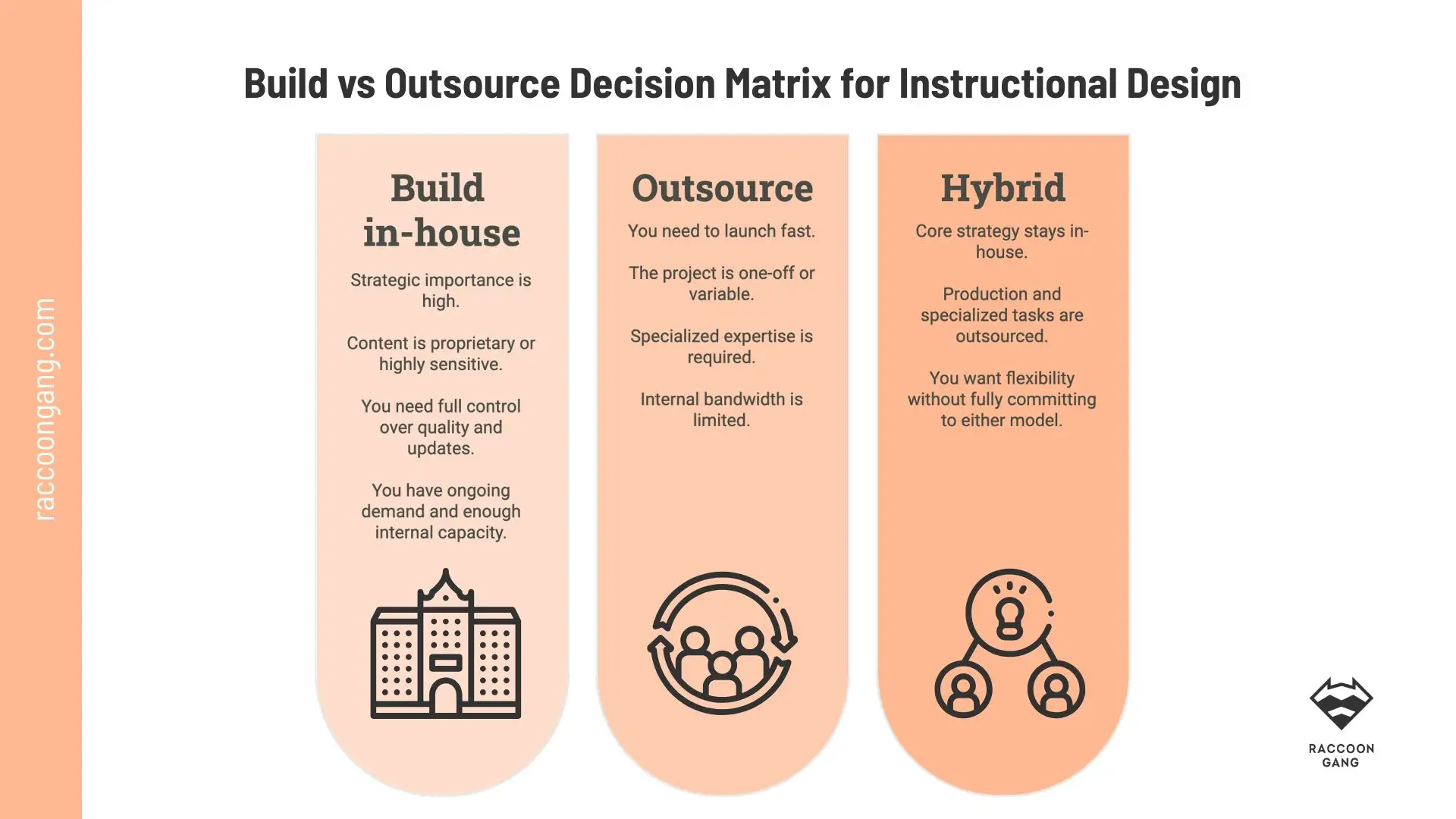
Hybrid delivery protects internal strategy while expanding production capacity.
In-House vs Outsourced Instructional Design
The choice depends on where the constraint sits. Internal teams offer business context and direct control. External teams add capacity, specialist skills, and managed production.
| Area | In-House Team* | Outsourced Team** |
| Cost | Fixed salaries and tools make sense for steady workloads. Idle capacity still costs money. | Converts fixed headcount into project-based spending. Scope changes may increase the budget. |
| Expertise | Strong knowledge of internal processes, learners, and business goals. Expertise depends on available hires. | Provides access to accessibility, localization, multimedia, assessment, LMS, analytics, and XR specialists. |
| Speed | Handles small updates quickly. Competing priorities can delay larger projects. | Runs design, development, localization, and QA in parallel. Reviews and approvals still require client time. |
| Scalability | Scaling requires recruitment, onboarding, and more management capacity. | Adds production capacity across courses, languages, regions, and launch waves. |
| Flexibility | Responds faster when content or priorities change frequently. | Adjusts team size and specialist roles as project demand rises or falls. |
| Capacity | Works well when demand remains stable and the team has enough bandwidth. | Handles backlogs, product launches, migrations, and other temporary workload peaks. |
| SME Access | Maintains direct access to experts and institutional knowledge. | Depends on structured SME interviews, review windows, and timely client input. |
| Strategic Control | Retains full ownership of learning strategy, priorities, and performance goals. | Requires clear governance, defined responsibilities, and final client approval. |
| Quality and QA | Quality depends on internal standards, tools, and available review time. | Applies repeatable templates, review controls, accessibility checks, and technical QA across the portfolio. |
| Content Changes | Better for “live” content that changes weekly or requires immediate updates. | Better for defined scopes, controlled review cycles, and repeatable production. |
| Data and IP Risk | Best for sensitive data, proprietary methods, and competitive knowledge. | Works when NDAs, data controls, access restrictions, and source-file ownership protect the organization. |
* Rely on in-house teams when you need context, control, and frequent updates.
** Rely on outsourced teams when you need more capacity, specialist expertise, and large-scale delivery.
Instructional Design Agency vs Contractor
Choosing between an instructional design contractor and an instructional design agency, we recommend starting with one answer: Can one specialist complete the work, or does the project require a coordinated team with broader capacity and built-in QA? Because a contractor supports only defined tasks. On the other end of the scale is an instructional design company that can manage several workstreams at scale.
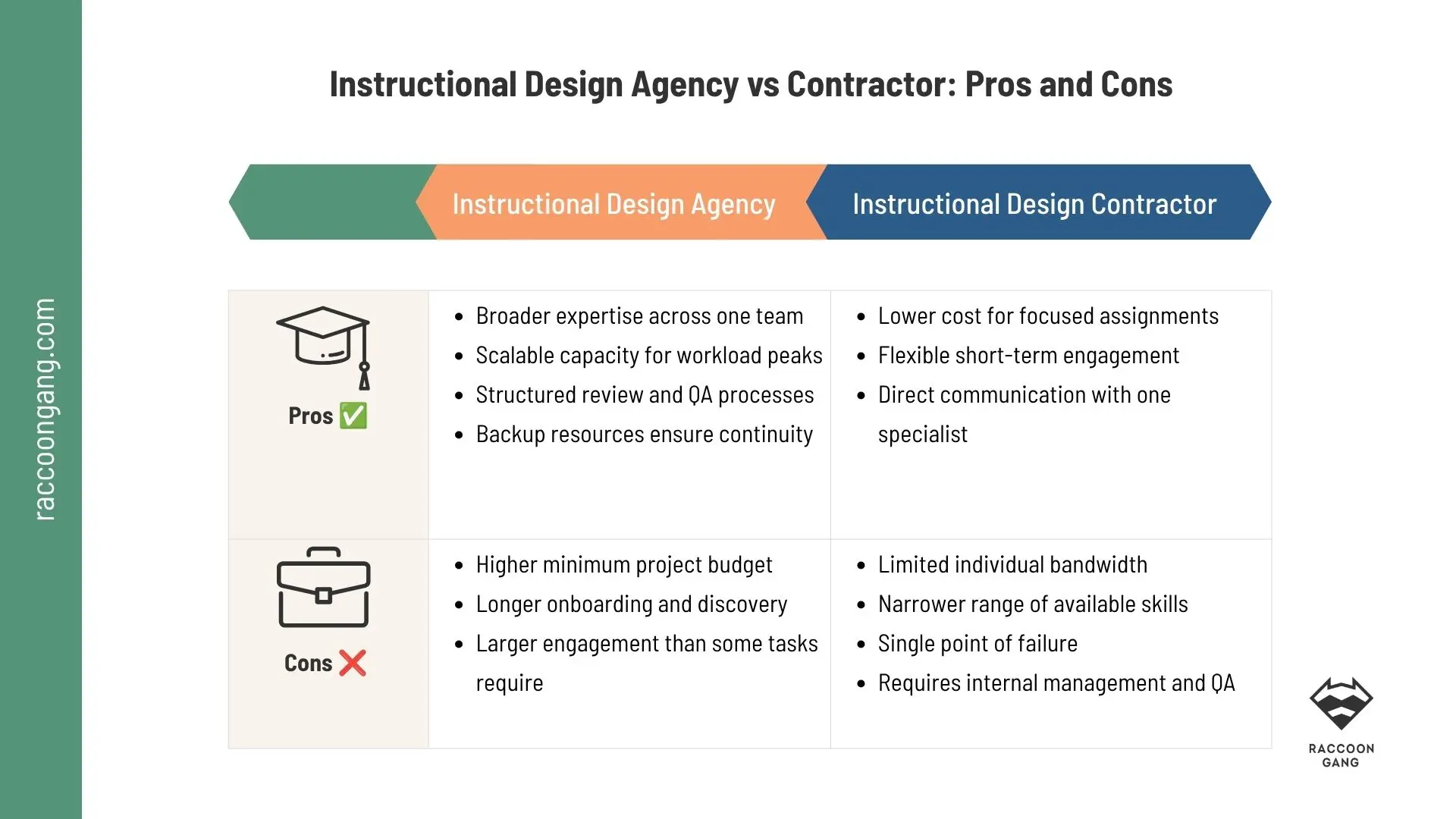
Contractors fit focused tasks; agencies reduce risk across complex programs.
Outsourcing eLearning Development
An eLearning outsourcing partner may handle:
- Learning needs analysis
- Instructional design
- Course development
- Storyboards and video scripts
- Multimedia production
- Assessments and interactive activities
- Accessibility adaptation
- Content localization
- Course testing and QA
- LMS setup and configuration
- Course migration and publishing
- LMS deployment and integrations
How to Scale Instructional Design Without Hiring Full-Time Staff
To scale instructional design, you do not need to build every capability in-house. External support lets you increase production capacity during busy periods while keeping strategy, SME relationships, and approvals within your L&D team.
| Project-Based Support* | Hybrid Staffing Mode** | Specialist Augmentation*** | |
| How It Works | An external team delivers a defined course, curriculum, or migration within an agreed scope, budget, and timeline. It can manage design, development, QA, and LMS publishing. | Internal leaders control priorities and learning strategy, while an external team supports recurring production. Capacity can increase or decrease as the course backlog changes. | Selected experts join the internal workflow to close a specific capability gap. These may include accessibility specialists, e-learning developers, localization teams, assessment experts, or LMS engineers. |
| Best Fit | Compliance rollouts, onboarding programs, LMS migrations, and projects with fixed deadlines. | Ongoing learning programs, uneven workloads, and organizations that need dependable support without permanent headcount. | Projects that the internal team can manage but cannot complete with its current skill set. |
* Choose hybrid staffing for changing demand.
** Choose project-based support for a defined outcome.
*** Choose specialist augmentation for a specific expertise gap.
How to Evaluate Instructional Design Services
One team can manage learning strategy, content production, LMS implementation, and QA across complex programs.
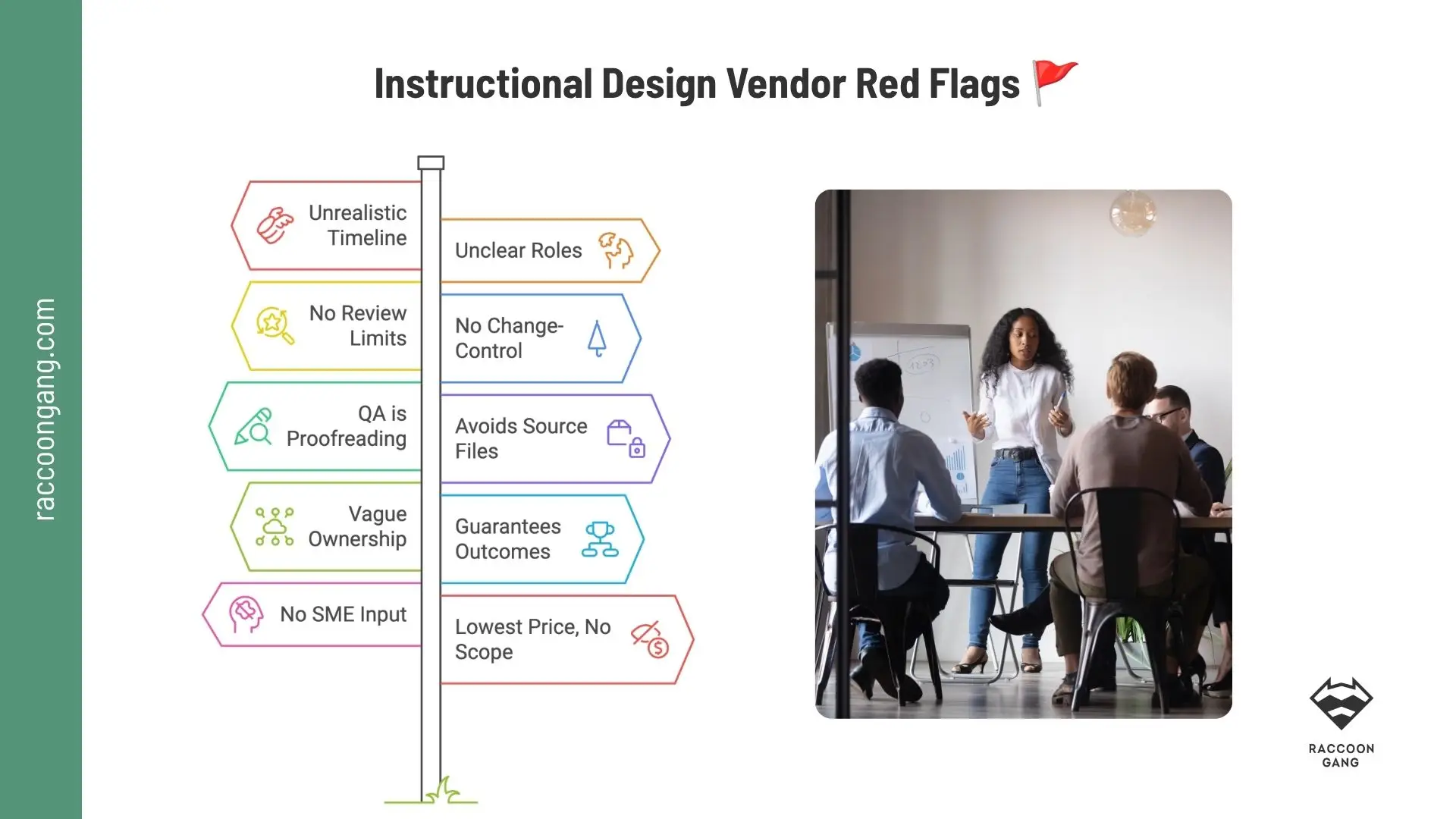
Unclear governance often creates more risk than limited vendor expertise.
Ask providers these six questions:
- Have they delivered similar projects at comparable scale?
- Do they understand your industry, learners, and compliance needs?
- Can they design, test, and publish within your LMS?
- Does their portfolio show objectives, activities, assessments, and accessibility?
- Who checks accuracy, accessibility, functionality, and LMS performance?
- Can they scale teams without disrupting delivery?
- Will you receive source files and reuse rights?
- How will they measure behavior and business outcomes?
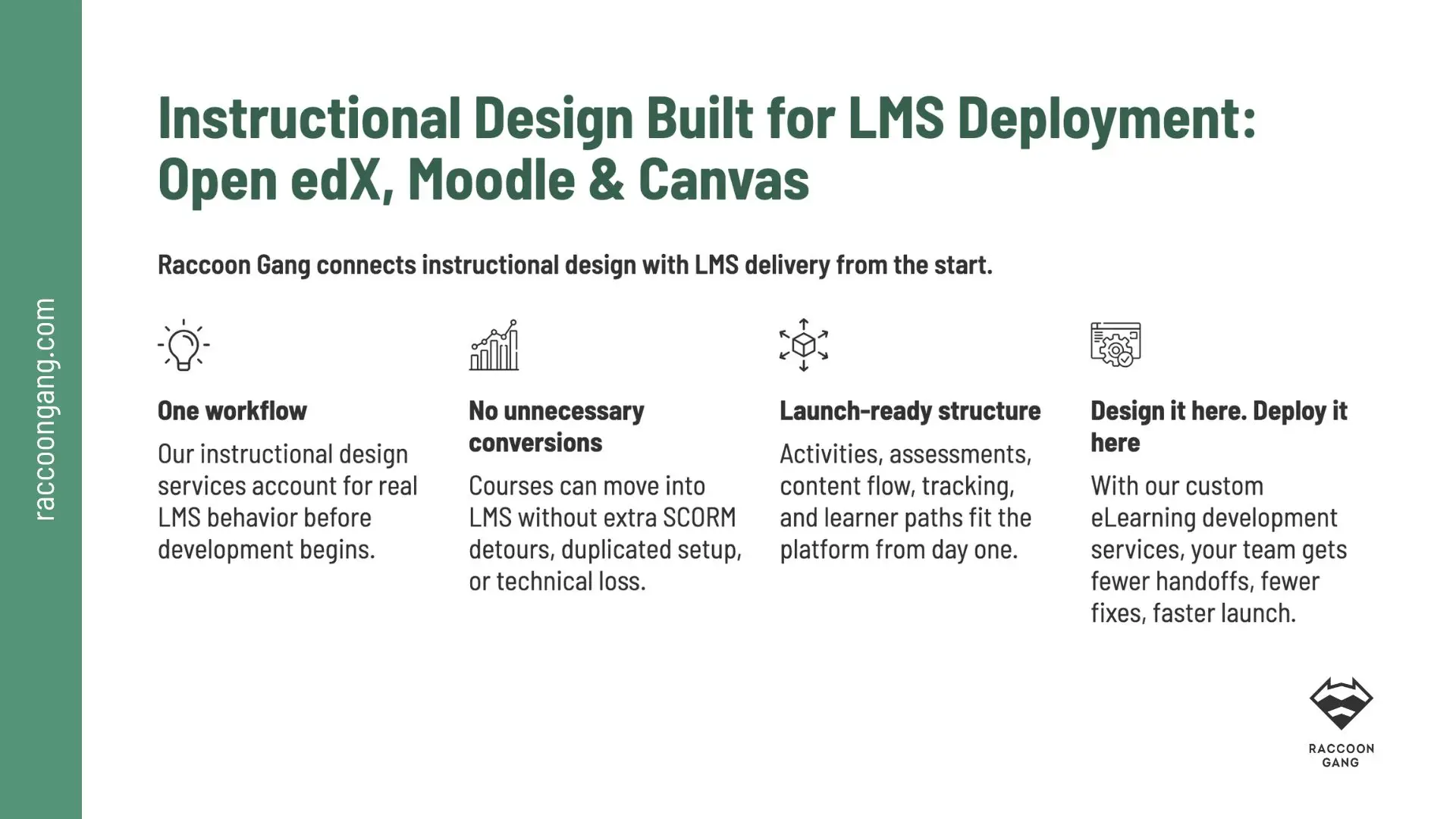
Designing for the target LMS reduces rework before launch.
How Raccoon Gang Supports Instructional Design Projects
Raccoon Gang provides instructional design services for a specific project stage or the complete process — from learning analysis to course deployment. Organizations can outsource instructional design when they lack internal capacity, specialist skills, or LMS expertise.
“Across more than 200 projects, Raccoon Gang has worked on both LMS development and instructional design. When we build a platform, we consider how courses and assessments will work within it. When we develop content, we account for the LMS features and technical requirements. This helps the platform and learning content work together from launch.”
— Sergiy Movchan, Co-founder and eLearning Strategist at Raccoon Gang
Over 150 professionals work on our team. They implement and configure Open edX, Moodle, and Canvas platforms. Their work may include integrations, course migration, and user role setup. They also support testing, publishing, and launch. Among our finished projects are an online course for NASA, E-Learning Modules for EBRD and more.
Conclusion: Choose What to Outsource
Of course, outsourcing instructional design is not a cure for every L&D challenge. At the same time, instructional design outsourcing will not ruin your plans for creating courses or learning modules. More often, the opposite happens.
| Project situation | Recommended model |
| Routine course update with available staff | Keep in-house |
| Strong internal strategy, limited production capacity | Hybrid |
| Multilingual certification program with a fixed launch date | Outsource |
| Specialized simulation needed for one program | Outsource the specialist work |
| Continuous course demand with stable volume | Build internal capability |
| Temporary content backlog or LMS migration | External team extension |
In any case, you can choose one of these approaches:
- Keep the work in-house
- Use a hybrid model
- Outsource the entire project
- Outsource specialist work
- Build internal capabilities
- Extend your team with external experts
FAQ
When should you outsource instructional design?
Deadlines are already slipping. Course backlogs keep growing. Specialist gaps are slowing delivery. Outsource before schedules fail.
What are the benefits of instructional design outsourcing?
Delivery will move faster. Specialists will improve course quality. Hiring risks will remain lower. Budgets will become more predictable.
How much do instructional design services cost?
Rapid 15–20-minute modules: $2,500–$8,000. Standard 30-minute modules: $3,300–$15,800. Interactive 60-minute courses: $10,000–$40,000+. Production: 40–400 hours; timelines: 3–5 weeks.
Should I hire an instructional design contractor or agency?
Contractors have handled focused tasks. They have kept costs lower. Agencies have managed broader programs. They have added scale and QA.
How do I choose an instructional design partner?
1. Define scope and success metrics. 2. Shortlist proven providers. 3. Check industry and LMS expertise. 4. Review QA and ownership terms. 5. Confirm capacity, timing, and costs.



- Why Instructional Design Becomes a Bottleneck
- What Is Instructional Design Outsourcing?
- When to Hire an Instructional Designer
- Signs Your Organization Should Outsource Instructional Design
- Benefits of Outsourcing Training and Instructional Design
- In-House vs Outsourced Instructional Design
- Instructional Design Agency vs Contractor
- Outsourcing eLearning Development
- How to Scale Instructional Design Without Hiring Full-Time Staff
- How to Evaluate Instructional Design Services
- How Raccoon Gang Supports Instructional Design Projects
- Conclusion: Choose What to Outsource