





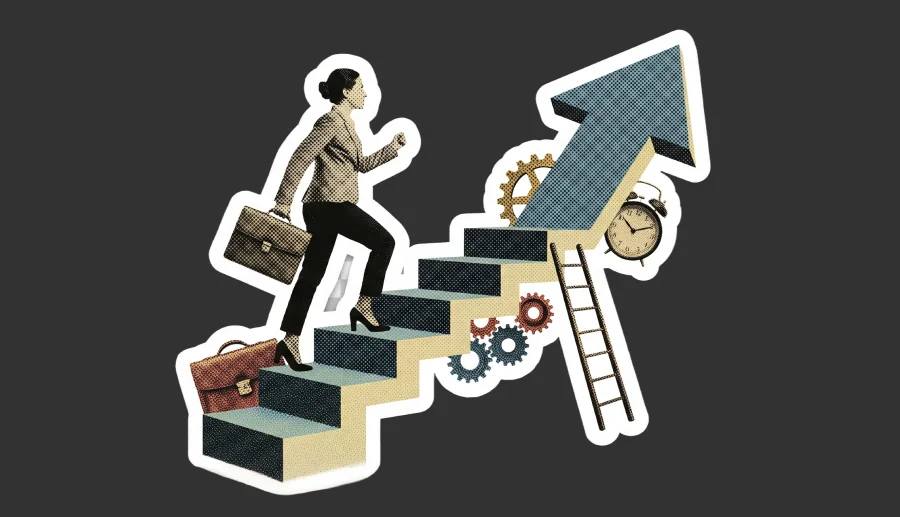
An LMS for upskilling and reskilling gives enterprises the infrastructure to close skills gaps at scale. It includes competency frameworks, personalized learning paths, skills tracking, and analytics tied to real business outcomes. This gives leadership teams clear, specific evidence of skills progress.
Key Takeaways:
- Upskilling goes deeper in a current role, while reskilling moves someone into a different one entirely.
- The World Economic Forum expects 39% of core workforce skills to shift or vanish by 2030.
- 63% of employers name skills gaps as their top transformation barrier.
- Competency frameworks and skills tracking matter more here than the size of the course catalog.
- Companies with strong internal mobility roughly double employee tenure.
- Platform choice comes down to fit with a company’s tech stack, scale, and HR data flow.
An LMS for upskilling and reskilling is a learning platform built around competency frameworks, skills tracking, and personalized learning paths. It compares what employees can already do against what the business needs, then routes people toward the specific skills that close that gap. Assessments and analytics confirm whether the training worked.
What Is Upskilling?
Upskilling means teaching employees new capabilities within a role they already hold. For instance, a marketing analyst picking up advanced data visualization or a support rep learning product knowledge for a line that just launched.
The goal is depth within the same role. Someone gets better at what they do, and that often qualifies them for more responsibility inside the same job family.
What Is Reskilling?
Reskilling prepares an employee for a genuinely different role, with a new set of core responsibilities.
A warehouse associate training to become a logistics coordinator, say. Or a customer service rep transitioning into a data analyst position as automation handles routine tickets. Overall, reskilling supports internal mobility and workforce transformation. It’s usually the response when a role is shrinking, changing shape, or disappearing outright.
Difference Between Upskilling and Reskilling
The distinction matters for how a company designs its learning strategy. Getting it right upfront — matching the strategy to whether a role is deepening or genuinely changing — saves a lot of rework down the line.
| Upskilling | Reskilling | |
| Goal | Deepen existing capabilities | Prepare for a different role |
| Audience | Employees staying in their current role | Employees facing role change or displacement |
| Learning Path | Advanced or specialized modules in a known domain | Foundational training in a new domain |
| Outcome | Greater expertise, expanded responsibility | Successful transition into a new position |
Both strategies typically run on the same LMS, often for the same workforce at different points in their career.
Why Upskilling and Reskilling Matter
Why upskilling and reskilling is important starts with one simple fact: what a job requires keeps changing. Digital transformation is the main driver — the tools and processes behind “doing the job well” shift faster than most job descriptions get updated to match them. Automation adds to that shift directly, taking over routine tasks across nearly every function and pushing the value of human work toward judgment and oversight, the parts machines still can’t handle.
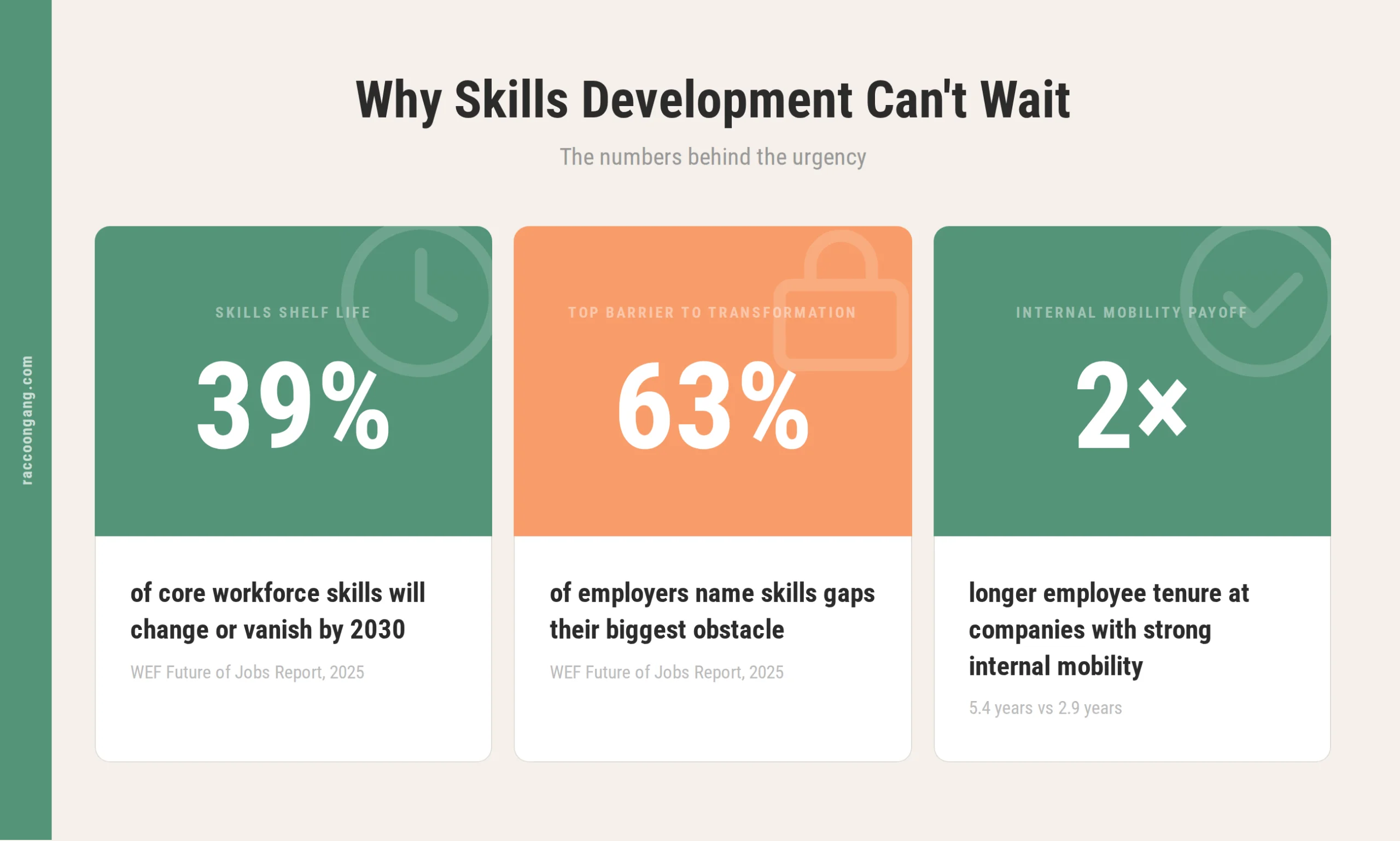
That changing skill landscape creates a hiring problem. Specialized and emerging skills are hard to find on the open market, which makes external recruiting for them slow and expensive. Growing those skills inside the company becomes the more practical option, and it comes with a side benefit: companies with strong internal mobility keep employees roughly twice as long — 5.4 years versus 2.9, a pattern we’ve written about in more depth around employee retention through training.
The data shows how widespread this pressure already is. The World Economic Forum’s 2025 Future of Jobs Report puts 39% of core workforce skills at risk of changing or becoming obsolete by 2030, and 63% of employers already name skills gaps their single biggest barrier to transformation. At that scale, closing skills gaps stops being a routine HR task and becomes a business priority with its own budget line.
The benefits of upskilling and reskilling follow directly from that shift: lower hiring costs, faster time-to-productivity for employees moving into new skills, and a workforce that can execute whatever strategy leadership sets.
What Is an LMS for Upskilling and Reskilling?
An LMS for upskilling and reskilling is built around a different question. A standard LMS asks whether the employee completed the course. This one asks whether the employee has the skill now.

That distinction drives the architecture:
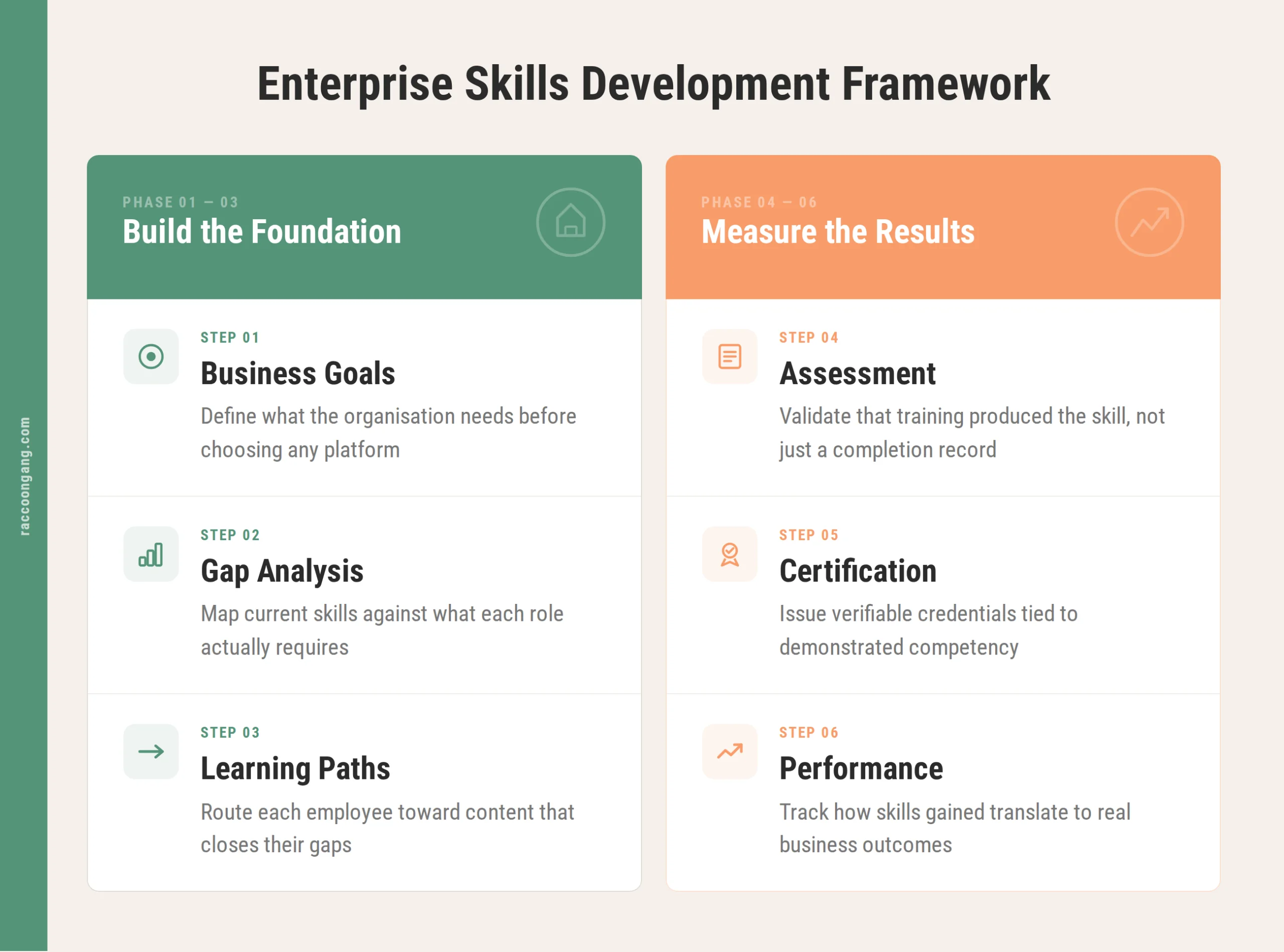
- Personalized learning routes each employee toward content relevant to their specific skill gaps.
- A competency framework defines what skills a role requires, at what proficiency level, so training has a target to aim at.
- Skills tracking maintains a live record of what each employee can do, updated as they complete training or demonstrate competency on the job.
- Assessments validate that a skill was gained through the training.
- Certifications give both the employee and the business a documented, portable record of what was achieved.
If organizations skip these pieces, their LMS can still run training just fine. It just can’t manage skills. This is usually the gap we help close first when a company wants their existing LMS to support skills development.
LMS Features That Support Skills Development
In our implementation work, a handful of capabilities consistently separate a skills-focused LMS from a generic course-delivery tool.
- Learning paths. Sequences of content mapped to a specific competency or career track, adjusting automatically as an employee completes prerequisites or demonstrates existing proficiency.
- Skill assessments. Pre- and post-training evaluations that measure actual capability.
- AI recommendations. Systems that suggest the next relevant course or learning path based on an employee’s role, current skill profile, and stated career goals — the same personalization logic that shows up in modern LXP platforms, increasingly built into LMS platforms directly.
- Certifications. Verifiable, often shareable credentials tied to demonstrated competency, a step up from a simple attendance record.
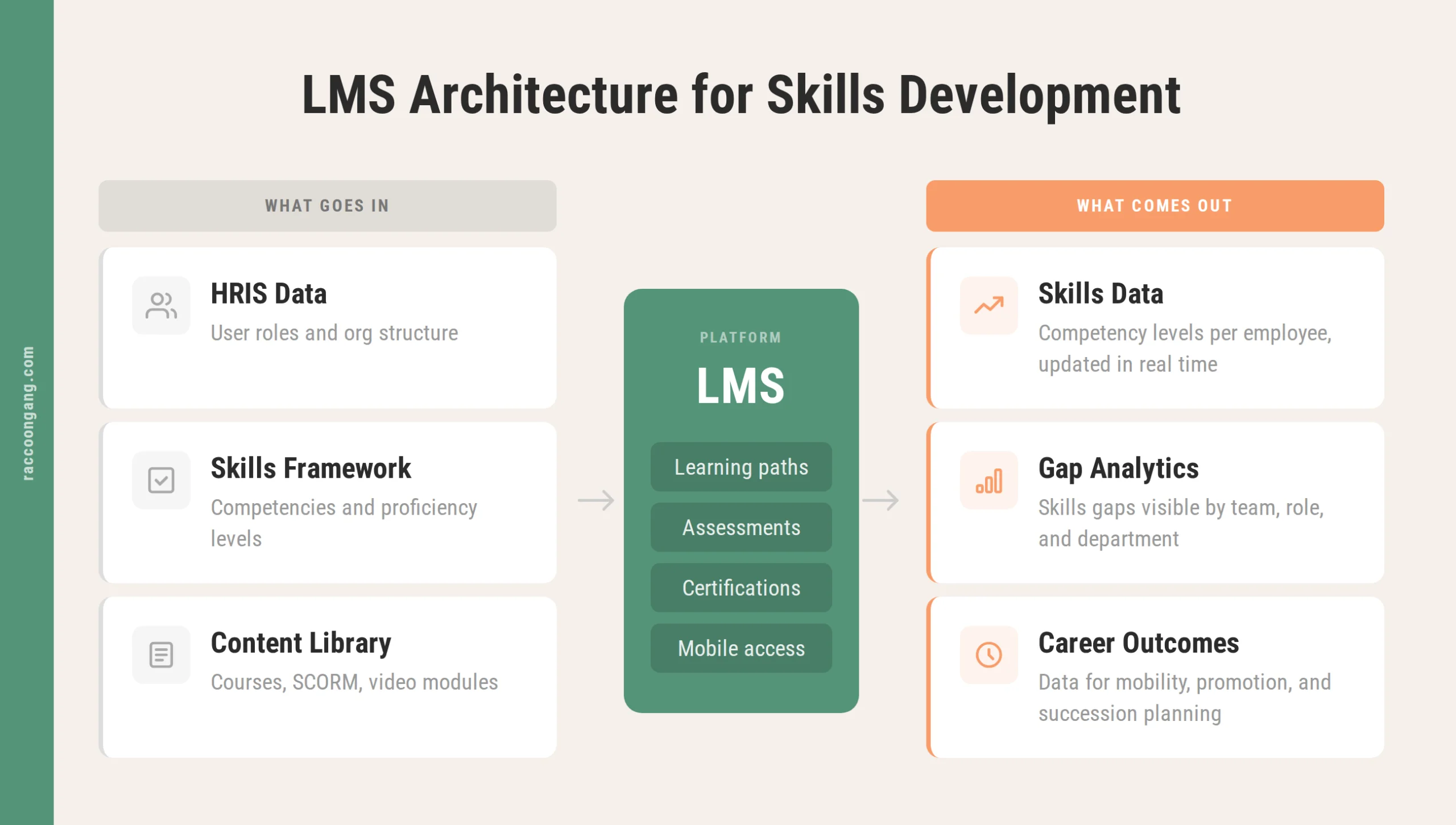
- Analytics. Skills-level reporting that shows gaps by team, department, or role. This is the data layer that lets L&D measure training ROI with real numbers.
- Competency management. A structured taxonomy of skills and proficiency levels that the rest of the platform’s features plug into. Without this, learning paths and assessments have nothing to organize around.
- Integrations with HR systems. Two-way data flow with the HRIS, so skills data informs performance reviews, succession planning, and internal mobility decisions, escaping the separate silo it usually lives in.
Employee Upskilling Programs
A few patterns show up repeatedly across upskilling programs we’ve seen work well.
- Leadership development builds management and strategic thinking skills in employees already succeeding in individual contributor roles.
- Technical training keeps engineering, IT, and product teams current as tools and frameworks evolve.
- Digital skills programs — often the fastest-growing category right now — cover everything from basic data literacy to working effectively alongside AI tools.
- Sales enablement keeps go-to-market teams current on product knowledge, competitive positioning, and evolving buyer behavior.
The content behind these programs matters as much as the platform delivering it. A learning path built on outdated or generic material won’t close a real skill gap, no matter how good the personalization engine is. Instructional content design is usually the actual bottleneck in these projects.
Employee Reskilling Initiatives
Reskilling programs tend to cluster around three business triggers.
- Career transitions happen when an employee’s current role is shrinking or has changed enough that their existing skill set no longer fits it well.
- Internal mobility programs proactively train employees for open roles elsewhere in the organization, reducing external hiring costs and time-to-fill.
- Organizational restructuring — mergers, automation rollouts, business model shifts — often creates the most urgent reskilling need, since entire job categories can change shape within a single fiscal year.
Overall, there’s one common thread across all three: reskilling works best when it starts early, before the role disappears entirely.
Best LMS Platforms for Upskilling and Reskilling
No single platform wins across every dimension here. The right fit depends heavily on existing tech stack, team size, and how deep the competency management needs to go.
- Moodle offers strong customization and a mature plugin ecosystem. Good fit if you want to build a highly specific skills framework of your own, and have the technical bandwidth to maintain it.
- Open edX brings similar openness with a stronger track record for large-scale, multi-audience deployments — Raccoon Gang has implemented it specifically for organizations running training across tens of thousands of learners.
- Canvas leans on usability and a genuinely intuitive interface, covered in more detail in our breakdown of Canvas for corporate training. Competency management is typically built out through integration.
- Docebo ships with AI-driven content recommendations and a skills management module aimed specifically at this use case.
- Cornerstone brings deep talent management integration. Makes the most sense for organizations already running Cornerstone for performance reviews and succession planning.
- SAP SuccessFactors integrates tightly with broader HR and talent systems, mainly a fit for enterprises already inside the SAP ecosystem.
- 360Learning focuses on collaborative, peer-driven learning. Works well where subject matter experts inside the business are already a primary source of training content.
Personalization, analytics depth, competency management maturity, integration flexibility, scalability — all of it varies meaningfully across this list. None of these platforms is the obvious answer for every organization. Matching the platform to the actual skills strategy matters more than a review-site ranking ever will.
How to Choose an LMS for Workforce Development
Worth running through this checklist before shortlisting vendors:
- Competency frameworks — can the platform model skills and proficiency levels natively, or does that need to be built through customization?
- Learning analytics — does reporting show actual skill-gap visibility by team or role?
- AI recommendations — how well does the personalization engine match content to individual skill gaps, versus surfacing generic “popular courses” suggestions?
- Integrations — does it connect cleanly to the HRIS, so skills data actually feeds performance and succession planning?
- Reporting — can leadership see skills-gap trends at a business-unit level?
- Scalability — does the platform hold up across multiple business units, regions, or thousands of learners without a costly re-architecture down the line?
Most vendor demos answer these questions well enough in the room. Real competency data and real org complexity are the true test, which is why a pilot group before signing anything tends to pay off, a step covered in more detail in our guide to the training design process.
Common Mistakes
Even a genuinely good LMS platform depends on the strategy behind it. A few patterns are worth watching for when building a skills development program.
- Focusing only on course completion treats training as the goal, when it’s really just the mechanism. Skill-level outcomes need their own tracking to show whether gaps are closed.
- Ignoring business skills gaps can happen when training content gets built mainly around what’s available or popular. Checking it against actual performance and hiring data early on keeps it grounded in what the business specifically needs.
- Skipping a competency framework leaves the whole system without a target, so learning paths end up ad hoc, well short of mapping to defined proficiency levels.
- Static learning paths that never adjust to what an employee already knows waste time, and tend to get tuned out as busywork over time.
Each of these is easy to plan around from the start. None of them gets solved by switching platforms alone — they’re strategy decisions the LMS can support, but the strategy has to come first.
How Raccoon Gang Helps Organizations Build Skills Development Platforms
Skills-based learning platforms are one of the areas our team gets pulled into most often — usually once a company has already outgrown a generic course-delivery setup. The work typically covers:
- LMS consulting — evaluating whether a company’s current platform, or a new one, can support competency-based learning at the scale the business needs.
- Platform implementation — building out Open edX, Moodle, or Canvas instances architected around real competency frameworks.
- Competency-based learning design — structuring skills taxonomies and proficiency levels that learning paths and assessments plug into directly.
- Instructional design — building the content itself, since a well-architected LMS with generic courses still won’t close a real skills gap.
- Analytics — connecting skills data to dashboards that show leadership where gaps exist by team, role, or business unit.
- HR integrations — linking the LMS to HRIS and talent management systems so skills data informs promotion, mobility, and succession decisions.
Raccoon Gang has delivered more than 200 LMS projects for customers and partners across corporate and education sectors. Competency-based learning design has become one of the most common requests among them lately.
Conclusion
Skills development is a continuous process. Skill requirements keep shifting, so the work keeps going along with them.
An LMS for upskilling and reskilling gives that process the infrastructure to scale: competency frameworks, personalized paths, and analytics that connect training to real business outcomes. Getting the most from that infrastructure starts with aligning the technology choice to actual business capability needs first, a principle worth revisiting alongside general LMS best practices before any platform decision gets finalized.
FAQ
What is the difference between upskilling and reskilling?
Upskilling deepens an employee’s capabilities within their current role. Reskilling prepares them for a different role, often in response to automation, restructuring, or a shrinking job category.
What is an LMS for upskilling and reskilling?
It’s a learning platform built around competency frameworks, skills tracking, and personalized learning paths to help organizations close specific skill gaps.
Why is upskilling important for organizations?
Skills gaps are now a major barrier to business transformation, with nearly 40% of core workforce skills expected to change by 2030. Upskilling helps existing talent develop the capabilities the business needs.
What features should an LMS have for workforce development?
Key features include competency management, personalized learning paths, skill assessments, AI-driven recommendations, certifications, skills-level analytics, and HRIS integrations. These capabilities often matter more than a large course catalog alone.
Which LMS platforms are best for upskilling and reskilling?
Moodle, Open edX, Canvas, Docebo, Cornerstone, SAP SuccessFactors, and 360Learning each offer different approaches to personalization, integration, and scalability. The right choice depends on the organization’s systems and competency management needs.



- Key Takeaways:
- What Is Upskilling?
- What Is Reskilling?
- Difference Between Upskilling and Reskilling
- Why Upskilling and Reskilling Matter
- What Is an LMS for Upskilling and Reskilling?
- LMS Features That Support Skills Development
- Employee Upskilling Programs
- Employee Reskilling Initiatives
- Best LMS Platforms for Upskilling and Reskilling
- How to Choose an LMS for Workforce Development
- Common Mistakes
- How Raccoon Gang Helps Organizations Build Skills Development Platforms
- Conclusion