






Technical training does not usually fail because the subject is too complex. It fails when nobody translates that complexity into a sequence built around actual performance. Instructional design for technical training is essential to ensure that technical information is delivered in a way that promotes true understanding and real-world application.
TL;DR
Technical training fails less because the material is difficult and more because experts no longer see the places where a learner becomes confused. Good instructional design converts expert knowledge into tasks, decisions, practice, feedback, and reference material that people can use during actual work.
Key Takeaways
- Technical expertise and instructional design expertise are separate skills. Complex programs usually need both.
- Job task analysis belongs before technical course development, not after the source material has already been turned into modules.
- Good technical objectives describe observable performance, its conditions, and acceptable criteria.
- SME collaboration works best as structured tacit knowledge extraction, rather than asking experts to write the course themselves.
- Cognitive load theory matters because technical subjects contain many interacting elements that cannot simply be removed.
- A deliberate content chunking strategy, scaffolding, signaling, and realistic practice make difficult material easier to process.
- SCORM 2004 can support structured sequencing, while xAPI can capture learning activity across simulations, applications, job aids, and other environments.
- Raccoon Gang has applied these principles to scientific learning for NASA, investment and policy education for the EBRD, and cybersecurity training environments.
At a Glance
Technical training requires instructional designers to work across two disciplines at once: the domain being taught and the science of how people learn difficult information. The designer does not need to become the senior engineer, researcher, or clinician in the room. They do need enough domain fluency to identify tasks, dependencies, risks, misconceptions, and expert decisions. From there, effective technical training instructional design becomes a practical sequence: analyze the job, define observable performance, extract SME knowledge, divide it into learnable units, design realistic practice, and deliver it through standards and platforms that collect useful evidence.
Why Technical Training Is a Different Design Problem
A generic communication course can survive an imperfect example. A diagnostic procedure, equipment-operation course, or safety module may not. Technical content is often procedural, conditional, and system-dependent. Step B changes according to what happened in Step A. One system state may require remediation; another may require escalation. Experienced practitioners routinely make small decisions they no longer think to explain.
That is the curse of knowledge in practical form.
An experienced network engineer might describe troubleshooting like this:
- Validate connectivity → check routing → inspect policy → remediate.
A novice hears something very different.
Which test comes first? Which output matters? What separates a routing problem from a firewall problem? What result means I should stop and escalate?
This gap is central to technical eLearning design.
The learner group can complicate matters further. The same program may serve a new hire, a practitioner with three years of experience, and a senior specialist learning one unfamiliar system. Sending all three through the same 60-minute information sequence rarely produces the same result.
And the broader transfer problem is already substantial: only 12% of employees apply new skills from training to their jobs. With complex technical material, that gap becomes even more consequential because learners are expected to transfer knowledge into procedures, diagnostic decisions, system configuration, or other work where mistakes have operational consequences.
That is why technical training has to be designed around transfer from the start. Clear expectations, relevant examples, active practice, realistic conditions, and opportunities to apply the skill should be built into the course rather than added after the content is finished.
The same principle appears in broader training-transfer guidance: what happens after a learner leaves the course depends heavily on relevance, practice, expectations, and the connection between learning and actual work.
This also explains the difference between documentation and learner-centered technical content.
Documentation tells people what a system contains. Training prepares them to use it correctly.
Professional instructional designer competencies reflect that broader responsibility. Performance analysis, design, development, implementation, evaluation, and project management all sit around the content itself.
Step 1: Job Task Analysis Before You Design Anything
The first question should not be:
What material do we already have?
Ask:
What must this person actually do after training?
A job task analysis, or JTA, identifies the tasks, decisions, tools, conditions, standards, inputs, outputs, and common failure points involved in performing a role.
Without that analysis, technical training often becomes an inventory of subject matter.
Accurate? Yes. Useful at the moment of performance? Maybe not.
For technical domains, JTA can combine several methods:
- direct observation;
- shadowing experienced practitioners;
- protocol analysis, where experts explain their thinking while completing a task;
- critical incident analysis using successful and failed cases;
- structured interviews with practitioners and supervisors;
- review of SOPs, technical manuals, service tickets, incident reports, audit findings, and system logs.
The output should be a task inventory, critical decisions, performance conditions, common errors, and the gap between current and required performance.
Example: training a network engineer
A content-first outline might look like this:
- Routing
- DNS
- Firewalls
- Monitoring
- Incident management
All relevant.
Still not a task.
JTA may reveal the real workflow:
- Confirm the reported symptom.
- Establish the affected scope.
- Test local connectivity.
- Check name resolution.
- Inspect routing.
- Validate relevant security controls.
- Isolate the failing layer.
- Apply the permitted remediation.
- Verify restoration.
- Document or escalate the incident.
Now the course has a performance spine.
Routing theory appears because a job decision requires it. Firewall logic appears at the point where the learner needs to distinguish one failure from another. Assessment can reproduce that same chain.
That is the difference between organizing information and procedural knowledge training design.
The principle extends directly into instructional design for engineering training, clinical systems, manufacturing operations, software certification, energy, aerospace, and other environments where competence means performing correctly under defined conditions.
Raccoon Gang uses the same performance-first logic in its broader training design process: identify the performance problem before deciding what content belongs in the course.
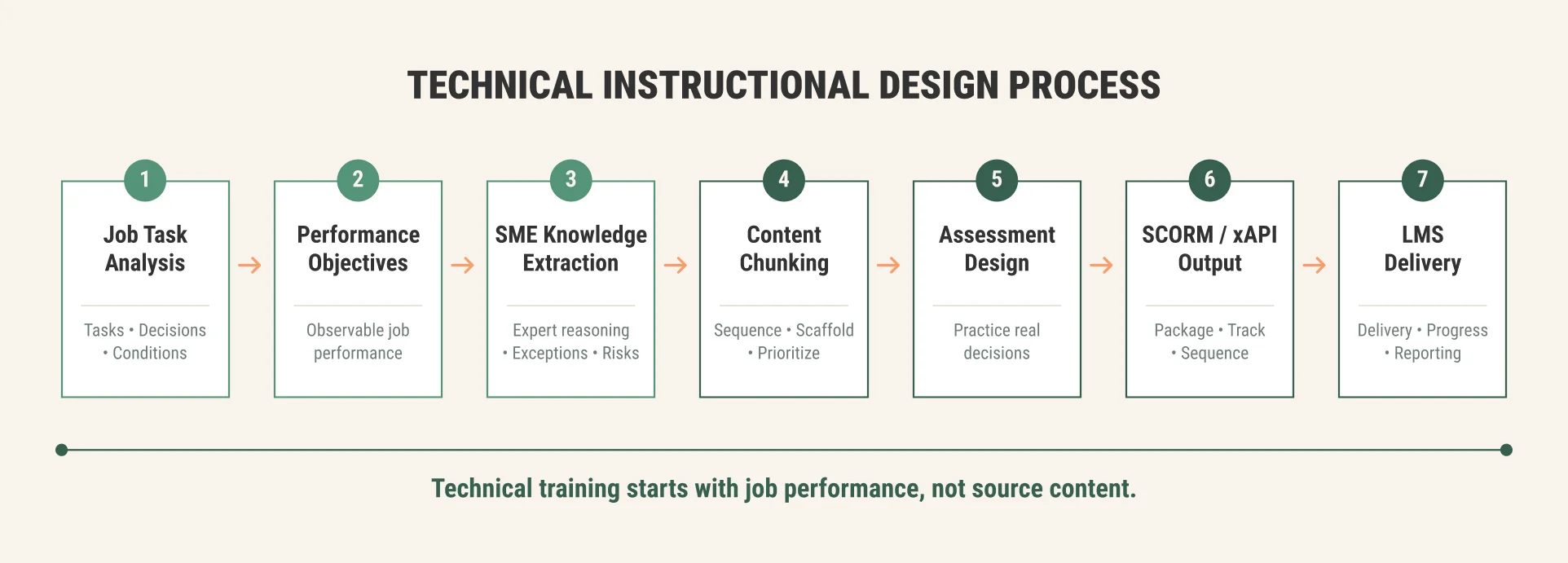
Technical course development starts with the job rather than the source material.
Step 2: Write Objectives That Describe Technical Performance
“Understand network security.”
“Know the equipment.”
“Learn how the application works.”
These may describe intent, but they do not tell a designer what learners must prove.
Good performance-based learning objectives normally answer three questions:
- What will the learner do?
- Under which conditions?
- What counts as acceptable performance?
Bloom’s Taxonomy for technical skills becomes particularly useful here because much technical learning belongs above Remember and Understand. Learners must Apply a procedure, Analyze evidence, Evaluate risk, or choose between competing actions.
Compare these objectives:
| Weak objective | Performance-based technical objective |
| Understand firewall configuration | Given a network diagram and approved rules, configure the firewall policy and verify required traffic without opening unauthorized ports. |
| Learn the patient-monitoring system | Using the training environment, configure a patient profile, verify sensor inputs, identify an abnormal reading, and select the correct escalation path. |
| Know the quality-control process | Given three production samples and inspection criteria, classify each sample correctly and document the required disposition. |
The objective should tell you what the assessment needs to look like.
If learners need to configure something, recognition questions alone are weak evidence. If they need to diagnose a fault, give them symptoms, system states, and incomplete information. If they need to evaluate risk, make them choose between plausible actions and inspect the consequence.
This connection is central to Instructional Systems Design (ISD). Objectives, practice, assessment, and delivery format should point to the same observable performance rather than operating as separate course components.
For a deeper look at the distinction between organizing subject matter and constructing a learning experience around outcomes, see our guide to instructional design vs. curriculum development.
Step 3: SME Collaboration and Tacit Knowledge Extraction
Subject matter experts are indispensable to SME-to-course development.
They can also become its largest bottleneck. Usually, the problem is not a lack of expertise. It is compression.
An experienced technician may look at ten signals and recognize a fault pattern in seconds. Ask, “How did you know?” and you may hear:
“You can just tell.”
That answer is where a good SME interview for instructional design begins.
Five questions that expose expert reasoning
- Where do new people usually make mistakes?
This reveals misconceptions and failure points quickly.
- What would make you reject the obvious answer?
Now exceptions and judgment begin to surface.
- What do you check before performing this step?
Hidden prerequisites become visible.
- What would make you stop and escalate instead of continuing?
This identifies risk boundaries.
- Show me a case where the written procedure was not enough. What did you notice?
This is often the richest source of tacit knowledge extraction.
Do not ask an SME to “write the training.” That request frequently produces a manual, a long presentation, or an exhaustive list of facts. The SME owns domain accuracy. The instructional designer owns the learning structure.
A practical principle in technical course design is to build around why learners use a system rather than walking through every feature simply because it exists. That keeps the course tied to work instead of becoming another software tour.
Raccoon Gang followed the same separation of responsibilities in the NASA Open Science 101 project. NASA SMEs supplied source material and scientific knowledge. Raccoon Gang’s instructional designers analyzed those inputs, chose treatment and presentation formats, developed the learning modules, tested them, and iterated through expert and learner feedback.
Put boundaries around the storyboard cycle
A technical eLearning storyboard should never arrive in an SME’s inbox with nothing more specific than “Please review.”
Give each round a purpose.
- Review 1: technical accuracy, sequence, missing decisions, dangerous omissions.
- Review 2: corrected content, terminology, assessment logic, scenario consequences.
- Review 3, if genuinely required: unresolved exceptions and final sign-off.
This keeps feedback useful and limits scope creep.
A familiar SME comment is:
“While we’re here, learners should probably also know…”
Maybe.
Or that information belongs in documentation, a downloadable reference, an advanced module, or a searchable job aid.
Raccoon Gang’s NASA project shows how extensive this iteration can become in a real technical curriculum. The initial five modules were delivered in approximately 390 development hours; later collaboration added another 310 hours and 846 content revisions. The curriculum ultimately contained 192 modular SCORM learning packages, making individual components easier to revise without rebuilding everything around them.
For a complex 30 to 45-minute technical module, discovery, 3 to 4 SME interviews, storyboarding, two focused review cycles, authoring, and QA can reasonably occupy around 6 to 10 weeks. Heavy simulations, localization, custom media, or slower approvals can push the project closer to 6 to 14 weeks.
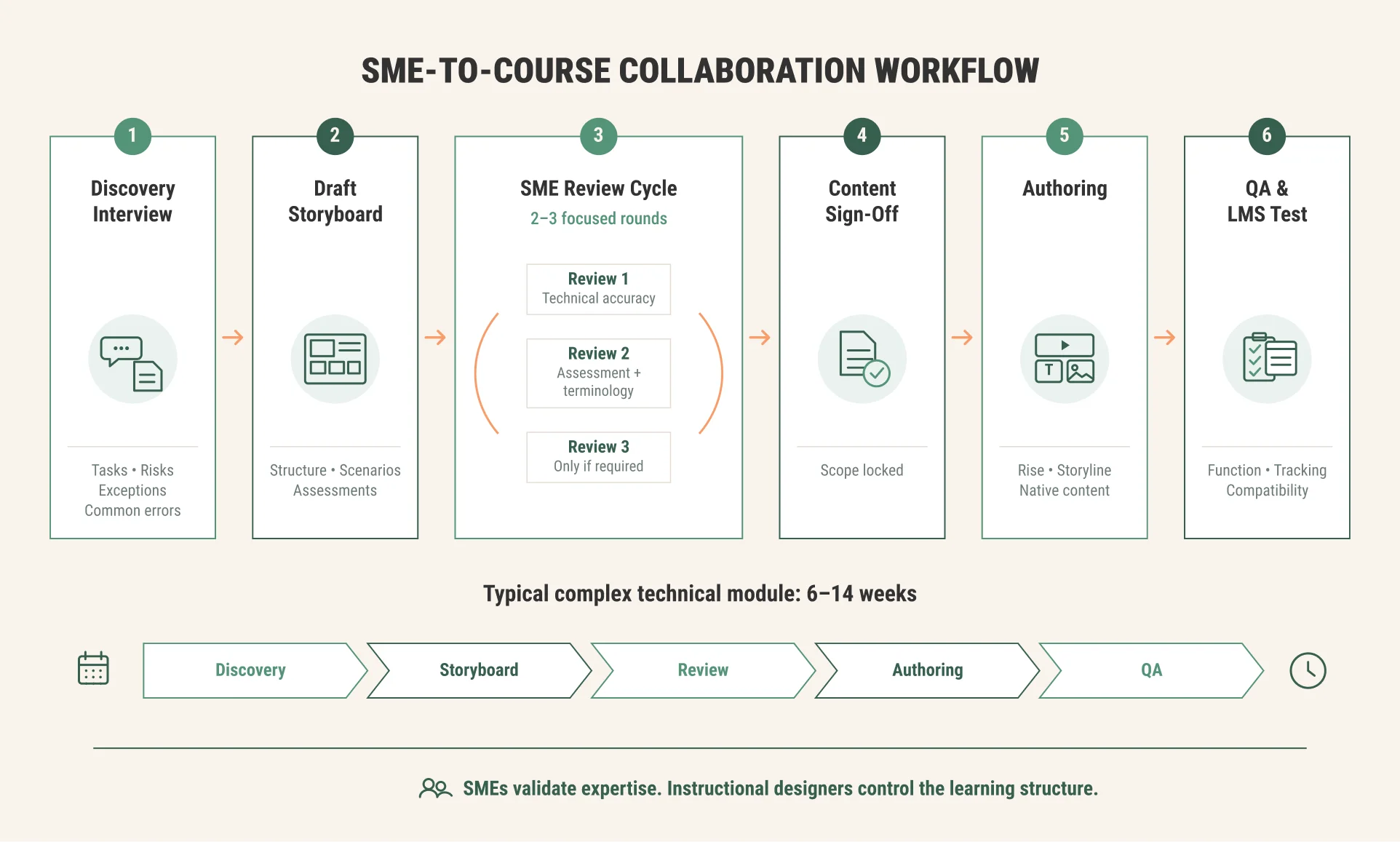
SME collaboration works best as a controlled knowledge-extraction and review process with clear ownership at every stage.
Step 4: Chunking and Cognitive Load Management
Once the content is accurate, another problem remains. The learner still has to process it.
Cognitive load theory starts from a practical constraint: working memory is limited. Technical subjects naturally create pressure because several elements often interact before a task makes sense. The foundational research on cognitive load showed how instructional conditions can consume mental resources that learners otherwise need for building useful knowledge structures.
A database connection, for example, may depend on authentication, network access, environment settings, permissions, connection strings, and application behavior.
Those dependencies belong to the task. The designer cannot simply delete them.
What can be reduced is the unnecessary load surrounding them.
Build a deliberate content chunking strategy
A useful learning chunk usually has:
- one clear objective;
- one connected group of concepts;
- one meaningful action or decision;
- practice before another dependency is introduced.
Poor chunk:
Module 3: Network Architecture, Security, Monitoring, Troubleshooting, and Incident Escalation
Better:
3.1 Identify the affected network layer
3.2 Validate routing
3.3 Test policy behavior
3.4 Interpret monitoring evidence
3.5 Decide whether to remediate or escalate
The second version does not make the subject less technical.
It gives the technical material an order.
Scaffolding does something similar at the activity level. Early practice might display the diagnostic sequence, highlight the fields to inspect, and provide hints. Later attempts remove those supports.
Pre-training can introduce system components before learners need to operate them. Signaling directs attention to the meaningful part of an interface, diagram, or dataset.
A common ID for complex content mistake is to divide material according to presentation length rather than cognitive purpose. Three concepts happen to fit into a 15-minute unit, so they become one module even though the learner needs different mental models for each.
Good technical design works in the opposite direction:
- explain enough → practice → add the next dependency → practice again.
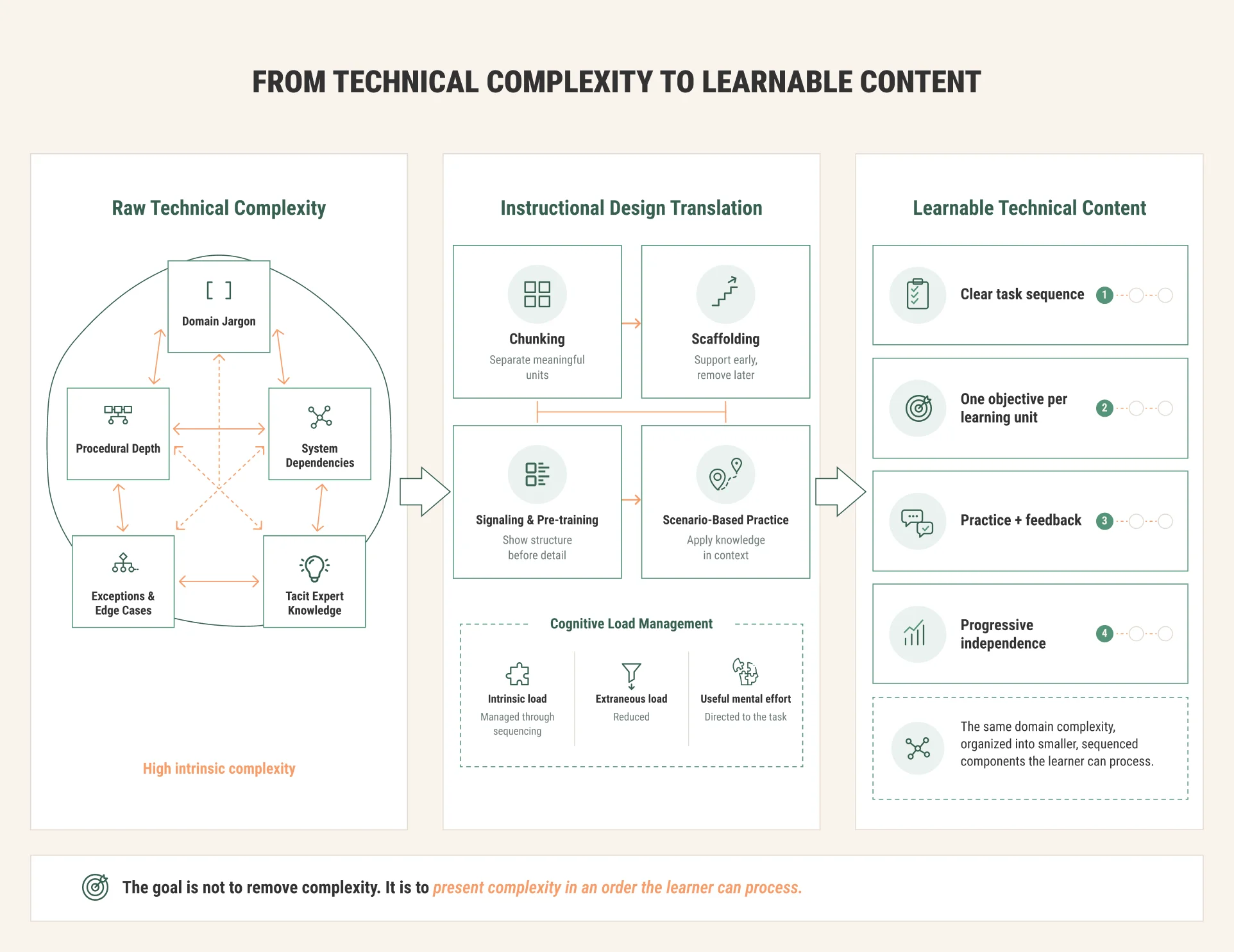
Instructional design does not remove technical complexity. It organizes jargon, dependencies, exceptions, and tacit knowledge into sequenced learning units with practice, feedback, and progressively less support.
Step 5: Match the Format to the Technical Task
Technical eLearning authoring tools should be selected after the performance requirement and assessment method are clear, not before.
Different technical problems need different instructional treatments.
| Technical content | Useful format |
| Procedural task | Guided simulation followed by independent practice |
| Conceptual system knowledge | Visual explainer plus interactive diagram |
| Diagnostic decision | Branching scenario with consequence feedback |
| Software operation | Screen demonstration followed by guided practice |
| Safety decision | Realistic scenario with operational consequences |
| Reference-heavy work | Searchable checklist, decision tree, or job aid |
Scenario-based learning for technical skills
The strongest technical scenarios reproduce uncertainty. The wrong answers should be plausible. Feedback should explain what the decision causes rather than displaying a generic “Incorrect.”
This makes scenario-based learning for technical skills particularly useful in:
- troubleshooting;
- clinical judgment;
- equipment operation;
- cybersecurity;
- safety;
- technical customer education.
Branching simulations in eLearning add another useful layer because one decision can change the conditions learners face next.
A diagnostic scenario might start with a timeout error. Check the wrong system first, and the learner wastes time. Disable the wrong control, and the simulated incident gets worse. Escalate too early, and they receive feedback about what evidence was still missing.
That resembles technical work much more closely than trivia.
Hands-on practice matters for the same reason. Technical training guidance consistently favors practice environments, scenarios, simulation, and job-relevant application over passive feature walkthroughs.
When an Articulate Storyline technical course fits
An Articulate Storyline technical course makes sense when the course requires custom interaction logic, triggers, variables, branching, screen capture, guided software practice, or detailed simulations.
Storyline supports screen recording that can be turned into demonstrations, guided trials, assessments, and editable software simulations. This makes it useful for:
- troubleshooting;
- software simulations;
- equipment procedures;
- clinical decisions;
- multi-step safety scenarios.
You can review the current Storyline capabilities when deciding whether its interaction depth matches the course.
When Rise 360 technical training fits
Rise 360 technical training is often a better fit for structured, responsive learning built from modular content blocks, diagrams, media, lighter interactions, knowledge checks, and concise scenarios.
Rise supports block-based lessons, interactive elements, quizzes, multimedia, and scenario blocks. The practical distinction is not that Storyline can branch and Rise cannot. Storyline gives the designer considerably more control over interaction logic; Rise makes structured modular production faster and works well across device sizes.
The current Rise 360 feature set gives a useful picture of where that format fits. Our instructional design tools guide covers authoring choices in more detail. And sometimes the right format is not another course interaction at all. A troubleshooting tree, field checklist, reference sheet, or searchable job aid may help a technician more during work than ten extra LMS screens.
SCORM 2004 and xAPI: Why Technical Training Standards Matter
Technical training may require more than a final completion flag.
Certification programs can depend on prerequisites, attempts, assessment results, simulation behavior, or evidence collected outside the LMS.
SCORM 1.2 vs. SCORM 2004 technical training
SCORM 1.2 can communicate more information than completion and pass/fail alone. Depending on the implementation, it can also carry scores, time, suspend data, objective information, and interaction data.
For SCORM 2004 technical training, the major additional capability in this discussion is standardized sequencing and navigation.
That allows learning activities to follow rules such as:
- Module 1 passed → Module 2 becomes available
- Critical assessment failed → remediation opens
- Prerequisite incomplete → advanced activity remains unavailable
The distinction matters for technical curricula where learners should demonstrate one level before progressing to another.
Our guide to SCORM explains the versions, LMS communication model, and common implementation considerations in more detail.
Where xAPI technical eLearning becomes useful
The xAPI specification describes communication about learner activities and experiences between learning technologies. Statements record an Actor, a Verb, and an Object, with activity records stored through a Learning Record Store.
For xAPI technical eLearning, useful evidence can come from:
- a software simulation;
- a mobile activity;
- an external assessment;
- a field checklist;
- a practice application;
- a job-support tool;
- another technical environment connected to the learning record.
This matters because technical competence may happen somewhere other than the course player.
Raccoon Gang produces SCORM 1.2, SCORM 2004, and xAPI-native content using Storyline, Rise 360, and custom H5P, with course behavior tested on the production LMS before handoff. Our instructional design services connect content, assessment, tracking, and LMS behavior during production rather than treating packaging as a file-conversion step at the end.
Technical Training in Practice: NASA, EBRD, and Cybersecurity Education
The strongest test of these principles is what happens when the starting material is already difficult.
NASA Open Science 101: expert scientific knowledge into modular learning
The NASA Open Science 101 project started with expert scientific source material rather than a finished digital curriculum.
The program covers practical open-science principles and practices, including FAIR principles, open data, open software, open results, collaboration, ethical considerations, and open-science and data-management planning.
Raccoon Gang worked with NASA SMEs to convert that knowledge into:
- 5 modules;
- 25 lessons;
- 12.5 hours of learning;
- Rise 360 content;
- SCORM delivery on Open edX;
- sequential lesson access;
- quizzes, matching, sorting, interactive images, accordions, and videos;
- digital badges.
The target was more than 20,000 scientists and researchers over five years.
What matters from an instructional-design perspective is the production process.
SMEs supplied expert materials. Raccoon Gang analyzed them, selected treatment formats, refined module structure, built the curriculum, tested it, collected feedback, and revised it repeatedly.
That is SME to course development in practice: expertise stays with the SME, while the design team turns that expertise into a learner path.
The project also demonstrates why modularity matters for technical subjects. Scientific recommendations and supporting materials can change. Separating content into smaller learning packages makes revision much more manageable than treating a long curriculum as one fixed asset.
EBRD: compressing 24 hours without flattening the subject
The EBRD Policy Academy project demonstrates another version of the same design problem.
A 24-hour instructor-led seminar was converted into an 8-hour self-paced program covering investment, policy, governance, and economic-development knowledge.
The finished learning materials included:
- 84 instructional videos;
- 6 case studies;
- 13 interactive exercises;
- 125 assessment questions;
- a scenario-based role-play;
- course storyboards;
- downloadable resources;
- Open edX courseware.
The platform supports EBRD staff and thousands of external stakeholders across 38 countries of operation.
This is a useful example of content chunking at program level.
The point was not to squeeze every classroom minute into a shorter digital container. The material had to be restructured for self-paced learning, with clearer navigation, assessments, multimedia, and supporting resources.
Cybersecurity training: connect learning with technical risk
A third Raccoon Gang case adds another useful angle.
The Cybint cybersecurity training platform required more than course delivery. The learning environment supported separate learning paths, reporting for companies, departments, teams, and individual learners, plus a custom skill-based Risk Factor metric intended to connect learning progress with cyber-risk reduction.
The platform served 55,000 learners and combined learning paths, assessment information, role-based access, dashboards, and technical reporting.
This example matters because technical learning eventually has to answer a harder question than:
Who finished the course?
The useful questions are:
- Which technical skills are weak?
- Where are learners making the wrong decisions?
- Who needs remediation?
- What changed after training?
That is where course design, assessment logic, analytics, and LMS architecture meet.
Build Technical Training In-House or Work With a Partner?
Neither approach is automatically better.
Build in-house when
- your instructional designers already understand the technical context;
- SMEs can participate regularly;
- content changes frequently and short revision cycles matter;
- the learner population is relatively small;
- your existing authoring and LMS setup already supports the required practice and tracking.
Consider an external instructional design partner when
- SMEs cannot dedicate enough time to course architecture and repeated production work;
- your current ID team lacks context in a specialized technical domain;
- the program needs advanced simulations, SCORM 2004, xAPI, localization, or accessibility work;
- learning must serve large or geographically distributed audiences;
- instructional design and LMS implementation need to remain connected.
That final point is easy to miss.
A carefully designed technical course can still create problems after publication if the LMS cannot support the required sequencing, tracking, roles, reports, or content formats.
Raccoon Gang combines instructional design with custom LMS development across Open edX, Moodle, Canvas, and connected learning environments. Course behavior and platform behavior can therefore be considered during the same project instead of becoming two unrelated handoffs.
For teams that already have source material but need production support, Raccoon Gang’s online course development services cover course planning, content production, technical packaging, QA, and launch.
Conclusion
Technical training is not harder because learners are incapable of learning difficult things.
It is harder because difficult things need more disciplined design.
The SME sees a familiar system. The learner sees dozens of new relationships.
Instructional design for technical training closes that gap through a clear sequence:
- Job Task Analysis → Performance Objectives → SME Extraction → Content Chunking → Scenario Practice → Assessment → SCORM/xAPI → LMS Delivery
That sequence combines technical expertise with technical training instructional design, rather than expecting one discipline to substitute for the other.
Raccoon Gang has applied the approach to scientific education for NASA, investment and policy learning for the EBRD, cybersecurity training, and other programs where simple content conversion would not have been enough.
If your current technical eLearning design contains accurate information but learners still struggle to use it, the subject itself may not be the problem.
The missing piece may be the translation between expertise and performance.
Talk to our instructional design team if your technical content has outgrown your current eLearning approach.
FAQ
What is instructional design for technical training?
How is technical training instructional design different from standard eLearning design?
What is job task analysis, and why is it important for technical training?
How do I work effectively with subject matter experts?
When should I use SCORM 2004 instead of SCORM 1.2 for technical courses?
What is xAPI, and why does it matter for technical training programs?
Should I build technical eLearning in-house or work with an instructional design company?
How long does it take to develop a complex technical eLearning module?


- TL;DR
- Key Takeaways
- Why Technical Training Is a Different Design Problem
- Step 1: Job Task Analysis Before You Design Anything
- Step 2: Write Objectives That Describe Technical Performance
- Step 3: SME Collaboration and Tacit Knowledge Extraction
- Step 4: Chunking and Cognitive Load Management
- Step 5: Match the Format to the Technical Task
- SCORM 2004 and xAPI: Why Technical Training Standards Matter
- Technical Training in Practice: NASA, EBRD, and Cybersecurity Education
- Build Technical Training In-House or Work With a Partner?
- Conclusion