






Instructional design vs curriculum development starts to matter when an L&D team launches training and people still make the same mistakes at work. Also when an education team runs a course and students still miss the core concepts after assessment.
When that happens, you should identify whether your team needs better learning experiences, better learning architecture, or both.
A quick warning before we go further: completion rates alone will not give you the answer. Course or training completion may be low, or it may be exceptionally high, yet neither scenario guarantees that new hires will stop bombarding managers with the same basic questions after finishing onboarding.
Some organizations achieve high completion and still struggle to improve performance. We’ve seen programs where learners completed every required module, while managers kept reporting inconsistent execution across teams.
That is why companies such as Amazon invest heavily in structured role-based pathways, mentoring, practice, and on-the-job application. They understand that the curriculum development vs instructional design comparison is not about terminology. It is about workforce readiness.
According to the World Economic Forum, employers expect 39% of workers’ core skills to change by 2030. LinkedIn also reports that many L&D teams face executive concern about skill gaps. Under those conditions, completion alone tells you too little.
- Curriculum development helps organizations decide what people need to learn.
- Instructional design development turns those learning goals into lessons, practice tasks, assessments, and feedback loops.
Below, we explain what each discipline means. Where they differ. How they help training move from simple content delivery to real workplace performance.
TL;DR
- Curriculum development defines the learning path. It decides what learners need to master and how learning should progress.
- Instructional design builds the learning experience. It turns goals into courses, practice, assessments, and feedback.
- Curriculum without instructional design may look good on paper. Learners can still struggle to apply it in practice.
- Instructional design without curriculum may create engaging courses. Those courses may still miss real business needs.
- The LMS should connect the path, content, assessments, credentials, and analytics. It should support the strategy, not decide it for you.
What Is Instructional Design?
The instructional design meaning has expanded over time. Research shows that instructional design has moved beyond course production alone. Specialists in this field, and designers at Raccoon Gang are no exception, now make design decisions, coordinate SME collaboration, support change management, provide consulting, and create organizational impact.
Today, Instructional Design Consulting Services help teams do more than create a set of presentations for a course or module. They help answer several practical questions:
- What should learners do after the course?
- Where will they need practice?
- Which assessment will prove they can use the skill, not just remember the theory?
Split content into modules. Add activities, scenarios, knowledge checks, and feedback points. Apply interaction design principles. All of this belongs to modern instructional design.
Interaction design principles connect all of this into a clearer learning experience. ADDIE, SAM, and other instructional design models give program teams a repeatable process. They help teams plan, build, test, and improve learning. Teams have used these models for years because they reduce guesswork. They also keep SMEs, designers, and stakeholders aligned.
*We should keep moving, but you can also go deeper in our complete guide: What Is Instructional Design?
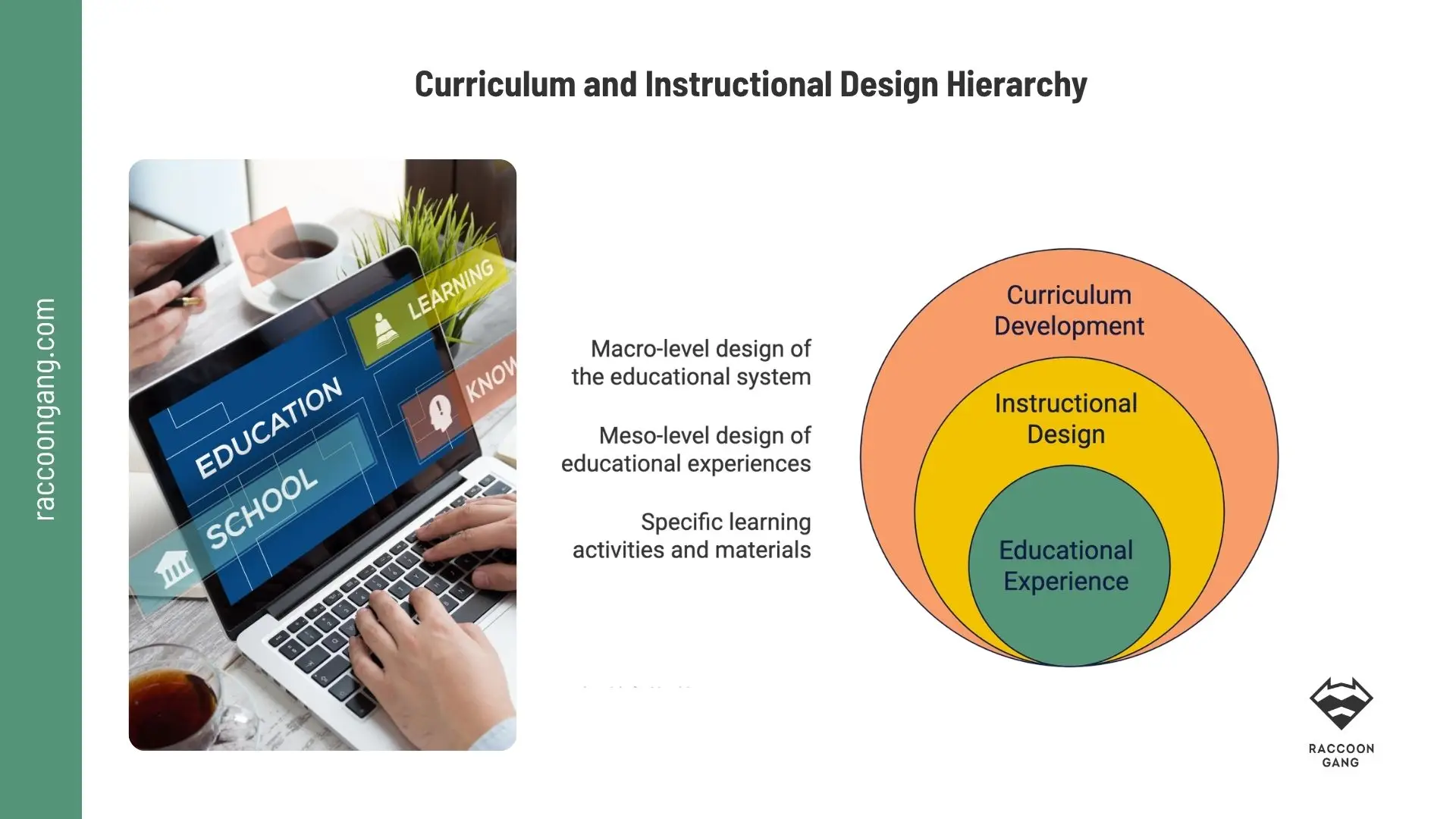
Curriculum development sets the structure. Instructional design builds the learner experience within it.
What Is Curriculum Development?
Curriculum development asks a different set of questions.
- Which capabilities matter most for this role?
- How do those capabilities connect to business goals, qualifications, or academic standards?
- What should learners master first?
- Which topics belong in the program, and which do not?
- How should learning progress across months, semesters, or career stages?
So, what do we see here? Curriculum design gives teams a top-down view of the learning program. It helps them see the whole structure of planned learning, not only separate lessons or modules.
“My team approaches curriculum development with less focus on the design of a specific lesson. Instead, we focus on the structure of the entire learning path that our clients need.”
— Olha Turutova, Head of Instructional Design and e-Learning Development at Raccoon Gang
UNESCO treats curriculum as more than a list of topics. It includes learning goals, content, methods, assessment, materials, and the way teachers or trainers prepare to deliver the program.
Instructional Design vs Curriculum Development: The Core Difference
When we compare the responsibilities of curriculum development and instructional design side by side, we need to define the areas of comparison first. Let’s explore the table below.
| Area | Curriculum Development* | Instructional Design* |
| Purpose | Define capabilities, learning pathways, and program structure | Design learning experiences that help people build those capabilities |
| Scope | Entire program, academy, certification, or curriculum | Individual courses, modules, lessons, and activities |
| Deliverables | Capability maps, program blueprints, learning pathways, curriculum frameworks | Storyboards, assessments, scenarios, activities, learning assets |
| Time Horizon | Months or years | Days, weeks, or course development cycles |
| Stakeholders | CLOs, program directors, academic leaders, business leaders | Instructional designers, SMEs, facilitators, content developers |
| Measurement | Capability growth, pathway completion, certification progress, alignment with standards | Assessment performance, learner engagement, completion, knowledge retention |
| Tools | Competency frameworks, curriculum maps, pathway models | ADDIE, SAM, storyboards, assessment frameworks, authoring tools |
| Change Approach | Controlled updates and long-term consistency | Rapid iteration, testing, and learner-focused improvements |
* Curriculum development focuses on the learning system.
** Instructional design development focuses on the learner experience inside that system.
How Curriculum Development and Instructional Design Work Together
So far, we have focused on what makes curriculum development and instructional design different. Now let’s look at the bigger picture. These are not isolated processes. They are connected parts of the same learning system.
Curriculum and instructional design solve different problems, yet neither produces strong results in isolation.
So, here is how the shared picture usually looks:
- Curriculum defines the program direction.
- Instructional design turns that direction into a learning experience.
- Work moves from strategy to execution.
As learning design experts often note, relying on curriculum development without instructional design can waste time and resources. You risk creating well-documented programs that feel difficult to apply in practice.
On the other side, instructional design without curriculum development can also fall short. You risk creating engaging courses that do not connect to broader business goals. In other words, the skills your course develops may not fit your actual business processes.
Another important difference appears at scale. A handful of standalone courses may work for a small audience. A learning academy, onboarding ecosystem, degree program, or certification pathway requires a shared structure that connects:
- content
- assessment
- credentials
- learner progression
Many organizations, therefore, treat curriculum and instructional design as different layers of the same learning ecosystem.
Strong instructional design continues after launch through measurement and iteration.
Instructional Design and Development Process: From Learning Goals to Course Assets
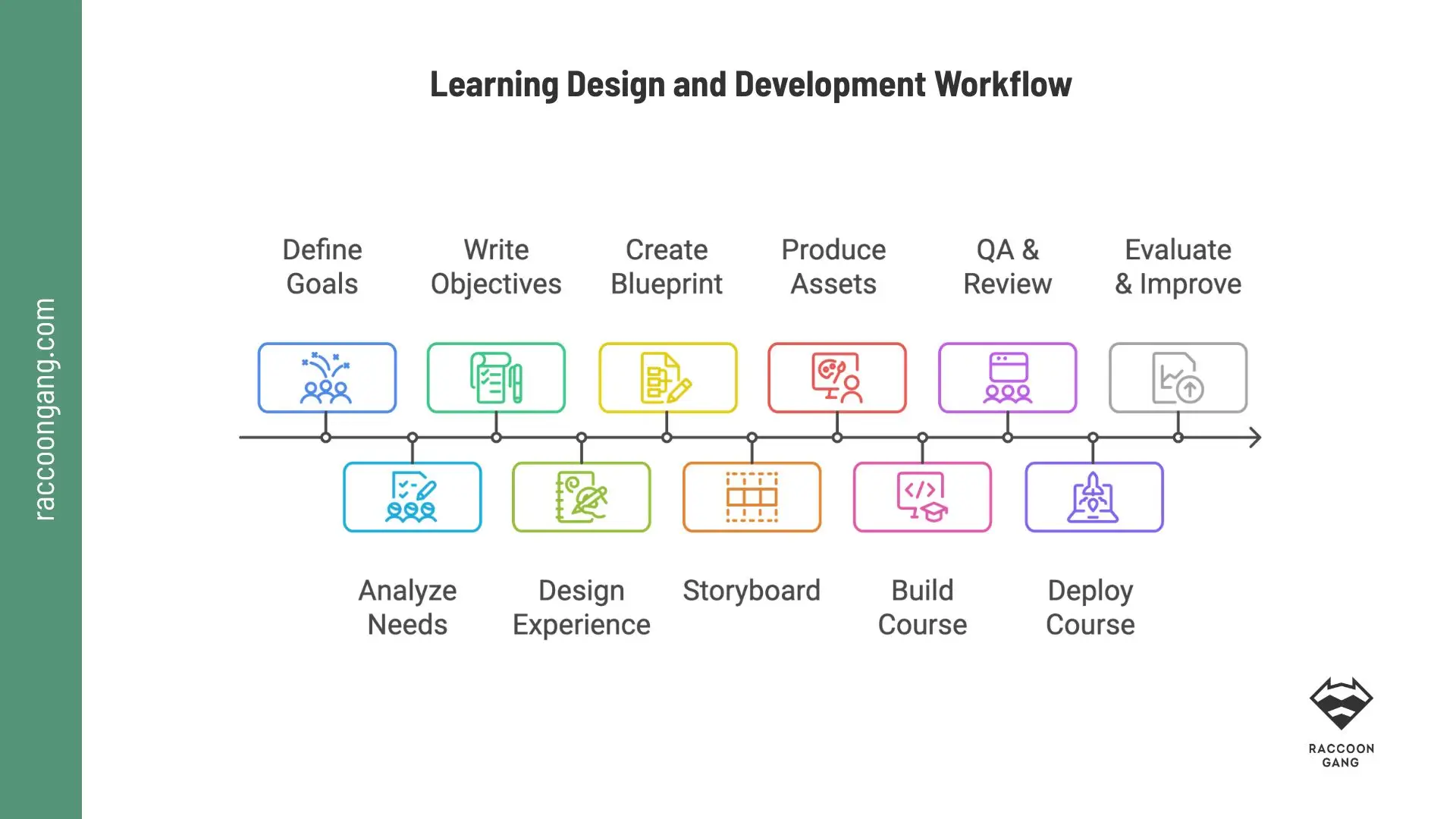
A practical workflow for instructional design and development usually looks like:
- Define the business or learning goal behind the course.
- Analyze learner needs, skill gaps, and delivery constraints.
- Turn broad goals into measurable learning objectives.
- Design the learning experience around practice and feedback.
- Create a course blueprint with structure, flow, and assessment logic.
- Storyboard screens, interactions, scenarios, and media elements.
- Produce learning assets for lessons, activities, and assessments.
- Build the course inside the LMS or authoring environment.
- Review content, functionality, accessibility, and learner experience.
- Deploy the course to the target learner group.
- Measure results and improve assets after launch.
The screenshot shows these stages as a linear workflow. In real projects, teams often move back and forth between steps. A weak pilot may send the team back to the storyboard.
Strong instructional design turns expertise into structured learning experiences.
Real Examples: How Organizations Use Curriculum and Instructional Design
It is time to move from theory to practice. Let’s see how curriculum and instructional design look at real programs, real organizations, real businesses and educational environments. The difference becomes much easier to notice in real projects.
NASA Open Science 101
Raccoon Gang supported NASA Open Science 101, a program designed to help researchers adopt open science practices. The learning goals already existed. The learning materials existed too, but they mostly came as a stack of presentations.
So the task was to turn the existing course goals and materials into a structured learner experience.
During the project, the team also had to align the vision of multiple subject matter experts. Raccoon Gang developed the initial curriculum version within 3 months, then supported updates and finalization in about 1.5 months.
The project demonstrates how instructional design supports a broader learning initiative once the direction is defined.
EBRD
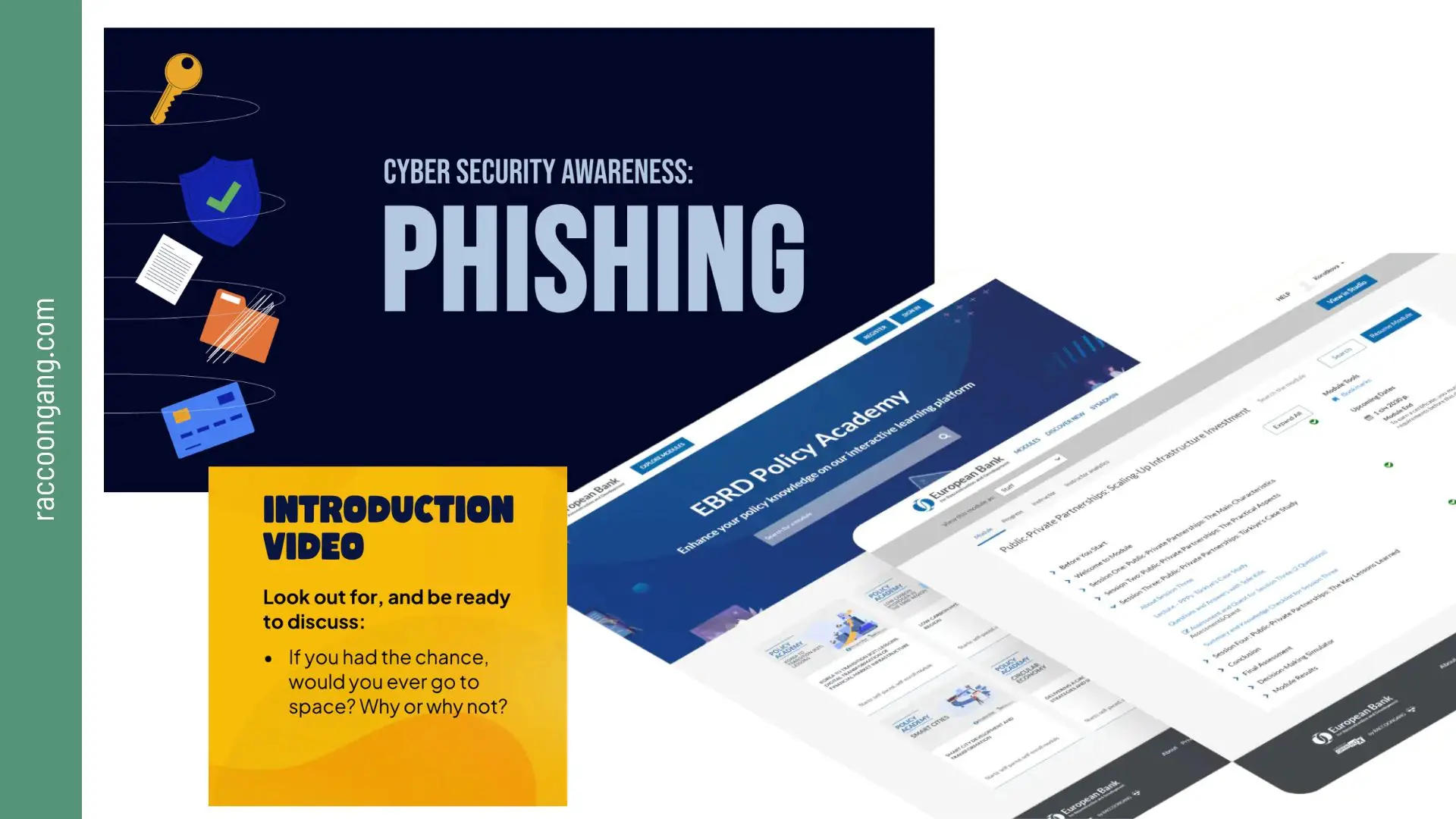
For the European Bank for Reconstruction and Development (EBRD), the task was different. Around 30 hours of video content and 21 presentations with notes had to become standalone e-modules with clear course plans and a shared instructional design framework.
EBRD Policy Academy’s knowledge became easier to access for internal staff and nationals from EBRD shareholder countries.
Deloitte University EMEA
Deloitte University EMEA works as a corporate academy, not a loose course library. Its leader-led curriculum covers leadership capabilities, professional skills, and industry-specific knowledge. Leaders help design and deliver the learning, so the curriculum stays close to strategy, culture, and real capability needs.
Amazon Upskilling
Amazon Technical Academy prepares employees without technical backgrounds for software engineering roles through a nine-month internal program.
The curriculum defines the role pathway and performance standards. Instructional design adds mentorship, workplace practice, and on-the-job learning that help employees apply those skills in real work environments.
Which Approach Do Organizations Need First?
Start with curriculum development when the learning path is unclear. Start with instructional design when the path is clear, but the learning experience does not work. Use both when you are building or redesigning an onboarding program, learning academy, certification pathway, or degree program.
| Situation | Start With | Reason |
| You do not know which skills learners need | Curriculum Development | Define capabilities first |
| Courses exist, but they feel disconnected | Curriculum Development | Fix the learning path |
| New roles or certifications need structure | Curriculum Development | Map standards and progression |
| Objectives are clear, but learners disengage | Instructional Design | Improve the learning experience |
| Learners finish training but do not apply skills | Instructional Design | Add practice, feedback, and better assessment |
| Assessments test memory, not performance | Instructional Design | Redesign how progress is measured |
| You are redesigning an academy or onboarding program | Both | Align the structure and the course experience |
| Changes affect roles, content, platform, and metrics | Both | Use one shared design approach |
A curriculum team may define coaching and feedback skills as a goal for new managers. An instructional designer may build that goal through role-play, peer discussion, reflection, and workplace scenarios. Same capability. Different design decisions.
*Learn more in our guide to Constructivist Learning Theory.
How LMS Platforms Connect Curriculum and Instructional Design
Over the last 10 years, our LMS developers at Raccoon Gang have worked on learning platforms for corporate training, higher education, nonprofits, and public sector organizations. One mistake appears surprisingly often.
Client’s teams try to choose an LMS before thinking about curriculum and learning design. The decision seems logical. A platform is visible. Stakeholders can compare features and pricing. Yet the ideal sequence is usually the opposite. The platform should support the curriculum, not define it.
Buying an LMS before defining learning architecture is like booking a venue before knowing what kind of event you’re running.
Google Career Certificates show the mechanism clearly. The external curriculum design comes from Google. The institution decides where it fits: curriculum, co-curricular learning, or workforce readiness. Then the LMS connects access, sequencing, certificates, and learner progress.
In practice, most organizations need several connected layers:
- LMS or LXP for learning delivery and orchestration
- Assessment tools for measuring progress and competence
- Lab or experience platforms for hands-on practice
- Credentialing systems for certifications and badges
- Analytics tools for reporting and business measurement
At Raccoon Gang, we often see organizations trying to solve curriculum or instructional design challenges through platform features alone.
A stronger learning ecosystem needs a different order: first, define the learning architecture. Then, connect the right technology stack around it.
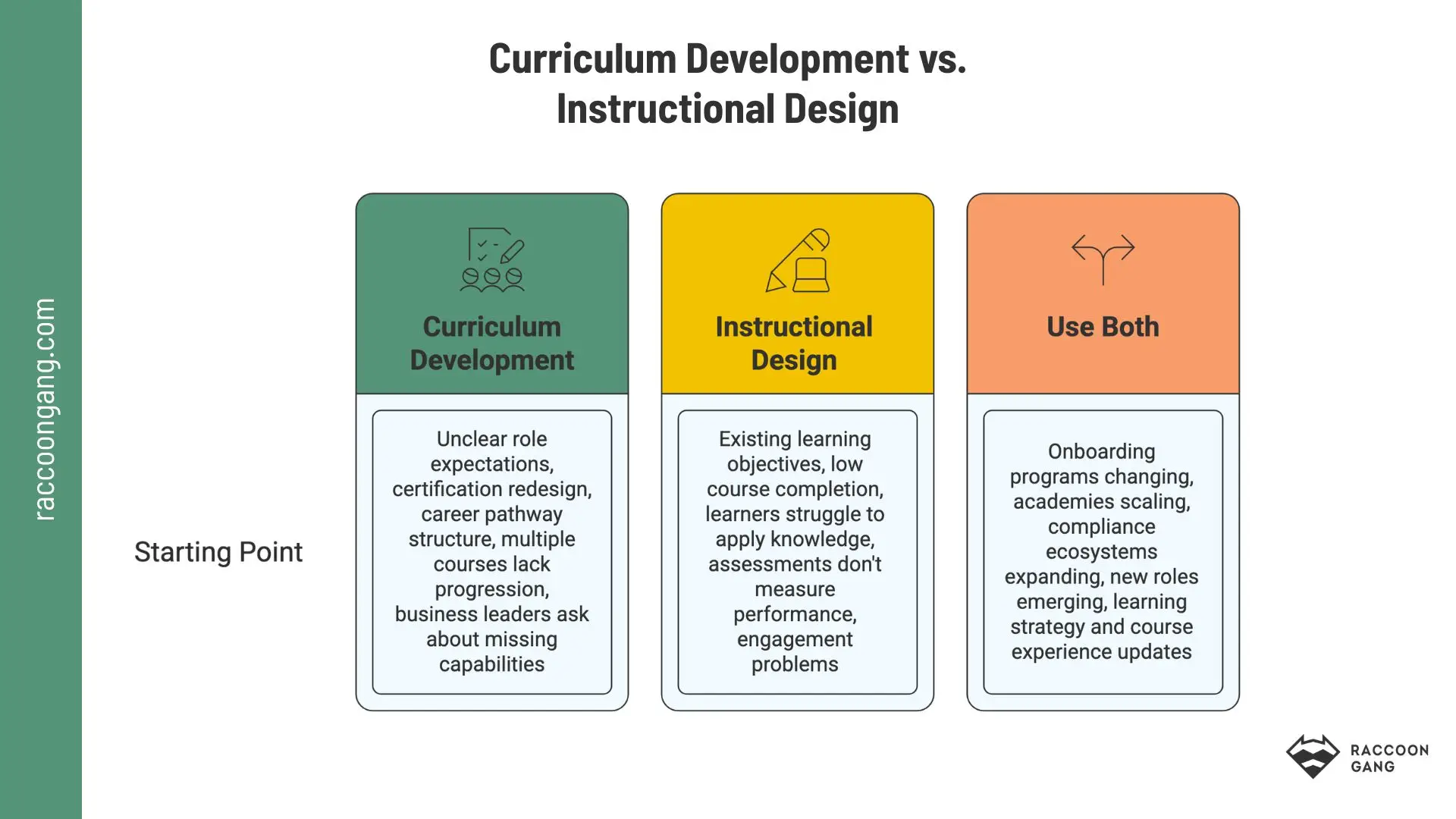
The right starting point depends on whether the challenge sits in the pathway, the course, or both.
How Raccoon Gang Supports Learning Design and Development
As the examples above demonstrate, successful learning programs rarely begin with course development alone. They start with a clear understanding of what learners need to achieve and how learning should support organizational goals.
Raccoon Gang helps organizations connect curriculum development, instructional design, and LMS implementation.
Learning Architecture and Curriculum Planning
Before course development begins, we work with L&D teams, universities, and training providers to define:
- capability frameworks
- learning pathways
- program structure
- assessment strategy
- learner progression models
Instructional Design and Course Development
Depending on the project, we use:
- ADDIE and agile design approaches
- Rise 360 and Storyline
- SCORM and xAPI standards
- scenario-based learning
- assessments and feedback loops
LMS Implementation and Learning Delivery
Learning experiences still need a delivery environment. Our team implements and configures Open edX, Moodle, and Canvas platforms to support:
- learning paths
- sequencing logic
- certifications
- reporting and analytics
- learner engagement workflows
“One of the most common mistakes is changing the curriculum every time a course needs improvement. The curriculum should change slowly. Learning assets should improve continuously.”
— Olha Turutova, Head of Instructional Design and e-Learning Development at Raccoon Gang
Final Takeaways
Instructional design vs curriculum development is not a choice between two competing approaches. They are two sides of the same scale that balance your learning environment.
Curriculum development answers questions such as:
- What capabilities matter?
- How should learning progress?
- Which standards, roles, or credentials should the program support?
Instructional design answers a different set of questions:
- How will learners build those capabilities?
- Where should they practice?
- Which assessments will prove competence?
- How will learning transfer into real performance?
One final recommendation: the strongest organizations use both.
- Curriculum development designs the learning system.
- Instructional design creates the learning experiences inside it.
Sometimes the problem sits inside a lesson. Sometimes it sits inside the pathway itself. Your team should be able to recognize the difference. What is at stake? Whether your course or module remains simple content delivery or becomes part of a learning ecosystem that supports long-term capability growth.
FAQ
What is the difference between instructional design and curriculum development?
What is instructional design?
What is curriculum development?
Can curriculum development exist without instructional design?
Which comes first: curriculum or instructional design?



- What Is Instructional Design?
- What Is Curriculum Development?
- Instructional Design vs Curriculum Development: The Core Difference
- How Curriculum Development and Instructional Design Work Together
- Instructional Design and Development Process: From Learning Goals to Course Assets
- Real Examples: How Organizations Use Curriculum and Instructional Design
- Which Approach Do Organizations Need First?
- How LMS Platforms Connect Curriculum and Instructional Design
- How Raccoon Gang Supports Learning Design and Development
- Final Takeaways