







While researching this article, scrolling through search results, and even asking AI for insight, we caught ourselves thinking one thing: We still couldn’t find a direct, clear, and genuinely useful explanation of what project-based learning is.
Yes, you’ll find plenty of definitions. We found them too. Most sound like this: “Project-based learning is a teaching method based on…” followed by a list of principles, activities, and expected outcomes.
That kind of definition checks the box. It gives you a formal answer. Still, in our view, it rarely explains the idea in a way that helps educators, instructional designers, or LMS administrators or course owners actually work with it.
Because when a course or module from your curriculum moves into an LMS, the simple idea starts asking hard questions.
- Where do learners find the project brief?
- How do they work in teams?
- Who gives feedback before the final submission?
- What does the platform show and track?
Schools use it to connect subjects with real tasks. Universities use it to support research, teamwork, and applied practice. Corporate learning teams use it when employees need to prove skills through onboarding projects, business cases, simulations, or role-based tasks.
From our experience in instructional design and LMS development, a strong PBL project needs more than a good idea. It needs structure, checkpoints, feedback logic, assessment criteria, and a digital environment that supports the whole workflow.
In this guide, we’ll look at project-based learning through that lens: not as another teaching trend, but as a practical model for digital education and LMS-driven programs.
TL;DR
- Project-based learning is an approach that allows you to build the course around a real problem, complex question, sustained investigation, or final product.
- PBL works when learners use knowledge while the course is still running. They research, create, test, explain, revise, and present, rather than studying theory first and taking a test later.
- Instructors, instead of active tutors, become facilitators.
- Learners submit drafts, use feedback, review peer work, reflect on decisions, and improve the final output, providing instructors and L&D teams with stronger evidence than completion data alone.
- Online PBL needs a designed LMS workflow. Learners should see the brief, roles, milestones, feedback windows, rubrics, submission points, reminders, and progress path.
- PBL fits best when the course needs proof of thinking and applied skills. When learners only need to remember rules, terms, or basic procedures, a shorter learning format may work better.

The project-based learning cycle helps learners move from a real problem to inquiry, collaboration, reflection, revision, and final presentation.
What Is Project-Based Learning? A Practical Definition for Digital Education
PBL is an approach where learners gain knowledge by working on real, personally meaningful projects. In practice, it usually includes a complex question, inquiry, learner autonomy, authenticity, and a realistic product or presentation.
That sounds accurate. Still, it needs one important clarification.
A project in a course does not automatically create project learning. A learner can submit a slide deck at the end of a module and still follow a passive path. Real PBL learning asks learners to think through the problem while the course is still happening, rather than after the theory has already ended.
“A strong PBL project needs more than an interesting topic. It needs structure. It needs milestones. It needs feedback loops and assessment criteria. And it needs an LMS that supports the whole workflow, so learners can move from the first brief to the final result without losing the thread.”
— Head of Instructional Design, Raccoon Gang
At its core, project-based learning combines three things:
- Learner ownership. Learners make choices, test ideas, and take responsibility for the final output.
- Real-world context. The task connects to a situation they might face in school, university, work, or community life.
- Inquiry-driven learning. Learners ask questions, search for evidence, compare options, and revise their thinking.
A strong project-based learning experience gives learners a reason to use knowledge while they are learning it. That is the difference.

Project-based learning gives learners a reason to apply knowledge while they are still learning it, whether in schools, universities, or workplace training.
What Is Project-Based Teaching, and How Does the Instructor Role Change?
If project-based learning exists, then project-based teaching has to exist too, right?
When project-based learning is introduced, the instructor’s role changes a little. What stays the same? The instructor still teaches, explains, and supports learners. What changes is the main focus: facilitation. Lisa Beck and Kim Mishkin make a similar point in their Edutopia article “Implementing a PBL Design Challenge in Your School,” where they describe PBL as a guided challenge, not a hands-off activity.
The teacher designs the route. In other words, they set the final destination, but they do not lead learners by the hand the whole time. They build the learning culture, set quality standards, give mini-lessons, and evaluate both the final product and the process.
The teacher’s role in PBL learning includes:
- Defines the challenge
- Guides the process
- Supports decisions
- Evaluates outcomes
In digital courses, this role can become easier because the LMS automates basic workflow elements: submissions, comments, peer review, grades, and milestone completion. AI assistants, which are increasingly built directly into learning platforms, can also help educators with routine guidance, draft review, and feedback support.

A strong PBL project includes a real-world problem, student inquiry, collaboration, reflection, and a final presentation that shows what learners have created and understood.
Key Principles of Project-Based Learning That Matter in Online Courses
Theoretically, PBL grew from inquiry-based learning and constructivist ideas. In plain English, learners build understanding by asking questions, testing ideas, and making something that proves what they have learned.
Joseph S. Krajcik and colleagues describe strong project environments through several features.
- It starts with a driving question.
- Then comes authentic inquiry.
- Learners collaborate with peers, teachers, and sometimes the community.
- Support tools guide the process.
- Public artifacts show what learners have created and understood.
“In our e-learning development projects, PBL works best when creativity has a frame. A well-built PBL experience needs structure, rubrics, deadlines, feedback protocols, and quality criteria learners can actually follow. Without that design work, teams often get interesting outputs, but weak evidence of learning.”
— E-learning Developer, Raccoon Gang
Benefits of Project-Based Learning for Learners, Instructors, and L&D Teams
So, what are the benefits of project-based learning if we look at it through course design and LMS workflow? Research has already shown that project-based learning can improve student learning outcomes. But what does it give to everyone else involved: learners, instructors, and L&D teams? Let’s break it down.
Learners get more ownership and better application
Thanks to PBL, learners stop completing mostly theory-based tasks just to get a grade. Instead, they have to apply their knowledge and understanding to reach the final goal of the project.
In school, that might be a science model or community research project. In a corporate program, it might be a sales playbook or process improvement proposal.
Instructors get more evidence of thinking and problem-solving
A final test, whether we like it or not, usually reveals only what learners remembered here and now.
A PBL project demonstrates the whole thinking process: how learners researched, compared options, made decisions, handled feedback, and revised their work.
L&D teams see clearer proof of skill development
The third benefit is somewhat similar to the previous one. The difference is that the learners are company employees, not school students.
As a result of a PBL project, your L&D team gets many useful insights. Did employees submit a role-based plan? Did managers review it? Did learners improve after feedback?
That is a different level of evidence than quickly passing a compliance test over lunch just to get a checkmark.
Benefits for all participants in project-based learning
The thematic study reveals that group projects teach learners to divide roles and solve conflicts. Team roles build communication, negotiation, and accountability — the skills 21st-century keeps asking for.
Common Challenges of Project-Based Learning and Where Programs Break
Project-based learning breaks most often when teams confuse freedom with lack of structure.
| Challenge | Where programs break | What helps |
| Time management | Learners miss interim steps and rush the final submission. | Milestones, interim deadlines, progress tracking, and LMS reminders. |
| Group dynamics | One learner takes over. Another disappears. The rest try to stay polite. | Clear roles, peer review, contribution tracking, and team check-ins. |
| Teacher inexperience | Instructors used to lectures may struggle with facilitation, scaffolding, and project guidance. | Facilitator guides, mini-lessons, sample feedback, and project templates. |
| Resource limits | Learners lack access to tools, materials, experts, or realistic contexts. | Shared resources, digital workspaces, simulations, and curated examples. |
| Assessment gaps | Rubrics grade only the final product and miss research, teamwork, and revision. | Process-based rubrics, draft reviews, reflection tasks, and feedback history. |
* Research on PBL also has gaps. Many studies focus on primary and secondary schools, while universities and digital education still need more detailed evidence. That makes LMS data more important. We will see it in the following blocks of the article.
How Project-Based Learning Works in Digital Education
Online PBL may require even more attention during implementation than a traditional classroom or training project. Especially in corporate learning.
When schools, universities, or companies move into blended or remote learning and try to enrich it with digital PBL, the course owner has to think beyond the project idea.
Why? Because the course owner has to design two things at once:
- The learning workflow
- The LMS workflow
Related platforms and tools can support different parts of digital PBL. Moodle can support H5P activities and BigBlueButton sessions. Open edX can support structured learning sequences and graded submissions. Google Workspace, Microsoft Teams, Figma, Miro, Canva, GitHub, and Zoom can support collaboration and creation around the LMS.
We’ve seen this many times in course design projects for our customers, including NASA. Yes, the “to the moon and back” reference writes itself.
7-Step Digital PBL Cycle
- Launch: Video driving question + KWL chart (digital template).
- Research: Shared Notion/OneNote; curated resource library.
- Planning: Miro/Mural digital whiteboards for brainstorming.
- Creation: Tool-specific modules (e.g., Scratch for coding).
- Feedback: Peer review forms + teacher comments in LMS.
- Revision: Version history shows iteration.
- Presentation: Recorded pitches + public gallery in LMS.
Your main task here is to design an LMS workflow that turns the project from a large assignment into a guided learning process.
What an LMS Needs to Support Project-Based Learning
You have reached the point to answer the question: Can the LMS of my organization actually support this model without creating manual work for instructors?
Let’s frame the LMS as the operational layer behind project-based learning.
| PBL need | LMS capability |
| Learners need a clear project path | Course sequencing, modules, milestones |
| Teams need to collaborate | Groups, forums, shared workspaces, integrations |
| Instructors need visibility | Progress tracking, activity logs, dashboards |
| Learners need feedback before the final submission | Draft submissions, comments, rubric-based review |
| Programs need fair assessment | Rubrics, peer review, grading logic |
| Managers need proof of progress | Reports, completion data, assessment exports |
| Organizations need scale | Automation, notifications, role permissions, integrations |
* Your platform can grow with your program. You can add new features, plugins, and custom integrations when the course model requires them. Just do it systematically. Updates and integrations should work together, not create conflicts. If you need guidance, an LMS vendor like Raccoon Gang can help.
When to Use Project-Based Learning: A Simple Decision Framework
Now, let’s define when Project-based learning works and when another model works better. Use this quick framework before choosing it for a course.
Use PBL when learners need to:
- Prove understanding through action.
- Solve a realistic problem.
- Compare options and defend decisions.
- Improve work through revision.
- Practice collaboration.
- Leave evidence of skill development.
Consider another instructional model when learners need to:
- Remember rules, terms, or policies (microlearning, short modules).
- Complete basic compliance training.
- Learn a simple procedure (guided practice or scenario-based exercises).
- Work without feedback capacity.
- Use a platform that cannot support group work, rubrics, or submissions.
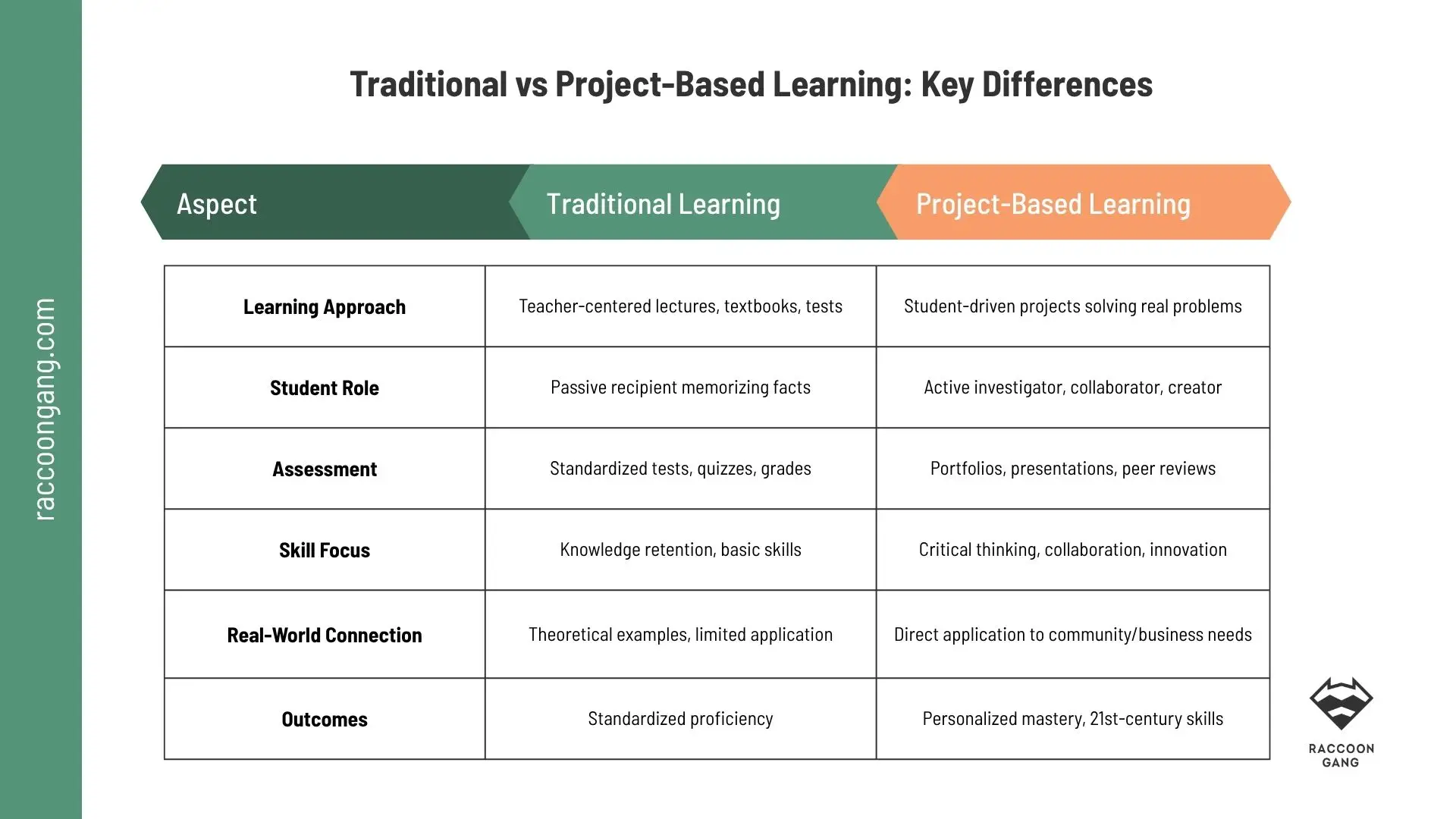
Traditional learning often centers on lectures, tests, and knowledge retention, while project-based learning focuses on inquiry, collaboration, applied tasks, and real-world outputs.
How Raccoon Gang Helps Design and Build LMS-Ready Project-Based Learning
At Raccoon Gang, we have spent the past 10 years developing, customizing, and adapting LMS solutions to fit our customers’ learning approaches. Our instructional design team can also help define and build the right learning model for your organization, including a project-based approach.
Related services you may be interested in:
- Instructional design
- Course structure
- LMS configuration
- Custom development
- Analytics and reporting
That practical LMS experience matters when project-based learning moves from concept to implementation. As Andrew Ang from Harvard shared:
“Raccoon Gang has been a great partner that has helped us with multiple web development projects. Their experience with hosting OpenedX instances, implementing LTI integrations, and general experience developing education applications has been especially valuable.”
— Andrew Ang, Harvard
Conclusion
Project-based learning has evidence behind it, and it still needs careful design.
So the honest answer is this: PBL works best when teams stop treating it as “give learners a project and see what happens.”
To get stronger results, the PBL-based course needs:
- a clear driving question
- a realistic task
- trained instructors or facilitators
- supporting materials
- milestone submissions
- feedback loops
- assessment criteria
In digital education, the LMS also has to support the workflow. Learners need to see what comes first, where collaboration happens, when feedback arrives, and how their work will be evaluated.
A project can look impressive on paper. In real course conditions, though, your team and your LMS must be ready to support the actual implementation.
That is where project-based learning becomes more than a teaching method. It becomes a designed learning process with clear tasks, visible progress, and platform support behind every step.
Hopefully, your next PBL project helps learners submit better drafts, receive feedback on time, and leave the course with work they can actually use.
FAQ
What is project-based learning?
Project-based learning puts a real problem, complex question, or final product at the center of the course. Learners do the work as the course unfolds: they research, create, test, explain, and improve. It feels less like “study first, apply later" and more like learning through the task itself.
What are the benefits of project-based learning?
The benefits show up in what learners actually do. They submit drafts, use feedback, review peer work, reflect on decisions, and improve the final result. On that note, instructors and L&D teams get better evidence than a simple completion checkmark.
How does project-based learning work?
It usually starts with a driving question or a realistic challenge. Then learners move through research, planning, creation, feedback, revision, and presentation. In an LMS, each stage should be easy to find through modules, deadlines, group spaces, rubrics, reminders, and submission points.
What is the difference between project-based learning and traditional learning?
Traditional learning often starts with content and ends with a test. PBL starts with a task. Learners use knowledge while they build something, so the course shows how they think, decide, revise, and apply what they have learned.
Can project-based learning be used in online education?
Yes. By the way, online PBL usually needs a tighter workflow than classroom PBL. Learners need a project brief, roles, milestones, feedback windows, peer review, and clear assessment criteria; otherwise, instructors might end up managing the whole project manually outside the LMS.


- TL;DR
- What Is Project-Based Learning? A Practical Definition for Digital Education
- What Is Project-Based Teaching, and How Does the Instructor Role Change?
- Key Principles of Project-Based Learning That Matter in Online Courses
- Benefits of Project-Based Learning for Learners, Instructors, and L&D Teams
- Common Challenges of Project-Based Learning and Where Programs Break
- How Project-Based Learning Works in Digital Education
- What an LMS Needs to Support Project-Based Learning
- When to Use Project-Based Learning: A Simple Decision Framework
- How Raccoon Gang Helps Design and Build LMS-Ready Project-Based Learning
- Conclusion