









An employee can complete a mandatory course, pass a quiz, receive a certificate, and still hesitate when the same issue appears six months later at work. The completion record satisfies one part of compliance. Gamification for compliance training aims to address this gap in learning and encourage real behavioral change. It does not prove that the learner can recognize a phishing attempt, respond correctly to a data request, report harassment, or stop an unsafe process.
A badge is not behavior change. A leaderboard is not knowledge retention. A realistic scenario where learners make a decision and receive immediate feedback gets much closer.
The useful chain runs: Compliance requirements → learning experience → behavior change → reduced risk
Key Takeaways
- Gamification should reinforce compliance behavior rather than turn mandatory learning into entertainment.
- Scenario challenges are particularly useful when employees need to recognize risk and choose the correct response.
- Points, badges, levels, and progress indicators work best when they represent meaningful achievements, and refresher activity moves compliance beyond a once-a-year completion event.
- Different compliance topics need different mechanics. Competition may fit a cybersecurity challenge and be completely inappropriate for anti-harassment training.
- LMS reporting should connect completion with assessment quality, retention, overdue training, certification, and refresher activity.
- Raccoon Gang has implemented gamification, badging, scenario activities, analytics, and risk-oriented reporting across enterprise learning projects.
At a glance
Gamification for compliance training means applying game mechanics such as challenges, progression, feedback, points, badges, and achievement rules to mandatory learning objectives. The purpose is not to replace regulatory requirements with games, but to give learners active practice with the decisions those requirements govern. Well-planned gamification in training supports participation, recall, and workplace application while the LMS handles assignment rules, assessments, certificates, reminders, and audit records.
Why Traditional Compliance Training Often Falls Short
There is nothing inherently ineffective about mandatory training. Problems start when “mandatory” becomes the instructional strategy:
- Policy text → presentation → Next button → final quiz → certificate
Employees may complete every step and still do very little with the information before the assessment.
Passive exposure is easy to complete
Reading policy text introduces a topic. It gives employees few chances to retrieve the information, compare alternatives, or experience the consequence of an error.
Cybersecurity awareness shows the difference. Telling somebody that suspicious links are dangerous is useful. Showing a realistic email and asking whether to open, report, verify, or ignore it requires application.
Annual training leaves long gaps between practice
Compliance programs follow an annual cycle because organizations need documented completion. Memory does not follow that calendar.
If an employee takes the course in January and faces the relevant decision in September, a lot disappears in between. Short refreshers, scenario questions, and role-specific reminders bring critical decisions back before the next certification cycle.
Information overload hides the action
Policies contain legal definitions, processes, exceptions, escalation rules, and supporting documentation. A course does not need to simplify the regulation until it loses meaning, but it does need to show learners which part affects their behavior.
A privacy course may carry extensive GDPR content. The employee handling a customer request needs an answer to a narrower question:
What should I do with this request now?
Completion does not equal behavior
A 100% completion rate is useful for audit records, but it is not a measure of learning. A company can report perfect completion and still see employees fail phishing simulations, mishandle personal information, ignore a safety step, or use the wrong escalation route.
Raccoon Gang’s guide to LMS user engagement separates usage, completion, and meaningful interaction for this reason. A learner can finish mandatory material with almost no evidence that it will stay useful afterward.
Gamification becomes useful at exactly this point, as a way to make learners retrieve, decide, practice, and receive feedback before the workplace supplies the consequence.
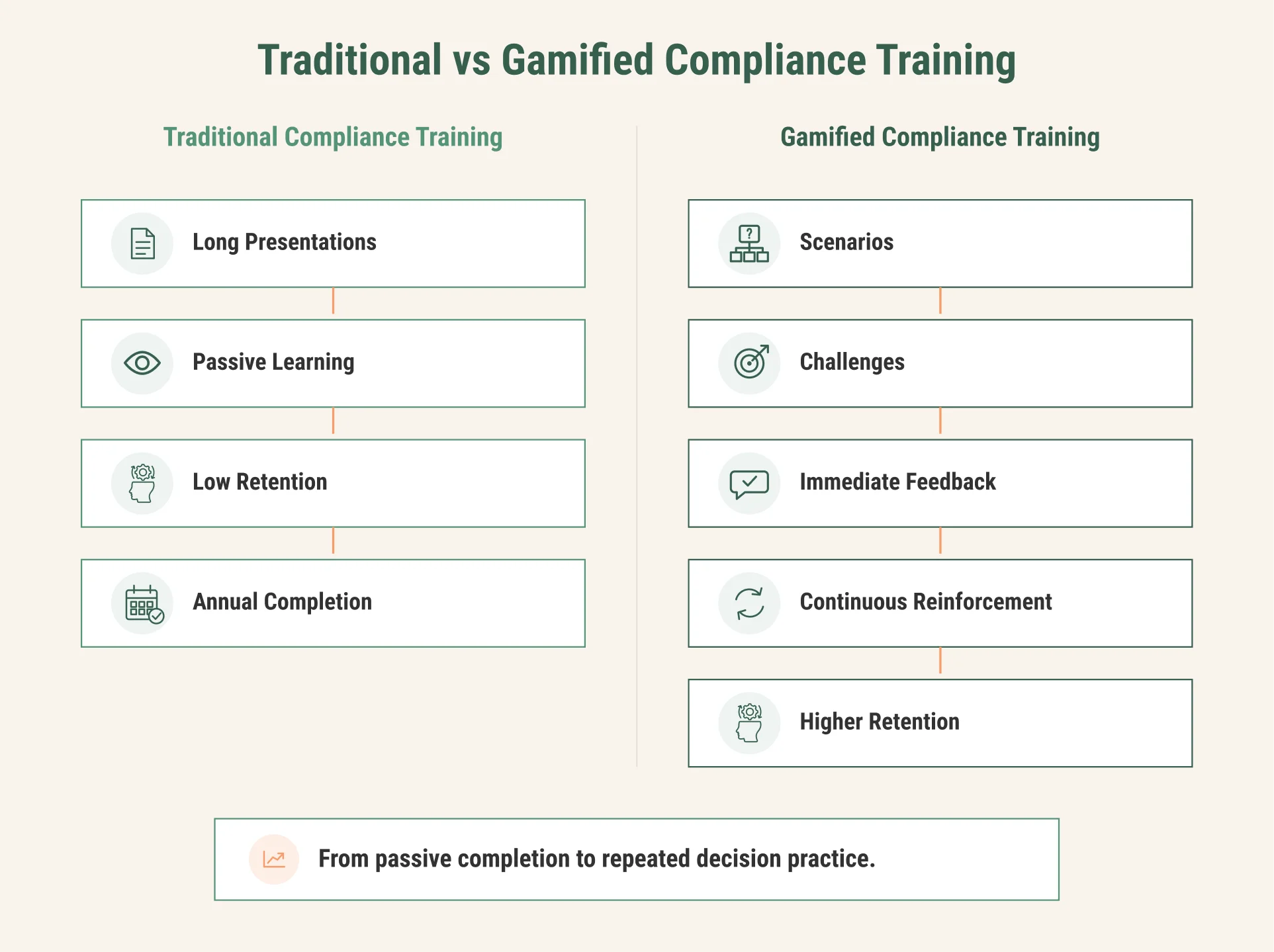
Gamification moves compliance from passive exposure toward decisions, feedback, and repeated reinforcement
What Is Gamification in Compliance Training?
Gamification in compliance training means using selected game mechanics inside mandatory learning to encourage participation, practice, feedback, and progression.
Common mechanics include:
- scenario challenges;
- points;
- levels;
- badges;
- progress indicators;
- missions;
- branching decisions;
- achievement thresholds;
- team challenges;
- repeated knowledge checks.
This is gamification training, but it does not necessarily mean building a complete educational game.
One compliance scenario can award points for identifying privacy risks. A progress indicator can show which mandatory topics remain incomplete. A refresher challenge can reopen several months after certification.
The regulatory content stays intact; the learner’s interaction with it changes.
Research points in the same direction: results depend heavily on how the mechanics support the learning design. A 2025 peer-reviewed review of 46 studies on gamification in education and training found that outcomes turn on instructional design, on how well content matches learner needs, and on how individual mechanics are applied. The review is useful precisely because it does not treat mechanics as an automatic improvement.
Practical guidance on gamifying compliance training follows the same logic: define the intended learning outcome first, then choose challenges, badges, points, levels, collaboration, or other mechanics that support it. It also warns that competition can create pressure for some learners, which is particularly relevant when compliance subjects are sensitive.
The purpose is not to make people enjoy earning points. It is to give them enough useful practice that the correct response becomes easier to retrieve when risk appears at work.
“Don’t hand out badges for every click or login. If everything earns a reward, your badges mean nothing and your data stops telling the truth.”
— Olha Turutova, Head of Instructional Design & e-Learning Content, Raccoon Gang
Raccoon Gang’s guide to LMS gamification makes the same point.
Benefits of Gamified Compliance Training
The case for gamified training becomes much stronger when we stop asking whether employees found the course entertaining and start looking at what changed during learning.
Increased learner engagement
Gamification changes what the learner has to do:
- a scenario requires a response;
- a challenge requires action;
- a visible path shows where they are and what remains.
That moves the learner from viewer to participant, which matters most in mandatory programs where the motivation is an external requirement rather than personal choice.
Better knowledge retention
Compliance decisions need retrieval, not recognition alone. Gamification creates natural reasons to recall the same principle more than once through scenario choices, checkpoints, challenges, and refresher activities.
Repetition does not mean replaying one quiz. A privacy concept introduced during onboarding can return later in a customer-data scenario. A phishing principle can reappear through a simulated email. A safety rule can return during an incident reconstruction.
The same principle matters beyond compliance. Raccoon Gang’s employee retention training guide distinguishes employee retention from skill retention, and explains how applied tasks, repetition, and feedback loops keep learned skills active after formal training ends.
Higher completion quality
Completion quality is different from completion rate. Two learners may both finish a course: one guessed until the passing score appeared, the other handled several applied scenarios correctly on the first attempt.
Those records should not mean the same thing to an L&D or compliance team, and a well-configured LMS keeps the difference visible instead of reducing both learners to one completion flag.
Greater confidence applying policies
Compliance decisions are often situational. Employees may know the rule but hesitate because two answers appear reasonable.
Scenario practice gives them a controlled place to make that decision before the situation matters. Instead of:
Which statement is correct?
Ask:
A supplier offers you tickets to an event three days before a procurement decision. What do you do next?
Continuous reinforcement
One annual module leaves a large gap between certification and workplace application. Gamification can distribute reinforcement across shorter learning moments:
- Learn → Practice → Feedback → Repeat → Mastery → Workplace Application
Microlearning works particularly well here. Raccoon Gang’s approach to online course development treats short modules as a practical format for compliance refreshers and just-in-time learning.
Reduced compliance risk
This is the outcome that matters most to compliance officers and governance leaders. Gamification does not reduce risk because employees collect more badges. It reduces risk when training gives repeated practice with the decisions that create exposure:
- Metric A: 98% of employees completed cybersecurity training.
- Metric B: 98% completed it, while phishing-simulation failures fell, repeated errors became less common, and high-risk teams received targeted refresher training.
Metric B connects learning activity with risk. Raccoon Gang implemented this logic in a cybersecurity learning platform serving 55,000 learners. The project included separate learning paths, gamification and badging, custom dashboards, and a skill-based Risk Factor metric that could be viewed across the company, department, team, or individual learner.
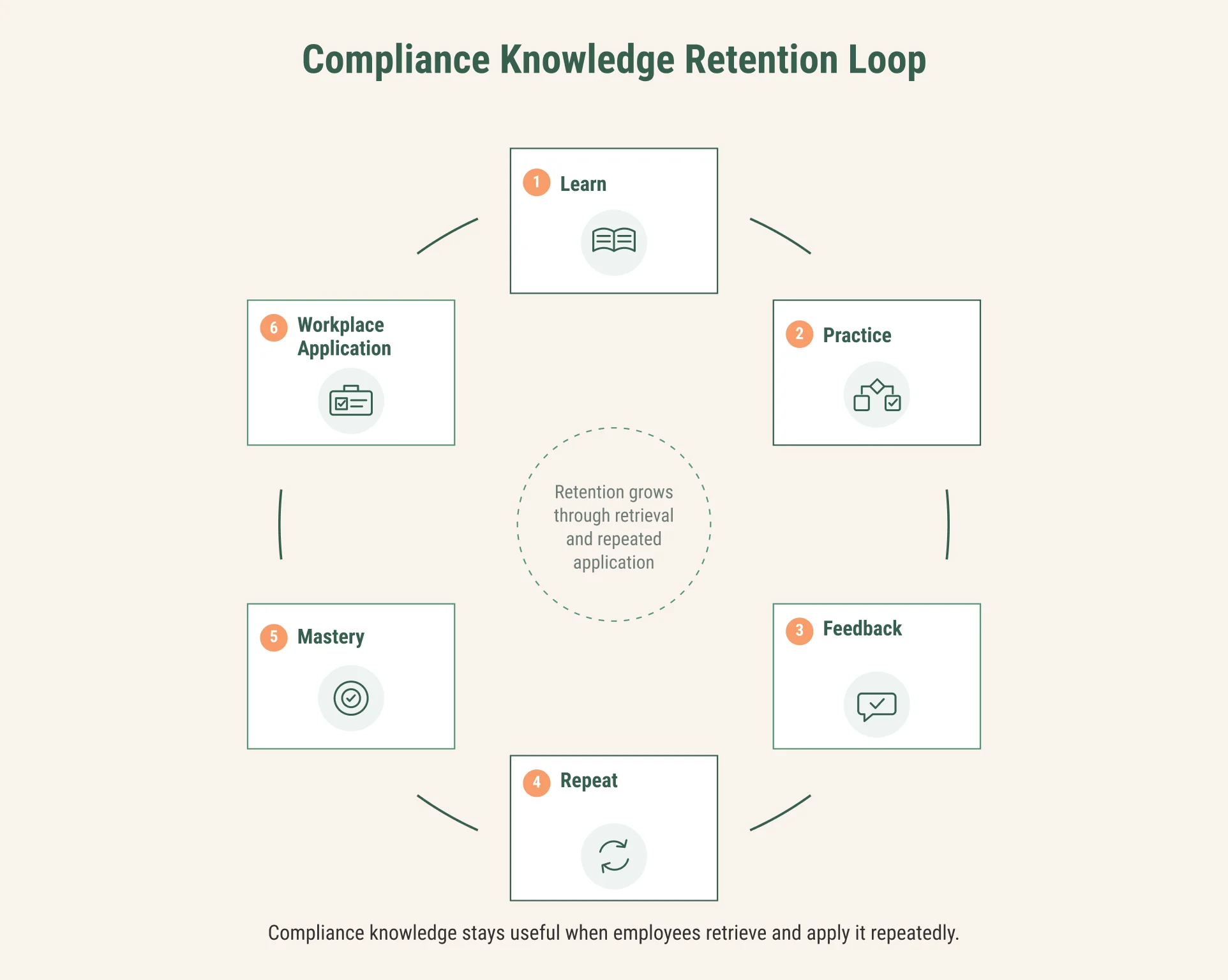
Compliance knowledge becomes more useful when employees retrieve and apply it repeatedly rather than encountering it only during annual certification
Real-World Compliance Training Examples and Gamification Ideas for Training
There is no universal mechanic for compliance. The right gamification ideas for training depend on the decision learners need to make.
Cybersecurity awareness
Use inbox simulations, phishing challenges, suspicious-link identification, password decisions, or social-engineering scenarios.
Instead of asking “Which of these is a phishing indicator?”, build the challenge in three steps:
- Show the email.
- Let the learner inspect the sender, wording, domain, link behavior, and request.
- Ask what they would do next.
Data privacy and GDPR
Use scenarios involving access requests, accidental disclosures, document sharing, retention rules, or escalation. For example:
A customer asks support to delete all personal data held about them. What should happen next?
The employee selects an action and receives immediate explanation tied to the organization’s procedure. The points are secondary; the decision is the learning event.
Workplace safety
Useful mechanics include:
- hazard spotting;
- procedural sequence challenges;
- incident reconstruction;
- simulated stop-work decisions;
- refresher missions.
Avoid rewarding speed where careful judgment matters. Fastest is not best in a safety simulation.
Anti-harassment
This is where restraint matters. A public leaderboard around harassment scenarios would be inappropriate, and competitive scoring can trivialize sensitive situations or expose learner performance.
Use private branching scenarios instead. Show a realistic conversation, ask the learner to recognize the issue and decide whether to intervene or report, then explain the consequence of that choice.
Here, gamifying training means adding decision structure and feedback, not competition.
Ethics and code of conduct
Ethical mistakes rarely happen because employees cannot recite the policy. They happen when incentives, relationships, deadlines, or conflicts of interest make the correct response less obvious.
Branching cases fit well: a learner moves through a supplier relationship, procurement decision, gift offer, or conflict disclosure, where one choice changes the situation they see next.
Healthcare compliance
Healthcare combines privacy, access, documentation, procedures, safety, and patient-facing decisions. Useful mechanics include patient-data scenarios, role-based privacy decisions, procedural sequence exercises, clinical documentation challenges, escalation scenarios, and periodic refresher activities.
Published compliance gamification examples across regulated sectors rely on the same combination: scenario decisions, progression, immediate feedback, and gating rules that connect learning with action rather than recall.
Build Gamification Across the Full Compliance Cycle
One of the more useful ways to gamify corporate training is to stop designing a gamified course and start designing the whole compliance journey:
Pre-assessment: find out what the learner already knows and where risk is concentrated.
↓
Microlearning: cover one policy, principle, or decision at a time.
↓
Scenario Challenge: ask learners to apply the rule in context.
↓
Knowledge Check: verify the required knowledge.
↓
Certification: record completion against the required threshold.
↓
Refresher Training: return selected material based on time, role, performance, policy changes, or observed risk.
The gamification layer connects these stages through milestones, points, badges, progress paths, mastery rules, or recurring challenges.
Compliance often begins during onboarding, where new hires first meet policies, security requirements, data-handling rules, and codes of conduct. That makes it a natural place to connect mandatory learning with a broader gamified path. Our future guide on gamification for employee onboarding will cover that use case separately.
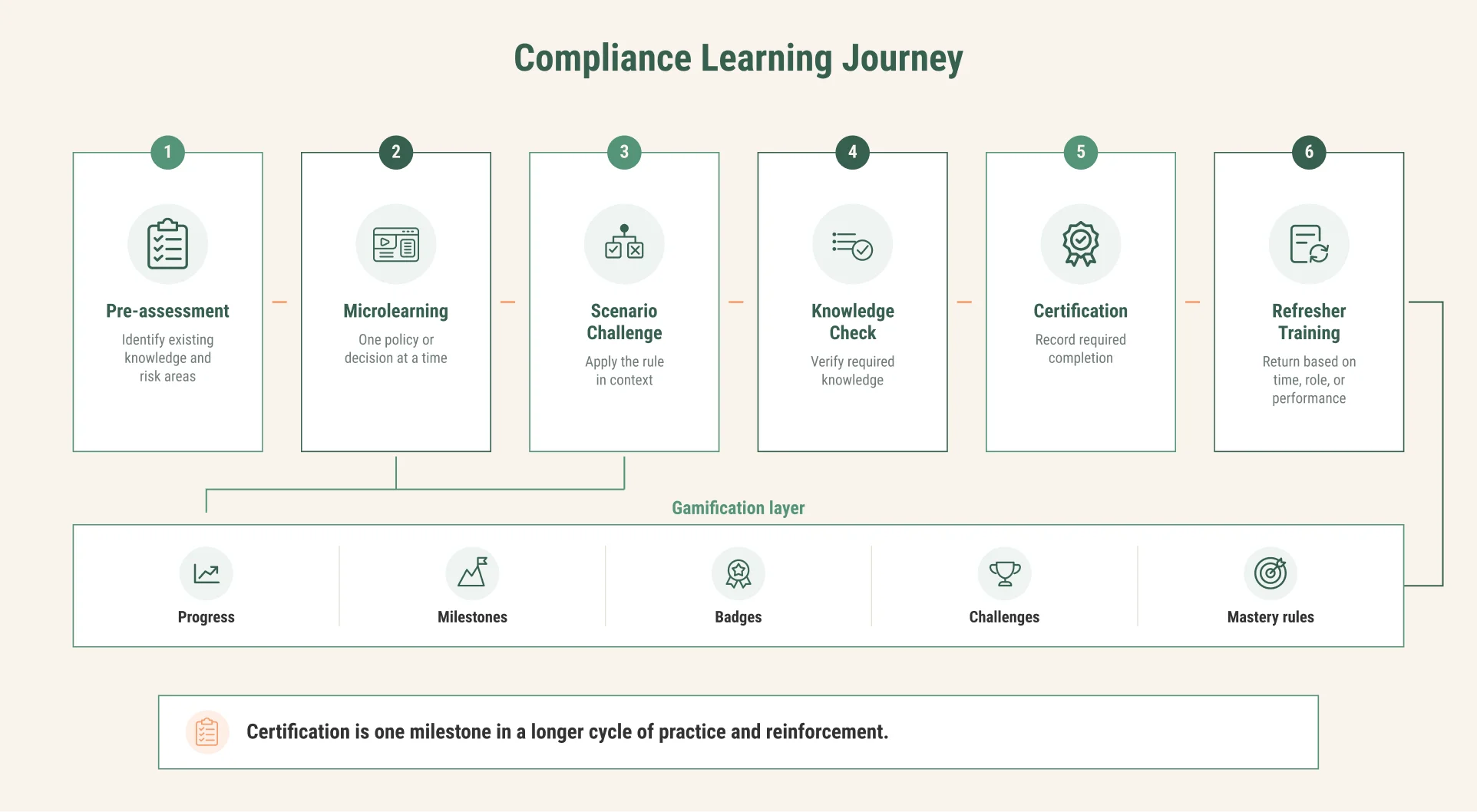
Certification works better inside a longer cycle of assessment, practice, feedback, and refresher activity
How an LMS Supports Compliance Gamification
A course creates the learning activity. The LMS makes corporate training gamification workable across roles, departments, locations, and recurring requirements.
Learning paths and adaptive release
Different roles need different compliance requirements: anti-bribery and data handling for a finance employee, safety certification for a warehouse employee, harassment-response training for a manager.
Adaptive release can also connect progression with mastery: a learner who passes a pre-assessment may move past introductory material, while someone who struggles with a critical scenario receives remediation before certification.
Badges and certificates
Badges should signify something meaningful: mastery of a topic, completion of a defined path, a passed high-stakes assessment, or a finished refresher sequence.
Certificates serve a different purpose: documenting that the required completion or assessment criteria were met.
Raccoon Gang has also worked on configurable credential issuance in Open edX, including rules that connect course completion to external digital credentials.
Scenario branching and assessments
The LMS and connected authoring tools support conditional scenarios, scored activities, remediation, and knowledge checks, so learners do not all need the same route. A repeated incorrect choice triggers additional explanation; strong performance immediately opens the next stage.
Reminders and refresher rules
Compliance does not end when the certificate is issued. The LMS can support deadline reminders, overdue notices, recurring enrollment, certificate renewal, refresher modules, and manager notifications.
Mobile learning
Mandatory training often reaches people who do not spend the day at a desk. Mobile access matters for field teams, frontline workers, distributed workforces, and employees who complete a short refresher close to the moment of work. Raccoon Gang’s course-development services support training across phones, tablets, and desktops, while microlearning keeps refreshers short enough to use in those settings. Progress, challenges, reminders, and feedback all need to work on the devices employees actually use.
Dashboards and audit reports
A useful compliance dashboard should answer more than:
Who finished?
Track:
- completion rate;
- assessment scores;
- overdue training;
- certification status;
- repeat attempts;
- knowledge-retention checks;
- refresher completion;
- compliance status by department;
- scenario performance.
HRIS and enterprise integrations
Employee status often determines compliance status. A new hire, promotion, transfer, leave, or new role can change what training somebody needs.
Assignment logic should therefore connect with the systems that already know who the employee is and what role they hold, so the LMS applies requirements automatically instead of depending on manually maintained spreadsheets.
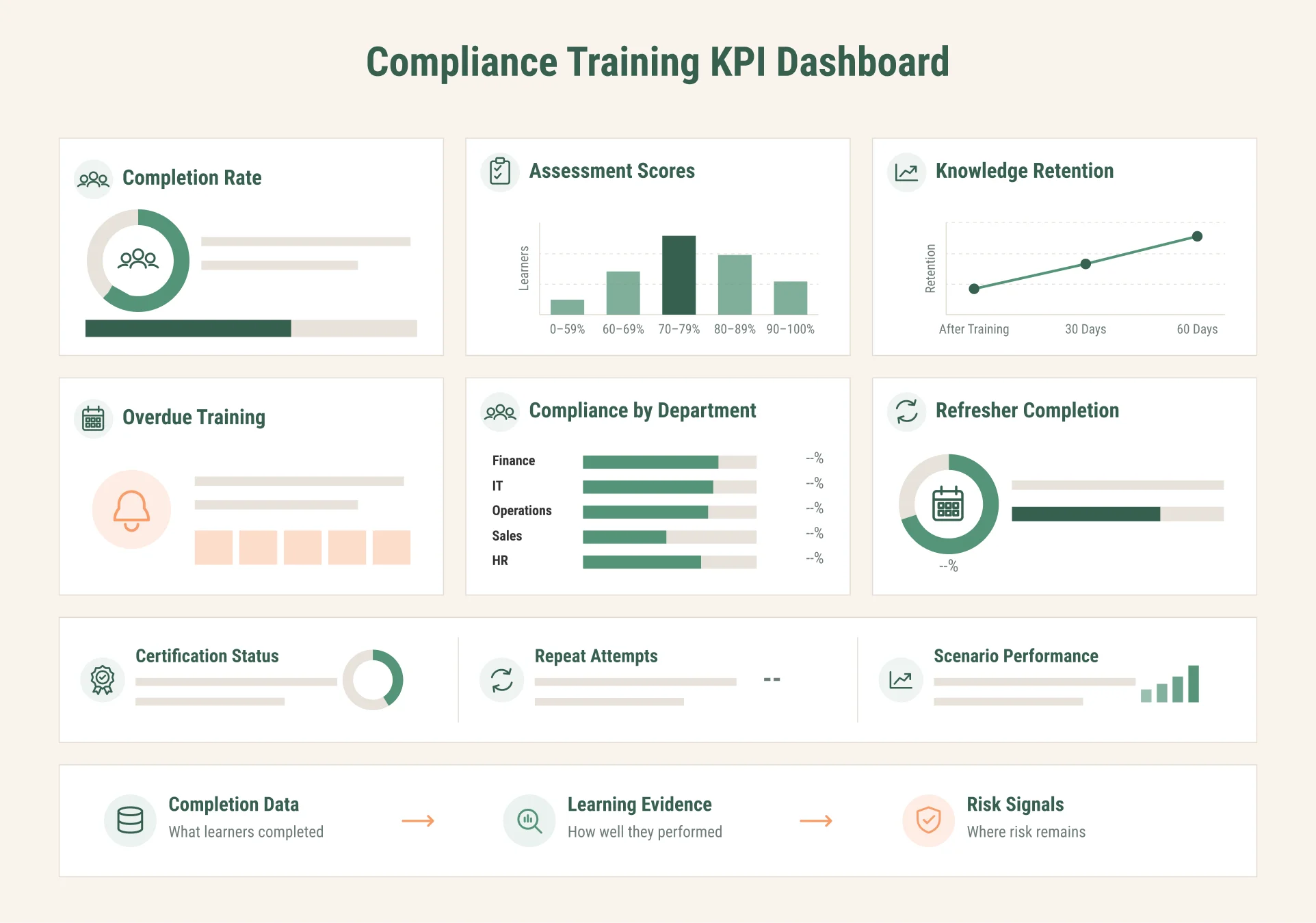
Useful compliance reporting combines completion with assessment, retention, certification, and departmental risk signals
Best Practices for Designing Gamified Compliance Training
Successful gamifying training requires restraint, because more mechanics do not automatically create better learning.
Start with the compliance decision
Two questions come before any mechanic: what mistake are we trying to prevent, and what does the correct workplace behavior look like? Only then should the team decide whether a scenario, point system, badge, progression rule, or challenge belongs in the course.
Raccoon Gang’s training design process follows the same outcome-first logic.
Match mechanics to the sensitivity of the subject
- Leaderboards can fit a voluntary cybersecurity challenge. They are usually wrong for harassment, ethics remediation, health, or individual compliance failures.
- Badges work well for certification milestones. They add little when awarded for opening a page.
“In the process of creating a leaderboard for our partners, I often ask myself: ‘Would I feel motivated or crushed by this board?’ Only if the answer is positive will I add it to the course.
— Olha Turutova, Head of Instructional Design & e-Learning Content, Raccoon Gang
Use realistic workplace scenarios
Use situations employees can plausibly encounter: recognizable roles, realistic pressure, common mistakes, competing priorities, and meaningful consequences. Avoid one obviously correct answer surrounded by nonsense.
Give immediate explanatory feedback
“Correct” is weak feedback. Better:
Correct. Reporting the message instead of deleting it allows the security team to inspect the threat and warn other employees.
Reinforce the decisions that carry risk
Not every paragraph in a policy needs repetition. Identify the decisions where errors create real exposure, then bring those back through refreshers and scenario challenges. Employees who consistently demonstrate mastery do not need the same refresher as people who repeatedly struggle with a topic.
Personalize refresher training
Use role, previous assessment results, time since certification, and policy changes to decide what returns to whom.
Protect accessibility
Game mechanics cannot become a barrier to mandatory learning. Check keyboard access, screen-reader behavior, contrast, captions, readable feedback, time limits, motion, and alternative ways to complete interactions.
Practical checklist
- [ ] Define the behavior the training needs to reinforce.
- [ ] Separate mandatory requirements from optional enrichment.
- [ ] Choose mechanics that fit the sensitivity of the topic.
- [ ] Build challenges around realistic workplace decisions.
- [ ] Provide immediate explanatory feedback.
- [ ] Connect badges and points with meaningful achievements, never with competition that can expose learners.
- [ ] Build refresher activity into the learning journey.
- [ ] Measure assessment quality as well as completion.
- [ ] Test accessibility and mobile behavior, then verify certification, reminders, and reporting in the production LMS.
If the design workload exceeds internal capacity, Raccoon Gang’s guide to outsourcing instructional design explains when outside course-design support makes sense and what should remain with internal SMEs and compliance stakeholders.
How Raccoon Gang Builds Engaging Compliance Learning
Raccoon Gang works across two sides of compliance learning that are usually handled separately: instructional design and the LMS environment that records what happens afterward. Our specialists work with:
- Open edX, Moodle, and Canvas;
- instructional design and scenario-based learning;
- adaptive pathways and assessments;
- gamification, badges, and certificates;
- analytics and compliance reporting;
- enterprise integrations and mobile learning;
- eLearning content production.
The starting question is never which mechanic to add. It is what behavior matters, and what evidence will show that learners can perform it.
That approach follows the same logic as Raccoon Gang’s eLearning content development process, which starts with the business goal and learner need before content production, LMS setup, testing, and iteration.
EBRD: gamification inside a wider learning program
For the EBRD Policy Academy project, Raccoon Gang transformed a 24-hour instructor-led seminar into an 8-hour self-paced program delivered through Open edX.
The work produced 84 instructional videos, 6 real-world case studies, 13 interactive exercises, 125 assessment questions, and a scenario-based role-play, alongside progress tracking, certificates, analytics, and structured quality assessment. The platform supports EBRD staff and thousands of external stakeholders across 38 countries.
Gamification was part of that learning environment rather than a substitute for the instructional work behind it. For compliance, that distinction is the whole point: mechanics support the program; they do not replace the controls.
Cybersecurity: connect learning activity with risk
The cybersecurity training platform developed by Raccoon Gang shows the connection more clearly. The environment served 55,000 learners and included:
- gamification and badging;
- learning paths;
- custom course assignment;
- assessments;
- dashboards;
- reporting by company, department, team, and learner;
- a custom Risk Factor metric.
For compliance stakeholders, this is the more useful direction for gamification in training: not whether employees earned the badge, but what their performance says about preparedness.
Gamification at LMS level
Raccoon Gang’s RG Gamification for Open edX adds configurable points, achievements, badges, leaderboards, dashboards, levels, and rules to learning paths.
That helps when an organization wants gamification across several courses rather than rebuilding each one around separate game logic.
Talk to our experts about designing compliance training that employees remember, and auditors can trust.
Conclusion
Compliance training should build confident decision-makers, not just complete enrollment records. That does not mean every policy needs a game. It means mandatory learning should ask employees to do more than consume information.
Compliance eLearning gamification can introduce realistic scenarios, challenges, progression, feedback, mastery rules, and repeated practice around the decisions that carry the greatest risk. Strong instructional design keeps those mechanics tied to the requirement, while the LMS handles learning paths, certification, reminders, reporting, and audit records.
Together, those pieces turn gamified training into something more useful than entertainment: repeated opportunities to recognize risk, choose the right action, and remember why it matters.
The rule holds whenever organizations gamify corporate training: define the behavior first, choose the mechanic second, measure what happens after completion.
FAQ
What is gamification in compliance training?
Does gamification improve compliance training?
Which game mechanics work best for compliance learning?
Can an LMS support gamified compliance training?
How do you measure the success of compliance training?
Is gamification suitable for highly regulated industries?




- Why Traditional Compliance Training Often Falls Short
- What Is Gamification in Compliance Training?
- Benefits of Gamified Compliance Training
- Real-World Compliance Training Examples and Gamification Ideas for Training
- Build Gamification Across the Full Compliance Cycle
- How an LMS Supports Compliance Gamification
- Best Practices for Designing Gamified Compliance Training
- How Raccoon Gang Builds Engaging Compliance Learning
- Conclusion