







But the comparison becomes less obvious once an L&D team asks a different question: what does the training need learners to do differently after they finish it? When considering custom e-learning solutions vs off-the-shelf content, it’s clear that a generic cybersecurity awareness course and proprietary incident-response training solve very different problems. Price and production speed matter, but they are only part of the decision.
The pressure behind that decision keeps growing. LinkedIn’s 2026 Talent Velocity research found that 89% of surveyed talent leaders were concerned about skills agility, meaning their ability to supply the right skills as work requirements change.
For teams weighing off-the-shelf e-learning against custom e-learning, there are really three choices:
- buy ready-made learning content;
- develop content around your own learners, processes, and goals;
- combine both inside one learning path.
The third option deserves more attention than it usually gets.
Key Takeaways
- Off-the-shelf content is usually the better choice for universal topics where organization-specific context adds little learning value.
- Custom eLearning becomes more useful when learners must apply proprietary processes, products, standards, or role-specific decisions.
- A cheaper course is not necessarily cheaper training. Utilization, maintenance, learner volume, updates, and performance outcomes all affect total cost.
- Instructional design matters on both sides. A custom course can fail just as easily as a library course if learners receive information without meaningful practice or assessment.
- Many enterprise programs combine ready-made content for foundational knowledge with custom modules for company-specific application.
- Training ROI should connect learning data with operational measures such as time-to-productivity, error reduction, support volume, or customer outcomes.
At a Glance
Choose off-the-shelf content when the subject is widely applicable, speed matters, and a standard course can meet the learning objective without substantial adaptation. Choose custom eLearning when the required behavior depends on your processes, products, terminology, scenarios, or performance standards. Choose a hybrid strategy when some knowledge is generic, but learners also need to apply it in your organization’s specific context. This build-buy-combine decision should start with learning needs and end with measurable performance, rather than starting and ending with course price.
What Is Off-the-Shelf eLearning?
Off-the-shelf eLearning is ready-made digital training produced for a broad audience and licensed or sold to multiple organizations.
Instead of creating a course from scratch, an L&D team selects existing modules from a provider. These may be purchased individually or accessed through a subscription content library containing hundreds or thousands of courses. Common subjects include workplace safety, cybersecurity awareness, data protection basics, communication, leadership fundamentals, wellbeing, and common office software.
The attraction is easy to see. Off the shelf elearning courses already exist, so rollout can be considerably faster than producing new materials.Recent industry comparisons draw the same conclusion: ready-made content fits generic topics well, whereas company-specific systems, products, and procedures usually require more context. Catalog courses have to work for any company in any sector, which is precisely why they rarely reflect any single organization’s context.
There is still work to do before purchasing a library: evaluate content quality, accessibility, language coverage, LMS requirements, reporting, licensing terms, update policies, and expected utilization.
A library containing 5,000 courses sounds impressive. If employees need 30 of them, catalog size is a weak purchasing metric.
This matters most when comparing off-the-shelf elearning content providers. The real question is not, “Who has the biggest library?” It is, “Which off the shelf elearning content solves the learning needs we actually have?”
What Is Custom eLearning?
Custom eLearning is developed around a defined audience, learning objective, business context, and delivery environment.
That changes the production process considerably. Instead of selecting an existing course, instructional designers work with subject matter experts to determine what learners already know, what they should be able to do afterward, where mistakes currently happen, which scenarios reflect actual work, how practice should be structured, and how competence will be assessed. This analysis is the first step in the training design process, and it shapes every decision that follows.
A custom eLearning solution may include interactive scenarios, simulations, video, branching decisions, job aids, product demonstrations, role-specific learning paths, or other formats. Published guidance on choosing between the two approaches puts a typical custom project at roughly eight to sixteen weeks, depending on length, interactivity, and review cycles — a realistic planning horizon rather than a reason to avoid the route.
Branding is part of the picture, but it should rarely be the main reason for commissioning bespoke elearning. Changing colors and adding a logo does not turn generic training into an effective custom course.
Good custom eLearning design begins earlier. Learning objectives determine the structure; designers map activities to those objectives; SMEs validate the knowledge; and assessments test whether learners can apply it. A custom eLearning solution covers considerably more than custom content. Our instructional designers define learning strategy, assessment logic, and the ecosystem in which the training will live before production begins — the sequence that practitioner discussions across the industry consistently identify as the difference between a course and a learning program.
Raccoon Gang follows this logic in its broader eLearning content development process: analysis comes before instructional design, development, LMS integration, testing, launch, and iteration.
Our work on NASA’s Open Science 101 curriculum is a useful example. NASA already had deep subject expertise; the job was converting it into a structured digital curriculum. Our team worked with NASA SMEs across five modules and 25 lessons, developed interactive content in Rise 360, delivered it to an Open edX platform through SCORM, and supported quizzes, progression rules, badges, and learning analytics.
The value was not simply “custom content.” It was the connection between expert knowledge, instructional structure, assessment, LMS delivery, and learner progression.
Custom eLearning vs Off-the-Shelf Content
Here is where the trade-offs become clearer.
| Area | Off-the-Shelf Content | Custom eLearning |
| Development time | Usually available immediately or after basic configuration | Requires analysis, design, development, review, and QA |
| Implementation | Fast once licensing and LMS setup are complete | Planned around the target LMS, audience, and rollout |
| Initial cost | Usually lower | Usually higher |
| Cost model | Often subscription or per-user licensing | Project investment plus maintenance |
| Learner engagement | Depends on library quality and relevance | Can use company-specific scenarios, decisions, and tasks |
| Branding | Limited or provider-controlled | Can match the learning program and brand |
| Flexibility | Restricted by provider options | Structure and interactions can be changed |
| Localization | Depends on provider catalog | Languages and regional variants planned around the audience |
| Updates | Provider manages generic updates | Organization controls or commissions updates |
| Analytics | Depends on package and provider | Measurement planned around learning and business goals |
| Long-term ROI | Attractive for smaller or changing learner populations | Improves with large, stable audiences and reusable content |
| Best fit | Universal knowledge and fast deployment | Proprietary knowledge, application, and differentiation |
The cost rows deserve particular attention.
Ready-made content has a lower entry cost, while custom development requires more investment before launch. Over several years, per-user licensing can change that comparison as learner numbers rise. One published illustrative example shows the break-even point moving as learner volume grows, while explicitly noting that real figures depend on pricing and circumstances. A useful exercise is a three-year total cost comparison: license fees compound with headcount and renewals, while a custom build is owned outright.
So there is no universal rule such as “custom is cheaper after three years.” Your break-even point depends on:
- learner count × licensing model × content lifespan × maintenance × administration × utilization
And that still measures only cost. The harder question is what the course produces.
When Off-the-Shelf Content Works Best
Off-the-shelf content works particularly well when the knowledge is transferable between organizations.
Take basic fire safety: the foundational principles are the same in almost any company. The same logic applies to introductory cybersecurity awareness, workplace conduct topics, and general communication skills.
Buying existing off the shelf elearning content makes sense when:
- the subject is generic and a good course already exists;
- rapid rollout matters;
- the audience changes frequently;
- organization-specific scenarios add little to performance;
- training primarily establishes baseline knowledge;
- internal production resources are limited.
It can also protect your custom development budget. Suppose a leadership program needs both general coaching principles and your company’s own performance-review process. A ready-made module can cover the foundation, so your resources go into the company-specific part.
The limitation is relevance. A library course cannot know how your managers conduct reviews, which software they use, which escalation rules apply, or which behaviors your leadership team expects.
The question is therefore simple: how much organizational context does successful performance require? If the answer is “very little,” buying content becomes attractive.
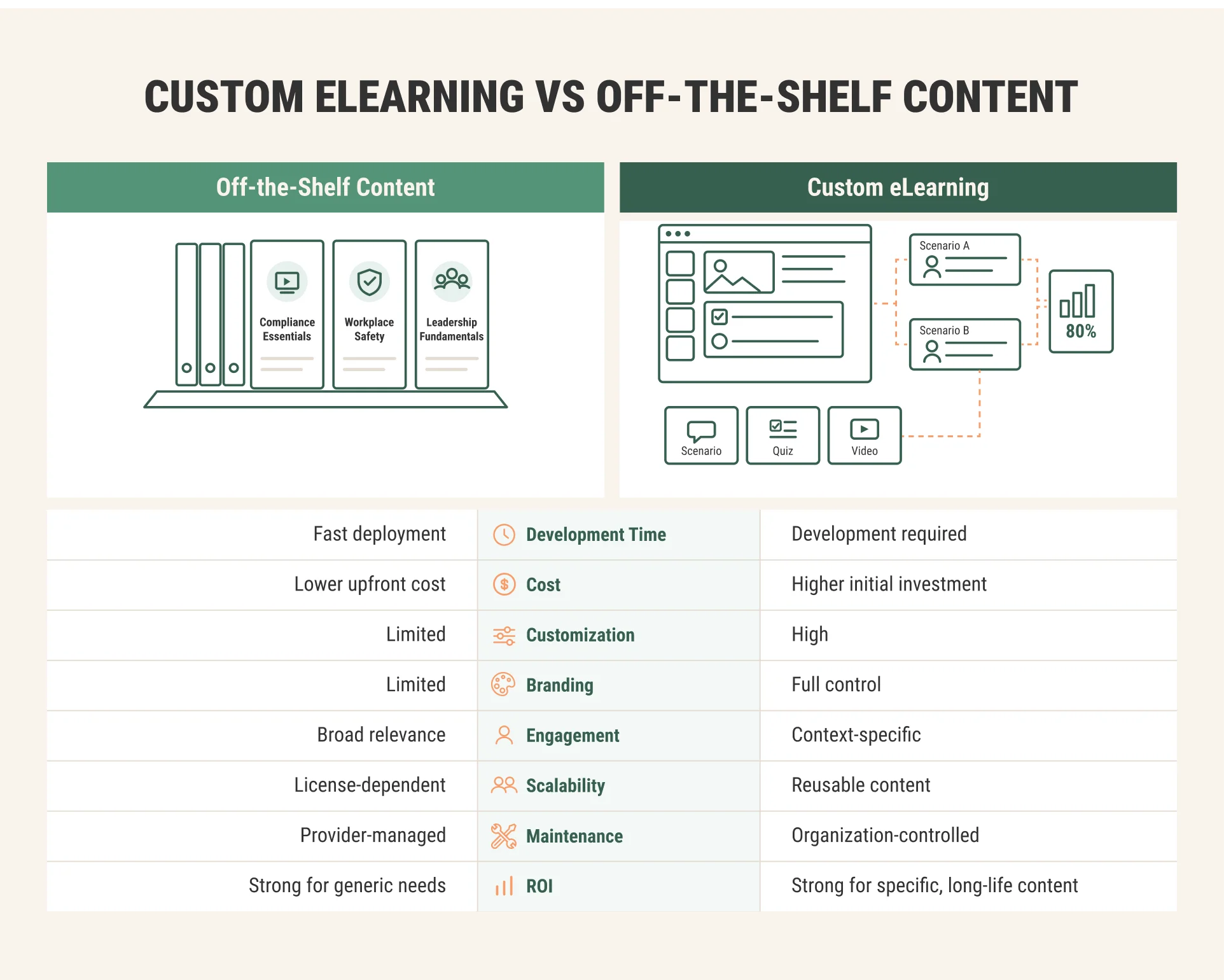
Off-the-shelf content favors speed and lower initial spending, while custom development offers greater control over context, learning design, and long-term use.
When Custom eLearning Delivers Better Results
Custom development becomes more convincing as the distance grows between generic knowledge and actual job performance.
Consider product training. A standard course can teach broad selling techniques, but it cannot explain your product architecture, the objections customers raise, your implementation process, or your sales playbook.
The same gap appears in proprietary operating procedures, customer education, partner enablement, specialized onboarding, healthcare workflows, manufacturing processes, financial services procedures, software adoption, and company-specific compliance.
Here, relevance is part of instructional design. Learners practice the decisions they will actually make. Assessments mirror real situations. Feedback explains what the organization expects rather than what a generic provider assumes.
This distinction also matters for a customer education platform. The training may be part of the product experience itself. A course teaching customers how to use your software cannot be substituted with an unrelated library module.
Raccoon Gang met a related content-transformation challenge in the EBRD Policy Academy. Existing materials included case studies, academic lectures, recorded discussions, reading materials, and seminar records. The project required instructional design, content enhancement, accessibility work, migration, Open edX delivery, platform management, and structured evaluation of content quality after launch.
That type of requirement cannot be reduced to “find a similar course in a catalog.” When performance depends on your own standards, a bespoke elearning approach and a well-scoped custom eLearning solution earn their budget.
Hybrid Learning Content Strategy
Enterprise learning rarely needs one content source for every problem. A more practical strategy often looks like this:
- Off-the-shelf modules → Custom modules → Instructor-led activities → Job support → LMS reporting
The library handles universal knowledge. Custom modules explain how that knowledge applies inside your company. Instructor-led sessions provide discussion, coaching, and expert feedback. Job aids support employees after formal training ends. The LMS connects the pieces.
Independent guidance on learning content options increasingly describes this build-buy-combine model as the practical way to reserve custom development for the areas where context matters most. Leadership development is a common example: generic content introduces coaching principles, while custom cases and workshops show managers how those principles fit company expectations.
Imagine onboarding a new customer-support specialist. They might complete:
- an off-the-shelf module on communication;
- a custom module about your products;
- a custom simulation using common ticket scenarios;
- a live coaching session;
- a searchable job aid for escalation rules.
That is one learning path, even though the content comes from several sources. The same logic supports a customer onboarding process, a partner academy, or a compliance program.
SCORM, LMS, and Technical Compatibility
A good course that does not work correctly inside your LMS is still a bad investment. Technical compatibility should enter the selection process before the contract is signed.
SCORM remains widely used for packaging digital course content and communicating basic learner data between a course and an LMS. Depending on implementation, it can report completion, score, status, and learner progress.
The important feature is portability. If a provider gives you a SCORM package, verify which SCORM version it uses, whether your LMS supports it, what completion data is reported, whether the course resumes correctly, how it behaves on mobile, and how updates are distributed.
Our complete guide to SCORM explains the packaging and LMS communication process in more detail.
Platform support also differs. Open edX can display SCORM through its SCORM XBlock, which supports SCORM 1.2 and SCORM 2004 and can retain learner state and report scores. Moodle provides a SCORM activity for uploading and managing SCORM or AICC packages. Canvas documentation describes importing SCORM content as assignments or pages where the integration is available.
xAPI addresses a broader class of learning activity, describing how learning technologies exchange data about learner experiences beyond conventional LMS course events.
This is why LMS compatibility belongs in content strategy rather than appearing as a technical check at the end. For more context on platform architecture, see our guide to the Open edX platform.
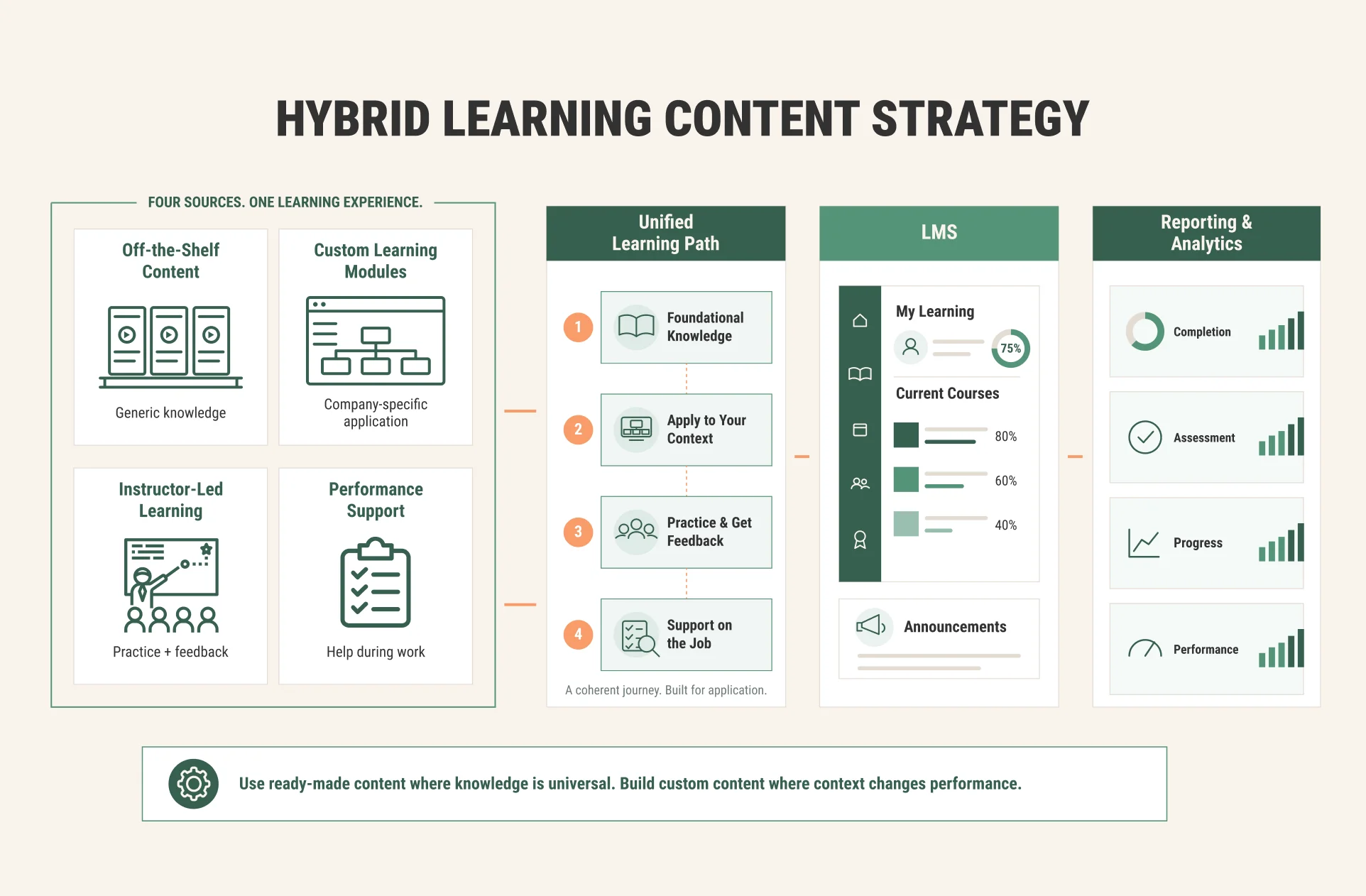
Hybrid learning content places generic knowledge and organization-specific training in the same learner journey rather than forcing one content model to solve every problem.
Calculating Training ROI Beyond the Course Invoice
The weakest comparison looks like this: Library: $X. Custom course: $Y. Choose the lower number.
Training ROI needs a wider denominator and a much wider view of benefits. A basic calculation is:
ROI (%) = [(measurable benefits − total training costs) / total training costs] × 100
Raccoon Gang’s guide to measuring training ROI recommends looking beyond completion and connecting learning with operational measures such as productivity, onboarding time, compliance performance, support volume, retention, and customer outcomes. Evaluation frameworks like the Kirkpatrick model are useful here because they push measurement past reaction and completion toward behavior change and business results.
For content selection, gather four groups of data:
- Learning metrics: completion rate, assessment performance, knowledge retention, learner satisfaction.
- Performance metrics: task accuracy, time-to-competence, error rate, adherence to procedures.
- Business metrics: support ticket volume, sales conversion, onboarding duration, audit findings, rework costs.
- Cost metrics: licensing, development, LMS configuration, learning time, administration, translation, updates, maintenance.
A simplified illustration, with hypothetical numbers: imagine 1,000 learners who need the same product training annually for three years. A library license at $30 per user per year costs $90,000 over that period. A custom module at $45,000 upfront plus $5,000 in yearly updates costs $60,000 — and it teaches your actual product workflow, which can also reduce support escalations.
Now reverse the volumes. For 150 employees needing annual baseline cybersecurity training, the same license costs $13,500 over three years, and the provider keeps the content current. Rebuilding that foundational material yourself adds production and maintenance costs without a meaningful performance gain.
The point is not the specific figures. It is that learner volume, licensing, content lifespan, and measurable outcomes decide the answer — not the first invoice. That is why ROI has a timeline.
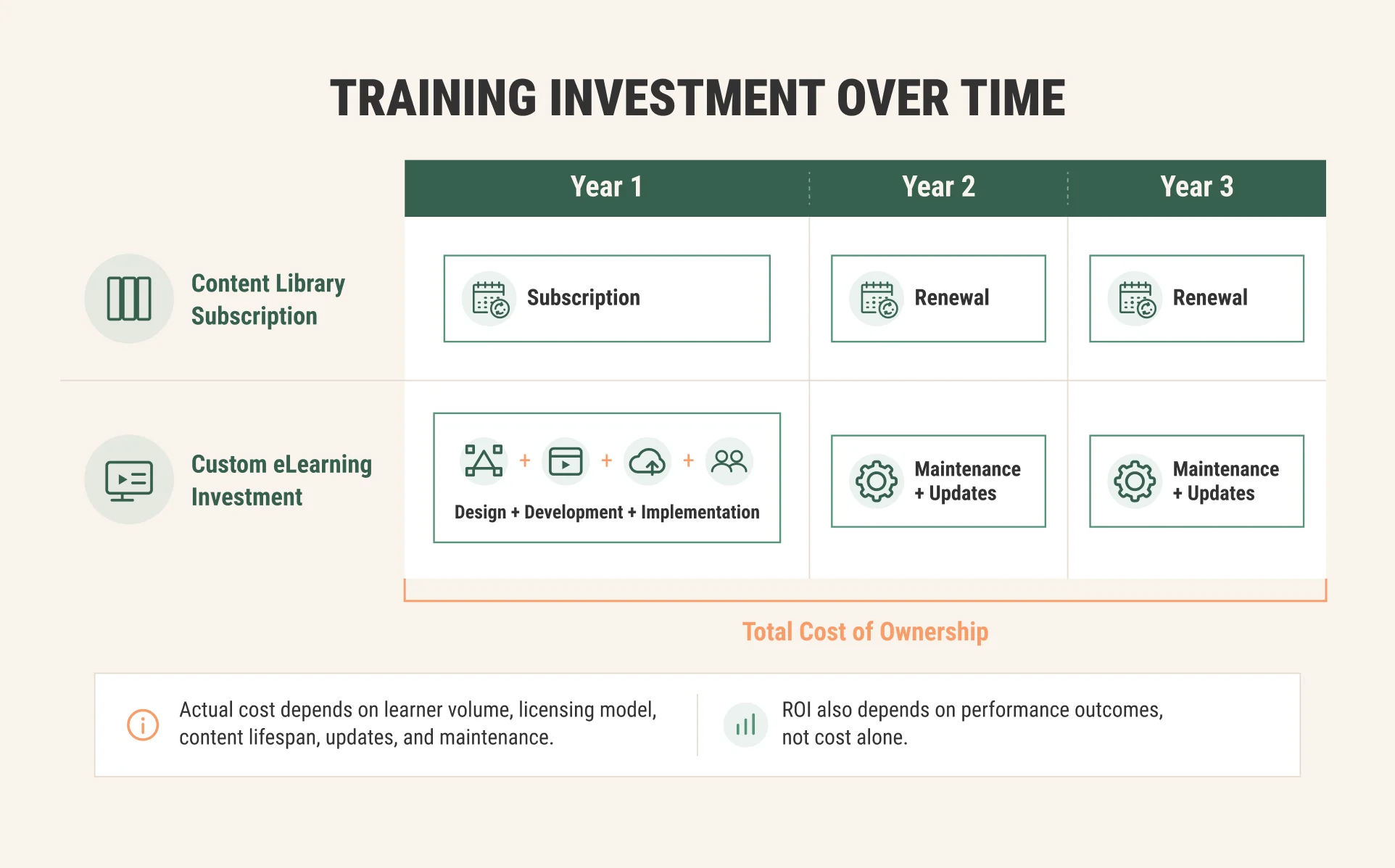
Initial price tells only part of the story. Learner volume, recurring licenses, content lifespan, updates, and measurable performance determine the longer-term cost picture.
Common Mistakes When Choosing Learning Content
Choosing based only on price
Cheap content that does not solve the learning problem is still wasted spending. Expensive custom content that does not solve it is worse.
Ignoring instructional design
Custom does not automatically mean effective. If a course simply turns an 80-slide SME presentation into 80 digital screens, the organization has purchased conversion, not instructional design. This holds whether you build courses in-house or outsource instructional design to a partner. Our comparison of instructional design and curriculum development explains the distinction: learning goals need to connect with activities, practice, assessment, and feedback.
Buying a huge library without checking utilization
Catalog size is useful only when employees use the relevant courses. Ask providers for usage reporting, renewal conditions, and course-level activity data.
Forgetting localization
Translation alone may not be enough. Examples, legal references, terminology, narration, interfaces, assessment language, and accessibility requirements can vary between learner groups.
Checking LMS compatibility too late
Implementation is the fifth step in the training design process, and it is usually where compatibility problems surface if testing waited too long. We have watched otherwise sound content decisions unravel at this stage for a simple reason: the package was never opened in the target environment before the contract was signed. Our team treats a short compatibility pilot as part of selection rather than a post-purchase discovery. Test representative packages before rollout, and make platform behavior part of your enterprise LMS evaluation checklist.
Measuring completion instead of performance
Completion answers: did the learner reach the end? It does not answer: can the learner perform better now? Evaluation should follow implementation, and the resulting evidence should feed later improvements.
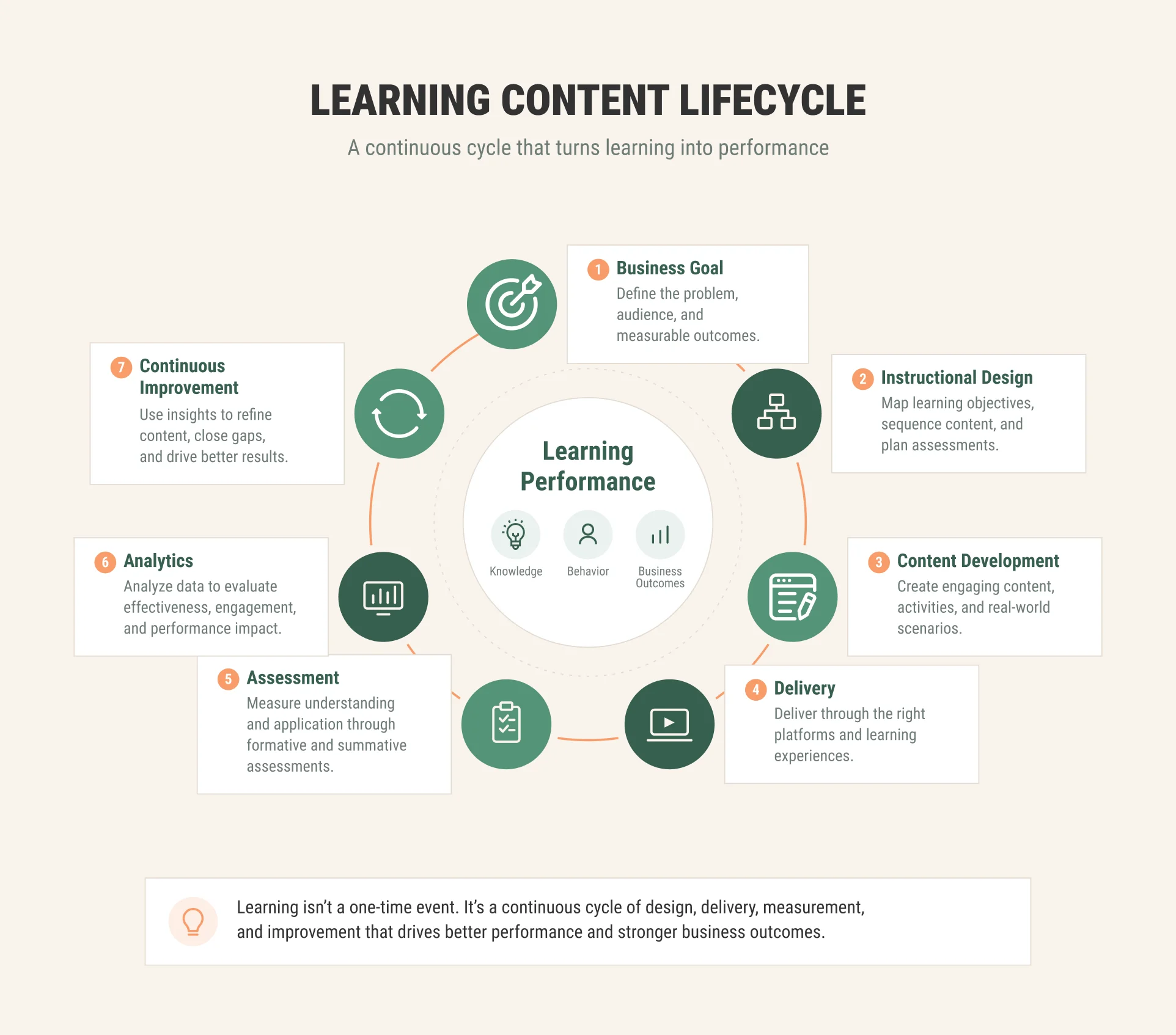
Content selection starts with the business goal and continues after launch. Assessment and analytics show what should change in the next iteration.
Decision Framework: Which Option Fits?
This is the fastest way to make the decision.
Choose Off-the-Shelf if:
- Your training need is mostly universal, and the course already exists in acceptable quality.
- You need deployment quickly.
- Your learner population is small, uncertain, or changes frequently.
- The subject changes often and provider-managed updates are valuable.
- The purpose is foundational knowledge rather than deep application.
Typical examples: general cybersecurity awareness, basic workplace safety, communication fundamentals, introductory leadership topics.
Choose Custom eLearning if:
- Learners must follow your process rather than a generic one.
- Errors carry operational, financial, safety, regulatory, or customer consequences.
- Your product, systems, terminology, or roles are central to the learning objective.
- You need scenarios that reproduce actual decisions, and assessment must prove application rather than recall.
- The content will serve a large or stable audience for a long period.
- You need control over accessibility, localization, analytics, or updates.
Typical examples: software product training, healthcare procedures, equipment operation, customer education, partner certification, proprietary onboarding.
Choose a Hybrid Strategy if:
- Some required knowledge is universal, and some is organization-specific.
- Your library covers fundamentals but not application.
- Live practice or coaching is still important.
- Different learner groups need different levels of depth.
- You want to reserve custom development for the moments where context produces the most value.
Typical example: managers complete a ready-made coaching course, then work through custom scenarios based on your performance-review process, supported by a workshop and a job aid.
If two of these columns describe your situation, start from the hybrid model and decide module by module.
One useful final question: what happens if the learner completes this course but cannot apply it correctly? If the consequence is small, buying existing content may be enough. If it is substantial, closer control over instructional design, practice, and assessment becomes more important.
How Raccoon Gang Designs Enterprise Learning Content
Raccoon Gang approaches learning content as part of a wider training system. Our specialists work across learning needs analysis, instructional design, custom eLearning development, multimedia production, SCORM development and integration, Open edX, Moodle, Canvas, accessibility, localization, assessments, analytics, and post-launch improvement.
The process starts before production. What should change after the course? What does the learner need to practice? Which existing materials are useful? What can be purchased rather than recreated? What needs custom development? Which evidence will show that the program worked?
This approach has taken different forms across our projects. For NASA Open Science 101, our team converted specialist scientific content into a five-module curriculum with interactive activities, SCORM delivery, assessment, badges, and analytics. For the EBRD Policy Academy, the work included transforming varied source materials into e-modules, supporting accessibility and language work, migrating knowledge assets, and managing the Open edX platform.
Different content. Different audiences. Different requirements. The common point is that course production follows the learning problem rather than the other way around.
Conclusion
The best learning content is not necessarily the cheapest course or the fastest one to deploy.
Sometimes the right answer is a content library. Paying for custom development to create high-quality generic training makes little sense. Sometimes custom eLearning is worth the additional effort because the behavior, process, product, or performance standard belongs specifically to your organization. Quite often, the strongest answer sits between them.
Use off the shelf elearning for knowledge that does not need to be reinvented. Use custom content where your context changes what learners need to know or do. Connect both through purposeful instructional design, LMS delivery, assessment, and business measurement.
That is a much more useful way to evaluate training ROI than comparing two development quotes.
FAQ
What is off-the-shelf eLearning?
What is custom eLearning?
Which is more cost-effective: custom eLearning or content libraries?
When should organizations invest in custom eLearning?
Can off-the-shelf content be used in any LMS?
What is SCORM, and why does it matter?
How do you measure training ROI?




- Key Takeaways
- What Is Off-the-Shelf eLearning?
- What Is Custom eLearning?
- Custom eLearning vs Off-the-Shelf Content
- When Off-the-Shelf Content Works Best
- When Custom eLearning Delivers Better Results
- Hybrid Learning Content Strategy
- SCORM, LMS, and Technical Compatibility
- Calculating Training ROI Beyond the Course Invoice
- Common Mistakes When Choosing Learning Content
- Decision Framework: Which Option Fits?
- How Raccoon Gang Designs Enterprise Learning Content
- Conclusion