







A hospital’s training program answers to a different standard than most corporate ones, because errors surface on different timelines. If an onboarding step gets skipped, a new hire just takes a little longer to get up to speed. If a compliance step gets skipped, it might not surface until an accreditation review or an OCR audit pulls the record, with a patient’s file attached to it. This guide walks through what a healthcare LMS needs to do to hold up under that kind of scrutiny, and how to judge the platforms that say they do it.

Hospitals lost an average of $61,110 for every registered nurse who left in 2024, and national RN turnover held at 16.4% that year, according to the 2025 NSI National Health Care Retention & RN Staffing Report. Some units, step-down and telemetry among them, effectively turn over their entire nursing staff within four and a half years. Every one of those replacements has to be onboarded, credentialed, and brought up to competency fast, and that is precisely the kind of volume a healthcare LMS is designed to absorb. A generic corporate platform was never built to handle it at that scale.
TL;DR:
A healthcare LMS is a learning platform built specifically to manage clinical competency tracking, regulatory compliance, and certification renewal at hospital scale. Choosing the right one comes down to organization size, integration requirements, and how much ownership the organization wants over its own learning data.
At a Glance
- Healthcare LMS — a learning platform purpose-built for hospitals, clinics, and health systems to manage clinical training, credentialing, and mandatory compliance courses from one system.
- Clinical Competency Management — the ongoing process of validating and re-certifying the specific skills a role requires, anchored to real patient-care outcomes.
- Compliance Training — the mandatory education healthcare staff must complete to satisfy regulations such as HIPAA and OSHA, plus internal policy and accreditation requirements.
- LMS Evaluation Framework — a structured method for comparing platforms on compliance support, integrations, scalability, and total cost of ownership.
What Is a Healthcare LMS?
A healthcare LMS is a learning management system built to run clinical education, mandatory compliance training, and credentialing for hospitals, clinics, and other care organizations. A general corporate LMS tracks course completions and calls it done, while a hospital learning management system has to carry a good deal more weight.
Training has to tie back to license renewal dates, competencies need mapping to specific clinical roles, and the resulting audit trail has to hold up when a state surveyor or accreditation body comes asking questions. Skills tracking is the piece that makes this concrete: it’s the mechanism that proves a nurse is cleared to perform a procedure, backed by a scored, dated record tied to a specific competency that a surveyor can pull up on demand.
That’s really the dividing line between healthcare LMS systems and their corporate cousins. Retail and manufacturing platforms optimize for reach and completion rates, getting as many people through a course as fast as possible. Healthcare platforms optimize for something closer to defensibility: the ability to show, on demand, exactly who was trained on what, when, and whether that training still counts today.
Why Healthcare Organizations Need an LMS
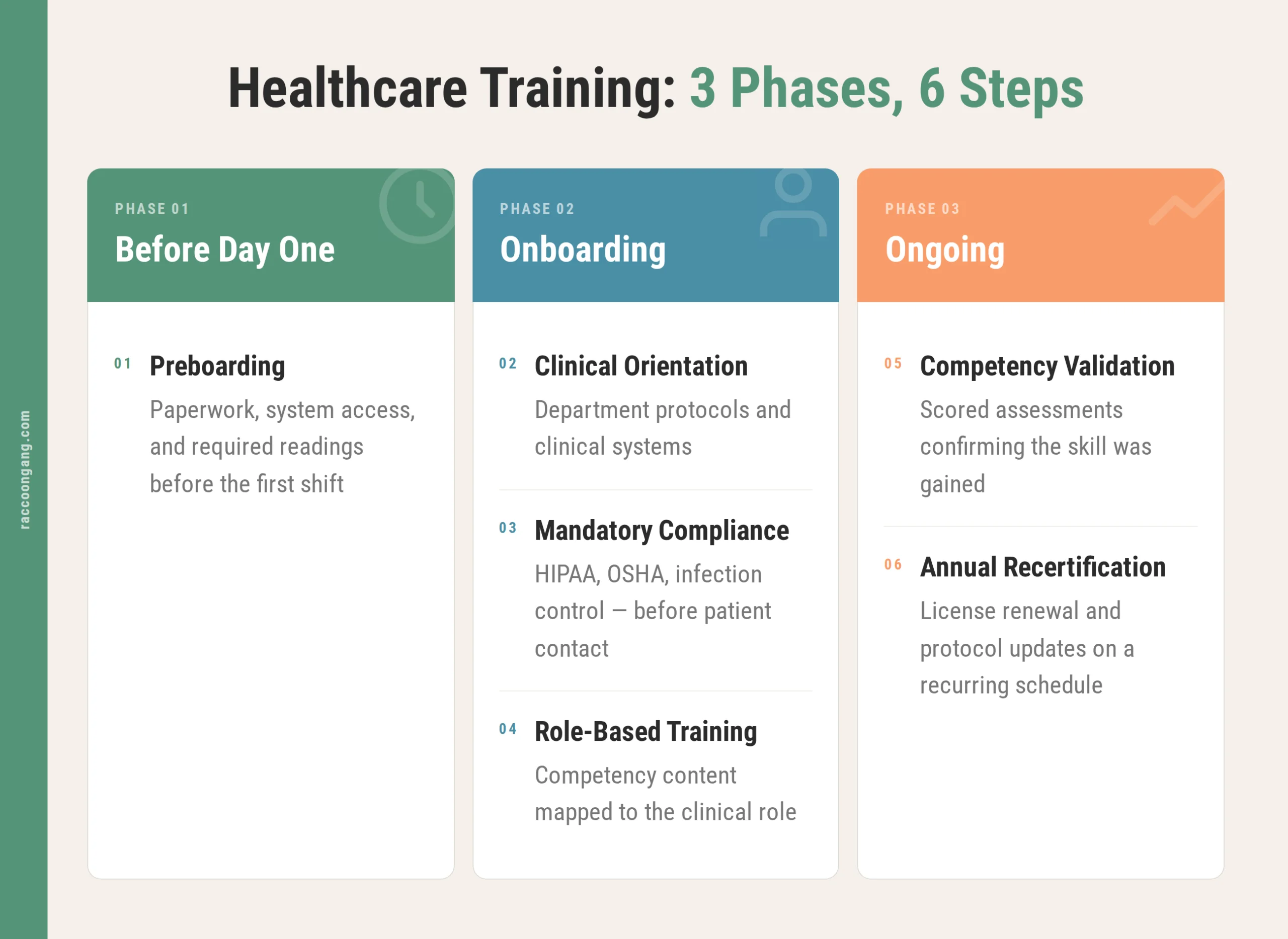
The healthcare and pharmaceuticals segment is now the fastest-growing vertical in the entire LMS market, expanding at roughly a 13.7% CAGR according to Mordor Intelligence. Regulatory exposure explains a good chunk of that growth.
HIPAA, OSHA, and accreditation bodies each carry their own training mandates, and OCR has said that inadequate risk analysis shows up in roughly 90% of its Security Rule enforcement actions. A lot of that traces back to gaps in staff training and documentation alongside the technical failure that triggered the breach itself.
Compliance is only part of the story, though. Onboarding speed matters just as much when a hospital is backfilling hundreds of positions a year, and continuing education requirements pile up regardless of staffing levels, since clinical competency has to be demonstrated and re-demonstrated on a schedule that doesn’t pause for shortages.
Geography adds another layer. A health system with satellite clinics, traveling nurses, and per-diem staff can’t rely on in-person sessions to reach everyone consistently.
A healthcare training platform gives every location the same curriculum, the same version of a protocol, and the same record of who completed it. That matters when a protocol changes mid-quarter and someone needs proof the update reached staff, beyond just knowing it was published somewhere.
Types of Organizations That Use Healthcare LMS Platforms
The phrase “hospital LMS” undersells how broad this category gets.
- Hospitals and multi-site healthcare systems are the most visible users, running everything from nurse residency programs to annual OSHA refreshers through one system.
- Clinics lean on the same core infrastructure at a smaller scale, usually prioritizing onboarding speed over the reporting depth a large hospital network needs.
- Pharmaceutical and medical device companies use it somewhat differently. Their training centers on product certification and field rep compliance, with documentation built around FDA-adjacent requirements, a compliance surface built around the product itself.
- Public health agencies coordinate training across county or state networks where staff may never set foot in the same building.
- Medical universities and teaching hospitals sit somewhere in between, blending curriculum delivery with the same competency tracking and credentialing a working hospital relies on.
- Professional associations round things out, managing continuing education credits for members who aren’t even employees.
Essential Features of a Healthcare LMS
Feature gaps in a healthcare LMS rarely show up during a demo. They tend to surface later, during an audit or an incident, right when a compliance officer needs a record the platform was never built to produce.
Learning Paths and Clinical Competencies
Learning paths and competency tracking work best as one connected system. A path can route a new ICU nurse through orientation content and automatically layer in role-specific competency checks as they progress, so the sequence unfolds on its own, and the nurse never has to hunt through a static course catalog to find what’s next.
Skills Tracking, Certifications, and Assessments
A good system flags a certification a set number of days before it lapses and ties expiration status directly to scheduling, so a lapsed credential blocks the shift the moment it expires, well before someone would otherwise notice in a spreadsheet weeks later — that alone accounts for most of the compliance value an LMS delivers. Assessments back it up with real evidence, since a completed course means little without a scored evaluation attached to it.
Mobile Learning and Reporting Dashboards
Mobile learning matters more in healthcare than in most industries, simply because clinical staff rarely sit at a desk. A nurse finishing a module between patients needs it to load fast on a hospital-issued tablet during that short window. Reporting dashboards turn all of that activity into something a compliance officer can use directly: real-time visibility into who’s overdue, which department is lagging, and which certifications are approaching expiration.
Multi-Tenancy, APIs, and Data Standards
For organizations running multiple facilities or brands under one instance, multi-tenancy keeps each site’s content and reporting separate while still rolling up to a central view.
On the technical side, API support along with SCORM and xAPI compatibility determines how well the LMS plays with everything else in the stack. SCORM remains the baseline standard for importing existing course content (our SCORM guide covers the mechanics in more detail), while xAPI picks up where SCORM stops, capturing learning activity outside a formal course, like a simulation lab session or a mentor-led skills check.
Role-Based Permissions and AI Recommendations
Role-based permissions control who can see and edit what, so a department head doesn’t end up with the same access as a system administrator. AI learning recommendations are showing up in more healthcare LMS platforms lately too, surfacing refresher content based on a staff member’s role, recent performance, or upcoming recertification date, saving people from searching a catalog on their own.
Compliance and Clinical Training
Healthcare compliance training carries legal weight that most corporate training doesn’t. HIPAA violations alone have produced penalties ranging from $25,000 to $3 million in 2025 resolution agreements, according to Ogletree’s review of OCR enforcement trends. A documented, auditable training record is one of the clearest ways an organization can show it took its obligations seriously ahead of time, before something went wrong.
An LMS typically needs to cover several regulatory areas at once. HIPAA privacy and security training has to tie back to a documented risk analysis, and OSHA requirements span bloodborne pathogen exposure, hazard communication, and general workplace safety.
Infection prevention training needs a recurring refresh schedule that keeps pace with changing protocols, and patient safety content follows a similar rhythm, updated as evidence and guidance change, with fast redistribution when a protocol shifts mid-quarter.
Medical device training adds its own layer, requiring documented proof that a staff member trained on the exact model they operate, often tied to the vendor’s own certification process. Continuing education closes the loop, keeping licensed staff current with state and specialty board mandates.
None of this exists in a vacuum. Organizations still need to map every course back to the specific regulation or accreditation standard it satisfies, and confirm with their own compliance and legal teams that content stays current. An LMS can enforce completion, but whether what’s being completed is accurate stays the organization’s call.
Healthcare LMS Integrations
A healthcare LMS rarely operates as a standalone system, and healthcare organizations tend to carry more integration points than most industries manage.

HRIS and Identity Providers
HRIS integration keeps employee records, role changes, and terminations synced automatically, so a departing employee’s access doesn’t linger and a new hire’s training assignments trigger without someone manually setting them up. Identity provider integration through SSO cuts down on the password fatigue that comes with juggling a dozen clinical systems in a single shift.
Credentialing Systems and BI Platforms
Credentialing systems need a live connection to the LMS so a lapsed certification blocks scheduling the moment it happens, right inside the system where shifts get assigned. BI platforms pull training data into the same dashboards leadership already uses for clinical and financial metrics, which helps when training ROI needs a seat in a broader budget conversation, beyond its own separate report that nobody reads.
Content Libraries, Virtual Labs, and EMR/EHR
Webinar tools and content libraries let the LMS deliver more without building everything from scratch internally, and virtual labs cover the simulation-based training that video simply can’t replace.
EMR/EHR integration deserves a mention too, even at a high level: some organizations connect training completion status to clinical systems so role-based access reflects current certification, though how deep that connection goes still depends a lot on the specific platform and vendor.
Healthcare Learning Management System Comparison
No single platform wins across every category, and the right answer depends heavily on what an organization already has in place. Here’s a balanced look at how five commonly evaluated options compare on the criteria that matter most for healthcare buyers.
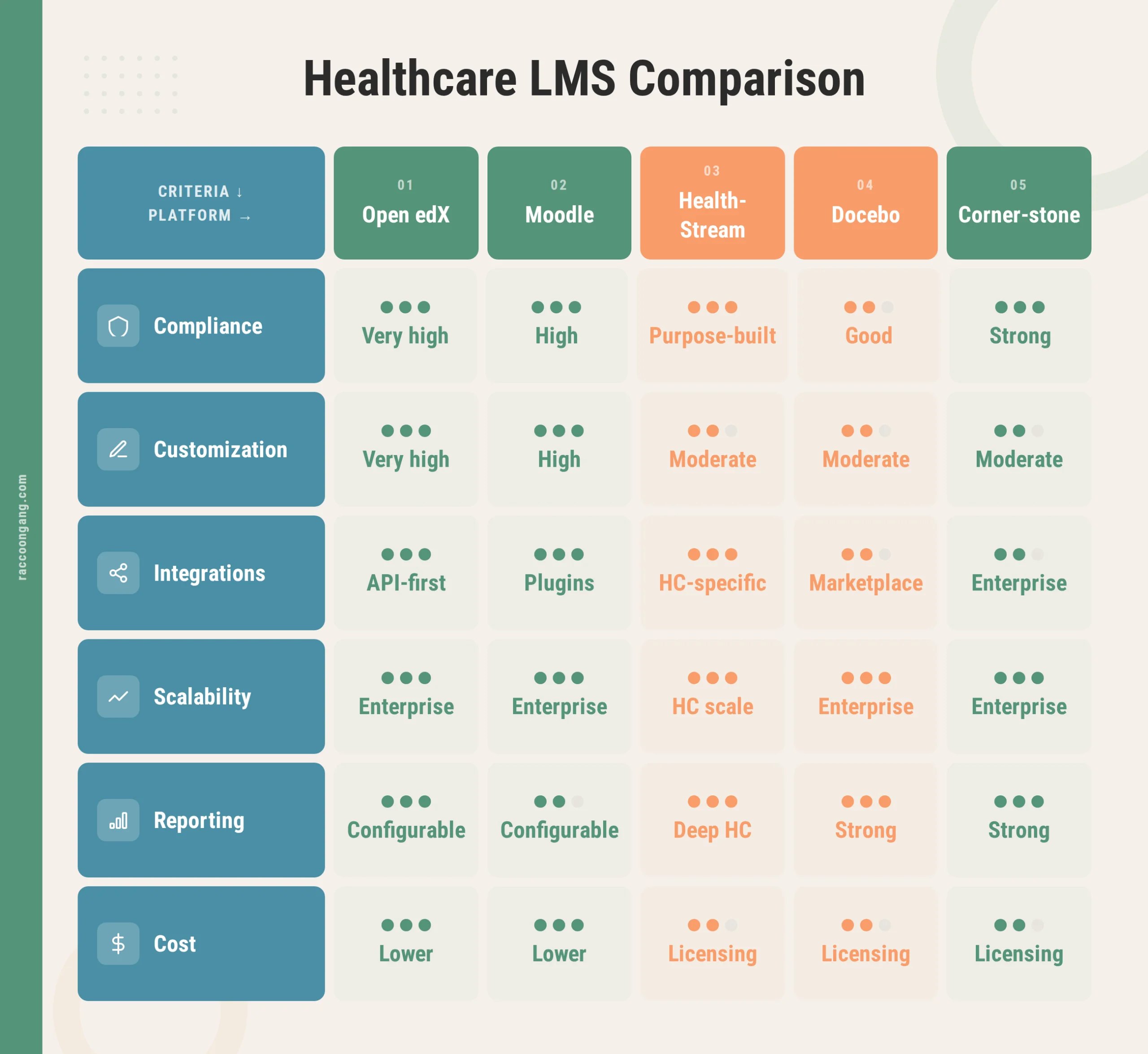
Overall, HealthStream’s edge is depth in healthcare-specific compliance reporting that comes pre-built into the platform, which suits teams that don’t want to configure that layer themselves. Docebo and Cornerstone bring strong general enterprise learning capabilities, with healthcare needs covered through their broader feature sets.
Moodle offers a genuinely open-source alternative with a large plugin ecosystem, and organizations that have already built Moodle integrations elsewhere can often extend that same investment into healthcare training.
Open edX distinguishes itself on ownership and extensibility: the source code belongs to whoever runs it, which turns into a real advantage for health systems planning a multi-year LMS strategy.
How to Choose the Best Healthcare LMS
A 40-bed community hospital and a 12-facility health system are shopping for fundamentally different things, even if both call it “a healthcare LMS.” A handful of criteria tend to decide the shortlist.
- Organization size and complexity. Start here, since it determines how much of everything else — reporting depth, integration count, admin structure — the platform needs to carry.
- Compliance requirements. Map which regulations, accreditations, and state-specific mandates apply before comparing vendors, since that list sets the floor for how much reporting depth is non-negotiable.
- Workforce complexity. An organization with dozens of clinical roles, each carrying distinct competency requirements, needs a platform that can model that without turning every update into a manual project.
- Integration needs. Scope this honestly against the current HRIS, identity provider, and credentialing systems already in place. It’s the step teams most often push to “we’ll figure it out later,” and it usually costs the most once it gets there.
- Reporting and multilingual support. This matters most for organizations with a workforce that spans language groups or reports up to multiple regulatory bodies.
- Ownership model. A SaaS platform trades control for convenience, while an open-source platform trades some initial simplicity for long-term flexibility and data ownership, a trade-off covered in more depth in our comparison of custom versus SaaS LMS platforms.
- Implementation partner and future scalability. A vendor with genuine healthcare implementation history asks sharper questions during discovery, and whatever gets chosen should still make sense three years down the road, when facility count and staff volume look different than they do at go-live.
Common Healthcare LMS Buying Mistakes
- Choosing on price alone. A platform that looks cheapest on the license line often carries the highest total cost once implementation, integration work, and ongoing configuration get factored in.
- Ignoring integrations until after the contract is signed. Discovering the LMS can’t talk to the existing HRIS, or that credentialing data has to be re-entered by hand, turns a training project into an IT project nobody budgeted for.
- Overlooking scalability. A platform that fits current headcount can become a bottleneck the moment the organization adds a facility or a service line.
- Inadequate stakeholder involvement. Skipping clinical staff during selection tends to surface as resistance during rollout, when the people who weren’t consulted push back on a system that doesn’t match how they work day to day.
- Underestimating migration effort. Moving years of training records, certifications, and course content off a legacy system is rarely as simple as a vendor’s sales deck makes it sound.
- Skipping governance planning. No clear owner for content updates, permission changes, and compliance mapping usually means the failure stays quiet — until a well-chosen LMS drifts out of alignment with regulations within a year or two, and nobody notices until then.
Why Open edX Is a Strong Choice for Enterprise Healthcare Learning
Because the platform’s code is open, healthcare organizations don’t have to wait on a vendor’s product roadmap to build the specific competency workflow their clinical education team needs. Our overview of the Open edX platform covers what that architecture looks like in practice, for readers who want the fuller picture.
What matters for a health system, in short, is ownership: the organization keeps its learning data, its content, and its configuration outright, which counts for a lot when the plan is to run the same platform for the next decade.
Scale is the other half of the argument. Open edX already runs learning at a global level, which translates well to a health system training staff across dozens of facilities.
APIs and custom workflows connect the platform to credentialing systems, HRIS, and BI tools in ways that fit an organization’s existing stack, without forcing everything to rebuild around the LMS.
On the clinical side, competency pathways can be modeled with real granularity, mapping specific skills directly to specific roles beyond generic course completion. Multilingual delivery covers workforces that span language groups without needing a separate platform per region, and simulation support extends into the hands-on, scenario-based training clinical education increasingly relies on, with virtual labs and content libraries slotting into the same architecture.
How Raccoon Gang Helps Healthcare Organizations
Raccoon Gang works with healthcare organizations across the full arc of LMS strategy, starting with consulting on what a platform needs to do before any implementation begins. Open edX implementation is a core part of that work, alongside Moodle implementation for organizations already committed to that ecosystem or migrating away from it.
Instructional design support goes beyond building courses. It means structuring content around how clinical staff learn day to day, using a training design process built around competency validation. Healthcare learning architecture work covers the integrations, permissions, and reporting structure that make an LMS genuinely usable at scale.
Migration and hosting support round things out for organizations moving off a legacy system, and ongoing content development stays part of the picture too, where building out new eLearning content is treated as a continuing roadmap.
Conclusion
Most healthcare LMS shortlists get built backward — a few familiar names come up first, then the search for reasons to justify them begins. Running compliance obligations, workforce complexity, integration needs, and long-term strategy through the evaluation framework earlier in the process changes that order, and it takes longer at the start. That extra time upfront is usually what makes a platform chosen this way still the right fit five years down the line.
FAQ
What is a Healthcare LMS?
What features should a healthcare learning management system include?
How do hospitals choose an LMS?
What is the best Healthcare LMS?
Can Open edX be used for healthcare training?
What integrations should a healthcare LMS support?
What is the difference between a hospital LMS and a corporate LMS?



- What Is a Healthcare LMS?
- Why Healthcare Organizations Need an LMS
- Types of Organizations That Use Healthcare LMS Platforms
- Essential Features of a Healthcare LMS
- Compliance and Clinical Training
- Healthcare LMS Integrations
- Healthcare Learning Management System Comparison
- How to Choose the Best Healthcare LMS
- Common Healthcare LMS Buying Mistakes
- Why Open edX Is a Strong Choice for Enterprise Healthcare Learning
- How Raccoon Gang Helps Healthcare Organizations
- Conclusion