






Employee onboarding gamification matters because onboarding has a persistent performance problem. Long-running workplace research on the employee journey finds that only 12% of employees strongly agree their organization does a great job of onboarding.
At the same time, HR and L&D teams are expected to deliver more role-specific training across distributed teams, changing processes, compliance requirements, and growing content libraries. The result is familiar: too much information arrives too early, while the knowledge needed for actual work is buried somewhere inside it.
Gamification does not fix that by making orientation feel like a video game.
It helps when it changes learner behavior: complete one meaningful task, apply one concept, get feedback, see progress, then move to the next level of role readiness.
Employee onboarding → gamification → learning engagement → faster productivity → better retention
TL;DR
Gamified onboarding works when missions, progress, scenarios, feedback, and rewards guide new hires through useful work rather than reward clicks. An LMS can connect those mechanics with role-based learning paths, assessments, manager checkpoints, HRIS data, analytics, and 30/60/90-day milestones.
The result HR should measure is not “how many badges were earned.” It is whether people complete onboarding, retain critical knowledge, gain confidence, and reach expected job performance sooner.
At a Glance
Course Development Bottleneck: the point where HR or L&D cannot create, update, or localize role-specific onboarding modules as fast as hiring and process changes require.
Rapid Instructional Design: a shortened design-and-review cycle used to produce onboarding content faster while keeping learning objectives, assessment, SME review, and QA intact.
Modular Content: reusable learning units that separate topics such as security, product knowledge, processes, culture, and role practice so they can be assigned in different onboarding paths.
Build-vs-Partner Decision: the choice between maintaining onboarding content, LMS logic, integrations, and gamification internally or working with an external learning technology team.
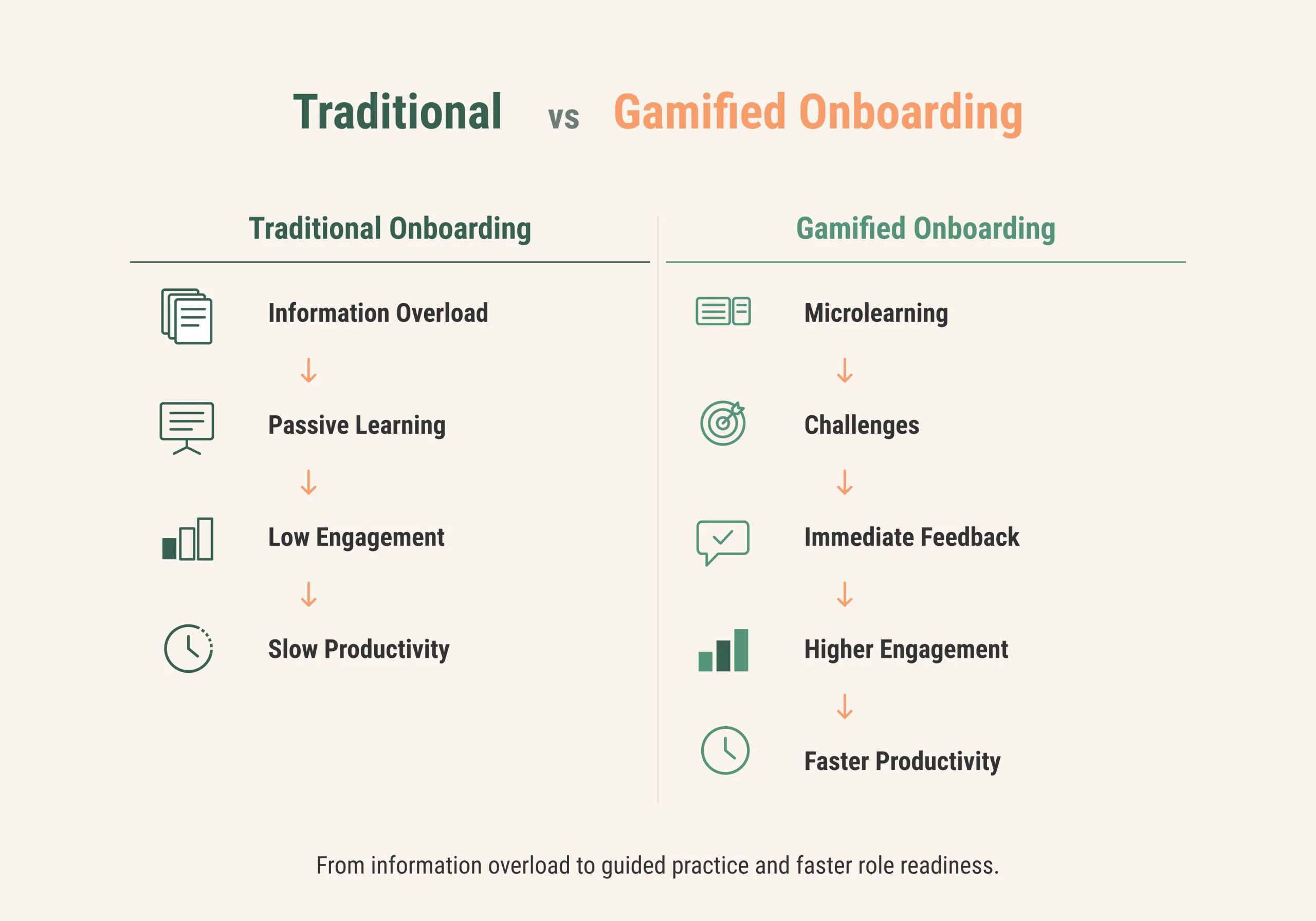
Gamified onboarding replaces one large information dump with smaller actions, practice, feedback, and visible progress.
What Is Gamification in Employee Onboarding?
Gamification in employee onboarding means applying selected game mechanics to the tasks and learning activities a new hire already needs to complete.
Those mechanics may include:
- missions;
- progress bars;
- points;
- badges;
- levels;
- quizzes;
- scenario decisions;
- unlockable modules;
- team challenges;
- achievement rules;
- selective leaderboards.
The definition is simple. The implementation is where most of the value is won or lost.
Good gamification onboarding gives structure to behavior.
A new sales representative might complete a “Know the Product” mission, practice a discovery call, pass a product scenario, receive feedback, then unlock a shadowing task with a manager.
That is different from giving the employee 20 points for opening the handbook.
One rewards evidence of progress. The other rewards interface activity.
Practical research and industry guidance on onboarding gamification repeatedly return to the same useful mechanics: visible progression, personalized challenges, feedback, social learning, and rewards tied to meaningful milestones.
The distinction matters:
Entertainment gets attention. Meaningful activity changes what the learner can do.
Raccoon Gang’s team applies the same principle in our LMS gamification guide.
“Don’t hand out badges for every click or login. If everything earns a reward, your badges mean nothing and your data stops telling the truth.”
— Olha Turutova, Head of Instructional Design & e-Learning Content, Raccoon Gang
Why Traditional Employee Onboarding Often Fails
Weak onboarding rarely fails because nobody created enough content. Usually, there is too much of it.
Information overload arrives before context
Policies. Org charts. Product decks. Security rules. Process documentation. Benefits. Software walkthroughs. Compliance modules.
A new hire receives all of this while still trying to answer basic questions:
- What am I expected to do?
- Who do I ask?
- What should I learn first?
Good onboarding is about helping people see how work happens, build relationships, and gain confidence in the role, not merely completing orientation.
Passive content produces weak evidence
A 40-slide presentation proves that the information was shown. It does not show whether the employee can apply it.
A scenario about handling a customer escalation, spotting a security issue, or choosing the correct production procedure produces much better evidence.
Experiences differ between teams
One manager has a detailed 30-day plan. Another sends a folder of links. One office gets live product demonstrations. A remote employee watches recordings.
Without a structured path, onboarding quality depends heavily on local management habits.
Productivity is delayed
Every unnecessary search, duplicated explanation, unclear process, and poorly sequenced module adds friction before a new hire can contribute independently.
That is why onboarding should extend beyond the first-day orientation. Our team treats it as a staged process with preboarding, manager involvement, automation, and 30/60/90-day milestones.
Gamification gives that journey visible structure.
Advantages of Gamification in Employee Onboarding
The strongest advantages of gamification for employee onboarding appear when mechanics support work the new hire already needs to perform.
Higher engagement
- A mission gives the learner a destination.
- A progress bar shows what remains.
- A scenario asks for a decision.
- A manager challenge turns an abstract topic into an action.
This is a more active onboarding experience than asking learners to consume one content block after another.
Better completion quality
Completion should mean more than “the module reached 100%.”
A gamified path can require the learner to demonstrate several milestones:
Learn → Practice → Pass → Apply → Confirm
That creates better evidence for L&D than one final status flag.
Stronger knowledge retention
Retrieval, practice, feedback, and repetition give new hires more opportunities to use information before forgetting it.
The principle also connects with longer-term skill retention. Our employee retention training guide explains why applied tasks and feedback loops keep learned skills active after formal training.
Greater learner confidence
Confidence is particularly useful during onboarding because uncertainty is high.
A new employee who has already practiced a support escalation, safety sequence, sales conversation, or privacy decision in the LMS arrives at the real task with some prior experience.
Faster role readiness
This is where gamification in new-hire training starts to make a business case.
Game mechanics can break onboarding into role-specific steps, guiding employees through the knowledge and practice each job milestone actually requires.
How Gamification Reduces Time-to-Productivity
Time-to-productivity measures how long it takes a new employee to reach an expected level of contribution. It belongs beside retention, new-hire surveys, satisfaction, engagement, and performance measures when HR evaluates onboarding.
A useful time-to-productivity gamification strategy attacks avoidable delay in four ways.
Spaced learning
Do not teach everything on day one.
Distribute learning according to when the employee will use it.
Basic security may belong in preboarding. Product fundamentals can arrive during week one. Advanced exception handling may make more sense after the employee has completed initial supervised work.
Active recall
Short quizzes and decision questions make learners retrieve information rather than simply recognize that they have seen it.
Continuous feedback
Feedback shortens the distance between an error and its correction.
If a learner chooses the wrong escalation path, explain the consequence immediately. Do not wait until a final test 40 minutes later.
Progressive skill development
Levels can represent real role readiness:
- Level 1: Orientation
- Level 2: Product Knowledge
- Level 3: Guided Practice
- Level 4: Independent Task
- Level 5: Manager Validation
The label is secondary.
The progression logic is what matters.
Measure:
- onboarding completion;
- assessment scores;
- repeat attempts;
- confidence surveys;
- manager evaluations;
- completion of supervised tasks;
- time to independent work;
- early retention.
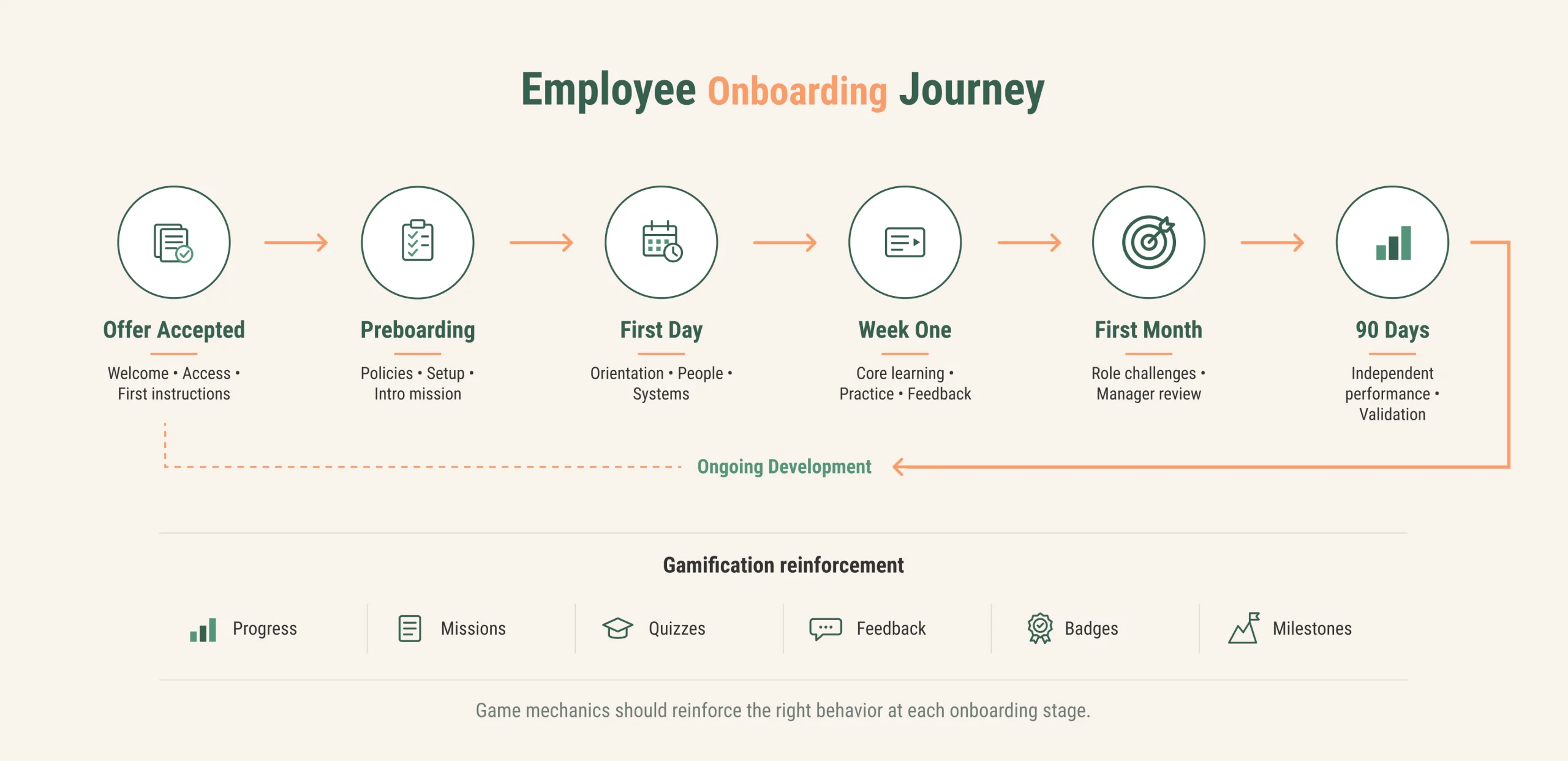
Game mechanics can reinforce different behaviors at preboarding, first day, week one, first month, and 90-day milestones.
Game Mechanics That Actually Work
The right game mechanics for an onboarding program depend on what the employee needs to do next.
| Mechanic | Best use | Avoid |
| Missions | Group related onboarding tasks around a meaningful outcome | Missions made of arbitrary clicks |
| Learning paths | Sequence role-specific knowledge and practice | One path for every department |
| Progress bars | Show how much required work remains | Progress based on page views alone |
| Quizzes | Retrieve critical knowledge | Trivia disconnected from the job |
| Branching scenarios | Practice decisions and consequences | Obviously wrong distractors |
| Badges | Mark meaningful milestones or mastery | A badge for every small action |
| Points | Give weight to useful activities | Rewarding volume instead of quality |
| Levels | Represent progressive role readiness | Artificial levels with no practical meaning |
| Unlockable content | Gate advanced learning behind prerequisites | Hiding information people need immediately |
| Team challenges | Support social learning and peer connection | Forced competition between unequal roles |
| Leaderboards | Optional challenges where comparison helps | Sensitive compliance, remediation, or high-anxiety onboarding |
Published guidance on onboarding gamification makes the same point about progress bars, scores, quizzes, and rewards: they work by producing accomplishment and immediate feedback when a learner clears a challenge, and do nothing as decoration on the screen.
Leaderboards deserve particular caution.
Competition can motivate some groups and discourage others. New hires already enter with different experience, roles, working hours, and access to support. A single ranking can make those differences look like performance differences.
We recommend matching each mechanic to a measurable goal and testing it with a small learner group, rather than adding mechanics because the LMS supports them.
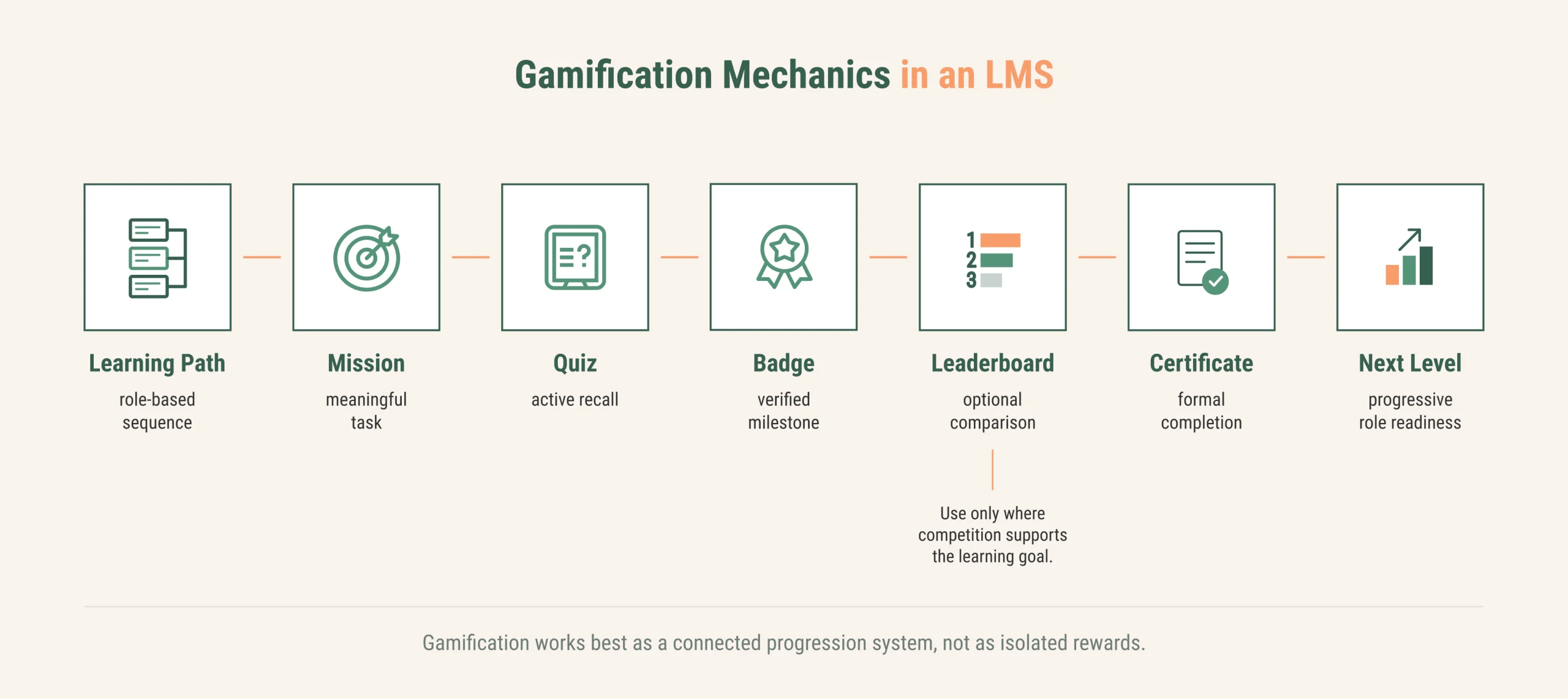
Gamification works best as a connected progression system rather than a collection of unrelated badges and points.
Employee Onboarding Gamification Examples
The most useful employee onboarding gamification examples start with the work context.
Sales onboarding
Create a mission chain:
Product basics → buyer scenario → objection challenge → mock call → manager review
A badge can mark completion of product certification, while the meaningful outcome is readiness for customer conversations.
Retail onboarding
Retail learning often needs mobile access, short modules, product knowledge, safety, and store procedures.
A new associate might complete one short mission before a shift, practice a customer scenario, then unlock the next task after manager confirmation.
For more on the platform requirements of distributed store teams, see our retail LMS guide.
Manufacturing onboarding
Use procedural challenges for:
- PPE;
- safety checks;
- machine startup;
- quality procedures;
- escalation;
- stop-work decisions.
Do not reward speed on tasks where care matters more.
Healthcare onboarding
Separate mandatory knowledge from role practice. Privacy, safety, documentation, escalation, and system-access decisions can use scenarios and checkpoints without turning sensitive subjects into entertainment.
Customer support onboarding
Build a progression from policy knowledge to simulated tickets, prioritization, escalation, and communication. Employees can advance only after demonstrating the required decision quality.
Compliance onboarding
Use private scenarios, immediate feedback, mastery thresholds, and refresher activity. Do not use public competition for harassment, ethics, privacy failures, or remedial learning. These onboarding gamification examples share one pattern: the mechanic represents progress through work-relevant behavior.
LMS Features That Enable Gamified Onboarding
LMS gamification for new employee onboarding becomes much more useful when it runs inside the systems HR already uses.
Seven capabilities carry most of the weight:
| Capability | What it does for onboarding |
| Adaptive learning paths | Assigns different modules by role, department, location, prior experience, or assessment result, so a warehouse hire and a finance hire do not receive the same week |
| Badges, points, and certificates | Mark defined milestones. Tied to general activity instead, they stop meaning anything to the employee or the manager reviewing progress |
| Quizzes and branching scenarios | Produce evidence of recall and decision-making before an employee faces the situation without support |
| Leaderboards and team challenges | Suit collective or voluntary goals. Individual ranking during a probation period usually costs more in anxiety than it returns in motivation |
| Notifications | Bring people back to unfinished missions, approaching deadlines, and pending manager actions, which is where most onboarding paths stall |
| Mobile access | Reaches frontline, retail, field, and distributed teams who never open a laptop during a shift |
| Analytics and dashboards | Show where new hires stop, which questions cause repeated errors, which roles need longer, and whether manager validation happens on schedule |
Track where new hires stop, which questions create repeated errors, which roles need more time, and whether manager validation happens on schedule.
We have implemented these mechanics at the platform level. RG Gamification supports configurable points, statuses, achievements, learner dashboards, leaderboards, event-based rules, and notifications on Open edX.
The Cybint project adds another enterprise example: our team built learning paths, automated assignment by teams and departments, gamification, badging, custom dashboards, and reporting at company, department, team, and learner levels.
HRIS integration and automation
The onboarding path should know when somebody joins, which role they have, who manages them, and when their milestone dates occur.
That makes possible flows such as:
HRIS hire event → LMS enrollment → role path → missions → analytics → manager review
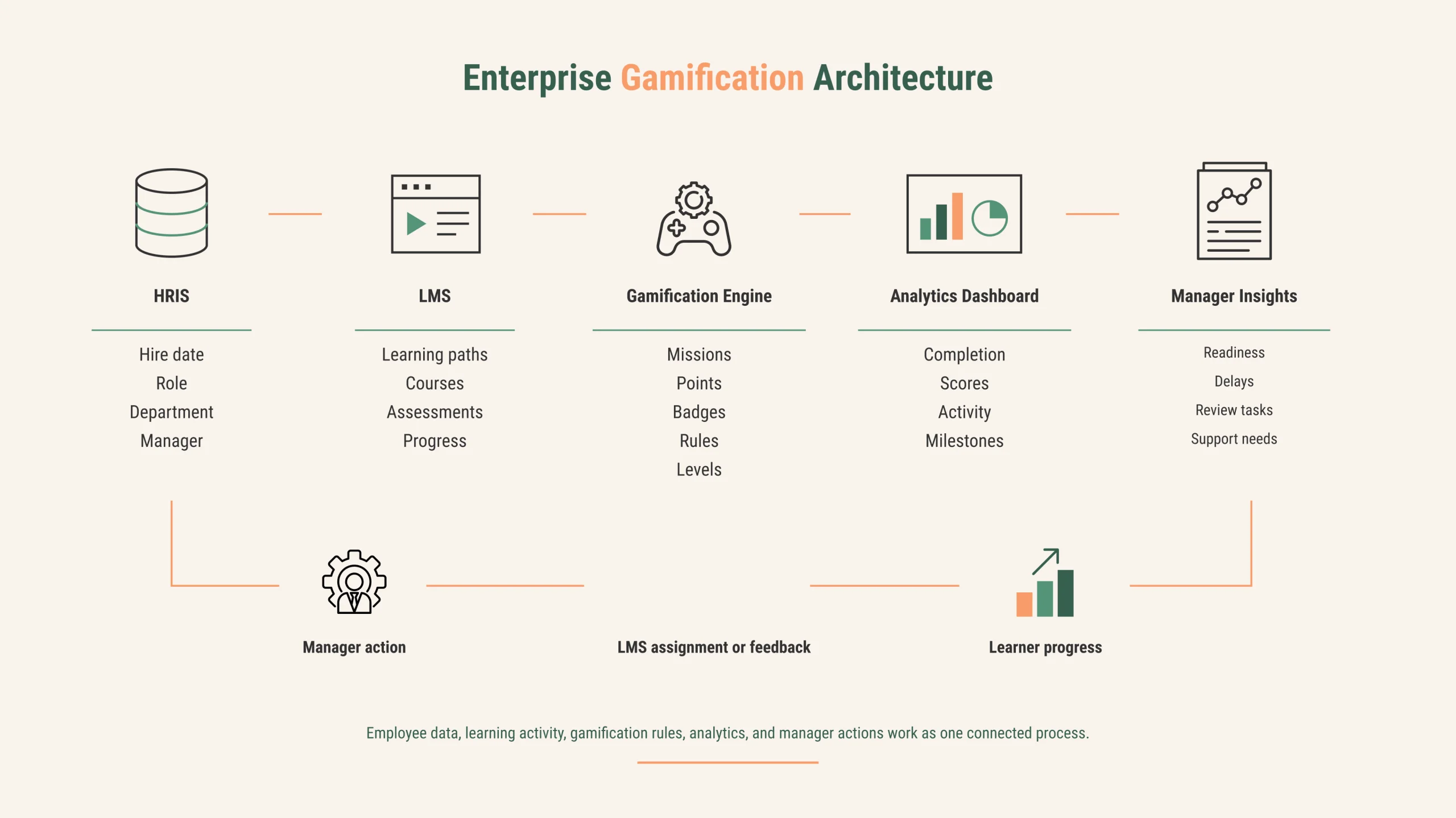
Enterprise onboarding works better when learner activity, HR data, gamification rules, analytics, and manager actions operate as one connected process.
Best Practices for Gamifying Employee Onboarding
To gamify onboarding effectively, start with behavior.
- Define role-readiness milestones. Decide what a new hire should be able to do by day 7, 30, 60, and 90.
- Match rewards to meaningful actions. Reward verified progress, not logins.
- Personalize paths. A sales representative and a finance specialist should not receive identical missions.
- Use feedback immediately. Explain why a choice works or fails.
- Balance individual and social mechanics. Progress can be private even when learning includes team challenges.
- Keep competition optional where possible. Leaderboards should earn their place.
- Use modular content. Small units are easier to reuse across roles and easier to revise when processes change.
- Measure beyond completion. Connect LMS data with manager validation and time-to-productivity.
- Test accessibility. Keyboard access, readable feedback, captions, contrast, motion, and mobile behavior all matter.
- Review the path after launch. Drop mechanics that generate activity but no useful learning signal.
The instructional logic should come before the gamification layer. Our training design process guide and eLearning content development guide cover that sequence in more detail.
Common Mistakes
Rewarding clicks instead of learning
Page views are easy to count. They are weak evidence of readiness. A new hire can open every module before lunch and still freeze at the first real customer question. Tie points to demonstrated decisions: a passed scenario, a completed practice task, a manager sign-off.
Too many badges
If every action earns an award, no award says much. Employees work out the pattern quickly, and the badge wall stops carrying information for the manager reviewing it. One useful test is whether you can explain in a single sentence what an employee had to prove to earn each badge.
One-size-fits-all onboarding
Different roles need different learning depth, practice, and milestone timing. A single shared track is usually too shallow for the specialist and too heavy for everybody else. Shared modules still make sense for company basics, and role paths should branch as soon as the work does.
Ignoring analytics
A mission that half of new hires abandon is telling you something. The cause is usually the design: unclear instructions, a difficulty jump, or a task that depends on system access somebody has yet to receive. Onboarding data ages quickly, so review it after each hiring wave while the cohort can still explain what happened.
Focusing only on competition
Onboarding is also about confidence, social connection, and asking for help. Competition can work against those goals. A new hire near the bottom of a public ranking learns to hide confusion at exactly the moment when questions matter most. Team goals, shared progress, and peer recognition raise engagement without exposing anybody during their first weeks.
Poor instructional design
A confusing course with points is still a confusing course. Gamification amplifies whatever the course already does. Clear objectives, worked examples, and practice with feedback make the mechanics feel earned; without them, points only draw attention to how little the module teaches.
This is also why LMS activity should not be mistaken for genuine participation. Our LMS user engagement guide distinguishes access and completion from meaningful learner interaction.
How Raccoon Gang Builds Gamified Employee Onboarding
We approach gamification in onboarding as a learning-system problem, not a badge-design exercise.
Our specialists work across:
- Open edX;
- Moodle;
- Canvas;
- instructional design;
- adaptive learning paths;
- scenario-based content;
- gamification logic;
- badges and certificates;
- analytics;
- mobile learning;
- HRIS and enterprise integrations.
The process starts with the role.
What should this employee know? What should they be able to do? Which tasks require practice? Which milestones need manager confirmation? What information belongs in the LMS, and what should happen with a buddy, trainer, or supervisor?
Then the mechanics can support that structure.
Our RG Gamification work shows the technical side. Rules can connect points and achievements with course events; badges can depend on combinations of actions; dashboards show learner progress; notifications bring employees back to unfinished tasks.
Another platform we built, a gamified learning environment, combined challenges, badges, leaderboards, progress indicators, notifications, prerequisites, analytics, and mobile-first design. It attracted more than 5,000 new users during its first three months and issued ten times more certificates than the previous offline model.
That was not an onboarding project, but it shows how the same mechanics can be combined at the platform level and measured rather than treated as decoration.
The content side matters just as much.
A technically capable LMS cannot compensate for a weak learning path. Our instructional design services cover employee onboarding, product knowledge, compliance, internal process training, assessments, and learning-data evaluation.
The objective is simple: build a path where the learner always knows what comes next, why it matters, and what evidence shows they are ready to progress.
Conclusion
Gamified onboarding should support learning outcomes, not distract from them.
Points, missions, badges, levels, scenarios, and progress bars are useful only when they guide new hires through the knowledge, decisions, relationships, and practice required for the job. That is the strongest case for employee onboarding gamification.
Combine thoughtful learning design with LMS automation, role-based paths, feedback, analytics, HRIS integration, and manager validation, and onboarding becomes easier to measure. HR can see more than who completed orientation. It can see where people struggle, what they have demonstrated, and how quickly they move toward independent performance.
Building that combination is what the Raccoon Gang team does. Our instructional designers and Open edX engineers work on the same programs, so the learning path, the gamification rules, the HR integrations, and the reporting are designed together instead of bolted on afterward.
The target is not a more entertaining first week. It is a better first 90 days.
FAQ
What is gamification in employee onboarding?
How does gamified onboarding improve employee engagement?
What game mechanics work best during onboarding?
Can an LMS support gamified employee onboarding?
How do you measure the success of a gamified onboarding program?
What are the biggest mistakes when gamifying employee onboarding?


- TL;DR
- What Is Gamification in Employee Onboarding?
- Why Traditional Employee Onboarding Often Fails
- Advantages of Gamification in Employee Onboarding
- How Gamification Reduces Time-to-Productivity
- Game Mechanics That Actually Work
- Employee Onboarding Gamification Examples
- LMS Features That Enable Gamified Onboarding
- Best Practices for Gamifying Employee Onboarding
- Common Mistakes
- How Raccoon Gang Builds Gamified Employee Onboarding
- Conclusion