











Low completion numbers and lukewarm reviews get blamed on pricing, marketing, or the platform long before anyone opens the course itself. Here’s why the root cause usually sits in the instructional design — passive content, rigid paths, missing feedback — and what a design-driven fix looks like, ahead of any redesign budget conversation.
Course completion has stayed stubbornly low across the e-learning industry for years. Average online course completion rates sit at just 5% to 15%, according to industry estimates from eLearning Industry — a number that hasn’t moved much even as course catalogs and marketing budgets have grown. When a catalog underperforms at that scale, the instinct is to look at pricing or ad spend before anyone opens the course itself. Instructional design for learner retention rarely gets the same scrutiny, even though it’s often where the drop-off starts.
TL;DR
Retention and completion problems usually trace back to how a course was designed. Passive content, one-size-fits-all paths, and missing feedback loops drive learners out at predictable points, and fixing those design choices tends to move completion rates more reliably than a platform overhaul or a new campaign.
At a Glance
- Instructional design (in this context) — the deliberate structuring of content, interaction, and feedback within a course to guide how a learner engages with it.
- Interactive learning design — course content built around requiring a learner to respond, decide, or practice at regular points.
- Adaptive learning path — a course sequence that changes based on a learner’s demonstrated knowledge or performance as they progress.
- Course drop-off rate — the percentage of learners who start a course but exit before reaching completion, typically clustered around specific points in the content.
Why Retention and Completion Are Design Problems First
Poor reviews and thin completion numbers usually get treated as a top-of-funnel issue — the wrong audience found the course, or the price didn’t match perceived value. Sometimes that’s true. Just as often, though, the course converts learners perfectly well and loses them later, somewhere inside the content itself.
Which one it is matters, since each calls for a different kind of fix. A marketing problem responds to adjusted targeting or new messaging. A completion problem lives inside the course itself, so no amount of ad spend closes a gap that opens three modules in.
The business cost shows up in more than one place at once:
- A learner who drops out mid-course rarely renews the subscription behind it, and the review they leave mentions boredom or confusion far more often than price.
- That impression doesn’t stay contained to one course — reviewers rarely separate one weak course from an entire catalog when they’re deciding whether to trust it again.
That’s the friction behind something course providers raise often: courses aren’t converting or retaining learners, and what moves the number is improved design and learner experience, well ahead of a new pricing tier or another round of ads.
Where Design Causes Learners to Drop Off
A handful of design patterns show up again and again in courses with weak completion numbers, and none of them are platform bugs.
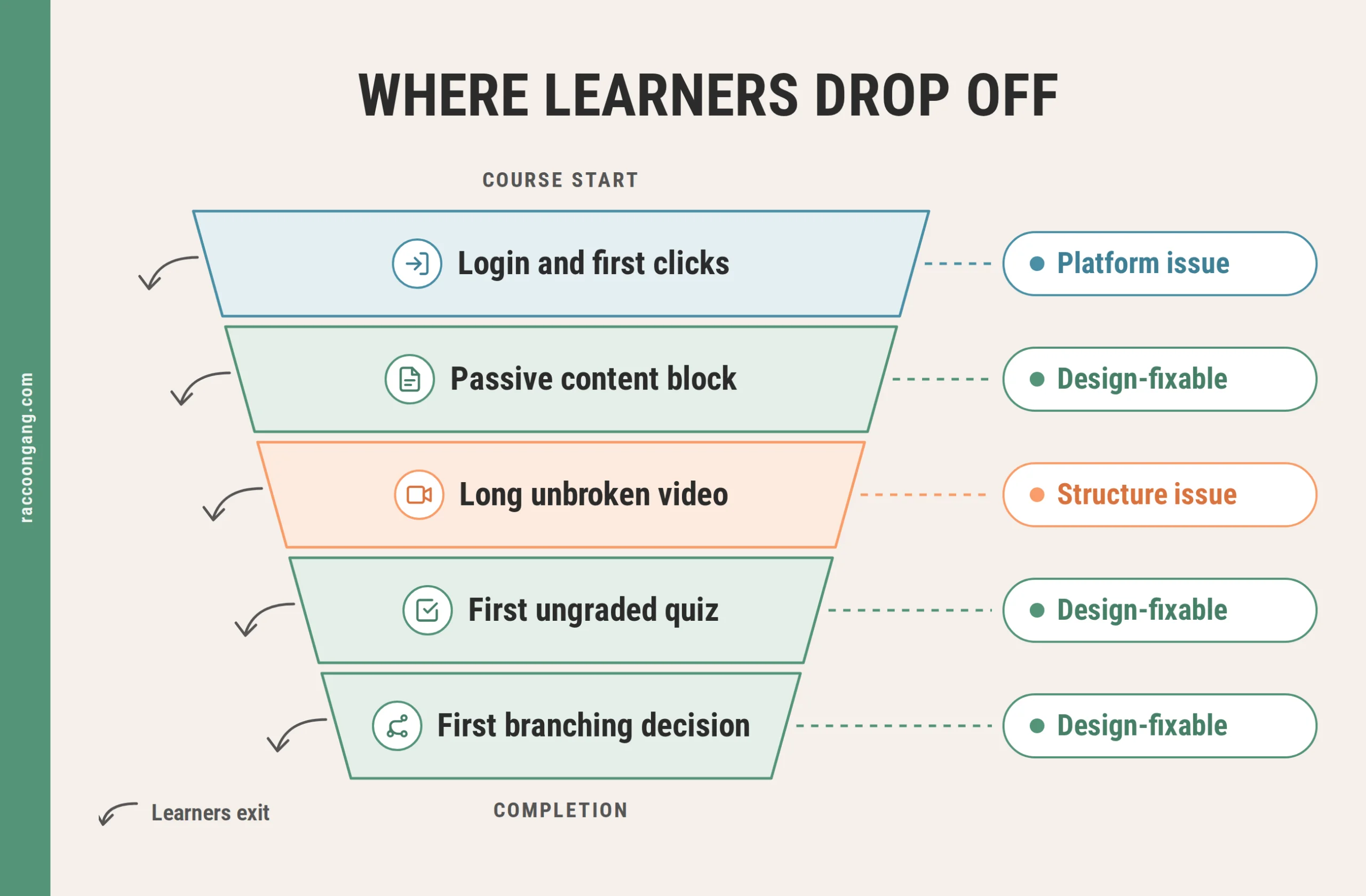
Passive, one-directional content is the most common one. A learner watching a 20-minute video with no checkpoints has no reason to stay mentally present, and no way for the course to notice when attention has already wandered. The exit usually happens quietly, mid-video, well before the learner consciously decides to leave.
Rigid, one-size-fits-all paths cause a different kind of drop-off. A course built for a single skill level forces advanced learners through material they already know, and it’s boring in a way that reads as wasted time. The same fixed path drowns beginners in content they’re not ready for. Both groups leave, for opposite reasons, at roughly the same structural point.
Weak or missing feedback loops compound both problems. A quiz that returns nothing more than a score gives a learner no path forward if they got it wrong, and no reason to feel accomplished if they got it right. Without a response that addresses what the learner chose, assessment turns into a box to check, and a box that gets checked without much thought rarely holds anyone’s attention.
It’s worth separating this from two adjacent issues that get confused with design fairly often. Module order, pacing, and video length sit under course structure — that layer gets its own treatment in how to structure an online course, worth a look if the drop-off pattern points there instead. Login trouble and general navigation friction belong to the platform, a topic improving engagement across an LMS covers in more depth. This piece stays with what happens inside the course content itself.
Interactive Learning Design That Keeps Learners Moving
Interactive learning design answers the passive-content problem by building in a requirement to respond. The shift shows up in a few concrete forms.
Branching scenarios and decision points replace passive video or text with a situation the learner has to act on. Learning Guild’s coverage of scenario-based learning describes it as a shift from knowledge transfer toward skill development — the learner works through the problem directly, making the decisions a real situation would demand.
Micro-interactions and knowledge checks land best woven through the content at regular intervals rather than saved for a final exam. A short check-in every few minutes catches disengagement while it’s still recoverable; a final exam only reveals the problem after a learner has already checked out modules earlier, when there’s nothing left to recover.
Simulations and practice tasks tied to a learner’s actual goals close the gap between theory and application. A sales rep practicing a difficult conversation inside a branching scenario, playing the other side of it, retains the pattern differently than one who just read a transcript of how it should go.
Feedback loops matter most at the point most courses skip them: after an answer, right or wrong. Contextualized, immediate feedback explains why a choice worked — the mechanism Learning Guild’s research on branching video design points to as the difference-maker. Building that in doesn’t require new video or a new module, just a rewritten response after each quiz question, and it targets exactly the moment described earlier, where an assessment turns into a box to check instead of a checkpoint that means something.
Adaptive Learning Paths: Meeting Learners Where They Are
A single fixed path assumes every learner walks in at the same starting point, and that assumption breaks down fast across any audience with real skill variation. Mixed-skill groups make up most course audiences, which makes a fixed path a drop-off risk regardless of how good the content itself is.
Branching by pre-assessment routes learners before they’ve wasted time on material that’s either too basic or too advanced for them. A short diagnostic at the start, three to five questions, is usually enough to sort learners onto a path that matches where they’re starting from.
Adjusting pacing and depth based on performance extends that same idea past the opening assessment. A learner who breezes through the first two knowledge checks doesn’t need the same depth of remediation as one who’s clearly struggling, and adaptive learning design lets the course respond to that gap as the learner moves through it, not after the fact.
This directly answers a pain that shows up often among course providers evaluating a redesign: the need for adaptive and interactive learning tools that respond to who’s actually enrolled, since a generic audience profile rarely matches who’s really taking the course. Getting the underlying learning objectives and content structure right still comes first — a point covered in more depth in the principles of instructional design — since adaptive branching layered onto a weak content foundation just produces more paths through the same underlying problem.
Diagnosing Whether Your Retention Problem Is a Design Problem
Not every retention issue is a design issue. Ruling out the alternatives first keeps a redesign budget from solving the wrong problem.
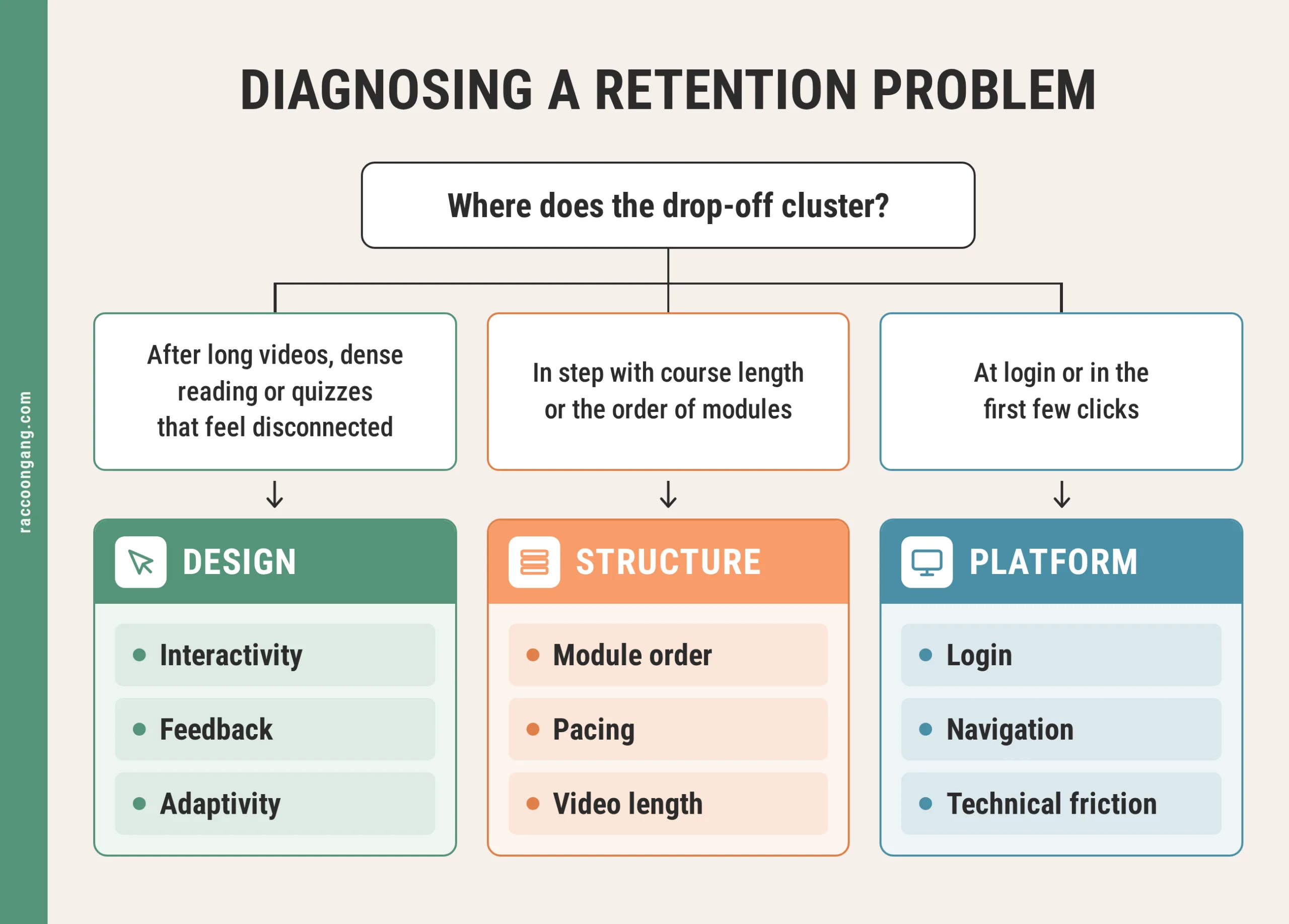
Decision tree that traces learner drop-off to design, course structure or platform causes based on where it clusters.
Signals that point toward design:
- Drop-off clustering right after a long passive segment — a video, a dense reading block — suggests learners are checking out during content that asks nothing of them.
- Quiz completion lagging well behind the surrounding content’s view rates, which often means the assessment feels disconnected from what came before it.
- Learners rewatching or rewinding the same segment repeatedly, a sign the content didn’t land clearly the first time through.
- Review language that specifically calls the content boring, confusing, or repetitive — a different signal from login complaints or navigation gripes, which point somewhere else entirely.
Signals that point elsewhere get a link to where they’re already covered in depth. Drop-off concentrated at login or in the first few clicks usually traces back to platform UX, closer to what’s addressed in improving LMS engagement. If the pattern tracks closely with course length or the order modules appear in, structure is the more likely cause — the guide to structuring an online course covers that layer in full. And if the issue looks less like mid-course abandonment and more like learners forgetting material weeks after finishing, that’s a retention-of-knowledge question — learning retention insights covers that ground better than a design audit would.
A few questions to put to a content team this week:
- Where exactly does the drop-off curve bend — after which module, at which minute mark?
- Are quiz completion rates lower than the surrounding content’s view rates?
- Does the same pattern repeat across multiple courses, or is it isolated to one?
- What do the one- and two-star reviews mention by name — the content, or something else entirely?
Answering those upfront usually settles the diagnosis, so the redesign conversation starts from the right place.
The Business Case for Investing in Design-Driven Retention Fixes
Completion-rate lifts translate into numbers that show up on a P&L directly, just in places a completion percentage doesn’t show on its own:
- Reviews shift in tone — a learner who finishes a course is far more likely to leave one that mentions value.
- Renewals and next-course sales follow the same pattern. Both come easier from someone who came out the other side of a course than from someone who stalled partway through.

Interactive formats tend to see more learners finish. Sources: EdSurge, Ruzuku.
Raccoon Gang’s own delivery data shows what that lift can look like in practice. Three projects from our portfolio show the range:
- A MOOC built through our instructional design process reached 80.2% completion, against an industry baseline where many open online courses complete at just 5–15%. Learner satisfaction on the same project came in at 4.41 out of 5.
- A custom LXP for a network of higher education institutions produced 35% higher completion rates, alongside a perfect 5-out-of-5 satisfaction score.
- A custom LMS built for the International Center on Nonviolent Conflict delivered 45% higher retention, with learners reporting markedly higher motivation.
Results vary by program and audience, and no course provider should expect an identical jump from a generic checklist. The pattern across these three holds steady regardless: interactive, well-structured design carries the number more than the platform choice behind any of them does.
Set against the other levers available, that pattern holds up even better. Broad platform changes or a new marketing push cost similar budgets, but neither one touches what happens once a learner is already inside a course, so any lift takes longer to show up, if it shows up at all. A targeted redesign of the highest-traffic, worst-completing courses tends to close that gap faster, simply because it’s aimed at the source of the leak.
Fixing an entire catalog at once rarely fits a real budget, so prioritization decides where the first redesign dollar goes. The courses to start with are the ones with high enrollment and low completion — that combination produces the largest lift in finished learners and renewal revenue for the least amount of rework.
How Raccoon Gang Helps E-Learning Platforms Improve Retention Through Design
Our team runs instructional design and UX reviews focused specifically on where a course loses learners. That focus tends to surface the friction point faster than a broad platform audit would.
From there, our specialists build the fix directly into the content: branching scenarios, adaptive pathing, feedback loops woven through the assessments themselves. This work sits alongside broader content development capability, covered in more detail in our approach to e-learning content development, for teams that need both the diagnostic work and the rebuild handled by the same team.
Raccoon Gang’s approach stays consultative through that process. The team diagnoses what’s driving the drop-off first, and a redesign only gets proposed once that cause is confirmed. The academic associations project and the ICNC redesign mentioned above both started from that same diagnostic step, with the same symptoms this guide opened with — low completion and thin reviews, no clear sense yet of where in the course learners were leaving.
Talk to our team about diagnosing what’s driving drop-off in your course catalog.
Conclusion
Retention and completion problems often start as design problems long before anyone notices it in the marketing numbers. Passive content and feedback that stops at a score drive drop-off at predictable points inside a course, and a path that ignores where a learner started only makes that worse. Fixing those choices tends to move completion rates more reliably than a platform overhaul or another round of campaign spend. Instructional design for learner retention starts with figuring out exactly where learners are leaving and why — and from there, improving course completion rates becomes a narrower, far more solvable problem than it looked at the start.
FAQ
How does instructional design affect learner retention?
Instructional design shapes whether a learner stays engaged moment to moment inside a course — through interactivity, feedback, and how well the content matches their starting knowledge. Weak design in any of those areas creates predictable exit points, regardless of how strong the platform or marketing behind the course is.
What design choices cause learners to drop out of online courses?
The most common culprits are passive, one-directional content with no interaction points, rigid paths that ignore differences in learner skill level, and feedback loops that stop at a pass/fail score without ever explaining why an answer worked or didn’t.
What is adaptive learning design and how does it improve completion rates?
Adaptive learning design adjusts a course’s path, pacing, or content depth to match a learner’s demonstrated knowledge as they move through it. It reduces drop-off among advanced learners who disengage from material they already know, and among beginners who fall behind a pace set for someone else.
How is a design-driven retention problem different from a platform or structure problem?
Design problems live inside the course content itself — how interactive it is, how it responds to what a learner does. Platform issues tend to show up earlier, at login or in basic navigation. Course length and the order modules appear in point toward structure. Confusing one for another usually means fixing the wrong thing.
What are examples of interactive learning design?
Branching scenarios where learner choices change the outcome, knowledge checks embedded throughout a module, simulations tied to real tasks, and feedback that explains the reasoning behind a right or wrong answer all count as interactive design.
How much can better instructional design improve completion rates?
Documented cases vary widely depending on the starting point and audience, but redesigns built around interactivity and adaptive pathing have moved completion rates from single digits into the 60–80% range in some programs. Diagnosing the drop-off pattern first puts a real number on what a fix might deliver.




- TL;DR
- At a Glance
- Why Retention and Completion Are Design Problems First
- Where Design Causes Learners to Drop Off
- Interactive Learning Design That Keeps Learners Moving
- Adaptive Learning Paths: Meeting Learners Where They Are
- Diagnosing Whether Your Retention Problem Is a Design Problem
- The Business Case for Investing in Design-Driven Retention Fixes
- How Raccoon Gang Helps E-Learning Platforms Improve Retention Through Design
- Conclusion