







That changes the custom LMS vs. off-the-shelf discussion. When considering a custom LMS platform vs off-the-shelf solutions, it’s important to weigh your organization’s specific needs and goals.
The useful question is not, “Which LMS has more features?” It is, “How much of the learning platform does our business actually need to control?”
For one company, standard enrollment, compliance courses, certificates, and HRIS synchronization may be enough. Another may need customer-specific portals, proprietary certification logic, unusual entitlement rules, multiple identity systems, commerce, or reporting connected deeply with business operations.
Those requirements point to different platform strategies entirely:
Business requirements → platform strategy → build vs buy → long-term ownership
Key Takeaways
- Off-the-shelf SaaS works well when learning workflows are standard, and deployment speed matters more than deep platform control.
- A fully custom LMS makes sense when proprietary workflows, data models, or product logic are part of the business itself.
- Open edX is positioned between those models: established open-source LMS functionality with substantial control over infrastructure, integrations, UX, data, and extensions.
- “Custom” does not automatically mean “built from scratch.” Reusing a mature learning platform can avoid paying to recreate course management, enrollment, assessment, and other standard functions.
- Five-year cost matters more than the first-year quote. Licensing, integrations, hosting, maintenance, upgrades, administration, and eventual migration all belong in the comparison.
- Ownership creates responsibility. Moving away from SaaS reduces dependence on a platform vendor, but somebody still needs to own security, upgrades, infrastructure, architecture, and future changes.
Quick Answer
Choose an off-the-shelf LMS if your learning model is conventional, your integrations are supported, and rapid implementation is the priority. Consider an Open edX custom platform if you need deeper control without paying to recreate mature LMS functionality. A fully custom platform makes sense when the learning system itself contains proprietary workflows or product logic that existing platforms cannot represent cleanly. The best choice depends on business fit, ownership, operating capacity, integrations, and total cost over several years.
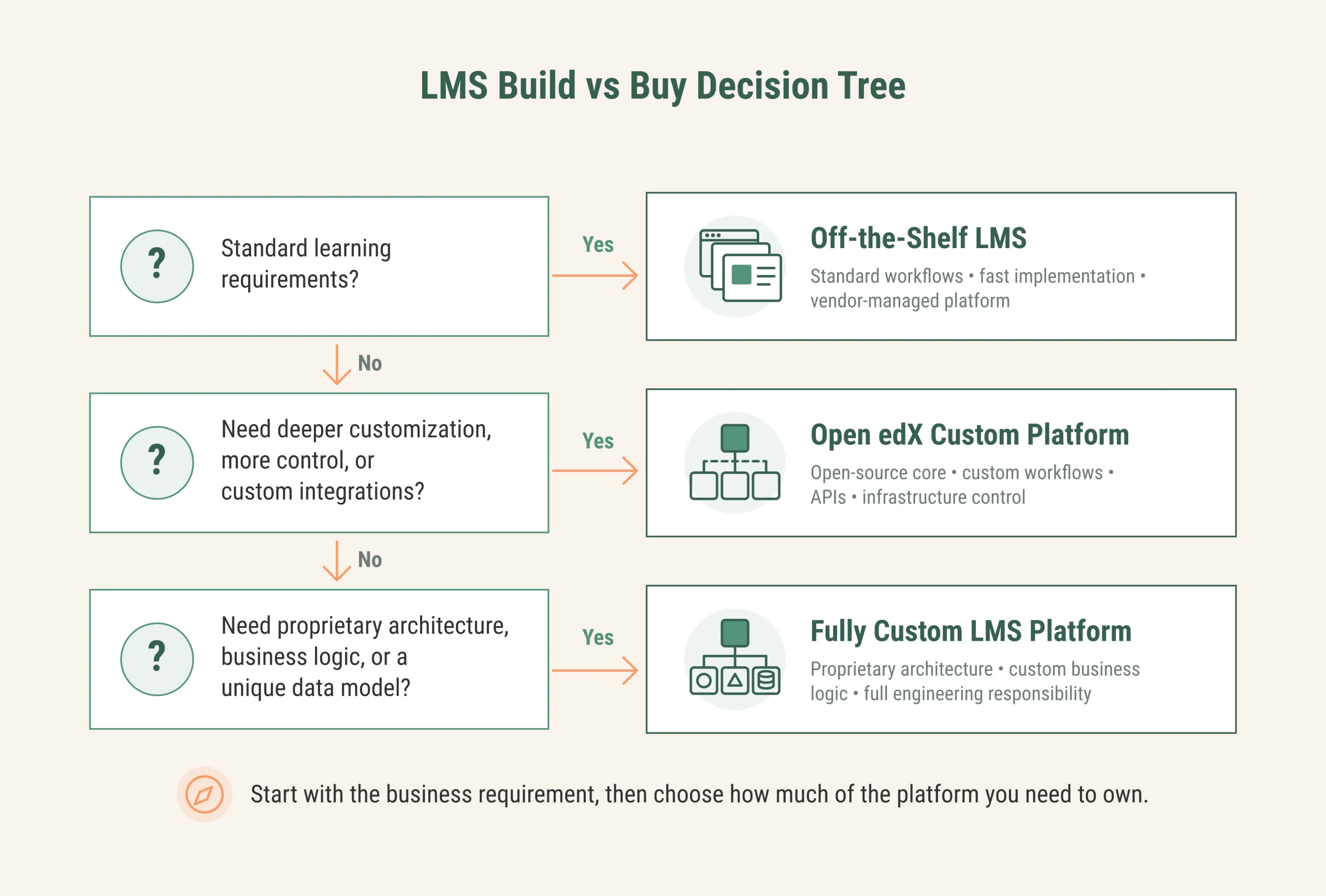
The platform decision becomes clearer when organizations start with business requirements rather than a feature list
1. What Is a Custom LMS Platform?
A custom LMS platform is a learning system built around requirements specific to one organization, product, or business model.
That definition needs a qualification, because “custom LMS” can describe very different technical approaches:
- a proprietary system developed largely from scratch;
- a mature LMS extended through APIs, plugins, or custom services;
- an open-source platform whose UX, workflows, integrations, infrastructure, and learning components have been changed substantially.
These approaches do not carry the same cost or ownership burden. Changing colors, adding a logo, configuring SSO, or connecting a standard HR system does not turn a commercial LMS into a bespoke platform. At the opposite extreme, building authentication, authoring, assessments, roles, reporting, and enrollment logic from zero because the business needs one unusual workflow can waste a large part of the development budget.
“Every custom LMS should solve a business problem that standard platforms can’t. Otherwise, you’re paying to rebuild features you already could have bought.”
— Volodymyr Chekyrta, Engineering Manager, Raccoon Gang
That distinction also guides Raccoon Gang’s custom LMS vs SaaS LMS comparison: custom development earns its cost when control over workflows, data, integrations, or the product experience creates business value.
So when to build a custom LMS should be answered at the architecture level, not by counting missing features.
If a mature platform already carries most requirements and the remaining functions can be added cleanly, rebuilding everything else may be the expensive route.
2. What Is an Off-the-Shelf LMS?
An off-the-shelf LMS is a ready-made commercial platform built around learning requirements shared by many organizations.
Typical capabilities include:
- user and course administration;
- assessments;
- learning paths;
- certificates;
- reporting;
- notifications;
- standard integrations;
- mobile access;
- role management;
- compliance tracking.
Most commercial LMS products use a SaaS model. The provider operates the application and infrastructure, releases updates, patches the platform, and charges a recurring subscription.
That operating model is a major advantage.
A company that needs onboarding for 700 employees does not automatically benefit from owning servers, maintaining LMS code, or planning platform upgrades. Established software can be the more rational investment.
Independent build-vs-buy comparisons reach much the same conclusion: packaged systems generally offer faster deployment and lower initial cost, while deeper modification and integration needs tend to increase the case for custom development.
The trade-off is control. Your team works within the product’s supported data model, API capabilities, release schedule, reporting options, and interface conventions. Configuration may be extensive, but the underlying product remains controlled by its provider.
That is the central issue in off-the-shelf LMS vs custom comparisons: an off-the-shelf system asks the company to adapt some processes to the product; custom development asks the technology to adapt more closely to the company.
Neither is inherently better.
3. Custom LMS vs Off-the-Shelf: What’s the Difference?
A useful comparison needs three columns, not two. Published two-way comparisons put off-the-shelf ahead on speed and custom ahead on fit. That is accurate, and it still omits the middle option.
| Decision area | Off-the-Shelf SaaS | Open edX Custom Platform | Fully Custom LMS |
| Implementation | Usually fastest | Moderate; depends on extensions and integrations | Usually longest |
| Customization | Configuration within supported options | Deep platform, UX, XBlock, API, and workflow changes | Business logic built specifically for the product |
| Integrations | Connectors and supported APIs | Standard APIs plus custom integration work | Integration behavior built into the architecture |
| Platform ownership | Provider owns the product and roadmap | Organization controls deployment and data; core remains open source | Custom code ownership depends on contract terms and third-party licenses |
| Reporting | Standard reports plus available extensions | Native analytics plus custom reporting and BI connections | Reporting can follow proprietary data structures |
| Scalability | Managed within the provider’s commercial model | Infrastructure can be configured around usage patterns | Depends on architecture and operations |
| Security operations | Primarily provider-managed | Internal or partner responsibility | Internal or contracted engineering responsibility |
| Maintenance | Largely included in subscription | Hosting, upgrades, extensions, and support must be managed | Full codebase and infrastructure require maintenance |
| Cost model | Recurring subscription and service fees | Implementation + hosting + support + upgrades | Development + infrastructure + maintenance + future engineering |
| Best fit | Standard learning processes | Distinct requirements with substantial reusable LMS functionality | Proprietary learning products and unusual business logic |
Notice what the table does not say. Custom does not automatically win on integrations, security, reporting, or growth. It provides control over how those areas are built. That control becomes valuable only when the organization has a reason to use it.
“SaaS delivers the fastest path to launch. The real question is whether it will still be the most economical path after your organization doubles in size.”
— Natalia Boikiv, Delivery Director, Raccoon Gang
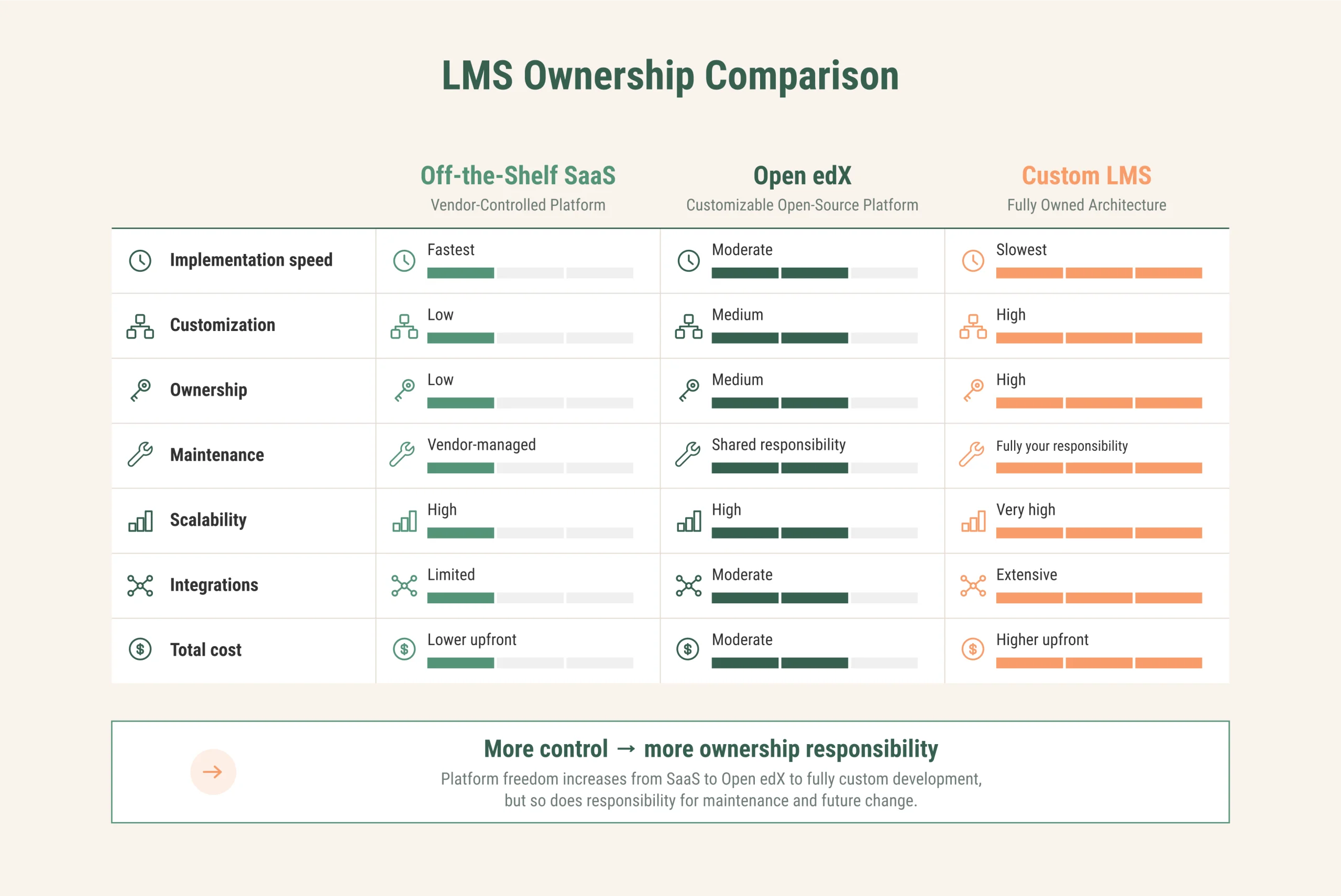
Greater platform control also moves more responsibility for architecture, maintenance, and future changes to the organization or its technology partner
4. When Is an Off-the-Shelf LMS Enough?
An off-the-shelf LMS is often the strongest choice when the learning requirement itself is standard.
Consider employee onboarding.
If the program needs role-based enrollment, videos, quizzes, completion records, certificates, reminders, and a common HR integration, there may be little business value in owning the LMS architecture.
The same can apply to:
- routine compliance programs;
- standard internal employee learning;
- modest learner populations;
- programs with limited integration requirements;
- teams without platform engineering capacity;
- projects where launch speed matters more than deep modification.
Independent build-versus-buy guidance agrees: ready-made platforms suit teams that want quick deployment, predictable subscription pricing, and vendor-managed updates, and that can accept configuration instead of control over data models.
Procurement should still look beyond the demo. Ask what happens when learner numbers increase. Check API limits, storage policies, support tiers, reporting restrictions, data export options, migration terms, custom branding charges, and fees for additional administrators or business units.
A platform can remain an excellent fit with those costs. The point is to know them before renewal rather than during an exit project.
5. When Should You Build a Custom LMS?
The strongest signal that you need custom development is not a long feature request.
It is a workflow the business cannot reasonably change.
The LMS is part of the product
A customer education business may sell learning subscriptions, certifications, assessments, or partner access. The LMS is no longer an internal utility. It participates directly in revenue, customer experience, and product differentiation.
Learning permissions follow proprietary rules
Partner tier, customer contract, geographic region, certification status, purchased product, or account entitlement may determine what somebody can access.
Trying to reproduce that logic manually inside a standard catalog can become more expensive than implementing the workflow properly.
Certification is unusually complex
Professional bodies and regulated training providers may need prerequisites, renewals, external verification, evidence submission, continuing education credits, or certification states that standard completion logic does not cover.
Integrations define the learner experience
A company may need two-way interaction with CRM, HRIS, ERP, SIS, identity, commerce, credentialing, analytics, or proprietary operational systems.
At that point, the LMS becomes part of a wider application architecture.
The data model is proprietary
If the system needs to represent something fundamentally different from courses, cohorts, grades, and completion records, extensive custom logic may become necessary.
These are stronger signals for when to build custom LMS than learner count alone.
A very large learner population using conventional workflows may fit a mature existing platform. A smaller commercial learning product with unusual entitlement and certification rules may justify custom engineering much earlier.
6. Open edX: The Middle Ground
Open edX changes the usual build-or-buy equation because the core platform already exists, while its source code and extension points remain open.
An organization can deploy the platform on infrastructure it controls, modify the learner experience, connect external systems, build custom workflows, and add new learning components without paying a per-seat license for the core software.
That does not make Open edX fully proprietary. It makes it customizable rather than custom-built.
Official Open edX documentation describes several supported extension routes, including XBlocks, LTI, external graders, custom JavaScript applications, and deeper platform customization. XBlocks can introduce new interactive component types that course teams then reuse across courses.
For an Open edX custom platform, the architecture can look like this:
Open edX core → APIs + authentication + external systems → XBlocks and learning extensions → Custom UX and workflows → Analytics, commerce, credentials, mobile, or business-specific services
This lets teams spend engineering time on the parts that are actually different.
Raccoon Gang used that approach for a global media education platform. The previous platform had reached 120,000 registered users. The replacement needed to preserve learner progress while adding eCommerce, reporting, gamification, mobile learning, organization-level course sales, and integration with the customer’s Azure environment. The new architecture was prepared for up to 20,000 concurrent users, with an uptime target above 98%.
The AISL Harrow project shows another reason to choose the same base. Raccoon Gang connected multiple identity providers, Microsoft Teams, Tencent services, Power BI, analytics, gamification, learning paths, and a custom interface. The project involved 10 developers, served roughly 3,000–6,000 learners, and was completed in seven months.
Neither project required rebuilding a learning platform from zero. That is the practical role of Open edX between SaaS and a completely proprietary build.
For a deeper technical overview, see our guide to the Open edX platform.
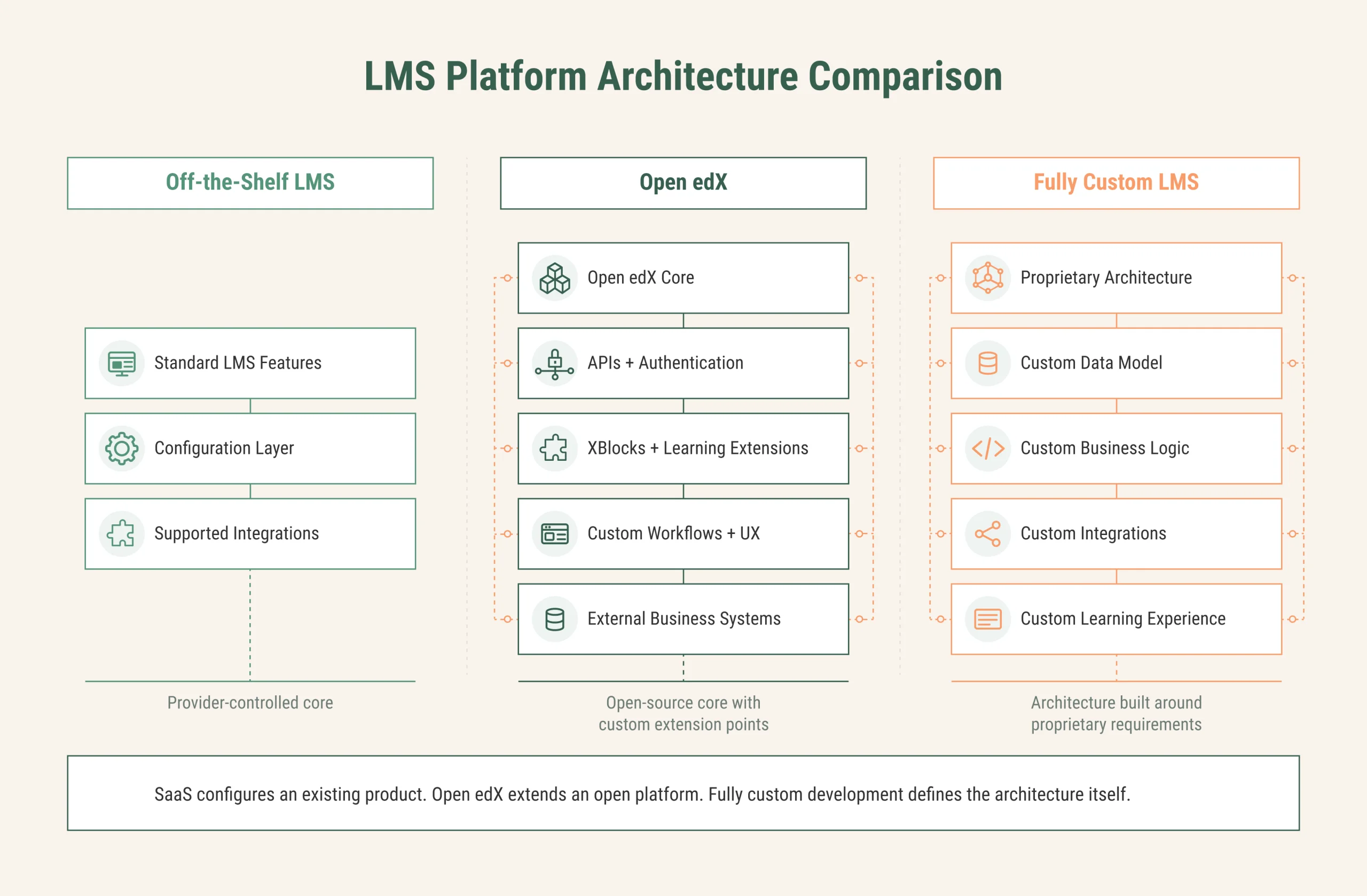
Open edX retains established LMS functionality while exposing more of the platform for extensions, integrations, and custom workflows
7. Custom LMS Development Cost: Compare Five Years, Not One Quote
Custom LMS development costs become misleading when a comparison places a first-year SaaS subscription alongside the complete development budget of another model.
The cost structures are different. In the enterprise projects we scope, SaaS subscriptions usually land around $25,000–$100,000+ per year, depending on learner volume and contract scope. Over five years, subscription fees alone can reach roughly $125,000–$500,000+, before separately priced implementation, migration, premium support, or integrations.
For custom development, we plan around $80,000–$200,000+ for enterprise-grade implementations, while a narrower MVP scope can begin closer to $30,000. Our solution architects also budget roughly 15–20% of the initial development cost per year for maintenance, security updates, infrastructure, fixes, and new requirements.
Open edX follows another pattern. Its core software carries no per-user license, but implementation and operations still cost money. A typical implementation we deliver runs $20,000–$35,000, covering deployment plus components such as mobile, analytics, and gamification. Our managed hosting starts at $800 per month for smaller platforms, with larger environments priced by load and support needs.
These are planning references, not universal fixed prices.
Each model simply spends money in different places.
| Cost category | SaaS LMS | Open edX | Fully Custom LMS |
| Software licensing | Recurring | No per-seat core license | Usually no proprietary license for code you own; third-party licenses may still apply |
| Initial implementation | Usually lower | Moderate | Highest |
| Integrations | Standard connectors may be included; custom work varies | Standard and custom integration work | Built as part of the product |
| Hosting | Usually included in subscription | Separate | Separate |
| Maintenance | Mainly provider-operated | Partner or internal team | Internal or contracted engineering |
| Upgrades | Provider schedule | Planned Open edX upgrades | Your own release schedule |
| Migration/exit | Depends on contract and data portability | Greater control over data and deployment | Organization controls its product, subject to dependencies |
Five-year TCO should also include administrator time and internal engineering effort. A system that looks inexpensive on invoices can consume substantial internal labor.
The same discipline applies to learning investment itself. Our guide to measuring training ROI explains why platform and content costs need to be connected with business outcomes rather than evaluated as isolated software expenses.
8. Hidden Costs Organizations Often Miss
The most expensive LMS cost is often attached to a future change nobody priced during procurement.
Vendor lock-in
Lock-in becomes visible when moving gets difficult. Before signing, ask whether you can export users, course structures, assessment history, credentials, analytics data, uploaded assets, and integration records in usable formats.
Growth pricing
Per-user pricing can look modest at launch and material after a customer rollout. Run the contract against expected learner counts for years three and five.
Migration
Migration is rarely a database copy. Course structures, roles, and IDs differ. Progress and certificate records may need transformation, and integrations need a controlled cutover.
The media institute project shows why: content had to be adapted to the new Open edX structure while learner progress transferred and the change stayed largely invisible to users.
Governance
More control means more decisions. Who approves upgrades? Who owns incidents? Who reviews access? Who decides whether a custom extension remains compatible with the next platform release?
If nobody owns those questions, technical freedom can create operational debt.
User adoption
A technically correct platform still fails if administrators find workflows cumbersome or learners cannot find what they need. Platform choice and learning design are connected, but they are not the same decision. Raccoon Gang covers that distinction across its eLearning content development guide, instructional design vs curriculum development comparison, and training design process guide.
Internal dependency and technical debt
Removing vendor dependence does not remove dependence. A proprietary platform can end up reliant on a small internal engineering group, outdated libraries, or custom code nobody wants to modify. Architecture ownership needs documentation, testing, knowledge transfer, and a maintenance budget.
9. Decision Framework: Which Option Fits?
The decision becomes easier when teams stop asking which platform is “better” and identify what they are unwilling to compromise.
Choose an Off-the-Shelf LMS if…
- workflows are conventional;
- standard reporting is sufficient;
- required integrations already exist;
- the team wants minimal infrastructure responsibility;
- implementation speed matters;
- the LMS is an internal tool rather than a commercial product.
Choose Open edX if…
- you need deeper branding and workflow changes;
- learner volume makes per-seat economics important;
- data and infrastructure control matter;
- custom integrations are central;
- the platform is expected to change substantially over time;
- you want established learning architecture without rebuilding standard LMS functions.
Raccoon Gang works with Open edX as well as Moodle and Canvas. That matters because deployment model and LMS product are separate decisions. Our Moodle vs Canvas comparison illustrates the same principle: platform selection should follow the use case rather than a universal ranking.
Choose a Fully Custom LMS if…
- proprietary platform behavior is central to the product;
- the underlying data model is unusual;
- core workflows cannot fit established LMS concepts cleanly;
- custom commercial logic is a competitive asset;
- deep integration behavior belongs inside the product architecture;
- the company accepts permanent responsibility for engineering and maintenance.
Do not confuse platform choice with content choice
A custom platform does not require every course to be custom, and an off-the-shelf LMS does not require generic content.
For broad topics such as workplace basics or common software skills, an existing content library may be economical. Bespoke eLearning becomes more valuable where the course must teach proprietary processes, internal systems, role-specific decisions, specialist certification, or organization-specific scenarios.
The same test applies: Is the difference important enough to the business to own it?
10. How Raccoon Gang Helps Organizations Choose the Right LMS Strategy
Raccoon Gang’s role can begin before the platform has been selected.
Our team works across Open edX, Moodle, Canvas, and custom learning systems, so discovery can start with business and technical requirements rather than a predetermined technology.
A typical engagement can include:
- LMS consulting: map business requirements, learner groups, governance, integrations, and ownership expectations.
- Platform architecture: compare SaaS, open source, and custom development against the operating model.
- Open edX implementation: deployment, themes, XBlocks, APIs, authentication, analytics, and custom workflows.
- Integrations: connect identity, HRIS, CRM, SIS, ERP, commerce, reporting, and other business systems.
- Migration: move users, courses, learner progress, credentials, and connected services through a controlled transition.
- Instructional design and content: align the platform with the learning program instead of treating implementation as an IT-only project.
- Managed hosting: operate Open edX environments across major cloud providers or private infrastructure, including monitoring, backups, upgrades, and platform operations.
- Long-term support: maintain integrations, platform versions, security updates, and new requirements after launch.
The point is not to push every project toward custom development.
It is to determine which parts of the learning operation are standard, which are genuinely distinctive, and how much ownership the organization is prepared to carry after launch.
That is why platform discovery should happen before procurement. Buying first and adapting the learning model afterward reverses the order.
Conclusion
The best LMS is not the one with the longest feature list. It is the one that fits how the organization intends to operate.
For straightforward learning requirements, an off-the-shelf product may provide the fastest and least demanding route. An Open edX custom platform fits organizations that need more control over integrations, infrastructure, UX, workflows, and data while retaining mature LMS functionality. A fully custom LMS platform becomes justified when proprietary learning logic creates enough business value to warrant permanent ownership of the product and its engineering responsibilities.
So the useful custom LMS vs off-the-shelf question is not:
Build or buy?
It is:
Which parts of this learning system create enough business value for us to own them?
Answer that first. The technology choice usually becomes much clearer.
FAQ
What is a custom LMS platform?
What is the difference between a custom LMS and an off-the-shelf LMS?
When should a company build a custom LMS?
How much does custom LMS development cost?
Is Open edX a custom LMS?
What is the difference between bespoke eLearning and off-the-shelf eLearning?
Should organizations buy off-the-shelf eLearning content or create custom courses?




- 1. What Is a Custom LMS Platform?
- 2. What Is an Off-the-Shelf LMS?
- 3. Custom LMS vs Off-the-Shelf: What's the Difference?
- 4. When Is an Off-the-Shelf LMS Enough?
- 5. When Should You Build a Custom LMS?
- 6. Open edX: The Middle Ground
- 7. Custom LMS Development Cost: Compare Five Years, Not One Quote
- 8. Hidden Costs Organizations Often Miss
- 9. Decision Framework: Which Option Fits?
- 10. How Raccoon Gang Helps Organizations Choose the Right LMS Strategy
- Conclusion